


Online food ordering has become a routine part of how consumers buy restaurant meals, groceries, and other everyday food items. The market is being shaped by mobile ordering, subscription programs, digital payments, quick commerce, and the continued expansion of third-party delivery platforms. Restaurants are also relying more heavily on digital channels to reach customers, increase off-premises sales, and encourage repeat purchases. The statistics in this article examine market size, regional growth, app usage, consumer behavior, order values, restaurant adoption, platform revenue, payment preferences, and customer retention trends.
Editor’s Choice
- The broad global online food delivery market is projected to generate $1.51 trillion in 2026, compared with nearly $1.4 trillion in 2025.
- The global grocery-delivery segment alone is projected to reach $1.04 trillion in 2026, accounting for a large share of total digital food delivery spending.
- China is forecast to lead national markets with $539.87 billion in online food delivery revenue in 2026.
- The U.S. market is projected at $473.49 billion in 2026, with revenue expected to rise 12.8% during the year under the broad GMV-based definition.
- A narrower restaurant-oriented market estimate values global online food delivery at $350.63 billion in 2026, up from $319.99 billion in 2025.
- One major global delivery group recorded 981 million orders in Q2 2026, an 11% year-over-year increase on a like-for-like basis.
- One of the largest U.S.-focused delivery marketplaces ended 2025 with more than 56 million monthly active users and more than 35 million paid or affiliated membership subscribers worldwide.
Recent Developments
- In Q2 2026, a major delivery marketplace increased total orders by 27% year over year; excluding a recent acquisition, organic order growth was 17%.
- The same marketplace increased marketplace gross order value by 36% year over year in Q2 2026, or 23% excluding the acquisition.
- Another major global delivery group recorded €13.2 billion in Q2 2026 GMV, representing 11.3% like-for-like year-over-year growth.
- Its Q2 2026 revenue increased 17.7% to approximately €4.0 billion, while quarterly orders reached 981 million.
- Quick-commerce GMV within that group increased 32% year over year in Q2 2026 and accounted for 18.3% of total group GMV.
- Orders through its small fulfillment warehouses increased 39% year over year in Q2 2026, while orders per location climbed 28%.
- An AI system introduced for restaurant and merchant partners supported more than 40,000 businesses in 2026; restaurants using the tool in an early deployment recorded 15% order growth.
- China’s rapidly expanding instant-retail sector is projected to reach roughly 1.2 trillion yuan, or $178 billion, in 2026, as major platforms extend food-delivery infrastructure into groceries, electronics, and other local retail categories.
- In 2025, quick-commerce GMV at one large international delivery group reached €7.5 billion, while several nonrestaurant categories grew between 40% and 55% year over year.
Global Online Food Delivery Market Revenue Statistics
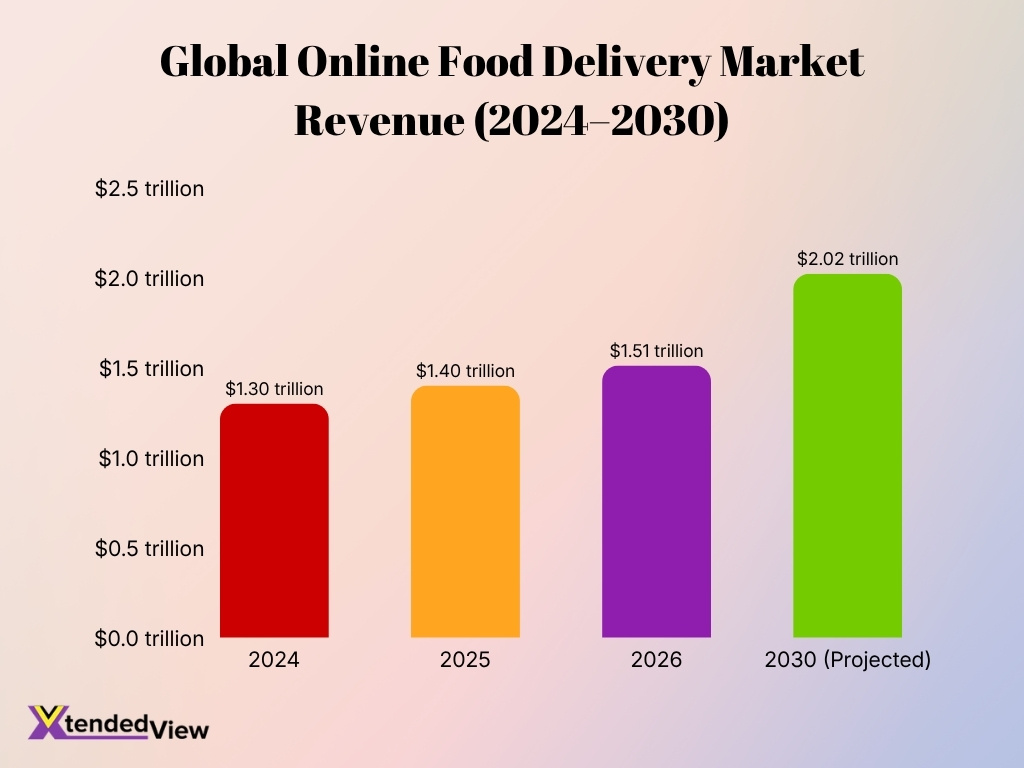
- The global online food delivery market generated approximately $1.30 trillion in revenue in 2024, highlighting the massive scale of digital food ordering worldwide.
- Global market revenue increased to around $1.40 trillion in 2025, representing an annual gain of approximately $100 billion.
- In 2026, global online food delivery revenue reached approximately $1.51 trillion, up about 7.9% compared with 2025.
- The market is projected to generate approximately $2.02 trillion by 2030, crossing the $2 trillion milestone for the first time.
- Between 2024 and 2030, online food delivery revenue is expected to increase by approximately $720 billion, equivalent to overall growth of about 55.4%.
- From 2026 to 2030, the market is projected to add roughly $510 billion in annual revenue, underscoring continued expansion in global online food ordering.
Online Food Ordering Market Growth and Forecast
- The broad global market is projected to expand from $1.51 trillion in 2026 to $2.05 trillion by 2031, representing a 6.24% compound annual growth rate.
- Global grocery delivery is forecast to record 9.8% revenue growth in 2027, keeping it among the faster-growing online food ordering categories.
- A restaurant-focused market forecast expects global value to rise from $350.63 billion in 2026 to $728.83 billion by 2034.
- That forecast represents a 9.58% CAGR from 2026 through 2034.
- A separate forecast projects the market to increase from $351.56 billion in 2026 to $603.43 billion in 2032, equal to a 9.36% CAGR.
- Another model forecasts $505.5 billion by 2030, with a 9.4% CAGR during the 2025-2030 period.
- Asia-Pacific is forecast to grow at approximately 12.53% annually, faster than the overall online food delivery market in one regional analysis.
- India’s broad online food delivery market is projected to increase from $61.76 billion in 2026 to $98.11 billion by 2031, a 9.70% CAGR.
- U.S. online food delivery GMV is forecast to climb from $473.49 billion in 2026 to $658.83 billion in 2031, representing a 6.83% CAGR.
Online Food Ordering Statistics by Country and Region
- China is projected to generate $539.87 billion in online food delivery GMV during 2026, the largest national total in the broad global forecast.
- The United States follows closely with projected 2026 online food delivery GMV of $473.49 billion.
- Together, China and the United States exceed $1 trillion in projected 2026 GMV, underscoring how heavily global online food delivery spending concentrates in the two markets.
- The U.S. market is expected to record 12.8% revenue growth in 2026 under the broad online food delivery definition.
- Grocery delivery alone is projected to generate $364.06 billion in the United States in 2026.
- U.S. meal-delivery user penetration is projected at 53.9% in 2026, substantially above the global rate of 29.2%.
- India is projected to generate $61.76 billion in combined online food delivery revenue in 2026, with $45.70 billion coming from grocery delivery.
- India’s meal-delivery user penetration is forecast at 21.5% in 2026, while the country’s meal-delivery user base could reach 369.8 million by 2031.
- North America accounted for 37.54% of online food delivery revenue in 2025 under one industry model, while Asia-Pacific ranked as the fastest-growing region.
- In Q2 2026, one multinational delivery group’s GMV increased 29.1% in the Americas, 14.9% in the Middle East and North Africa, 8.4% in Europe, and 6.4% in Asia on a like-for-like basis.
Online Food Ordering App Usage Statistics
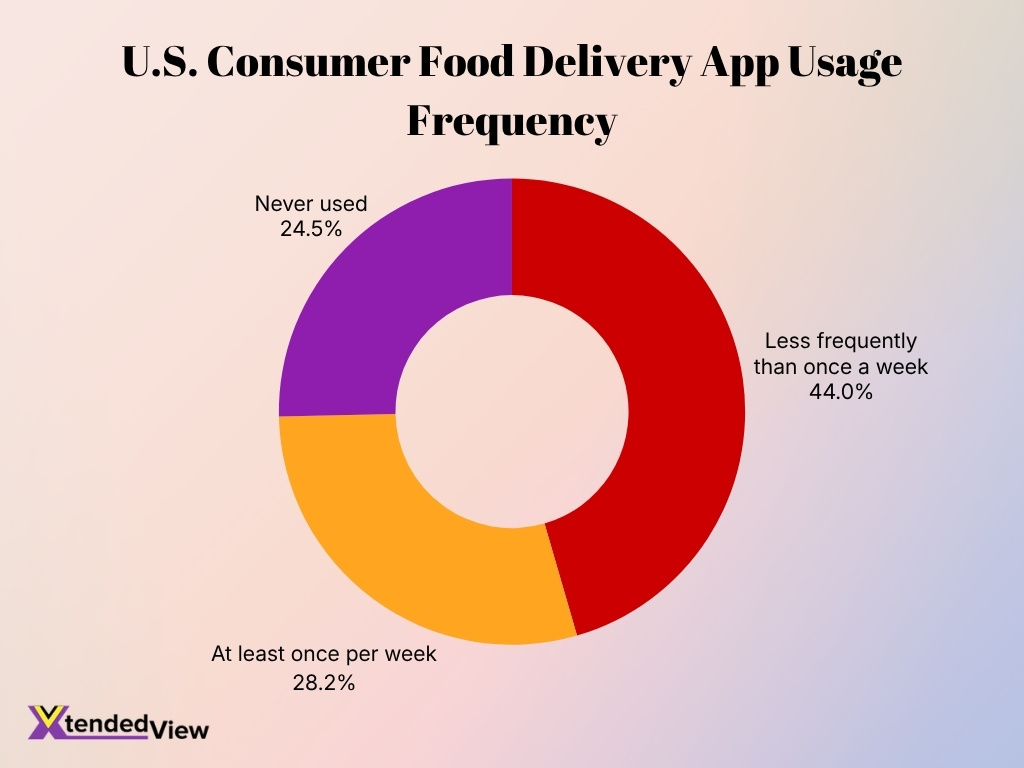
- In U.S. consumer data published in 2025, 28.2% of Americans said they used food delivery apps at least once per week.
- Another 44% of Americans used food delivery apps less frequently than once a week, showing that occasional users represent a larger group than weekly users.
- About 24.5% of Americans reported never having used a food delivery app, leaving a sizable portion of the population outside the category.
- Nearly two in five Gen Z and millennial consumers in the United States used food delivery apps at least once per week in the same consumer dataset.
- One leading delivery marketplace finished 2025 with more than 56 million monthly active users, providing a benchmark for the scale major ordering apps now reach.
- The same marketplace ended 2025 with more than 35 million membership subscribers across its global subscription programs.
- Another global mobility and delivery ecosystem reached 202 million monthly active platform consumers in Q4 2025, up 18% from 171 million a year earlier; this figure includes both mobility and delivery users.
- Consumers on that ecosystem completed 3.75 billion trips in Q4 2025, up 22% from 3.07 billion in Q4 2024; the metric includes mobility rides and delivery activity rather than food orders alone.
- One multinational delivery group reported that subscription customers represented 47% of its GMV in Q2 2026, up 12 percentage points year over year, signaling stronger usage among subscribed customers.
- Customers who used multiple quick-commerce categories on that network spent about five times more than customers using only one vertical, showing how app engagement can expand beyond prepared-meal ordering.
Most Popular Food Delivery Apps and Market Share
- The largest U.S. platform captured approximately 65% of the restaurant delivery market in 2025.
- The second-largest platform accounted for 25% of U.S. food delivery orders in 2025.
- The third-largest service held 4% of the order share, bringing the top three platforms to 94% combined.
- Alternative industry data placed the market leader at 67%, the second-largest at 25%, and the third at 8%.
- In March 2024, the leading platform claimed 67% of meal-delivery sales, while the second-largest held 25%.
- The U.S. restaurant delivery market generated an estimated $75 billion in total order value in 2025.
- The market leader’s global marketplace GOV increased 27% in 2025, or 23% excluding acquisitions.
- Platform momentum continued into Q2 2026 as total orders rose 27% year over year to 970 million.
- Global Delivery Gross Bookings reached $27.46 billion in Q2 2026, marking a 26% annual increase.
- Quick-commerce GMV expanded 32% year over year in Q2 2026, representing 18.3% of total GMV.
Food Delivery App Downloads and Active Users
- Worldwide food delivery app downloads reached nearly 450 million in the first half of 2025, continuing the recovery that began after the 2022 decline.
- Global food delivery app downloads increased 40% year over year during the first three quarters of 2025.
- Asia recorded a 78% year-over-year increase in food delivery app downloads during the first three quarters of 2025.
- Consequently, Asia accounted for more than 55% of worldwide food delivery app downloads in Q3 2025, gaining roughly 10 percentage points of global share in a year.
- India stood out: food delivery app downloads there increased 147% year over year in H1 2025, largely because of rapid adoption of ultra-fast grocery services.
- One leading delivery ecosystem ended 2025 with more than 56 million monthly active users, providing one of the clearest current measures of individual platform scale.
- The same ecosystem had more than 35 million paid and affiliated membership subscribers at the end of 2025.
- Another global mobility-and-delivery ecosystem averaged 208 million monthly active platform consumers in Q2 2026, up 16% from 180 million in Q2 2025. This figure includes both ride and delivery customers.
- Consumers completed 3.87 billion trips and deliveries through that ecosystem in Q2 2026, an 18% increase from 3.27 billion a year earlier.
- A separate international delivery network processed 981 million orders in Q2 2026, representing 11% like-for-like year-over-year growth.
Consumer Demographics of Online Food Ordering
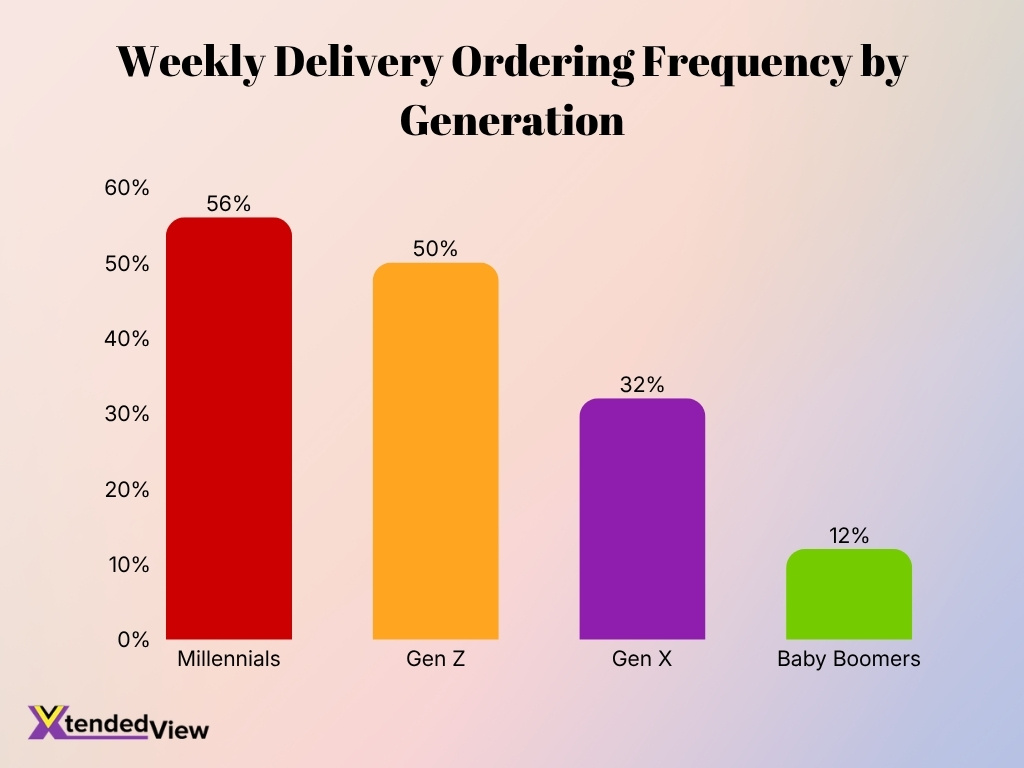
- 56% of millennials in a 2025 U.S. consumer survey said they ordered delivery at least once a week.
- Gen Z followed closely, with 50% ordering delivery weekly, compared with 32% of Gen X and only 12% of baby boomers.
- Gender also produced a sizable difference: 49% of men ordered delivery at least weekly, compared with 28% of women.
- Among frequent users, 34% of men ordered delivery multiple times per week, versus 15% of women.
- Parents with young children show especially high demand: 60% ordered delivery at least weekly, including 43% who did so multiple times a week.
- Mobile ordering also skews young. In 2025, 57% of U.S. adults had recently used mobile ordering, compared with 74% of millennials and 65% of Gen Z adults.
- In broader restaurant engagement data published in 2026, 86% of Gen Z consumers had dined at a restaurant, ordered takeout, or purchased a coffee or snack during the previous week. The rate remained 72% among baby boomers.
- Income also shapes restaurant activity: 90% of households earning at least $100,000 reported restaurant engagement during the previous week in 2026, compared with 84% of households earning $50,000-$99,999 and 72% earning below $50,000.
- Younger consumers nevertheless showed stronger spending pressure in 2026. In Q2, 45% of Gen Z consumers said they had reduced restaurant spending from the previous quarter, compared with 36% of consumers overall.
- Off-premises food has become particularly embedded in younger lifestyles: 41% of Gen Z and millennial consumers said they rely heavily on restaurant delivery in 2025.
Online Food Ordering Frequency, Habits, and Peak Times
- 37% of U.S. adults ordered restaurant delivery at least once a week in 2025.
- A separate 2025 consumer study produced a similar result: 38% of Americans ordered delivery at least weekly.
- Within that group, 24% of Americans ordered delivery at least several times per week.
- Moreover, 37% of consumers who had ordered delivery said they were doing so more frequently than a year earlier.
- U.S. consumers averaged 4.6 third-party delivery orders per month in a 2025 survey.
- Gen Z consumers ordered even more frequently, averaging 5.1 third-party orders per month.
- Nearly half of U.S. consumers, 49%, said they typically spend just five to 10 minutes deciding what food to order for delivery.
- 75% of surveyed U.S. consumers had made a last-minute delivery order during the previous month, indicating that immediate needs and cravings play a major role in order timing.
- More than 60% of younger adults said they were using takeout, drive-thru, and delivery more often in 2025 than a year earlier.
- Promotions can shift when customers order: roughly 8 in 10 off-premises customers respond to value offers such as limited-time deals, buy-one-get-one promotions, and discounts for ordering during off-peak periods.
Average Order Value in Online Food Delivery
- One leading marketplace generated $33.08 billion in GOV from 970 million orders in Q2 2026, implying approximately $34.10 in gross order value per transaction across its marketplaces. This is a calculated figure rather than a company-reported AOV.
- In Q2 2025, the same marketplace recorded $24.24 billion in GOV from 761 million orders, implying roughly $31.86 per order.
- That means calculated GOV per order increased by roughly 7% year over year, although acquisitions, currency movements, and category mix affect the comparison.
- The company itself confirmed that an increase in average order value contributed to its 36% year-over-year Marketplace GOV growth in Q2 2026.
- Another international delivery network recorded €13.21 billion in GMV across 981 million Q2 2026 orders, equivalent to approximately €13.46 per order across its global operations.
- The comparable Q2 2025 figures were €12.24 billion of GMV and roughly 884 million orders, implying about €13.85 per order; regional mix and currency movements make direct comparisons imperfect.
- Consumers who use multiple quick-commerce categories spend about five times more than customers who shop in only one vertical, showing how adding groceries and retail can substantially raise customer value.
- Delivery premiums remain significant for U.S. consumers. A 2025 analysis across major chains and the 10 largest U.S. metros found that delivered fast-food and fast-casual meals cost 79.5% more on average than pickup, a $9.30 difference.
- The geographic gap was substantial: average delivery markups reached 92.2% in Atlanta and 89.1% in New York, while Houston recorded the lowest markup among the cities studied at 67%.
Consumer Preference: Direct vs. Third-Party Ordering Statistics
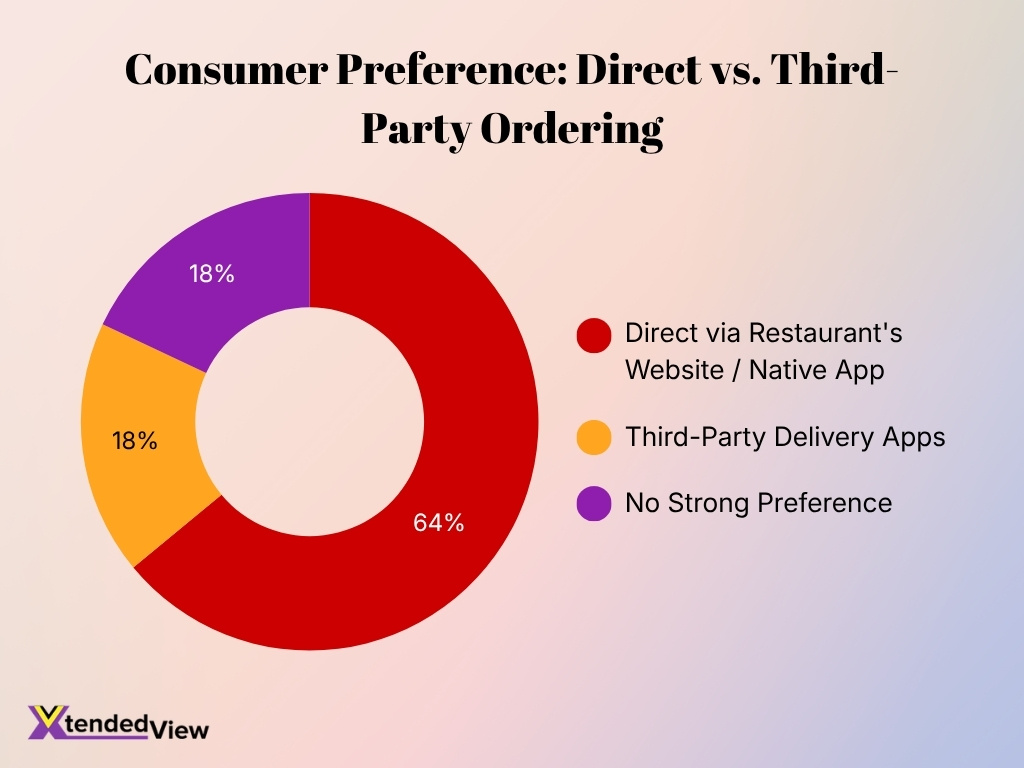
- 64% of consumers prefer ordering food directly through a restaurant’s website or native app, making it the dominant ordering channel.
- Only 18% of consumers prefer using third-party delivery apps, a share that is nearly 3.6 times lower than direct ordering.
- Another 18% of consumers report no strong preference between ordering directly from restaurants and using third-party platforms.
- Combined, 36% of consumers either favor third-party delivery apps or have no specific channel preference, compared with 64% who favor direct ordering.
- The 46-percentage-point gap between direct ordering (64%) and third-party apps (18%) highlights a substantial consumer preference for restaurant-owned ordering channels.
Restaurant Online Ordering Adoption Rates
- Approximately 75% of restaurant traffic occurred off-premises in 2025, encompassing takeout, drive-thru, and delivery transactions.
- 65% of limited-service restaurant operators offered delivery in 2025.
- Half of restaurant operators said off-premises sales represented a larger share of revenue than in 2019, illustrating how takeout and delivery have retained their pandemic-era gains.
- A 2025 restaurant technology study found that approximately one-third of operators offered their own self-operated delivery programs.
- Roughly one-third also offered a branded mobile app, putting first-party app adoption at a similar level to self-operated delivery.
- About half of limited-service and chain restaurant respondents offered smartphone apps and digital order-ahead for takeout, compared with roughly one-quarter of full-service and independent restaurants.
- Consumer readiness exceeds operator adoption in several areas: 70% of limited-service customers said they would place an order using a smartphone app if the option were available.
- Similarly, 68% of limited-service customers said they would order and pay in advance through a restaurant website before pickup.
- Among millennials, willingness to order through a restaurant smartphone app rises to 87%, while 82% would use a self-service ordering kiosk.
- In a survey of independent full-service operators, 99% used at least one online ordering platform, and restaurants used an average of three online ordering solutions.
Revenue Statistics of Major Food Delivery Platforms
- DoorDash generated $4.5 billion in revenue in Q2 2026, up 36% year over year. Excluding the effect of its Deliveroo acquisition, revenue still increased 24%.
- DoorDash Marketplace GOV reached $33.1 billion in Q2 2026, compared with $24.24 billion in Q2 2025, representing 36% reported growth.
- DoorDash processed 970 million orders in Q2 2026, up from 761 million a year earlier. The 27% increase shows that transaction growth remains a major revenue driver.
- DoorDash reported $914 million in adjusted EBITDA for Q2 2026, a 40% year-over-year increase, while GAAP net income attributable to common stockholders totaled $200 million.
- Uber’s Delivery business generated $27.46 billion in Gross Bookings in Q2 2026, up 26% from $21.73 billion in Q2 2025.
- Across Uber’s broader mobility-and-delivery ecosystem, total revenue reached $14.2 billion in Q2 2026, increasing 12% year over year. Delivery remains one of its two largest booking categories.
- Delivery Hero generated approximately €4.0 billion in Q2 2026 revenue, up 17.7% year over year on a like-for-like basis.
- Delivery Hero’s Q2 2026 GMV reached €13.2 billion, up 11.3% year over year, while quarterly orders increased 11% to 981 million.
- During the first half of 2026, Delivery Hero produced €7.8 billion in revenue and €25.7 billion in GMV. H1 revenue increased 17.8% year over year on a like-for-like basis.
- Just Eat Takeaway.com reported €1.75 billion in H1 2025 revenue, while adjusted EBITDA reached €147 million, 4% higher than a year earlier despite lower order volumes.
Online Food Ordering Payment Method Preferences
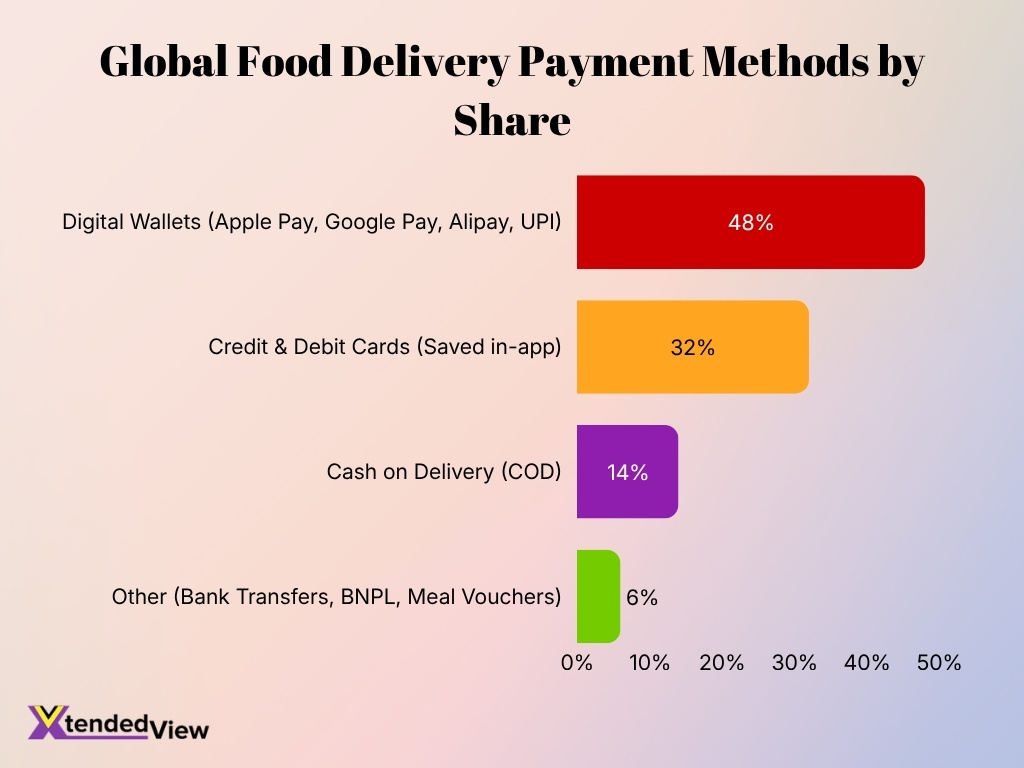
- Digital wallets dominate food delivery payments, accounting for 48% of the global market, nearly half of all transactions.
- Credit and debit cards are the second-most popular payment method, representing 32% of global food delivery payments.
- Together, digital wallets and cards account for 80% of the market, highlighting the strong shift toward cashless food ordering.
- Cash on delivery (COD) still holds a 14% share, indicating that cash remains relevant despite widespread adoption of digital payments.
- Other payment options, including bank transfers, BNPL, and meal vouchers, collectively represent just 6% of the global market.
- Digital wallets have a 16-percentage-point lead over credit and debit cards, making them the clear preferred payment method for food delivery customers.
- Non-card alternatives, including digital wallets, COD, and other methods, collectively account for 68% of global food delivery payments.
Mobile vs Desktop Online Food Ordering Statistics
- Mobile applications represented 72.3% of the U.S. online food delivery market by platform type in 2025, compared with 27.7% for websites.
- That split means mobile applications captured more than 2.6 times the share of websites in U.S. online food delivery during 2025.
- Mobile ordering reached 57% of U.S. adults in 2025, confirming that ordering through phones has moved into mainstream restaurant behavior.
- Adoption rises sharply among millennials, with 74% using mobile ordering, compared with 65% of Gen Z adults.
- In 2026, food delivery mobile-app satisfaction reached 84 out of 100, up from 83 in 2025.
- Food delivery website satisfaction reached 83 out of 100 in 2026, up from 82 the previous year. Mobile therefore retained a narrow satisfaction advantage.
- The overall food delivery ordering-process score climbed from 80 in 2025 to 83 in 2026, a larger improvement than either mobile-app or website satisfaction alone.
- Among quick-service restaurants, website satisfaction scored 85 in 2026, while mobile-app quality scored 84. This shows that well-built restaurant websites can remain competitive even as apps lead overall usage.
- About 68% of limited-service customers have expressed willingness to place and pay for an order in advance through a restaurant website, indicating that browser-based ordering still has a substantial audience.
- In 2025, 58% of consumers preferred a restaurant’s own app or website for delivery ordering, split evenly between 29% favoring apps and 29% favoring websites.
Impact of Online Food Ordering on Restaurant Sales
- Nearly 75% of U.S. restaurant traffic occurred off-premises in 2025, including takeout, drive-thru, and delivery orders.
- Off-premises sales accounted for a larger share of revenue than in 2019 for 58% of limited-service operators.
- The same was true for 41% of full-service restaurant operators, showing that digital and takeout channels also matter beyond quick-service restaurants.
- Half of restaurant operators reported in early 2025 that off-premises business represented a larger proportion of revenue than before the pandemic.
- Restaurants that added photos to more than half of their menu items could see an average 13% lift in sales in 2026 marketplace data.
- Adding descriptions to at least half of menu items was associated with up to 6% higher sales, showing that relatively small digital-menu improvements can influence conversion.
- Participation in a major subscription delivery program was associated with more than 30% higher take-home delivery sales for participating restaurants in 2026 platform analysis.
- Online delivery can create dine-in business as well: 62% of U.S. consumers said a delivery order had later led them to eat inside the same restaurant.
- The relationship also works in reverse. 74% of consumers said a dine-in experience had later prompted them to order delivery from the same restaurant.
- Better takeout packaging may unlock additional revenue: 90% of off-premises customers said they would likely order a wider variety of foods if packaging maintained restaurant-level temperature, taste, and quality.
Customer Retention, Satisfaction, and Repeat Order Statistics
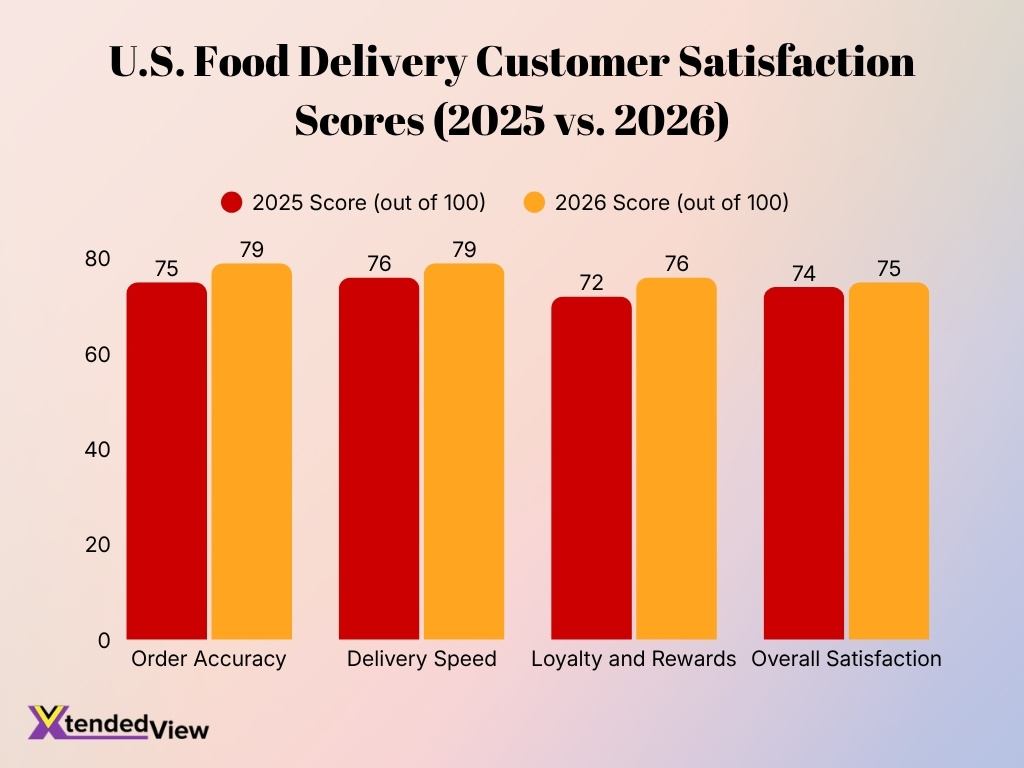
- Overall U.S. food delivery customer satisfaction increased from 74 in 2025 to 75 in 2026 on a 100-point scale.
- Mobile-app satisfaction reached 84 in 2026, making the mobile experience one of the highest-rated parts of food delivery.
- Order-accuracy satisfaction climbed from 75 to 79 in 2026, while satisfaction with delivery speed increased from 76 to 79.
- Loyalty and rewards program satisfaction improved sharply from 72 in 2025 to 76 in 2026, although it remains below app and ordering-process scores.
- In 2026 consumer data, 79% of delivery orders came from customers who had ordered from the restaurant before, emphasizing the economic importance of repeat ordering.
- By a customer’s third month on a delivery marketplace, repeat customers accounted for roughly 40% of restaurant orders.
- 66% of consumers said they order more frequently from restaurants where they actively participate in a loyalty program.
- A credit, discount, or perk influenced 87% of consumers to reorder from the same restaurant at least once during the previous six months.
- Personalization also affects repeat behavior: 65% of consumers said having a restaurant remember preferences such as favorite dishes or dietary restrictions would influence how often they choose it.
- Meanwhile, 63% said a personalized recommendation or follow-up had already prompted a return visit at least once during the previous six months.
Frequently Asked Questions (FAQs)
The global market is estimated at $355.6 billion in 2026, with another recent methodology estimating $350.63 billion.
The market is forecast to grow at approximately 9.4% CAGR from 2025 to 2030, reaching $505.5 billion by 2030.
DoorDash processed 970 million orders in Q2 2026, up 27% year over year.
Uber recorded $27.46 billion in Delivery Gross Bookings, representing 26% year-over-year growth.
Overall food delivery satisfaction reached 75 out of 100 in 2026, up 1% from 2025.
Conclusion
Online food ordering has evolved into a broad digital commerce ecosystem that extends well beyond restaurant delivery. Mobile apps, direct ordering platforms, subscriptions, loyalty programs, digital payments, grocery delivery, and quick-commerce services now influence how consumers choose, purchase, and receive food. At the same time, restaurants are using online ordering to generate off-premises revenue, improve customer reach, and encourage repeat business.
The data also shows that convenience alone is no longer enough to drive long-term growth. Consumers increasingly expect competitive pricing, accurate orders, fast delivery, simple checkout, useful rewards, and consistent digital experiences. As the market continues to expand, the strongest opportunities are likely to come from platforms and restaurants that combine convenience with value, personalization, reliable fulfillment, and stronger customer relationships.
