



Employee productivity shapes everything from company profits to long-term economic growth. Businesses rely on productivity data to optimize remote teams, improve workflows, and make smarter hiring decisions, while governments use it to track labor efficiency and guide policy. In today’s workplace, productivity is no longer tied to hours worked alone; it depends on technology adoption, employee well-being, and flexible work models.
From AI-powered automation in customer support to hybrid collaboration in global teams, productivity trends influence how organizations scale and compete. Moreover, shifts in employee expectations, especially around flexibility and mental health, continue to redefine what “productive work” looks like. As these factors evolve, understanding the latest productivity statistics becomes essential for leaders, managers, and professionals alike. Let’s explore the data and uncover what’s truly driving employee productivity.
Editor’s Choice
- U.S. labor productivity grew 2.5% year-over-year in 2025, reflecting steady efficiency gains.
- Remote workers log 29 more productive minutes per day than office employees.
- 86% of companies report improved productivity from AI adoption in 2026.
- Around 79% of U.S. employees work remotely at least part-time in 2025.
- Studies show 35%–40% productivity gains among remote employees.
- Hybrid workers are 33% less likely to quit, improving workforce stability.
- Nearly 70% of managers say hybrid work improves productivity.
Recent Developments
- U.S. productivity growth has averaged 2.1% annually since 2019, signaling long-term stability.
- Productivity rose 1.8% annualized in Q4 2025, despite economic slowdowns.
- AI adoption reached 88% of employees globally, though only 5% use it at advanced levels.
- 47% of companies introduced AI training programs to boost workforce productivity.
- Nearly two-thirds of employees report increased workloads, affecting productivity outcomes.
- 40% of workers globally now operate in hybrid or remote roles, reflecting a permanent shift.
- AI-driven productivity gains are expected to offset rising labor costs in the coming years.
- 54% of businesses adjusted policies due to return-to-office mandates, impacting productivity models.
Employee Productivity Trends Based on Burnout Levels
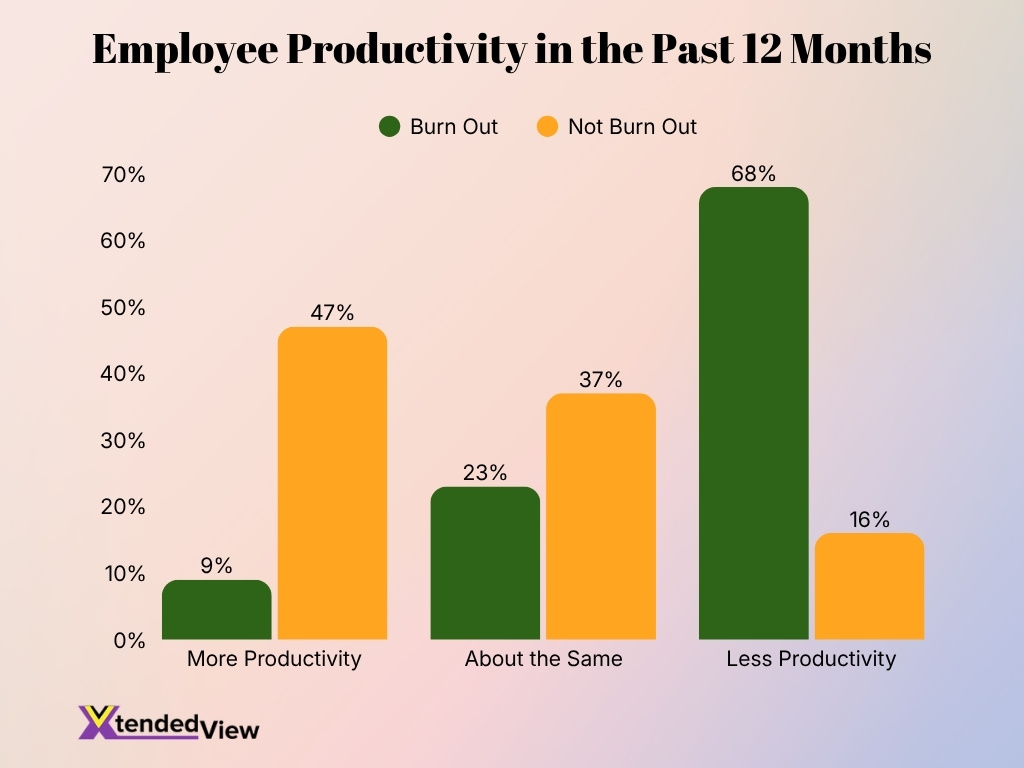
- Employees experiencing burnout show significantly lower productivity, with 68% reporting less productivity, compared to only 16% among non-burned-out employees.
- Only 9% of burned-out employees report higher productivity, while a much larger 47% of non-burned-out employees say they are more productive.
- A notable 23% of burned-out workers say their productivity stayed about the same, compared to 37% of those not experiencing burnout, indicating more stability in non-burned-out groups.
- The data highlights a strong inverse relationship between burnout and productivity, where higher burnout correlates with declining performance levels.
- Employees who are not burned out are nearly 3x more likely to report increased productivity (47% vs. 9%), showing the impact of well-being on output.
- Burnout appears to be a key driver of reduced efficiency, as the majority (over two-thirds) of affected employees report lower productivity.
- Overall, the data suggests that reducing burnout can significantly improve workforce productivity, making it a critical focus area for organizations.
Average Employee Productivity
- The average employee is productive for less than 3 hours per workday in many office settings.
- Knowledge workers spend over 60% of their year working remotely, altering productivity benchmarks.
- 90% of employees report equal or higher productivity in flexible work environments.
- 65% of workers say they get more done outside the office, citing fewer distractions.
- Employees spend significant time on non-work tasks, reducing effective productivity output.
- Workers in remote settings report higher focus levels (70%) compared to office environments.
- Hybrid workers consistently match or outperform office productivity levels.
- Around 77% of remote workers say they are more productive, reinforcing flexible work benefits.
Labor Productivity Trends
- U.S. labor productivity increased 2.8% year-over-year in late 2025, showing strong gains.
- Labor costs rose 4.4% in Q4 2025, impacting productivity margins.
- Compensation per hour grew 5% annually, influencing output efficiency.
- Productivity gains since 2019 average over 2% annually, higher than pre-pandemic levels.
- AI-driven automation is expected to increase labor productivity across industries.
- Businesses adopting digital tools report higher output per worker than traditional firms.
- Productivity growth correlates with investment in employee training and technology.
- Economic slowdowns still allow moderate productivity gains due to efficiency improvements.
Employee Engagement by Work Setting
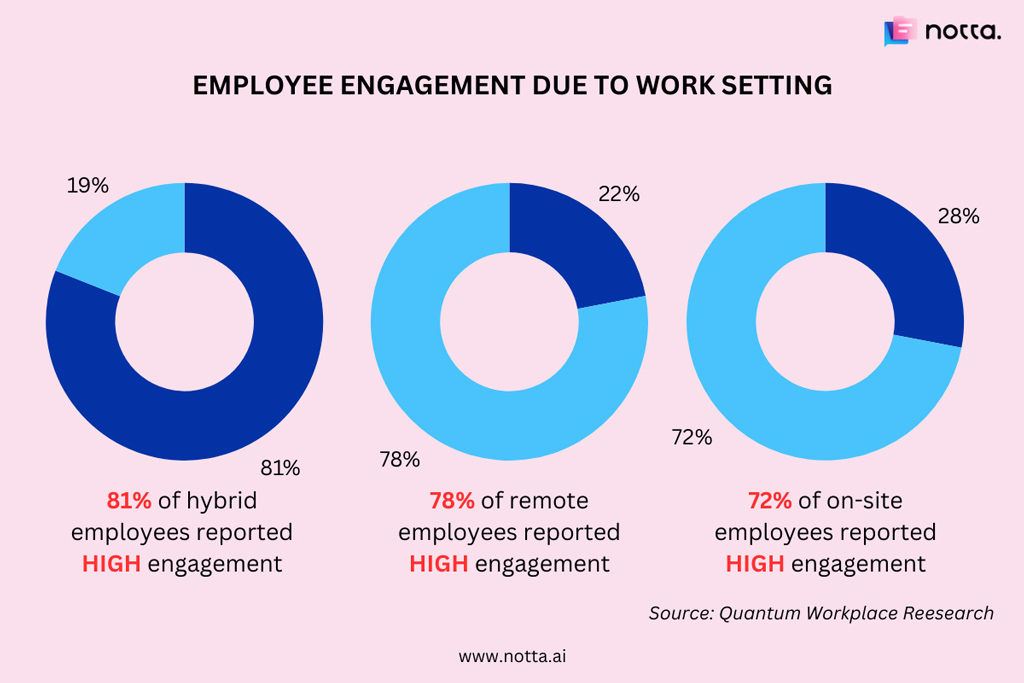
- Hybrid work leads to engagement, with 81% of employees reporting high engagement, the highest among all work models.
- Only 19% of hybrid employees fall into the low or moderate engagement category, indicating strong satisfaction and productivity balance.
- Remote work follows closely, with 78% of employees reporting high engagement, showing that flexible, location-independent work remains highly effective.
- However, 22% of remote employees report lower engagement, slightly higher than in hybrid setups.
- On-site work ranks lowest in engagement, with 72% of employees reporting high engagement.
- A notable 28% of on-site employees experience lower engagement, the highest disengagement rate among the three models.
- The gap between hybrid and on-site engagement is 9 percentage points (81% vs 72%), highlighting the impact of flexibility on employee satisfaction.
- Overall, flexible work models (hybrid + remote) consistently outperform traditional setups, with nearly 8 in 10 employees reporting high engagement.
- These findings suggest that organizations adopting hybrid strategies can achieve better employee morale, retention, and productivity outcomes.
Remote Work Productivity
- 77% of remote workers report higher productivity compared to office settings.
- Remote employees work 1.4 more days per month than office workers.
- 85% of managers say remote teams are as productive or more productive than in-office teams.
- Remote workers experience fewer interruptions, increasing deep work time by up to 20%.
- Companies save over $11,000 per remote employee annually, improving operational efficiency.
- Around 60% of employees prefer remote work for productivity reasons.
- Remote work reduces commute time by 72 minutes per day on average, reallocating time to work or rest.
- Employees working remotely are 13% more productive, based on controlled studies.
Hybrid Work Statistics
- 74% of U.S. companies adopted hybrid work models by 2025.
- Hybrid workers show 3.5% higher productivity than fully in-office employees.
- Employees in hybrid roles are 33% less likely to leave their jobs.
- 68% of employees prefer hybrid work, citing flexibility and focus.
- Hybrid schedules reduce burnout risk by 20% compared to full-time office roles.
- Companies using hybrid models report improved collaboration and productivity balance.
- Workers in hybrid setups spend more time on focused tasks than office-only employees.
- Hybrid work adoption increased over 50% since 2020, indicating long-term change.
Key Insights on Workplace Distractions and Productivity
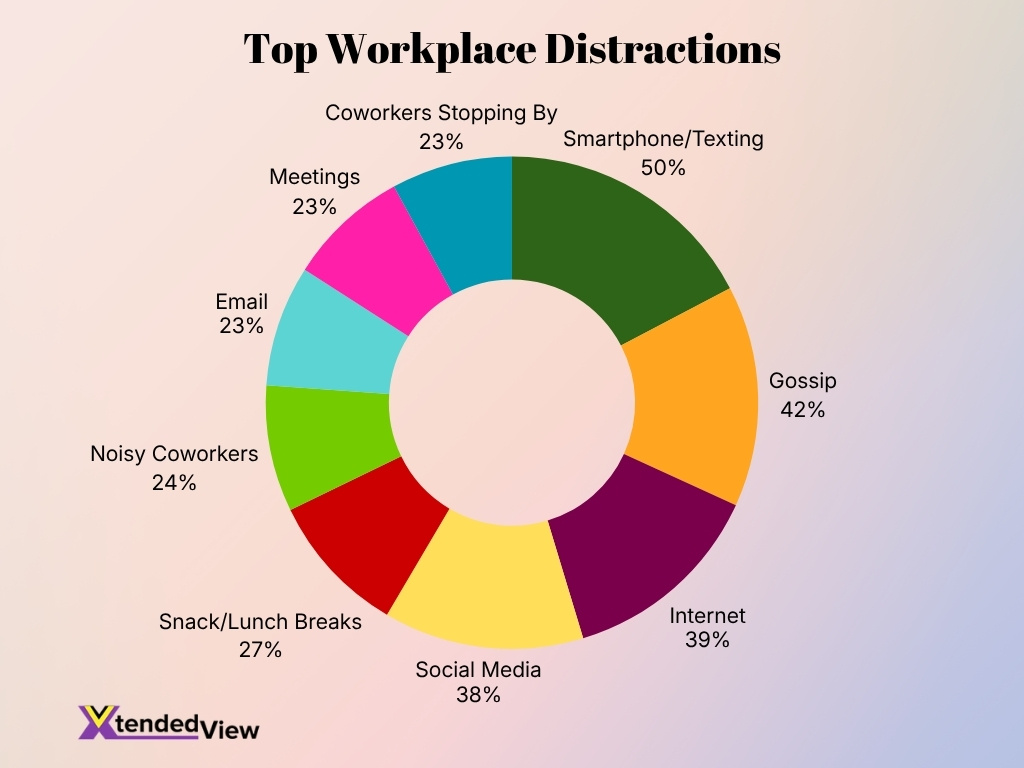
- Smartphone/Texting dominates distractions at 50%, making it the #1 productivity killer in the workplace.
- Gossip accounts for 42%, highlighting how informal conversations significantly disrupt workflow.
- Internet usage (39%) and Social Media (38%) are nearly equal, showing that digital distractions are a major combined threat (77%) to employee focus.
- Snack/Lunch breaks contribute 27%, indicating that non-work routines still have a notable productivity impact.
- Noisy coworkers affect 24% of employees, emphasizing the importance of a quiet and focused work environment.
- Email, Meetings, and Coworkers stopping by each stand at 23%, revealing that routine workplace interactions collectively create consistent interruptions.
- The top 4 distractions (50%, 42%, 39%, 38%) are all above 35%, suggesting that most productivity loss is concentrated in a few key areas.
- Digital distractions (smartphones, internet, social media) clearly outweigh physical or interpersonal distractions, making technology management critical for productivity improvement.
- The relatively equal percentages in the lower tier (23%–27%) indicate persistent, everyday interruptions that accumulate over time.
AI Productivity Boost
- 86% of organizations report productivity improvements after adopting AI tools.
- AI can increase employee productivity by up to 40% in certain tasks.
- Generative AI tools reduce task completion time by 30%–50%.
- 75% of knowledge workers use AI at work in 2025.
- AI adoption is expected to contribute $4.4 trillion annually to the global economy.
- Employees using AI report higher job satisfaction and efficiency.
- Businesses investing in AI training see significantly higher output per employee.
- AI reduces repetitive work, allowing employees to focus on higher-value tasks.
Meeting Time Waste
- Employees spend 31 hours per month in unproductive meetings.
- 91% of employees admit to daydreaming during meetings.
- Around 73% of meetings are considered ineffective.
- Businesses waste $37 billion annually on unnecessary meetings in the U.S.
- Employees attend 62 meetings per month on average.
- 45% of employees feel overwhelmed by meeting volume.
- Poorly structured meetings reduce productivity by up to 50%.
- Remote meetings have increased by 150% since 2020, adding new productivity challenges.
Mental Health’s Impact on Employee Retention
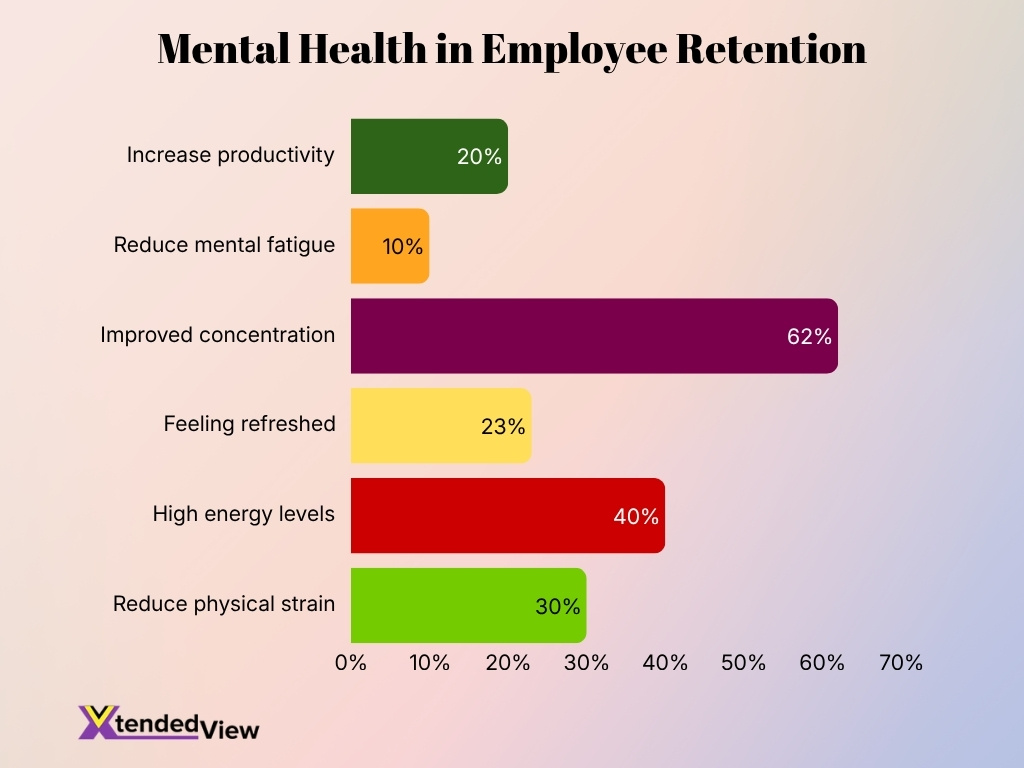
- Improved concentration leads to an impact at 62%, making it the most significant benefit of prioritizing mental health in the workplace.
- Around 40% of employees report higher energy levels, showing a strong link between mental well-being and sustained performance.
- 30% experience reduced physical strain, indicating that mental health support also contributes to better physical comfort and reduced burnout symptoms.
- Nearly 23% of employees feel more refreshed, highlighting how mental wellness initiatives improve overall mood and daily work experience.
- 20% report increased productivity, demonstrating that mental health directly enhances output and efficiency, though not as strongly as cognitive benefits.
- Only 10% see a reduction in mental fatigue, suggesting that while improvements exist, fatigue remains a persistent challenge for many employees.
Burnout Productivity Cost
- Burnout costs businesses up to $322 billion annually in turnover and lost productivity.
- Employees experiencing burnout are 63% more likely to take sick days.
- Burnout leads to a 13% drop in confidence in performance, impacting output.
- Around 44% of employees report feeling burned out frequently.
- Burnout-related turnover increases hiring costs by up to 33% of annual salary per employee.
- Employees with burnout are 2.6 times more likely to actively seek new jobs.
- Chronic burnout reduces productivity by up to 20% across teams.
- Organizations investing in burnout prevention programs report improved productivity and retention rates.
Industry Productivity Differences
- The technology sector outperforms traditional industries with up to 40% higher labor productivity projected by AI and automation by 2035.
- Manufacturing productivity grew at an annual rate of 2.9% in the first half of 2025.
- Healthcare workers spend 25-35% of shifts on paperwork, reducing bedside care efficiency.
- Financial services saw 10% increase in total factor productivity from remote work adoption.
- Retail productivity expected to boost 35-37% in the next five years via GenAI integration.
- Construction labor productivity has stagnated at less than 1% annual growth globally since 1990.
- Knowledge industries like data processing achieved 50.2-62.5% remote workers with productivity gains.
- The energy sector cuts operational costs by up to 30% using AI for optimization and maintenance.
- Administrative burden in healthcare consumes 24% of all labor hours annually.
The Generational Divide on Quiet Quitting
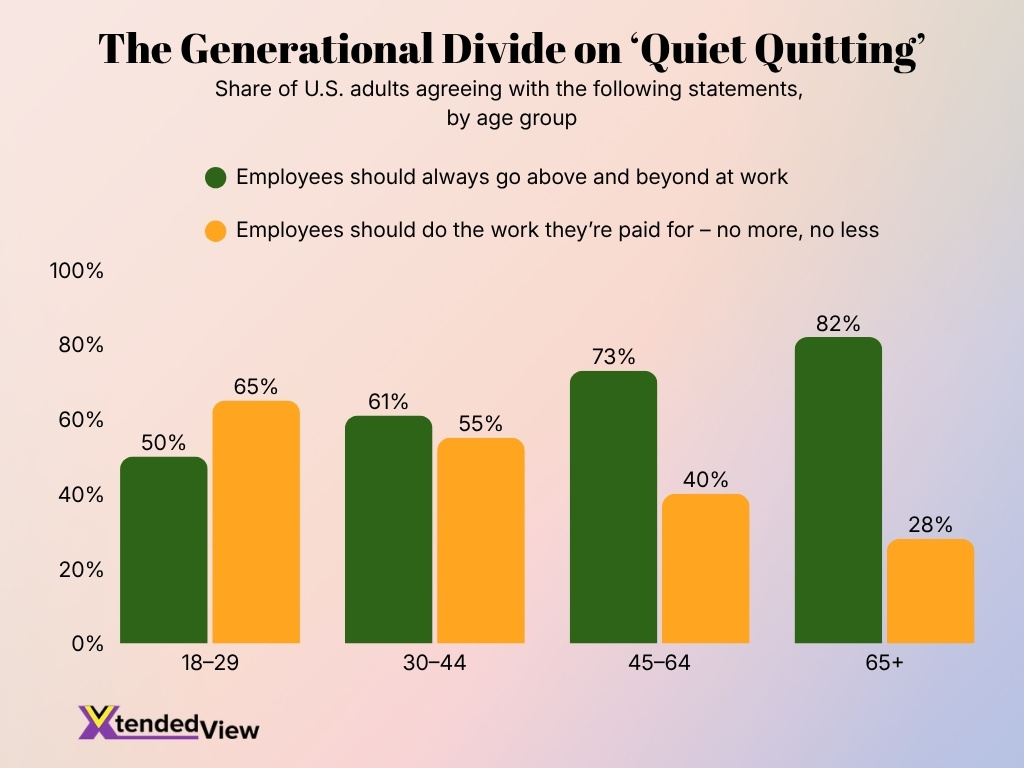
- Older generations strongly favor extra effort: A significant 82% of adults aged 65+ believe employees should go above and beyond, the highest among all groups.
- Support increases with age: Agreement with going the extra mile rises steadily from 50% (ages 18–29) to 82% (65+), showing a clear generational trend.
- Younger workers lean toward defined roles: A majority 65% of 18–29-year-olds believe employees should only do the work they’re paid for, the highest among all age groups.
- Decline in “minimum effort” mindset with age: Support for doing only assigned work drops sharply from 65% (18–29) to just 28% (65+).
- Mid-career professionals show balanced views: Among 30–44-year-olds, 61% support going above and beyond, while 55% favor sticking to defined roles, indicating a split perspective.
- Strong contrast in older groups: In the 45–64 age group, 73% support extra effort, while only 40% support doing the minimum, highlighting a clear preference for higher work commitment.
- Widest generational gap observed: The difference between youngest and oldest groups is striking—32 percentage points for “above and beyond” (50% vs. 82%) and 37 points for “no more, no less” (65% vs. 28%).
- Cultural shift in workplace expectations: The data suggests a shift from traditional work ethic (older generations) to boundary-focused work attitudes (younger generations).
- Implication for employers: Businesses must adapt to diverse workforce expectations, balancing employee well-being with productivity goals across age groups.
Measuring Productivity Metrics
- Output per hour worked measures GDP per labor hour globally, with top nations exceeding $80 in 2023.
- 73% of employers now use monitoring tools for remote workers in 2026.
- Remote employee monitoring has surged by 45% since 2020 due to hybrid work.
- Data-driven companies outperform rivals by up to 20% in efficiency.
- Time tracking software boosts productivity by enabling 25% cost savings.
- KPI systems achieve 85% goal rates with regular tracking.
- 68% of employers report higher productivity from tracking tools.
- Real-time analytics can increase productivity by 20-25% via quick fixes.
- Organizations tracking productivity see 15% gains from data analytics.
Technology Adoption Stats
- 91% of businesses use at least one digital tool to improve productivity.
- Cloud computing adoption exceeds 94% among enterprises, enabling productivity gains.
- Collaboration tools like Slack and Microsoft Teams are used by over 80% of companies.
- Automation tools reduce manual tasks by 30%–50%, boosting efficiency.
- Businesses investing in digital transformation report 20%–30% productivity improvements.
- Mobile workforce solutions increase productivity by 34% in field-based roles.
- Cybersecurity investments protect productivity by reducing downtime from attacks.
- Companies using integrated tech stacks achieve better workflow efficiency and output.
Impact of Flexible Work on Productivity
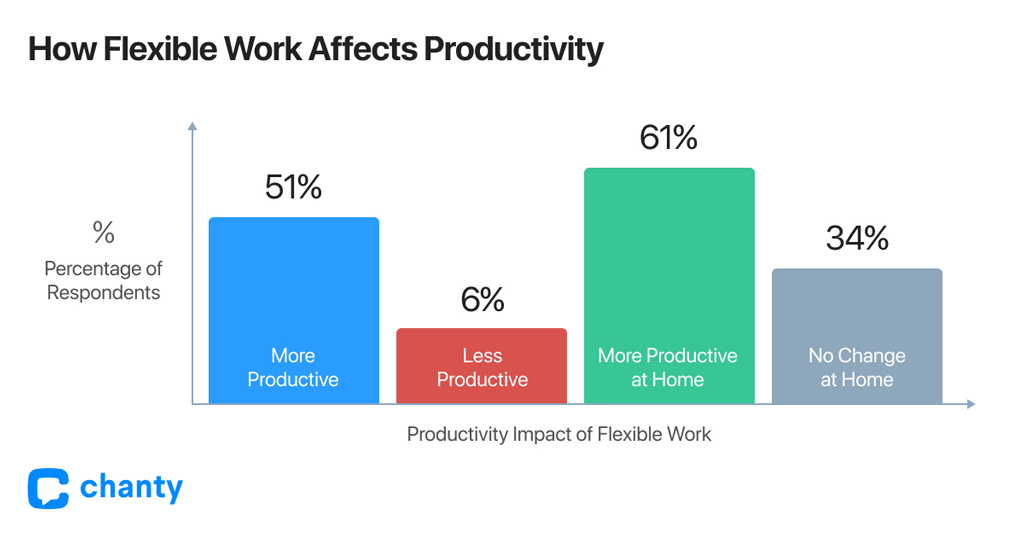
- A majority of employees report improved performance, with 51% saying they are more productive under flexible work arrangements.
- Only a small fraction, just 6% of respondents, feel less productive, indicating minimal negative impact.
- Remote work appears highly effective, as 61% of employees report being more productive at home, the highest among all categories.
- Meanwhile, 34% experience no change in productivity at home, suggesting flexibility does not harm performance for a significant group.
- Overall, the data highlights a strong positive correlation between flexible work and increased productivity, with over half of employees benefiting.
- The combined insights show that flexible and remote work models are largely productivity-enhancing, with very limited downside.
Training and Skills Impact
- Companies that invest in training see 24% higher profit margins.
- Employees who receive regular training are 47% more productive.
- 94% of employees say they would stay longer at companies that invest in learning.
- 87% of companies face skills gaps that reduce productivity, especially in tech and digital roles.
- Organizations with strong learning cultures are 92% more likely to innovate.
- Firms with upskilling programs report a 30–40% improvement in employee efficiency.
- Digital skills training boosts productivity by up to 32% in remote and hybrid teams.
- Leadership training increases team engagement and performance by up to 28%.
- Companies with continuous learning programs experience 37% lower absenteeism rates.
- Investing in workforce skills development improves employee retention by 33%.
Frequently Asked Questions (FAQs)
The average employee is productive for about 60% of the workday, with office workers averaging only 2 hours and 53 minutes of focused work daily.
Low engagement costs the global economy approximately $8.9 trillion annually in lost productivity.
U.S. labor productivity increased by around 2.5% year-over-year in 2025.
About 86% of organizations report improved productivity after adopting AI tools.
Full employee engagement could add up to $9.6 trillion to global GDP, equivalent to about 9% growth.
Conclusion
Employee productivity reflects a clear transition toward flexibility, digital transformation, and employee-centric work environments. The data shows that hybrid work models, AI adoption, and strong engagement strategies consistently improve output, while unmanaged distractions, burnout, and poor mental health continue to erode performance. Organizations that recognize this balance are better positioned to sustain long-term efficiency.
At the same time, productivity is no longer just a metric; it is a combination of tools, culture, and employee experience. Companies that invest in training, modern technology, and well-being programs not only boost productivity but also improve retention and innovation. As workplaces continue to evolve, the most successful organizations will be those that align performance goals with human needs, creating systems where both employees and businesses thrive.
