



TikTok enters the year as one of the world’s largest social platforms, with close to 2 billion monthly users by late 2025 estimates and more than 200 million users in both the United States and Europe. Its influence now extends well beyond short-form entertainment, shaping how people discover products, follow creators, watch live events and make buying decisions. Retailers use TikTok Shop and creator-led videos to drive product discovery, while restaurants, hotels and tourism operators increasingly use short-form content to turn recommendations into bookings and local demand.
At the same time, advertisers continue to increase spending as TikTok combines large audience reach with strong engagement among younger consumers. These TikTok statistics show how the platform’s audience, creator economy, commerce tools and advertising ecosystem continue to expand across major markets.
Editor’s Choice
- TikTok had roughly 1.99 billion monthly active users worldwide in October 2025, compared with 3.07 billion for Facebook and 2.58 billion for YouTube in the same ranking.
- TikTok’s U.S. community exceeded 200 million people by January 2026, a major increase from the 170 million figure commonly cited before the U.S. ownership restructuring.
- U.S. adult adoption reached 37% in 2025, rising four percentage points from 33% in 2024 and 16 points from 21% in 2021.
- Among U.S. adults ages 18 to 29, 63% used TikTok in 2025. Usage dropped to 44% among those ages 30 to 49, 30% among ages 50 to 64 and 12% among people 65 and older.
- TikTok reached 200 million-plus monthly users in Europe during 2025, compared with 175 million one year earlier. That audience represented close to one-third of the population across the EEA and the UK.
- TikTok’s UK monthly audience exceeded 30 million people in 2025. The platform also reported more than 1.5 million British businesses using it.
- TikTok’s adult U.S. advertising audience reached 153 million people in late 2025, up by 15.2 million, or 11%, from the end of 2024. Advertising reach figures measure addressable users rather than total active users.
Recent Developments
- TikTok’s U.S. operations underwent a major structural change in January 2026, when a majority American-owned joint venture began operating to address U.S. national security requirements.
- American and global investors received 80.1% ownership of the new U.S. joint venture, while ByteDance retained 19.9%.
- The new structure covers an American TikTok community of more than 200 million users and approximately 7.5 million businesses.
- In August 2026, TikTok and ByteDance agreed to a $400 million U.S. settlement involving allegations related to children’s online privacy. The agreement called for $300 million upfront and another $100 million subject to a previous consent decree being vacated.
- In August 2026, Brazil’s data protection authority imposed a 153.8 million-real fine, equivalent to about $29.8 million, over the processing of teenagers’ personal data. Authorities estimated that data from at least 8 million minors may have been affected.
- European regulators imposed €530 million in GDPR fines in May 2025 over EEA user-data transfers and transparency requirements. The total consisted of a €485 million fine and a €45 million fine tied to separate GDPR provisions.
- TikTok’s European monthly community rose from 175 million to more than 200 million between 2024 and September 2025 despite continuing regulatory scrutiny.
- TikTok expanded beyond media and product discovery in May 2026 by adding local booking capabilities for hotels, attractions and tours for U.S. users, putting more transactional functions directly inside the app.
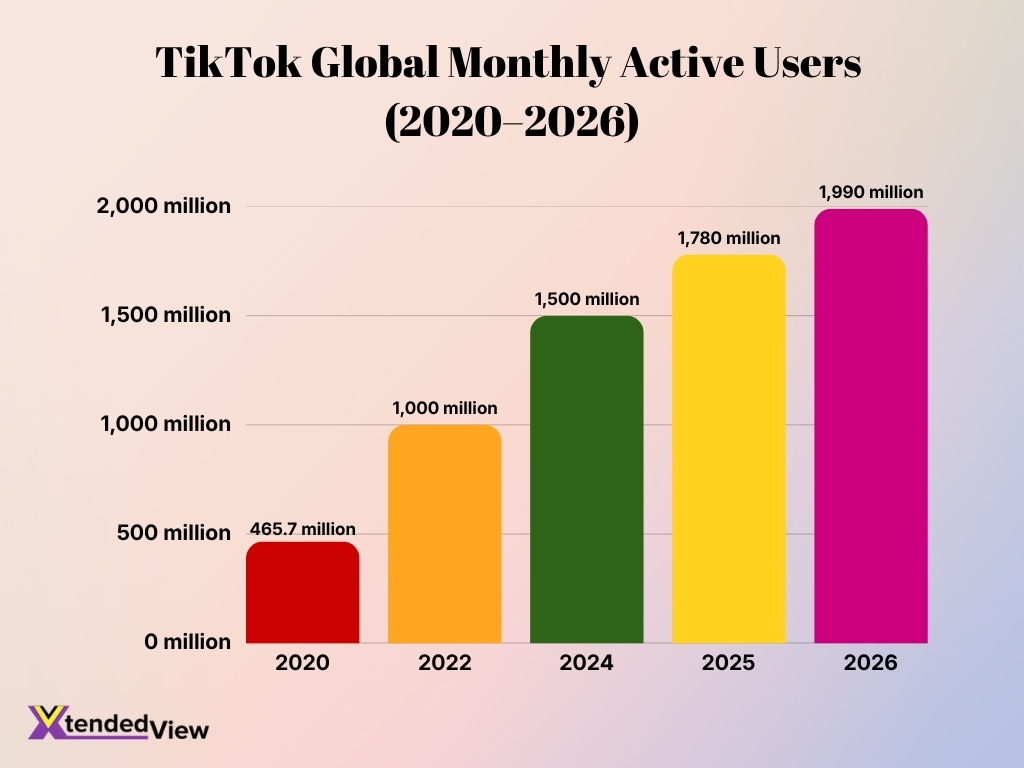
TikTok Global Monthly Active User Growth
- TikTok’s global monthly active users increased from 465.7 million in 2020 to an estimated 1.99 billion in 2026, representing more than a 4X increase in six years.
- The platform reached the 1 billion monthly active user milestone by 2022, more than doubling its 2020 user base.
- TikTok’s monthly active users climbed to approximately 1.5 billion in 2024, adding 500 million users compared with 2022.
- In 2025, TikTok’s global monthly active user base expanded further to an estimated 1.78 billion, an increase of 280 million users from 2024.
- TikTok is estimated to reach 1.99 billion monthly active users in 2026, adding another 210 million users year over year.
- Overall, TikTok added approximately 1.52 billion monthly active users between 2020 and 2026, highlighting the platform’s rapid global expansion.
Global TikTok User Statistics
- TikTok had approximately 1.99 billion monthly active users worldwide as of October 2025, excluding users of Douyin in China.
- At 1.99 billion users, TikTok’s reported global audience was roughly 65% the size of Facebook’s 3.07 billion monthly audience in the same October 2025 ranking.
- TikTok ranked as the fifth-largest platform in that worldwide ranking, behind Facebook, WhatsApp, Instagram and YouTube.
- TikTok’s January 2025 advertising audience included about 149 million users in Northern America, representing 9.3% of its reported global ad audience at the time.
- Southern America accounted for approximately 228 million addressable TikTok users in January 2025, or 14.3% of the worldwide advertising audience measured.
- Eastern Europe accounted for about 109 million TikTok advertising users in January 2025, equivalent to 6.8% of the global ad audience.
- Northern Africa contributed another 90.9 million addressable users, equal to 5.7% of TikTok’s global advertising audience in January 2025.
- Western, Northern and Southern Europe together accounted for roughly 149 million addressable users in January 2025 when their regional audiences are combined.
- By September 2025, TikTok reported more than 200 million monthly users across 32 European markets, including the EEA and UK. This is a monthly-recipient measure and should not be treated as identical to advertising reach.
TikTok User Growth and Adoption Rate
- The share of U.S. adults who used TikTok rose from 21% in 2021 to 37% in 2025, an increase of 16 percentage points.
- In relative terms, the 37% U.S. adult adoption rate in 2025 was about 76% higher than in 2021, showing that TikTok continued expanding after its initial rapid-growth period.
- U.S. adult adoption climbed from 33% in 2024 to 37% in 2025, adding four percentage points in one year.
- TikTok’s addressable U.S. adult advertising audience increased by 15.2 million people, or 11%, between the end of 2024 and late 2025.
- During the shorter period from July to October 2025, TikTok’s potential U.S. ad reach increased by another 7.05 million users, or 4.8%.
- European monthly users increased from 175 million in 2024 to more than 200 million in 2025, representing growth of at least 14%.
- TikTok’s UK monthly audience passed 30 million users in June 2025, meaning close to half of the country’s population used the platform monthly under the reported methodology.
- Germany reached 25.7 million monthly TikTok users in 2025, while Austria reached 2.5 million and Switzerland 2.2 million. Together, the DACH markets contributed more than 30 million monthly users.
- Poland reached more than 13.4 million monthly TikTok users in 2025, illustrating that TikTok’s growth extends beyond its largest Western European markets.
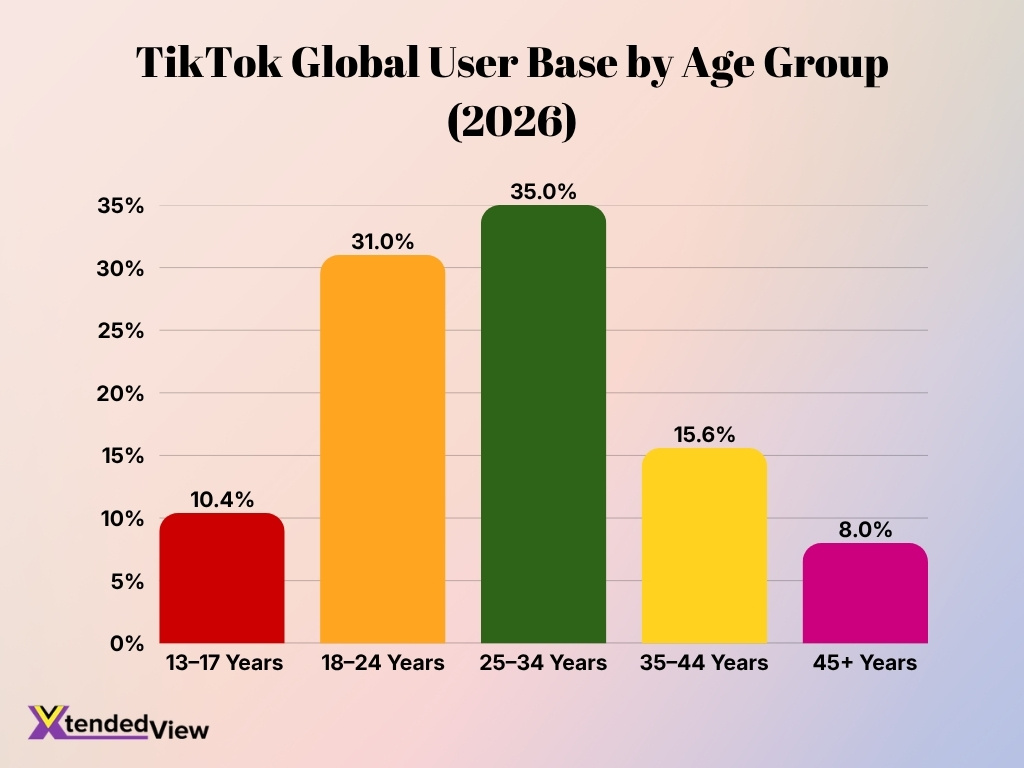
TikTok User Demographics by Age
- TikTok’s largest age group is 25–34-year-olds, accounting for 35.0% of its global user base.
- Users aged 18–24 represent 31.0%, making them the platform’s second-largest demographic.
- Combined, users aged 18–34 make up 66.0% of TikTok’s global audience, highlighting its strong appeal among younger adults.
- The 35–44 age group accounts for 15.6% of total users, showing that TikTok’s reach extends beyond Gen Z and younger millennials.
- Teenagers aged 13–17 are estimated to represent 10.4% of TikTok’s worldwide user base.
- Users aged 45 and older account for just 8.0%, making them the smallest age segment in the dataset.
- Overall, 81.6% of TikTok users are between 18 and 44, indicating that working-age adults dominate the platform’s global audience.
TikTok User Demographics by Gender
- TikTok’s global adult advertising audience was 55.7% male and 44.3% female in January 2025. These figures cover users available through its advertising tools rather than every registered account.
- The gender balance changes sharply by region. Female users represented 53% of TikTok’s adult ad audience in Western Europe in early 2025, giving women a slight majority there.
- Northern Europe showed a similar pattern, with women accounting for 52.6% of the platform’s adult advertising audience in January 2025.
- Southern Asia moved in the opposite direction, women represented only about 30% of TikTok’s addressable adult audience, reflecting broader regional differences in internet access and platform adoption.
- Female users made up 32.2% of TikTok’s adult ad audience in Western Africa in January 2025, leaving a substantial male majority.
- In the United States, TikTok’s late-2025 adult advertising audience was 52.3% male and 47.7% female, making the U.S. ad audience somewhat more balanced than the global total.
- Survey data tell a different story about U.S. adoption, 42% of American women said they used TikTok in 2025, compared with 30% of men. Survey usage and advertising-audience composition measure different populations, which explains the apparent contrast.
- The UK skewed strongly female by late 2025, with women representing 61.5% of TikTok’s adult ad audience and men 38.5%. At the beginning of 2025, the split had been much closer at 52% female and 48% male.
- Among U.S. teenagers, gender differences also appear in usage intensity. In late 2025, 24% of teen girls said they used TikTok almost constantly, compared with 17% of teen boys.
TikTok User Demographics in the United States
- TikTok’s advertising tools indicated an adult U.S. audience of 153 million people in late 2025, up substantially from the 136 million reported at the beginning of the year.
- TikTok ads could reach 55.7% of U.S. adults by late 2025. Relative to the country’s internet population, potential TikTok ad reach stood at 47.3%.
- Potential U.S. advertising reach grew by 15.2 million users, or 11%, between late 2024 and late 2025. It increased another 7.05 million, or 4.8%, between July and October 2025 alone.
- Survey-based adoption stood at 37% of all U.S. adults in 2025, rising from 33% in 2024 and 21% in 2021.
- Age remains one of the clearest demographic divides. TikTok usage reached 63% among Americans ages 18 to 29, compared with 44% among ages 30 to 49, 30% among ages 50 to 64 and 12% among adults 65 and older.
- TikTok use differed by race and ethnicity in the 2025 adult survey, 57% of Hispanic adults and 53% of Black adults used the platform, compared with 28% of White adults and 31% of English-speaking Asian adults.
- Adoption also varied by household income. TikTok was used by 42% of adults earning under $30,000, compared with 30% of those in households earning $100,000 or more.
- Education produced another noticeable split, 40% of adults with a high school education or less and 42% with some college experience used TikTok, compared with 29% of college graduates.
- Geography mattered as well. TikTok adoption reached 42% among urban adults, compared with 37% in suburban communities and 32% among rural adults.
- Daily use was concentrated among younger Americans. In early 2025, 47% of adults ages 18 to 29 used TikTok daily, compared with 28% of ages 30 to 49, 17% of ages 50 to 64 and just 5% of adults 65 and older.
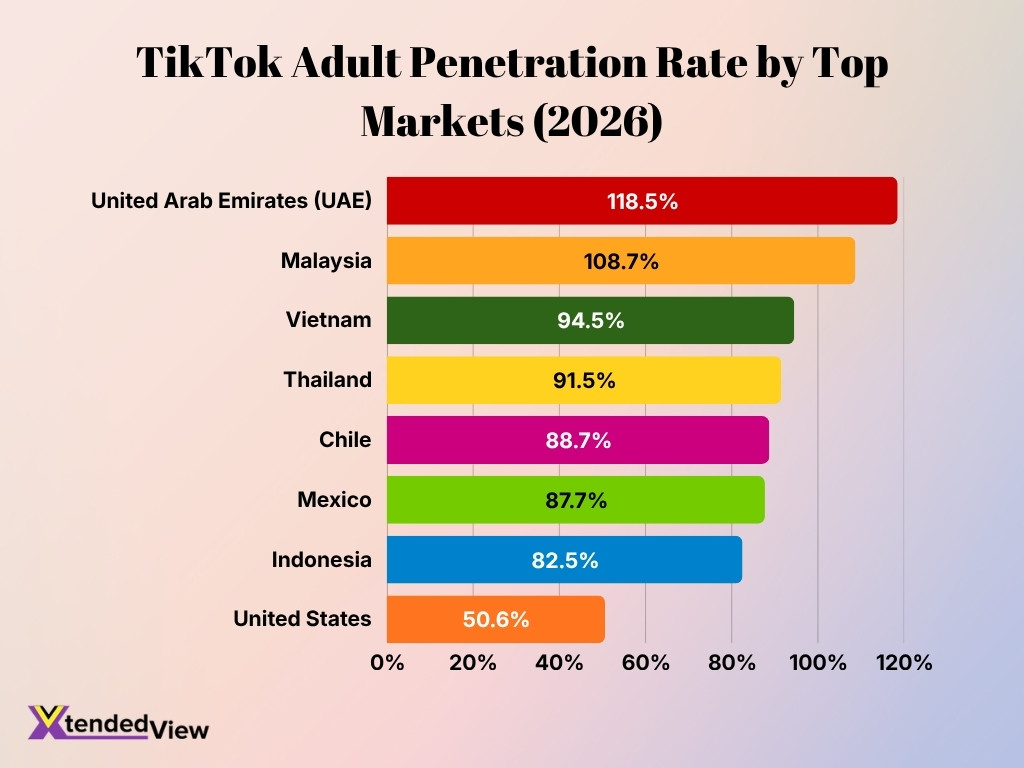
TikTok Adult Penetration Rate by Country
- The United Arab Emirates (UAE) leads the selected markets with a TikTok adult penetration rate of 118.5% in 2026.
- Malaysia ranks second at 108.7%, also exceeding the 100% penetration threshold.
- Vietnam records a strong TikTok adult penetration rate of 94.5%, followed closely by Thailand at 91.5%.
- In Latin America, Chile and Mexico post penetration rates of 88.7% and 87.7%, respectively.
- Indonesia reaches 82.5%, highlighting TikTok’s substantial reach among the country’s adult population.
- The United States has the lowest penetration rate among the markets shown, at 50.6%.
- The UAE’s 118.5% rate is more than twice the 50.6% recorded in the United States, showing a significant difference in TikTok’s relative reach across these markets.
- Rates above 100% can occur when advertising-audience estimates are compared with adult population estimates and should not be interpreted as more than 100% of unique adults using TikTok.
TikTok User Demographics in the United Kingdom
- TikTok had 26.8 million addressable users ages 18 and older in the UK in late 2025, according to its advertising tools.
- That adult advertising audience increased from 24.8 million at the beginning of 2025, adding about 2 million users during the year based on the respective reported snapshots.
- TikTok’s late-2025 advertising reach represented 48.4% of all UK adults, compared with 45% at the start of the year.
- Relative to UK internet users of all ages, TikTok’s advertising reach increased from 36.6% in early 2025 to 39.3% by late 2025.
- Potential adult ad reach grew by 2.96 million, or 12.5%, between late 2024 and late 2025.
- Between July and October 2025 alone, the UK addressable TikTok audience increased by another 211,000 people, or 0.8%.
- TikTok’s adult advertising audience shifted markedly toward women during 2025. Women represented 52% at the beginning of the year but 61.5% by late 2025, while the male share moved from 48% to 38.5%.
- UK adults who visited TikTok spent an average of 28 minutes per day on the service in May 2025. Adults ages 18 to 34 spent considerably longer at 49 minutes per day.
- TikTok use declined sharply with age in Britain, visitors ages 35 to 54 averaged 18 minutes per day, while those age 55 and older averaged only 9 minutes daily in May 2025.
Average Time Spent on TikTok
- The typical global TikTok user on Android spent 34 hours and 56 minutes per month in the app in November 2024, the underlying benchmark used in the 2025 global digital dataset.
- Monthly TikTok usage increased by almost two hours in just three months between August and November 2024, representing growth of nearly 6%. The increase came largely from users opening the app more frequently.
- TikTok’s monthly usage exceeded YouTube’s by nearly 8 hours per Android user in the same dataset and was more than twice the monthly time recorded for Instagram.
- Finland ranked first among measured markets, with the average active Android user spending 54 hours and 37 minutes per month on TikTok.
- U.S. Android users averaged 43 hours and 53 minutes per month, almost nine hours above the worldwide average.
- UK Android users spent an average of 42 hours and 2 minutes per month on TikTok, also considerably above the worldwide benchmark.
- Mexico averaged 45 hours and 25 minutes per month, while Indonesia recorded 44 hours and 54 minutes, showing particularly heavy TikTok consumption in two of its largest audience markets.
- In the UK’s broader cross-device audience measurement for May 2025, adult visitors averaged 28 minutes per day on TikTok. The figure climbed to 49 minutes among adults ages 18 to 34, compared with 18 minutes for ages 35 to 54 and 9 minutes for adults 55 and older.
- TikTok’s average global monthly Android usage translated to more than one hour per day when spread across a 30-day month, although actual behavior varies widely across countries, ages and individual users.
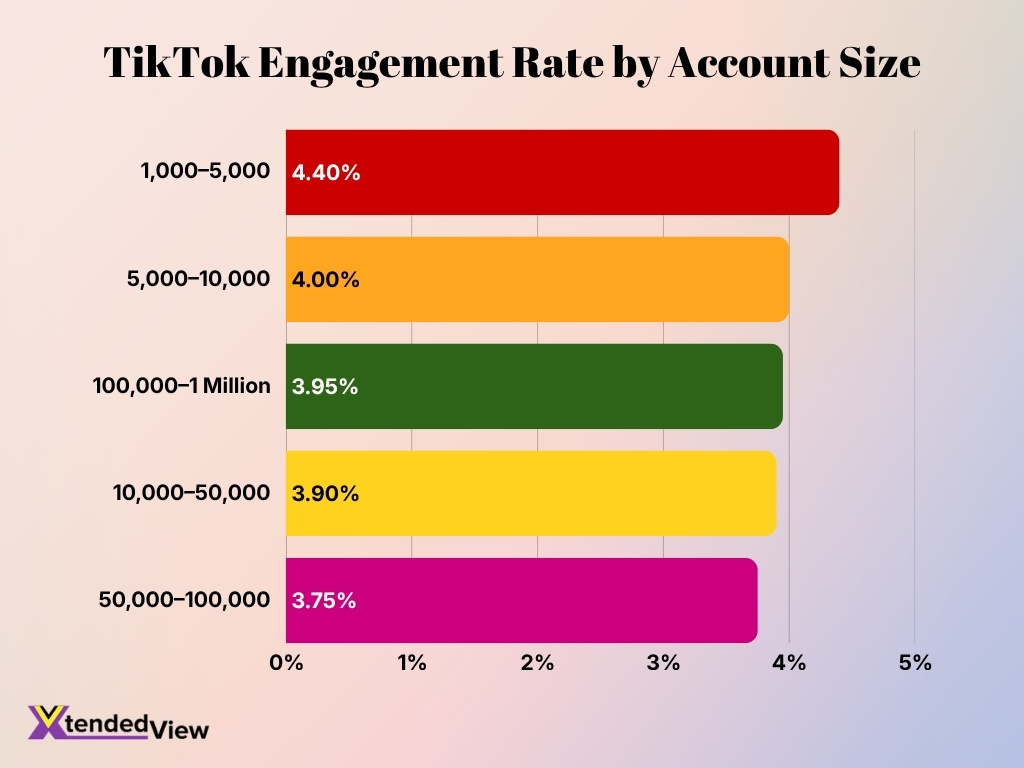
TikTok Engagement Rate Statistics
- TikTok’s average engagement rate by video views stood at 3.85% in Q2 2026, after remaining between 4.2% and 4.3% for five consecutive quarters from Q1 2025 through Q1 2026.
- The Q2 2026 engagement rate represented an 8% quarter-over-quarter decline, indicating that increasing content supply may be making interactions harder to earn.
- Across the full 2025 benchmark dataset, engagement by views increased from 3.85% in 2024 to 4.2% in 2025, a 9% year-over-year gain.
- Accounts with 1,000 to 5,000 followers recorded the strongest 2025 engagement by views at 4.4%, up from 4.2% in 2024.
- Accounts with 5,000 to 10,000 followers averaged a 4% engagement rate by views in 2025, compared with 3.85% a year earlier.
- Mid-sized accounts with 10,000 to 50,000 followers averaged 3.9% engagement by views, while accounts with 50,000 to 100,000 followers averaged 3.75%.
- Large accounts with 100,000 to 1 million followers averaged a 3.95% engagement rate by views in both 2024 and 2025, showing little year-over-year movement at that scale.
- A separate 2025 cross-industry benchmark using engagement relative to followers placed the median TikTok rate at 1.73%, nearly five times the corresponding Instagram benchmark in the same analysis. Different engagement formulas should not be compared without accounting for their denominators.
- Higher education led the measured industries with a 7.36% engagement rate by followers, followed by nonprofits at 3.04%, travel at 2.73% and sports teams at 2.68%.
- TikTok’s 2025 engagement advantage persisted even as one large industry benchmark found engagement had fallen 34% year over year under its methodology. This reinforces why marketers should benchmark against accounts of similar size and sector rather than rely on one platform-wide rate.
TikTok Video Views and Watch Time Statistics
- An analysis of more than 2 million TikTok videos from over 214,000 active profiles found that average views declined overall from 2024 to 2025, but performance diverged sharply by account size.
- Accounts with 1,000 to 5,000 followers averaged 350 views per post in 2025, down from 860 views in 2024. That represents a drop of roughly 59%.
- Accounts with 5,000 to 10,000 followers averaged 945 views per video in 2025, compared with 1,575 in 2024.
- For accounts with 10,000 to 50,000 followers, average views decreased more modestly from 3,655 in 2024 to 3,240 in 2025.
- Accounts in the 50,000-to-100,000 follower range moved against the broader decline, increasing from 8,688 views per post to 9,900 views in 2025.
- Large accounts with 100,000 to 1 million followers saw average views climb from 25,198 in 2024 to 34,900 per video in 2025, an increase of about 38.5%.
- Across the benchmark dataset, TikTok views fell about 23% year over year overall, even as larger profiles gained visibility. The data suggest that average reach increasingly depends on account scale, content history and competitive positioning.
- User attention remained substantial despite the decline in average views for smaller accounts. Global Android users spent almost 35 hours per month in TikTok, illustrating how lower average post reach can coexist with heavy overall platform consumption.
- U.S. Android users averaged nearly 44 hours per month on TikTok in the 2025 global usage dataset, while UK Android users averaged just over 42 hours. These figures measure total in-app time rather than watch time for an individual video.
- Engagement around videos strengthened in several areas during 2025, average likes increased about 9%, comments increased about 3%, and shares rose by as much as 13% overall in the benchmark analysis, even while aggregate views weakened.
TikTok Creator and Influencer Statistics
- TikTok’s Creator Rewards Program requires eligible creators to have at least 10,000 followers and 100,000 video views during the previous 30 days. Creators must also meet age, account-status and regional requirements.
- During the earlier testing phase of the creator monetization program, total creator revenue increased by more than 250% within six months. Meanwhile, the number of creators earning $50,000 per month nearly doubled.
- TikTok’s rewards formula evaluates content across four main areas, originality, play duration, search value and audience engagement. This puts measurable weight on content quality and viewing behavior instead of posting volume alone.
- An economic study published in 2025 estimated that approximately 2.26 million people in Japan created content on TikTok, generating an estimated ¥119.7 billion in creator-related income.
- In the same Japanese study, 26.7% of creators said their brand-project or collaboration opportunities had increased through their TikTok activity.
- About 83.3% of surveyed Japanese creators said they intended to continue creating on TikTok, indicating strong creator retention within that market.
- A 2026 survey of professional creators found that 94% regularly posted brand partnerships, 78% participated in affiliate marketing and 77% promoted services at least once per month. The results cover creators across several platforms and provide broader context for TikTok’s influencer economy.
- Creator businesses still face cash-flow pressure. In the same 2026 research, 49% said late or inconsistent payments affected their ability to operate, while 41% had declined opportunities because of cash-flow problems.
- The wider global creator population is estimated at roughly 200 million people, while the creator economy could reach $500 billion by 2027. That expanding market gives TikTok creators more opportunities to combine platform rewards, affiliate commissions, sponsorships and commerce.
Global Live Streaming Market Share by Platform
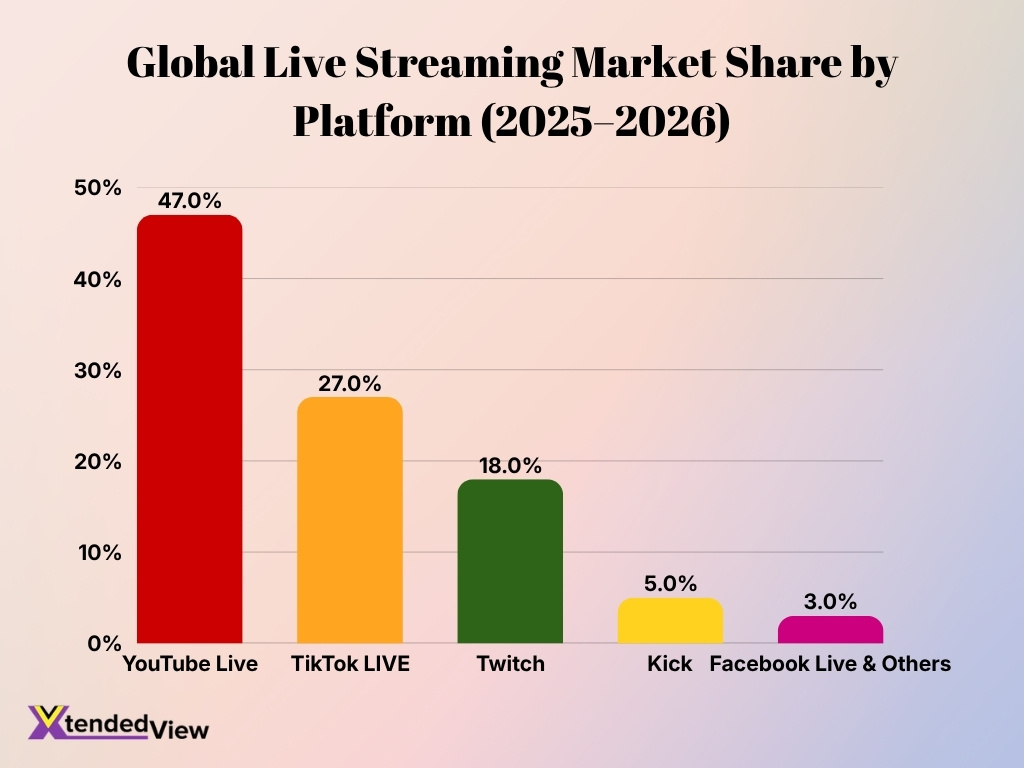
- YouTube Live dominates the global live streaming market, accounting for 47.0% of the total market share in 2025–2026.
- TikTok LIVE ranks second with a substantial 27.0% market share, highlighting its growing influence in live video content.
- Twitch holds an 18.0% share, maintaining its position as one of the world’s leading live streaming platforms.
- Kick captures approximately 5.0% of the global market, giving it a smaller but notable presence among established competitors.
- Facebook Live and other platforms collectively account for around 3.0% of the global live streaming market.
- Together, YouTube Live and TikTok LIVE control 74.0% of the market, indicating a highly concentrated competitive landscape.
- The top three platforms, YouTube Live, TikTok LIVE, and Twitch, collectively represent 92.0% of global live streaming market share.
TikTok Shop and Social Commerce Statistics
- U.S. TikTok Shop sales increased 120% year over year during the first part of 2025, continuing the rapid expansion that followed its September 2023 U.S. launch.
- TikTok Shop sellers offered more than 70 million products across 750-plus categories by mid-2025. Womenswear, beauty and personal care, health, sports, outdoor products and electronics ranked among popular categories.
- Research among TikTok Shop consumers found that 83% had discovered a new product through the shopping platform, while 70% had discovered a new brand.
- U.S. brands and creators hosted more than 8 million hours of LIVE shopping during 2024. Among consumers who engaged with TikTok Shop, 76% reported buying something through a livestream during the year.
- More than 171,000 local and small U.S. businesses were selling through TikTok Shop by mid-2025, and their sales had increased 70% year over year.
- TikTok Shop generated more than $500 million in U.S. sales during the four-day Black Friday-Cyber Monday period in 2025. The broader campaign attracted nearly 50% more purchasing shoppers than the comparable 2024 period.
- Shoppers viewed more than 760,000 LIVE shopping sessions during the 2025 Black Friday-Cyber Monday campaign, generating more than 1.6 billion livestream views. Sales from sellers hosting livestreams increased 84% year over year.
- Creator affiliates published almost 10 million shoppable videos during the 2025 U.S. holiday campaign, showing how closely influencer content and marketplace transactions have become connected.
- TikTok Shop’s 6.6 Birthday Mega Sale in 2026 produced an 80% year-over-year increase in GMV. Daily shoppers rose to more than 1.5 times the 2025 level, while livestream GMV doubled.
- During the same 2026 sale, the number of livestreams per day doubled, livestream views increased 167%, and affiliate LIVE GMV rose 170% compared with normal activity.
TikTok Advertising, Marketing, and Ad Revenue Statistics
- TikTok’s worldwide advertising revenue was forecast to reach about $32.4 billion in 2025, representing year-over-year growth of 24.5% under a forecast that assumed continued U.S. availability.
- That 2025 forecast would give TikTok approximately 11% of worldwide social media advertising spending, making short-form video a substantial component of global media budgets.
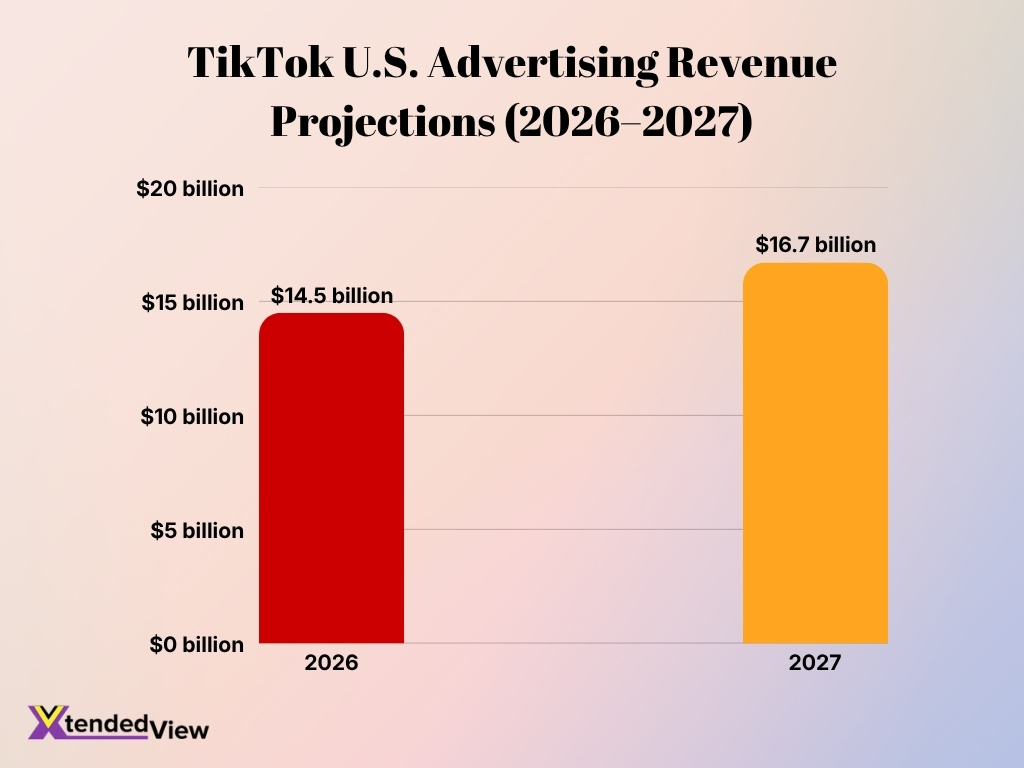
- A January 2026 forecast projected TikTok’s U.S. advertising revenue at $14.5 billion in 2026, with the American market contributing about 38% of its worldwide ad revenue.
- Based on that 38% share, the 2026 forecast implies worldwide TikTok advertising revenue of roughly $38 billion under the same forecasting assumptions.
- U.S. TikTok advertising revenue could rise further to approximately $16.7 billion in 2027, according to the same forecast.
- TikTok was expected to earn about $2.7 billion in U.S. advertising revenue during Q1 2025, representing 17.5% growth from the comparable quarter a year earlier.
- TikTok represented approximately 8.8% of measured U.S. social advertising spending during January through July 2025, down from 9.2% during 2024 as regulatory uncertainty affected advertiser planning.
- TikTok’s commercial reach extends beyond paid advertising. A 2025 study estimated that 7.5 million U.S. businesses used the platform, with 74% saying TikTok helped them scale their operations.
- About 4.7 million U.S. jobs benefited from business use of TikTok in that research. More than 3.1 million involved workers directly creating content or managing accounts, while over 1.6 million benefited indirectly through activities such as sales leads and customer engagement.
- In the EU, businesses advertising on TikTok were estimated to have generated €31 billion in economic output during 2025, including €13 billion attributed to small and medium-sized businesses.
TikTok Algorithm, For You Page, and Viral Content Statistics
- TikTok’s recommendation system groups its major signals into three broad categories, user interactions, content information and user information. User interactions typically carry more weight for most people.
- Watch behavior remains central to recommendations. Signals include whether viewers watch a video in full or skip it, while time spent watching generally receives more weight than basic device or account settings.
- TikTok does not treat follower count or a creator’s previous viral videos as direct ranking factors in the For You recommendation system. This helps explain why smaller accounts can still receive distribution beyond their existing follower base.
- The recommendation system considers numerous content signals, including sounds, hashtags, view counts and publishing country. However, TikTok advises creators against treating one engagement metric as the sole ranking signal.
- In 2025, TikTok introduced Manage Topics controls covering more than 10 content categories, giving users the ability to increase or decrease how frequently certain topics appear in their For You feeds.
- Its expanded keyword filtering system allows users to enter as many as 200 unwanted keywords. The global community had already used earlier filtering tools to exclude more than 200 million different words.
- A study of 1.1 million TikTok videos found that videos longer than 60 seconds received 43.2% more reach than videos lasting 30 to 60 seconds. They also generated 63.8% more watch time.
- Compared with videos lasting only five to 10 seconds, videos longer than one minute generated 95.7% more reach and 264.5% more watch time in the same 2025 analysis. Only 12.3% of analyzed videos exceeded one minute.
- Brand posting frequency increased approximately 40% from 2024 to 2025 across account-size groups. Accounts with 100,000 to 1 million followers increased their average monthly posting frequency from 15 posts to 23.
- Despite brands publishing more often, overall TikTok views in a large benchmark dataset fell 23% year over year. The finding suggests that higher posting volume alone does not guarantee For You Page distribution or viral reach.
Frequently Asked Questions (FAQs)
TikTok had about 1.98 billion monthly active users in April 2026, based on app-usage estimates.
TikTok has more than 200 million U.S. users in 2026.
TikTok’s U.S. advertising revenue is forecast to reach $14.5 billion in 2026, with the U.S. contributing about 38% of its global ad revenue.
TikTok had an estimated 1.20 billion daily active users in April 2026, up from about 1.17 billion in January.
TikTok’s U.S. ad revenue increased from about $1 billion in 2020 to a projected $14.5 billion in 2026, equal to roughly 1,350% growth over six years.
Conclusion
TikTok’s statistics show a platform that now operates across entertainment, creator monetization, livestreaming, advertising, product discovery and integrated commerce. More than 240 million creators went LIVE in 2025, while TikTok Shop recorded strong year-over-year sales growth and major shopping events generated hundreds of millions of dollars in U.S. transactions. Advertising also remains a core growth engine, with U.S. TikTok ad revenue forecast to reach $14.5 billion in 2026.
However, growth alone does not guarantee visibility for every creator or brand. Engagement benchmarks show that competition for views remains intense, while recommendation performance increasingly depends on watch behaviour, content relevance and sustained viewer interest. At the same time, demographic data show that TikTok continues to attract younger users most strongly, even as adoption expands among older age groups and across more international markets. Overall, TikTok now connects discovery, creator influence, advertising and transactions within one ecosystem, making it an increasingly important platform for marketers, creators, retailers and media companies tracking digital behaviour.
