



The internet continues to reshape how people work, learn, shop, communicate, and access essential services. Businesses rely on internet connectivity to power cloud applications, AI tools, digital payments, and remote collaboration, while governments and healthcare providers increasingly deliver services through online platforms. As internet adoption expands across developed and emerging markets, understanding the latest usage trends helps organizations make informed decisions. Explore the statistics below to see how internet usage continues to evolve across the world.
Editor’s Choice
- As of 2025, approximately 6 billion people, or 74% of the global population, use the internet, according to the latest international estimates.
- DataReportal estimates that 5.56 billion people were internet users at the beginning of 2025, representing 67.9% of the world’s population. Differences between estimates stem from varying methodologies.
- Around 136 million new people came online during 2024, reflecting continued global growth in internet adoption.
- Despite steady progress, roughly 2.2 to 2.6 billion people worldwide still lack internet access, with most living in low- and middle-income economies.
- Smartphones now account for nearly 87% of mobile handsets in active use, making mobile devices the dominant gateway to the internet.
- The United States had approximately 322 million internet users at the start of 2025, equal to an internet penetration rate of 93.1%.
- Mobile phone adoption rea
- ched 5.78 billion unique users globally in 2025, providing the foundation for continued internet growth in both developed and emerging markets.
Recent Developments
- The International Telecommunication Union estimates that global internet adoption increased from 60% in 2020 to 74% in 2025, adding roughly 1.3 billion users within five years.
- More than half of the global population now lives within areas covered by 5G networks, accelerating access to faster mobile internet services.
- 5G accounts for more than one-third of all global mobile broadband subscriptions, highlighting rapid migration toward next-generation connectivity.
- Global internet user growth continued during 2024, with approximately 2.5% year-over-year growth recorded.
- Broadband affordability improved across many lower-income countries, although service costs remain high relative to household income.
- Median internet speeds in high-income economies increased by roughly 50% between 2023 and 2024, while many low-income countries remained below 25 Mbps.
- The world’s connected population surpassed 5.6 billion users during 2025, reflecting continued expansion across Asia, Africa, and Latin America.
- Global internet adoption among women continued to grow faster than among men, gradually reducing the worldwide digital gender gap.
Global Internet Usage Overview
- Around 74% of the global population uses the internet in 2025, according to the latest estimates.
- Approximately 5.56 billion people used the internet worldwide at the beginning of 2025.
- Nearly 68% to 74% of the world’s population now has internet access, depending on the measurement methodology used by the reporting organization.
- Roughly 70.5% of the global population uses a mobile phone, supporting continued growth in mobile internet access.
- About 58% of the world’s population now lives in urban areas, where internet infrastructure is generally stronger than in rural regions.
- Around 206 million new social media identities were added worldwide during 2024, reflecting increased internet engagement.
- The internet remains one of the fastest-growing communication infrastructures ever developed, with billions of users added within just two decades.
- Cloud computing, streaming media, AI-powered applications, online education, and digital commerce continue to drive demand for faster and more reliable internet connectivity worldwide.
Global Internet User Growth From 1990 to 2025
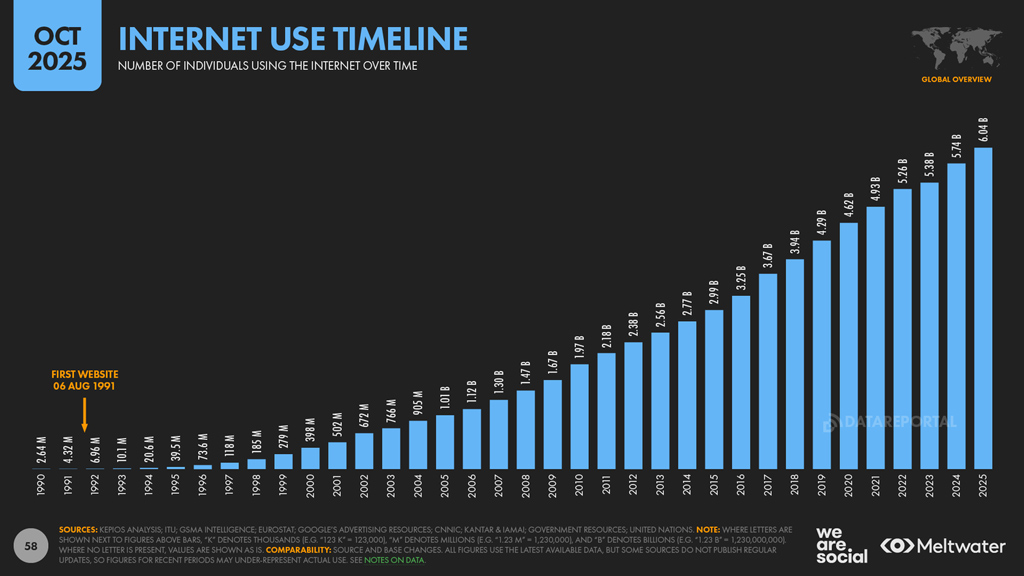
- Global internet users increased from just 2.64 million in 1990 to 6.04 billion in 2025, highlighting the internet’s extraordinary worldwide expansion.
- The number of users first exceeded 100 million in 1997, reaching approximately 118 million.
- By 2000, the global online population had grown to 398 million, more than 150 times the 1990 level.
- Internet usage crossed the 1 billion milestone in 2005, when an estimated 1.01 billion people were online.
- Global internet users nearly doubled from 1.12 billion in 2006 to 2.18 billion in 2011.
- The online population reached almost 3 billion in 2015, representing substantial growth across emerging and developed markets.
- Internet adoption accelerated between 2015 and 2020, rising from 2.99 billion to 4.62 billion users.
- The number of internet users surpassed 5 billion in 2022, reaching approximately 5.26 billion.
- Global internet usage increased by 660 million users between 2022 and 2024, climbing from 5.26 billion to 5.74 billion.
- From 2024 to 2025, the internet population grew by another 300 million, reaching a record 6.04 billion users.
Internet Penetration Rate Worldwide
- Global internet penetration reached approximately 74% in 2025.
- Internet penetration was estimated at 67.9% in early 2025 using an alternative methodology for measuring active users.
- High-income economies recorded internet penetration rates exceeding 94% during 2025.
- Europe achieved an internet penetration rate of approximately 92.2% in 2025.
- The Americas reported internet penetration of approximately 88.1% in 2025.
- Asia-Pacific reached approximately 77.1% internet penetration in 2025.
- Africa remained the least connected major region, with internet penetration at approximately 35.7% in 2025.
- Least-developed countries recorded internet penetration of only 33.7%, highlighting the continuing global digital divide.
Internet Users by Region and Continent
- Europe remains one of the world’s most connected regions, with internet penetration exceeding 92%.
- The Americas reached internet penetration of approximately 88.1% in 2025.
- Asia-Pacific accounts for the largest number of internet users globally because it includes China and India, despite varying adoption rates.
- Africa continues to experience the fastest long-term internet growth, although penetration remains below 40%.
- Internet penetration across the Arab States reached approximately 69.5% in 2025.
- High-income economies recorded internet adoption above 94%, while low-income economies remained near 23%.
- More than 2 billion people without internet access still live primarily across parts of Africa and South Asia.
- Regional investment in fiber networks, mobile broadband, satellite internet, and digital infrastructure continues to narrow connectivity gaps, although significant disparities remain.
Internet Users by Country
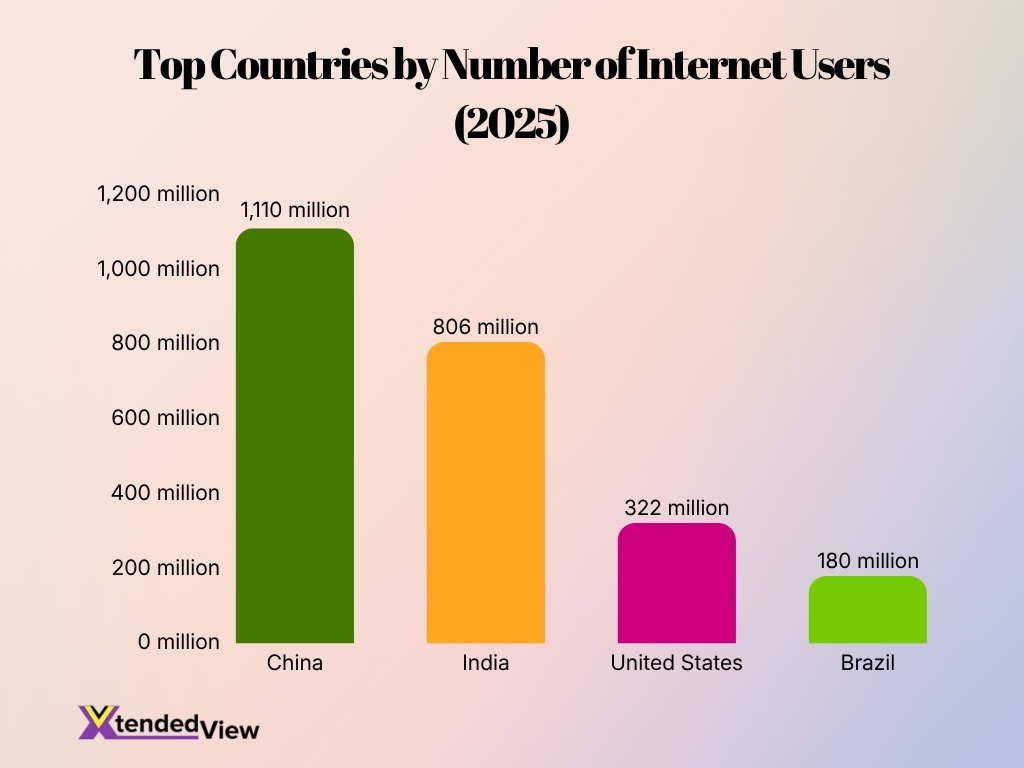
- China remained the world’s largest internet market with more than 1.11 billion internet users in 2025.
- India ranked second globally with approximately 806 million internet users at the beginning of 2025, adding 49 million new users year over year.
- The United States had approximately 322 million internet users in early 2025, with internet penetration exceeding 93%.
- Indonesia continued to rank among the world’s largest online populations, with internet penetration exceeding 70% and a rapidly growing mobile-first audience.
- Brazil remained Latin America’s largest internet market, with well over 180 million internet users.
- Japan maintained internet penetration above 85%, although its online population has grown more slowly because of demographic trends.
- Nigeria continued to lead Africa in internet users, supported by strong mobile broadband adoption despite relatively low national penetration.
- Russia remained one of Europe’s largest online markets, with internet penetration above 90%.
- Together, China, India, and the United States account for well over 2 billion internet users, representing a substantial share of the global online population.
Urban vs Rural Internet Usage
- Approximately 80% of urban residents in India actively use the internet.
- Around 65% of rural populations in India currently have internet access.
- More than 99% of India’s population is now covered by at least one 4G network.
- Globally, 81% of urban dwellers are online compared to only 50% of rural residents.
- Over 70% of rural internet users access the web exclusively through smartphones.
- Average download speeds for rural households are generally 30% to 50% slower than urban speeds.
- Fixed broadband infrastructure reaches less than 40% of rural households globally.
- Rural internet adoption recently grew by 15% year-over-year, driven by affordable smartphones.
Internet Usage by Gender
- In 2025, approximately 77% of men and 71% of women worldwide used the internet.
- Around 280 million more men than women use the internet globally, highlighting the remaining digital gender gap.
- The global internet gender parity score stood at 0.92 in 2025, showing little improvement since 2019.
- Europe and the Americas have effectively achieved internet gender parity, while larger disparities remain in parts of Africa and Asia-Pacific.
- Africa improved its gender parity score from 0.70 in 2019 to 0.78 in 2025, representing measurable progress.
- Women aged 16 to 24 spend more time on social media each day than men in the same age group.
- Men generally remain more likely to adopt emerging technologies and online financial services in lower-income economies.
- Expanding digital literacy programs and lower smartphone prices continue helping reduce the internet gender divide.
- Closing the gender gap remains an important objective for achieving universal digital inclusion.
Internet Usage by Age Group
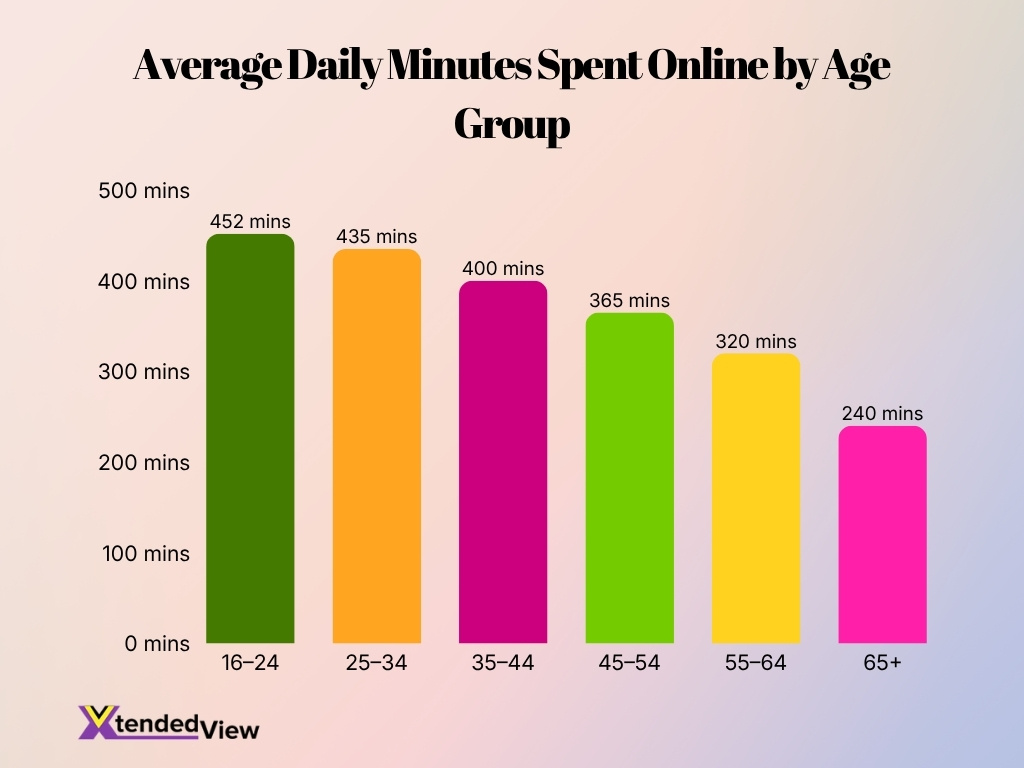
- Global internet users average 6 hours and 38 minutes online daily across all age demographics.
- Young adults aged 16 to 24 record the highest usage, averaging 7 hours and 32 minutes online every day.
- Users in the 25 to 34 age bracket spend an average of 7 hours and 15 minutes connected to the internet daily.
- Internet engagement for the 35 to 44 age group drops slightly to a daily average of 6 hours and 40 minutes.
- Adults aged 45 to 54 log roughly 6 hours and 5 minutes of internet usage each day.
- The 55 to 64 age demographic averages approximately 5 hours and 20 minutes of daily online activity.
- Seniors aged over 65 spend the least amount of time online, averaging around 4 hours per day.
- Gen Z individuals spend over 9 hours per day on screens compared to Baby Boomers who average 3 hours and 31 minutes.
- Mobile phones account for nearly 75% of the total online time for users in the 18 to 25 age group.
Device-wise Internet Usage Statistics
- Smartphones currently account for almost 87% of mobile handsets in use worldwide.
- Mobile devices now generate approximately 59.6% of all global web traffic.
- Approximately 61.5% of online adults still use laptops or desktop computers to access the internet.
- Desktop and laptop usage has steadily declined from 72.3% in 2020 to 61.5% in 2025.
- Internet users spend an average of 3 hours 46 minutes online daily via mobile and 2 hours 52 minutes via computers.
- More than 72% of internet users in the United States continue using computers alongside mobile devices.
- Mobile internet adoption in emerging economies like India has reached over 80% of total web traffic.
- Android devices currently lead global mobile web traffic with a commanding 73.49% share.
Time Spent Online Per Day
- The average internet user spends approximately 6 hours 38 minutes online every day.
- Daily internet usage declined by only 2 minutes compared with the previous year, indicating relatively stable digital habits.
- Internet users spend roughly 40% of their waking lives interacting with connected devices and online services.
- Average daily social media use reached 2 hours 21 minutes globally in 2025.
- Women aged 16 to 24 spend nearly 3 hours per day on social media, making them one of the most active demographic groups.
- Mobile devices account for more than 3 hours 45 minutes of average daily internet activity.
- Computer-based internet usage averages nearly 3 hours per day, driven primarily by work, education, and productivity tasks.
- Streaming, messaging, online shopping, AI-powered applications, and cloud collaboration continue to increase the amount of time people spend online.
- Daily internet usage remains significantly higher than pre-2015 levels, reflecting the expanding role of digital services in everyday life.
Internet Usage by Income
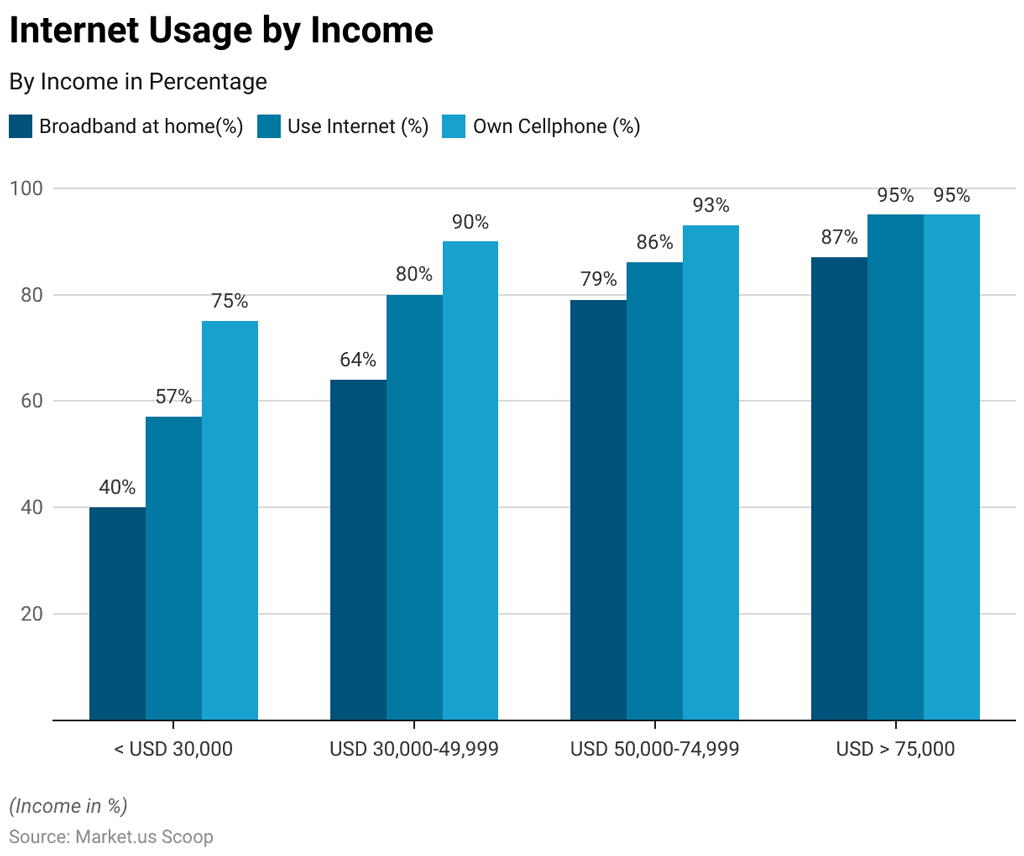
- Home broadband access rises sharply with income, increasing from 40% among people earning under $30,000 to 87% among those earning over $75,000.
- Internet usage grows from 57% in the lowest income group to 95% in the highest income group.
- Cellphone ownership is comparatively high across all income levels, ranging from 75% among people earning below $30,000 to 95% among top earners.
- Among people earning $30,000 to $49,999, 64% have home broadband, 80% use the internet, and 90% own a cellphone.
- In the $50,000 to $74,999 bracket, broadband access reaches 79%, while internet usage and cellphone ownership stand at 86% and 93%, respectively.
- The largest income-based gap appears in home broadband access, with a 47-percentage-point difference between the lowest and highest income groups.
- At incomes above $75,000, internet usage and cellphone ownership are equal at 95%, indicating near-universal digital access.
Social Media Usage via the Internet
- Global social media identities reached approximately 5.24 billion in 2025, representing 63.9% of the world’s population.
- Around 94% of internet users actively use at least one social media platform each month.
- Internet users spend an average of 2 hours 21 minutes per day on social media.
- 50.8% of social media users primarily use platforms to keep in touch with friends and family.
- More than 34% of active users visit social media to read news, demonstrating its role as an information source.
- 62.3% of users on a leading platform research brands before purchasing, reflecting a growing role in commerce.
- Women aged 16 to 24 continue to spend more time on social media than any other demographic group.
- Social media adoption exceeds 96% among internet users in several East Asian markets.
- Global identities increased by 206 million during 2024, reflecting continued platform growth.
E-commerce and Online Shopping Statistics
- Global online consumer goods sales exceeded $4.12 trillion during 2024, representing 14.6% annual growth.
- More than 2.5 billion people purchased consumer goods online during 2024, an increase of approximately 200 million shoppers from the previous year.
- Around 56% of connected adults make an online purchase at least once every week.
- E-commerce accounted for 17.3% of global consumer goods spending during 2024, remaining well above pre-pandemic levels.
- The fashion category generated more than $770 billion in global online sales during 2024, making it the largest e-commerce segment.
- Food ranked second, generating approximately $680 billion in online consumer spending worldwide.
- 70% of online shoppers report purchasing products directly through social media platforms.
- Approximately 59% of online shoppers buy from retailers located outside their home country, demonstrating continued growth in cross-border commerce.
- Nearly half of all e-commerce purchases still occur on desktop or laptop computers, despite continued growth in mobile shopping.
Internet Connection Speeds and Performance
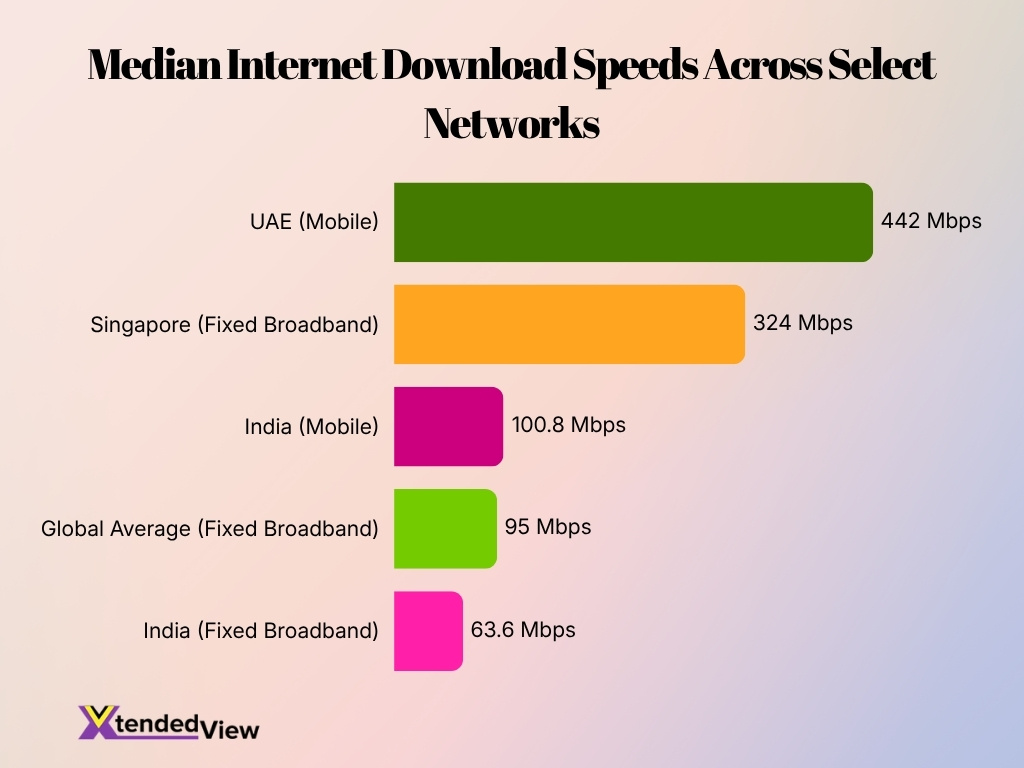
- Global median fixed broadband download speeds exceeded 95 Mbps during late 2024, continuing steady year-over-year growth.
- Median fixed broadband upload speeds reached approximately 51.5 Mbps, increasing by nearly 25% over the previous year.
- Fixed broadband connections remain approximately 55% faster than mobile networks for median download speeds worldwide.
- The United Arab Emirates recorded the world’s fastest median mobile download speed at approximately 442 Mbps.
- Singapore led global fixed broadband performance with median download speeds exceeding 324 Mbps.
- In India, median mobile download speeds reached approximately 100.8 Mbps at the beginning of 2025, up 6.5% year over year.
- India’s median fixed broadband download speed increased to approximately 63.6 Mbps, representing annual growth of 8.4%.
- More than 26 countries now record median mobile download speeds above 100 Mbps, reflecting continued global network upgrades.
- Continued investments in fiber infrastructure, 5G deployment, and satellite connectivity are expected to improve internet performance over the next several years.
Cybersecurity, Privacy, and Safe Internet Usage
- As of 2025, 2.2 billion people globally remain offline despite internet usage reaching 74% of the population.
- Global cybercrime is projected to cost businesses over $10.5 trillion annually, driving mandatory investments in security frameworks.
- Phishing remains the most common cyber threat worldwide, with an estimated 3.4 billion spam emails sent every single day.
- AI-driven attacks were involved in 16% of breaches in 2025, pushing the average data breach cost to $4.63 million.
- Over 1.35 billion people were impacted by data compromises and privacy breaches globally in recent years.
- Implementing multi-factor authentication has risen to 43% among small businesses to strengthen identity management.
- Ransomware now accounts for 44% of cybersecurity breaches, costing organizations an average of $1.85 million per incident.
- Despite expanding mobile broadband, 85% of urban residents have internet access compared to just 58% in rural areas.
- The shift toward Zero Trust security is accelerating, with 36% of organizations making it their top cyber budget priority in 2026.
Internet Usage by Purpose
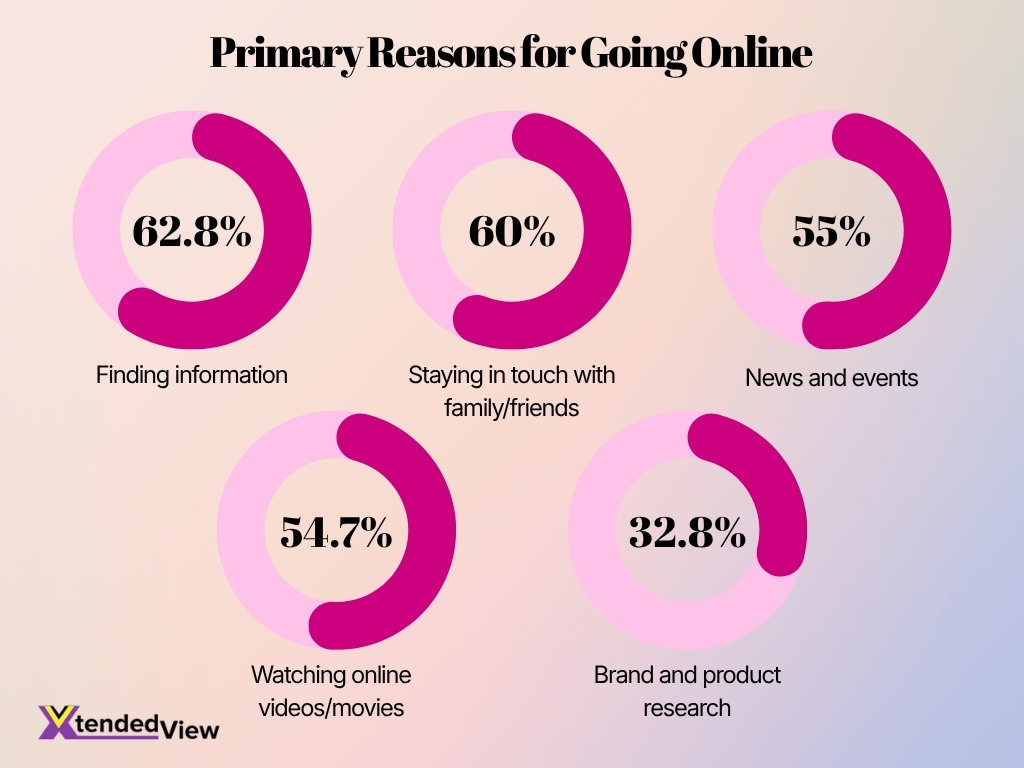
- 62.8% of internet users cite finding information as their primary reason for going online.
- Over 60% of users access the web specifically to stay in touch with family and friends.
- 55% of people use the internet primarily to keep up to date with news and events.
- 54.7% of individuals utilize the internet mainly for watching online videos and movies.
- 32.8% of online adults rely on search engines for discovering new brands and products.
- More than 80% of online adults use search engines regularly for daily browsing.
- Generative AI platforms have surged in popularity and now attract 2.42 billion active users monthly.
- Approximately 94.7% of all internet users engage with at least one social media platform every month.
Future Trends in Global Internet Usage
- Global internet users increased by over 240 million this past year, reaching 6 billion active users as global adoption expands.
- Approximately 2.2 billion people, or 26% of the global population, still remain offline, creating significant future adoption opportunities.
- Platforms utilizing Generative AI tools now attract over 2.42 billion active users, cementing AI as a core internet activity.
- The global average of daily time spent online has reached 6 hours and 38 minutes, deeply reshaping digital media consumption habits.
- Around 94.7% of all internet users actively engage with evolving search platforms for AI-assisted experiences and product research.
- Expanded 5G network deployments are estimated to cover 55% of the world’s population, significantly improving connectivity in underserved regions.
- Global digital commerce and AI applications are projected to drive $3.66 trillion in online consumer spending, fueling internet traffic growth.
- With only 4% of low-income countries having 5G, governments are drastically increasing investments in digital infrastructure and cybersecurity.
- The global internet penetration rate now sits at 74% of the world’s population, moving the world steadily closer to universal internet access.
Frequently Asked Questions (FAQs)
Approximately 6.0 billion people, or about 73.6% to 75% of the global population, use the internet worldwide in 2025, depending on the reporting methodology.
Around 2.2 billion people, or approximately 26.4% of the global population, remain offline in 2025.
Approximately 55.1% of the world’s population has access to 5G network coverage in 2025.
In 2025, about 85.4% of urban residents use the internet, compared with 58.2% of rural residents worldwide.
China ranks first globally with nearly 1.3 billion internet users in 2025, followed by India with more than 1 billion users based on the latest official revisions.
Conclusion
Global internet usage continued to grow, with billions of people relying on digital connectivity for communication, work, education, healthcare, entertainment, and commerce. While internet penetration has reached record highs, regional disparities, affordability challenges, and cybersecurity concerns remain key priorities for governments and businesses. At the same time, advances in AI, faster broadband networks, expanding 5G coverage, and digital commerce are reshaping how people interact online. As the remaining offline population gains access to reliable connectivity, the internet’s influence on the global economy and everyday life will continue to expand.
