


In today’s fast‑moving professional landscape, networking has evolved well beyond simple handshakes and business cards. From industry conferences to virtual meetups and online platforms, connections now span digital and physical realms alike. For example, a U.S. sales executive might land a major client after attending an in‑person round‑table, while a remote software engineer may secure a role through a virtual meet‑and‑greet on a professional platform. These scenarios show how networking influences business growth and career mobility.
Editor’s Choice
Here are seven key statistics worth noting up front:
- 98% of enterprise leaders say a modernized network is critical to implementing AI, IoT, and cloud‑driven workloads.
- 91% of organizations plan to increase the share of their IT budget allocated to networking in 2025.
- 60% of events held in 2024 were in‑person, and only 35% were fully virtual.
- 85% of job positions are filled through personal connections rather than open applications.
- 80% of professionals believe networking is essential to their career success.
- Virtual event attendees spend 27% more time online than at in‑person events.
- In the period 2023‑24, global Internet traffic rose by roughly 49%, signalling rapid networking and connectivity growth.
Recent Developments
- In the 2025 era, AI‑powered networking, edge computing, and intent‑based networking are emerging as core trends.
- In 2025, a shift toward Zero Trust network security is now considered standard.
- Hybrid environments combining on‑premises, cloud, and IoT are placing new demands on network infrastructure.
- A 77% share of organizations reported major network outages over the past two years, emphasizing reliability concerns.
- The percentage of firms declaring that secure networking is vital to operations and growth stands at 98%.
- Enterprises expect to allocate around 91% of network‑related budgets toward modernization in the coming months.
- There is growing adoption of Network‑as‑a‑Service (NaaS) models as organizations seek flexible, subscription‑style network solutions.
- With the proliferation of remote work, networks are expected to support increasingly distributed endpoints and mobile users.
- Sustainable networking (green energy, low‑power infrastructure) is gaining attention in network design decision‑making.
- By 2025, 82% of enterprises cite improved agility as the main reason for adopting modern networking solutions.
Global Networking Landscape
- A study shows global Internet traffic increased approximately 24.5% annually (about 49.2% over two years) in 2023‑24 across 472 IXPs.
- Adoption of IPv6 globally sits around 45‑49% of Google users, with the U.S. and Brazil around the 50% mark.
- In 2025, high‑performance networking equipment (used in data centres and cloud) is increasingly being invested in by enterprises worldwide.
- Around 60% of business events in 2024 were held in‑person, indicating a global tilt back toward face‑to‑face networking.
- Over 160 million Africans gained broadband internet access between 2019 and 2022, representing a 115% increase in internet users.
- Global 5G population coverage reached 55% at the end of 2024, with projections to reach 85% by 2030 outside mainland China.
- The modern network is now seen as the first line of defence in cybersecurity frameworks globally.
- Use of cloud networking and hybrid models is growing internationally, with 90% of organizations expected to operate with a hybrid cloud model by 2027.
- Automation and AI‑based network management tools are being adopted across multiple geographies, with 90% of IT leaders believing network management needs AI and automation.
- The AI‑driven network automation market was valued at $8.67 billion in 2023 and is expected to reach $60.60 billion by 2030.
In‑Person Networking Statistics
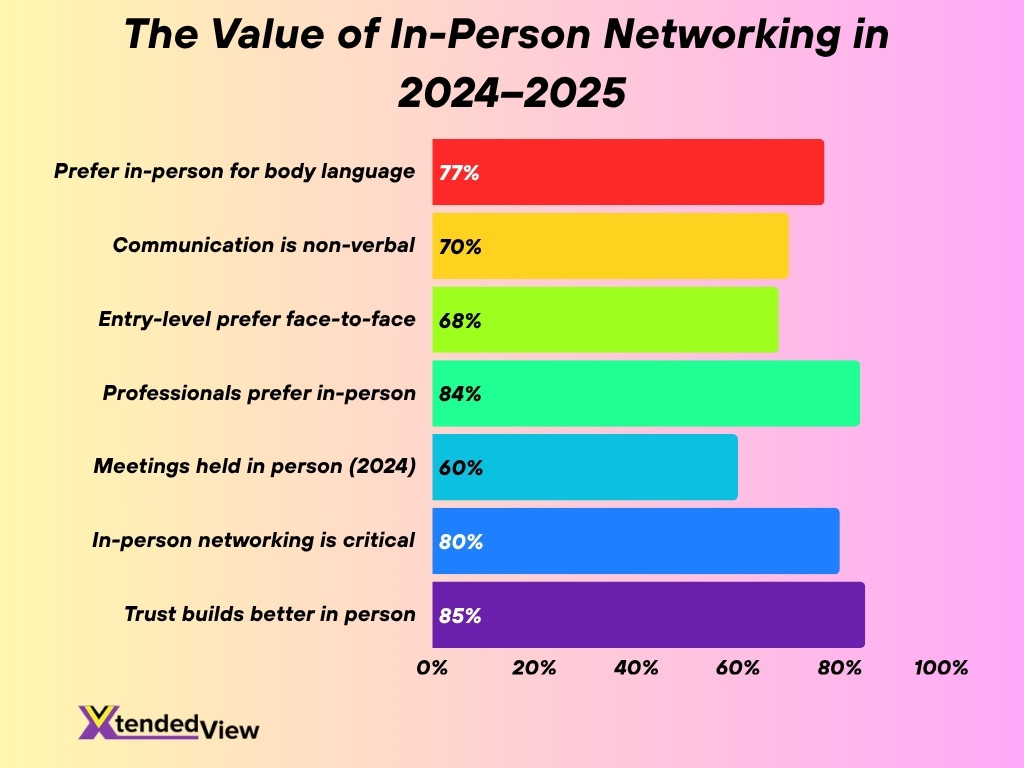
- 77% of professionals who prefer in‑person networking say it gives them the chance to read body language and expressions.
- 70% of communication is non‑verbal, underlining the value of face‑to‑face interactions.
- 68% of entry‑level professionals value face‑to‑face networking more than online methods.
- A survey found 84% of business professionals say they prefer face‑to‑face meetings for deeper relationship building.
- In‑person events still account for around 60% of professional networking meetings as of 2024.
- In‑person networking is reported as critical by nearly 80% of those who see networking as essential to their career.
- Attending live events is linked to higher trust levels in business relationships; 85% say they build stronger relationships in person.
- Professionals report that meeting peers in person leads to shorter hiring processes than purely remote introductions.
Virtual Networking Statistics
- Virtual event attendees in 2025 spend 27% more time online than at in‑person events.
- Virtual events report engagement rates in the range of 60‑70%.
- In 2024, only 35% of events were fully virtual, indicating hybrid and in‑person formats remain strong.
- Professionals who cannot attend physical events increasingly turn to virtual networking tools and platforms, with usage upticks of 40%+.
- Remote networking now supports connections across time zones, with 50%+ of virtual events hosting attendees from three or more continents.
- Virtual networking is particularly effective for early‑career and international professionals; 68% report meeting someone relevant in a virtual forum.
- Virtual interactions still yield strong outcomes; roughly 72% of networking outcomes hinge on first impressions, even in virtual venues.
- The use of virtual business cards or contact exchange apps has increased by more than 30% year‑on‑year among networking event providers.
Online Networking Statistics
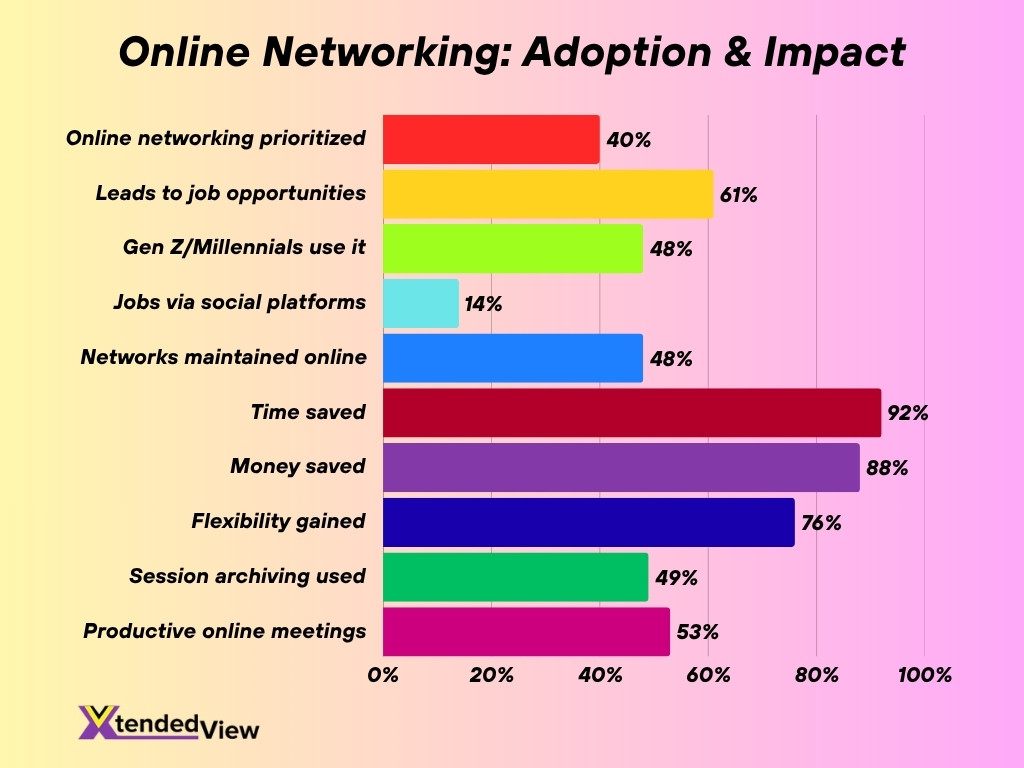
- About 40% of professionals now prioritize online networking over in‑person meetings.
- A survey found that 61% of professionals believe that regular online interaction with their network can lead to job or business opportunities.
- 48% of Gen Z and millennials reported using social platforms for networking.
- Approximately 14% of workers reported that they found and applied to their job using social platforms like LinkedIn, Facebook, or Instagram.
- 48% of professionals actively maintain their professional network via regular communication and networking events.
- 92% of participants said online networking saved them time, and 88% said it saved them money.
- 76% of survey respondents said online meetings offered more flexibility in terms of location and time.
- The convenience of archiving sessions or interactions was cited by 49% of online networking participants.
- More than 53% of the surveyed group said they were more productive during online meetings.
Social Media and Networking Statistics
- There were approximately 5.66 billion “user identities” on social media globally, with annual growth of about 4.9%.
- The average person uses about 6.83 different social networks per month in 2025.
- Global social media penetration is around 63.9% of the world’s population, and average daily usage is about 2 hours 21 minutes.
- Over 96% of small businesses use social media in their marketing strategy in 2025.
- Users spend an average of 143 minutes daily on social media platforms.
- 58% of consumers report discovering new businesses via social media.
- 78% of people prefer learning about new products via short videos on social.
- Mobile devices generate 63.05% of global web traffic, showing the mobile‑networking link.
- In 2025, social media advertising spend is projected to be near $276.7 billion globally.
Business Networking Statistics
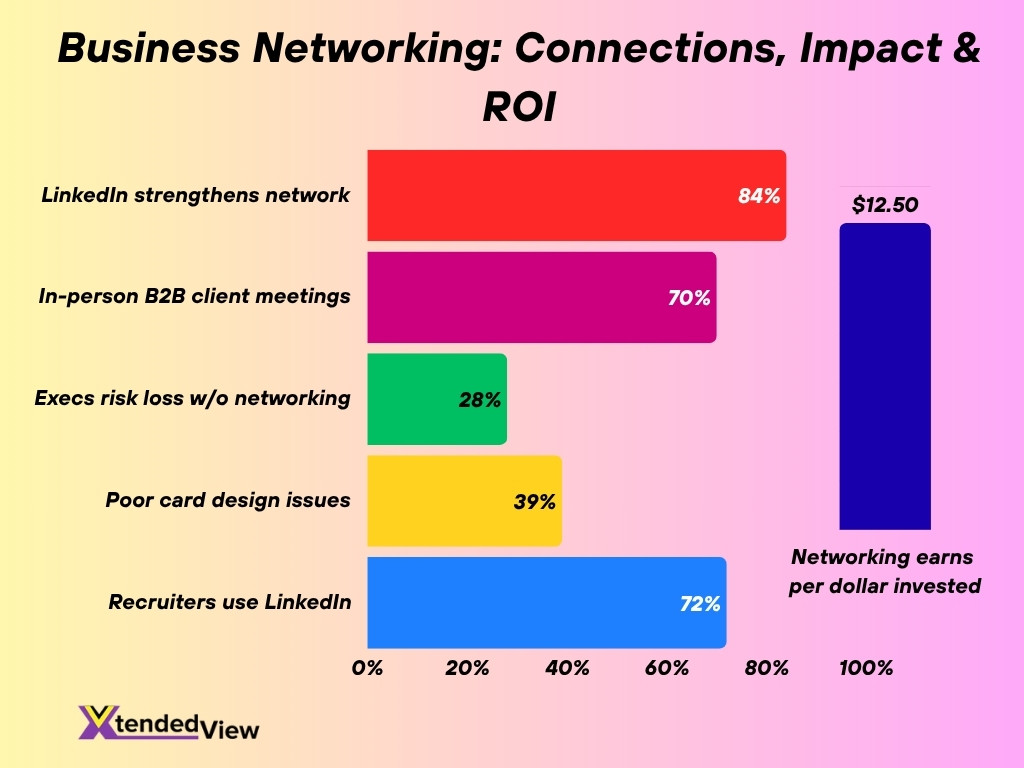
- 84% of people use LinkedIn to strengthen their professional networks.
- Employees hired via referrals or connections stay longer at their companies and cost less to hire.
- Around 70% of in‑person business meetings result in new client acquisition for B2B firms.
- Larger business executives report losing as much as 28% of their business if they stopped networking entirely.
- Companies that invest in face‑to‑face meetings for networking earn roughly $12.50 for every dollar invested.
- 49% of business owners say a lack of time makes it hard to maintain their business network relationships.
- Over 72% of people say a business card is still their first impression with a company, and 39% say a poor card design will stop them from doing business.
- Recruiting via employee referrals allows firms to fill roles 47% quicker than job boards.
- 72% of recruiters use LinkedIn to seek new hires.
Career Networking Statistics
- 80% of professionals believe that networking is essential to their career success.
- 35% of workers said they got their current job thanks to a professional connection.
- 70% of jobs are believed to be filled via referrals or internal channels rather than public posts.
- 46% of freelancers say jobs come through friends or family connections.
- 39% of workers found their job through networking.
- Increasing one’s professional network by 50% can deliver around 3.8% higher salary.
- Networking reduced the job search time by 1–3 months on average.
- Networking behaviour correlates with higher job satisfaction and salary growth.
- 70%+ of professionals believe networking gives them a higher chance of career advancement.
Networking for Business Relationships
- 75% of clients prefer or require an in‑person meeting before committing to a deal.
- Meeting business partners face‑to‑face is cited as crucial for trust‑building by nearly 100% of professionals.
- 47% of professionals said gaining new knowledge was their main reason for networking, 23% networked primarily for job or opportunity access.
- B2B sales cycles shorten significantly when based on prior network contacts.
- Firms that neglect networking report potential business losses of up to one‑quarter of revenue.
- 43% of attendees network to meet prospects, 48% to connect with vendors.
- Smaller gatherings (<10 people) are reported to generate higher quality interactions than large ceremonies.
- Consistent networking correlates with having access to more than twice the number of prospective clients or partners.
Networking for Career Growth
- 83% of men and 52.5% of respondents overall cited personal connections as the primary reason behind their most recent promotion.
- 76% of professionals believe a mentor is crucial for career success.
- Mentees had a retention rate of 72% vs 49% among non‑mentees.
- 50–80% of jobs are filled through the hidden job market.
- A referral candidate may be up to 15 times more likely to be hired than an applicant via a job board.
- Professionals with larger networks report an average salary increase of around 3.8% compared to peers.
- 41% of professionals say they want to network more but struggle to find the time.
- Candidates with active networks spend significantly less time seeking roles.
Networking Impact on Job Search
- 70%–85% of jobs are filled through networking rather than through public job postings.
- A casual conversation has led to a new opportunity for 35% of LinkedIn users.
- Networking cuts job‑search time by 1–3 months compared to online applications.
- 70%+ believe networking improved their career advancement chances.
- 41% of professionals want to network more but struggle with time.
- 39% found their job through networking.
- Contacts from previous roles correlate with higher job satisfaction and salary growth.
- Professionals with larger networks reported a 3.8% salary boost.
- Employers’ emphasis on networking‑based hiring reflects trends toward skills and fit.
Referral and Connection-Based Hiring Statistics
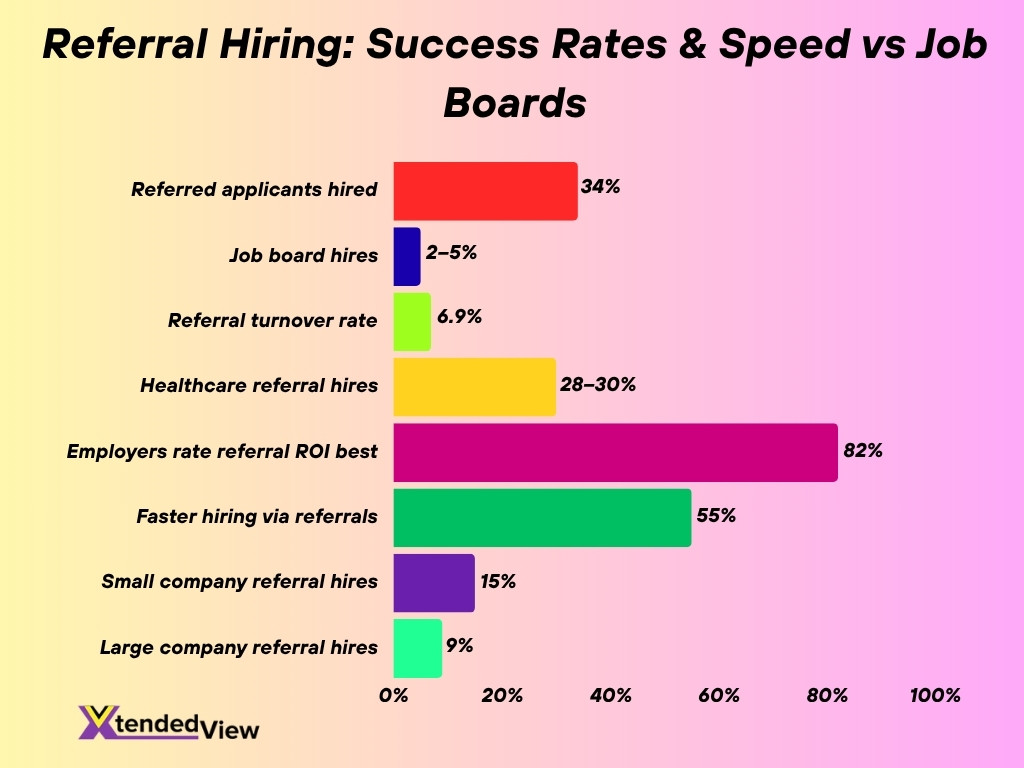
- 34% of applicants who are referred get hired, versus 2–5% from job boards.
- Referral hires have a turnover rate of 6.9%, 20% lower than non‑referrals.
- In healthcare, 28–30% of hires come via referrals.
- 82% of employers say referral hires offer the best ROI.
- Referral candidates are 55% faster to hire.
- Referrals increase hiring odds by 2.6–6.6×.
- 15% of hires at small companies come via referrals, 9% at large firms.
- Referrals drive a large share of hires from a small application pool.
- Referral systems may disadvantage those without strong networks.
Trade Show and Event Networking Statistics
- 89% of planners expect an 11–20% rise in in‑person meetings.
- 71% of SMEs won business via face‑to‑face trade shows.
- The trade show market is projected to $50 billion in 2025.
- 67% of attendees are new prospects for exhibitors.
- 51% requested a follow‑up meeting post‑event.
- Webinar attendance increased by 20%.
- 78% of organizers cite in‑person events as most impactful.
- 57% saw an increase in in‑person event attendance.
- 37% of U.S. businesses plan to increase trade show budgets.
Benefits of Networking
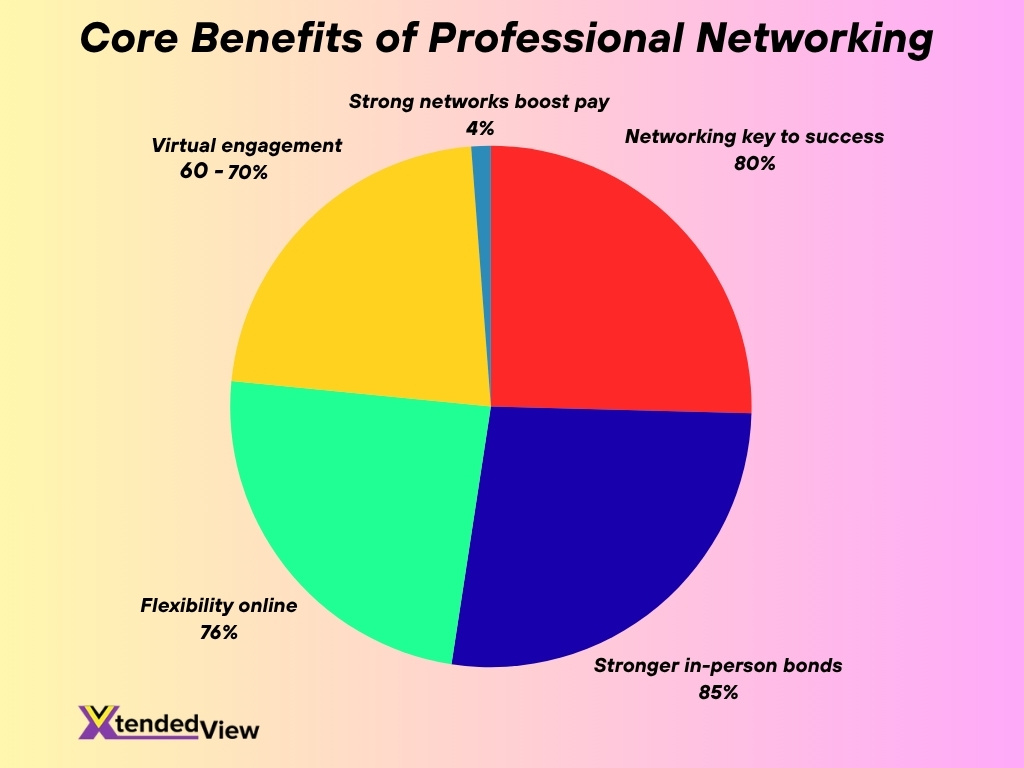
- 80% of professionals believe networking is essential to career success.
- Networking reduces job‑search time and increases exposure.
- Networked business owners access twice as many prospects.
- 85% say they build stronger relationships in person.
- Shorter sales cycles and better conversion rates result from networking.
- Stronger networks yield higher salary and job satisfaction (~3.8%).
- 76% report that online meetings offer greater flexibility.
- Virtual networking has 60–70% engagement rates.
- Smaller events are more effective for deeper connections.
Networking Challenges and Barriers
- 41% of professionals want to network more but lack time.
- Referral systems can entrench inequity.
- 38.2% of organizers find ROI hard to demonstrate.
- 30% cite costs, 31% cite budgeting as top event issues.
- Virtual fatigue can reduce connection depth.
- Professionals in remote areas face limited access.
- Relationship maintenance requires consistent effort.
- Virtual networking lacks trust and authenticity for some.
- Language and cultural barriers hinder cross-border networking.
Networking Tools & Platforms Adoption
- The market for networking tools is $15 billion in 2025, with a 12% CAGR.
- Open‑Network‑Index adoption rose from 8% to 18% in a year.
- 69% of employers offer referral incentives.
- 96% of small businesses use social media in networking strategies.
- The average user engages with 6.83 social networks monthly.
- Webinar attendance up 20%, showing tool adoption.
- 65.8% plan to maintain or increase in‑person events.
- Large firms report 11% of hires via referral, small firms 15%.
Future Outlook for Networking Statistics
- Skills like networking and cybersecurity are among the fastest‑growing for 2025–2030, ranking second only to AI and big data.
- Hybrid formats are expected to grow by 18% globally in 2025, with 71% of event planners committed to organizing hybrid events.
- Employers must address diversity gaps in referral systems, as women of colour are 35% less likely to receive a referral than other demographics.
- Networking tools will integrate AI and automation, with 90% of IT leaders believing network management needs AI and automation capabilities.
- Smaller, curated events will grow in relevance, as 51% of attendees say effective networking is reason enough to return to an event.
- Platforms will better measure ROI through analytics, with 54% of planners saying hybrid formats enable better data collection and engagement tracking.
- Globalization will bring richer but more complex networking, with 64 million new AI tool users added globally in 2025 alone.
- The hidden job market will continue to grow, with 70–80% of job openings expected to remain hidden and filled through networking by 2025.
- Next‑gen professionals want digital‑first but human‑centric networking, as 40% of younger professionals say current networking formats increase anxiety.
- By 2025, 70% of organizations will have formal diversity‑focused referral programs to address gaps in traditional networking systems.
Frequently Asked Questions (FAQs)
The professional networking market is expected to reach $65.64 billion in 2025.
The virtual networking market is projected to grow at a CAGR of 26.5% from 2025 to 2030.
54% of U.S. workers say they landed a job through a connection.
The global enterprise networking market is estimated at around $229.26 billion in 2025, growing at a CAGR of 5.4% from 2025 to 2030.
Studies estimate that 70%–85% of jobs are filled through networking rather than publicly posted applications.
Conclusion
As networking continues to reshape how we build careers, businesses scale, and opportunities surface, the data clearly underscores one truth: who you know and how you connect matter. From job‑search outcomes and referral‑based hiring to the resurgence of trade shows and the adoption of smarter networking platforms, the evidence shows that relationships are powerful currency.
At the same time, challenges around access, measurement, and equitable networking remain. Whether you’re a professional seeking your next role or an organization seeking growth, staying plugged in to this evolving networking ecosystem gives you a strategic advantage. Dive into the data, apply the insights, and let the numbers guide your next move.
