



Mobile applications now shape how people shop, bank, learn, communicate, and manage their health. Businesses also rely on mobile apps to drive customer engagement, process payments, deliver on-demand services, and support hybrid work. As AI-powered experiences and subscription models expand, the mobile ecosystem continues to influence nearly every industry. Explore the latest mobile application statistics to understand where the market is heading and what the numbers reveal for businesses, developers, marketers, and investors.
Editor’s Choice
- Global in-app purchase revenue reached $167 billion in 2025, marking a 10.6% year-over-year increase and setting a new industry record.
- Mobile app downloads climbed to nearly 150 billion in 2025, up 0.8% from the previous year.
- Consumers spent a record 5.3 trillion hours using mobile apps worldwide during 2025, averaging roughly 3.6 hours per user per day.
- Worldwide app market revenue is projected to reach $739.61 billion in 2026, with the United States contributing the largest share.
- Global app downloads are forecast to reach 528.48 billion across all monetization models in 2026.
- Non-gaming apps generated more consumer spending than games for the first time during 2025, driven largely by AI services and subscription-based applications.
- The global app market is projected to surpass $1.1 trillion in annual revenue by 2031, reflecting sustained long-term growth.
Recent Developments
- Generative AI apps emerged as one of the fastest-growing categories in 2025, recording 148% year-over-year download growth.
- Short-form drama apps posted an exceptional 278% annual download increase in 2025, making them one of the fastest-expanding entertainment segments.
- During Q4 2025, generative AI apps exceeded 1.1 billion downloads in a single quarter.
- Generative AI app revenue surged 212% year over year during Q4 2025, reaching $1.7 billion.
- Around 64% of generative AI users now access AI tools exclusively through mobile apps, highlighting the shift toward mobile-first usage.
- Mobile in-app purchase revenue increased 9.6% year over year during Q4 2025 despite slowing download growth.
- Digital advertising spending across mobile ecosystems grew 13% in Q4 2025, reflecting stronger advertiser investment.
- AI-powered mobile experiences became one of the primary drivers of app monetization growth throughout 2025, especially across productivity and utility apps.
Mobile Application Market Growth
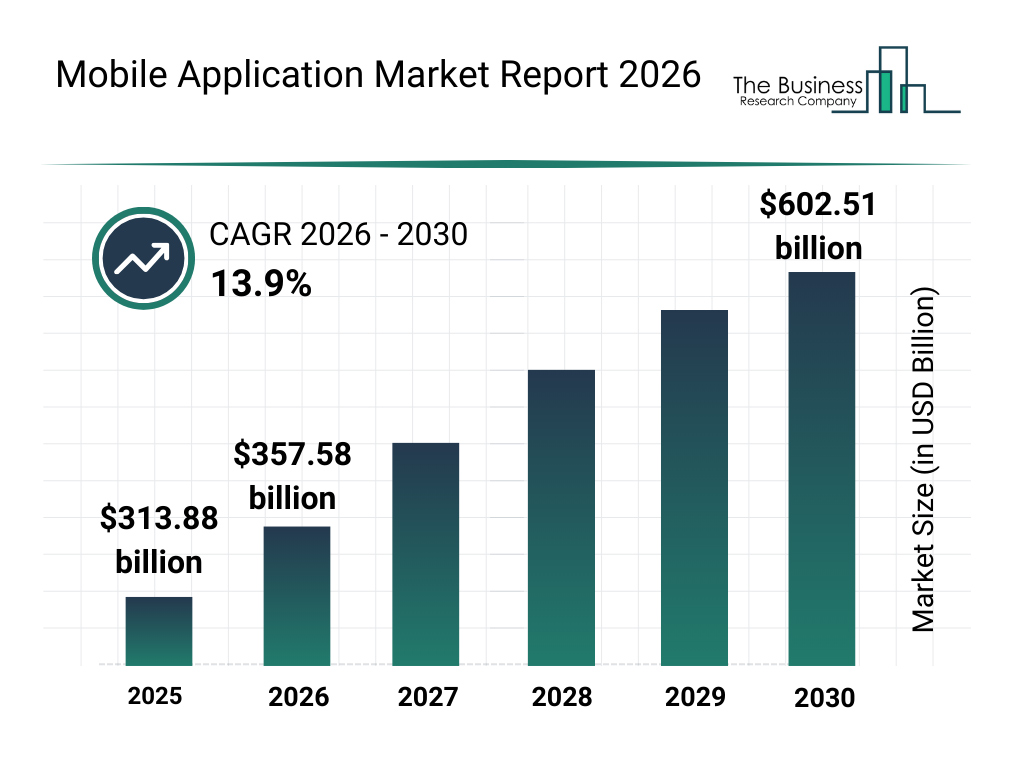
- The global mobile application market was valued at $313.88 billion in 2025 and is projected to reach $357.58 billion in 2026.
- The market is expected to expand at a strong 13.9% CAGR from 2026 to 2030, reflecting sustained demand for mobile-based services.
- By 2027, the mobile application market could generate approximately $407.28 billion in revenue.
- The market is forecast to surpass $463.90 billion in 2028, supported by rising smartphone adoption and app-based spending.
- Global mobile application revenue may increase to around $528.38 billion by 2029.
- By 2030, the market is projected to reach $602.51 billion, nearly doubling from its 2025 level.
- Between 2025 and 2030, the market is expected to add approximately $288.63 billion in total value.
- The projected growth indicates that mobile applications will remain a major revenue-generating segment across digital commerce, entertainment, finance, healthcare, and productivity.
Mobile App Growth Statistics
- Global app downloads increased 0.8% year over year in 2025 after several years of slower expansion.
- Consumer spending on mobile apps grew 10.6% during 2025, significantly outpacing download growth.
- Global app usage reached 5.3 trillion hours in 2025, representing 3.8% annual growth.
- Non-gaming apps delivered 21% year-over-year revenue growth, becoming the strongest contributor to market expansion.
- AI applications ranked among the fastest-growing app categories in both downloads and revenue throughout 2025.
- Mobile developers increasingly focused on retention and monetization rather than pure download growth as mature markets stabilized.
- India maintained its position as the world’s largest mobile download market with approximately 25 billion annual downloads.
- India’s annual in-app purchase revenue exceeded $1 billion during 2025 and is projected to reach $1.25 billion in 2026.
Mobile App Usage Statistics
- Mobile users spent approximately 3.6 hours per day using apps in 2025.
- Worldwide app usage reached an all-time high of 5.3 trillion hours during 2025.
- AI apps recorded some of the highest engagement gains across the mobile ecosystem during 2025.
- Approximately 64% of generative AI users now interact with AI services exclusively through mobile applications.
- Mobile gaming continued to dominate user engagement despite slower installation growth.
- Utility, productivity, media, shopping, and financial apps remained among the most frequently used categories in major mobile markets.
- Consumers increasingly favored subscription-based services over one-time purchases, leading to longer engagement cycles.
- AI-powered assistants, productivity tools, and entertainment apps generated the strongest increases in daily active usage during 2025.
Android App Engagement by Daily Usage Time
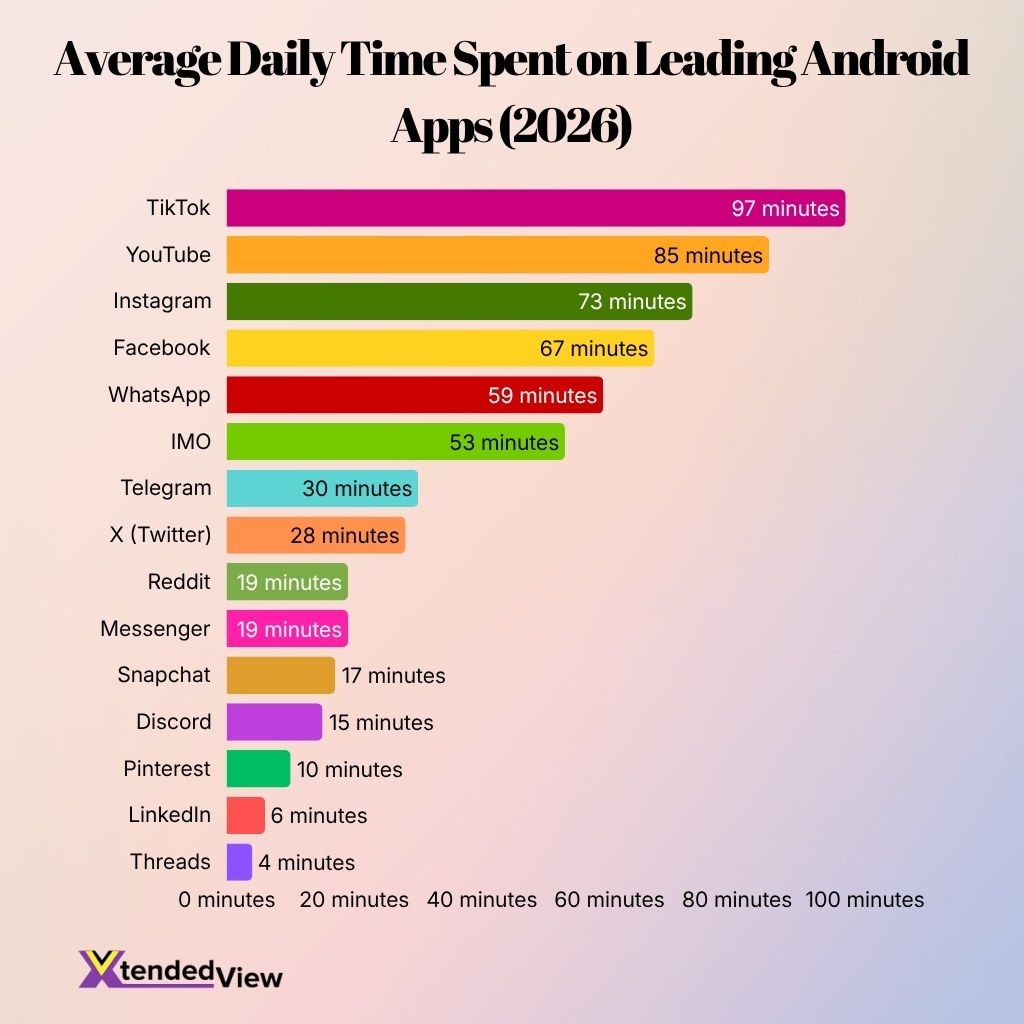
- TikTok ranks first, with Android users spending an average of 97 minutes per day on the platform.
- YouTube follows closely at 85 minutes daily, just 12 minutes behind TikTok.
- Instagram records 73 minutes of average daily usage, making it the third most time-consuming Android app.
- Facebook remains highly engaging, with users spending approximately 67 minutes per day on the app.
- Messaging platforms also command significant attention, led by WhatsApp at 59 minutes and IMO at 53 minutes daily.
- Usage drops sharply after IMO, with Telegram averaging 30 minutes and X at 28 minutes per day.
- Reddit and Messenger are tied at an average of 19 minutes of daily usage each.
- Snapchat and Discord generate comparatively moderate engagement at 17 minutes and 15 minutes per day, respectively.
- Professional and discovery-focused platforms receive less daily attention, with Pinterest at 10 minutes and LinkedIn at 6 minutes.
- Threads ranks last among the listed apps, with Android users spending only 4 minutes per day on average.
Mobile App Download Statistics
- Global mobile app downloads reached nearly 150 billion in 2025.
- Worldwide downloads are projected to reach 528.48 billion across all app monetization channels during 2026.
- Download growth accelerated slightly in 2025 after a relatively flat period across mature markets.
- Generative AI apps recorded 148% year-over-year download growth in 2025.
- Short-form drama apps expanded downloads by 278% during 2025.
- India continued generating approximately 25 billion downloads annually, more than any other country.
- Mobile games accounted for 52 billion downloads across platforms during 2025, with mobile representing the overwhelming majority.
- Although download growth has slowed globally, developers continue attracting new users through AI integration, subscriptions, and personalized experiences.
Mobile App Revenue Statistics
- Global consumers spent a record $167 billion on in-app purchases across iOS and Google Play in 2025, representing 10.6% year-over-year growth.
- Worldwide app market revenue is projected to reach $739.61 billion in 2026.
- In-app purchases are expected to generate $475.84 billion in revenue during 2026, making them the largest monetization model.
- Mobile app advertising revenue is forecast to total $256.87 billion globally in 2026.
- Revenue from paid app downloads is projected to reach $6.9 billion in 2026, reflecting the industry’s continued shift toward freemium models.
- Non-gaming apps generated more consumer spending than games for the first time in 2025, fueled by AI-powered services and subscription products.
- Mobile game in-app purchase revenue still reached $82 billion during 2025 despite slower download growth.
- The United States is projected to remain the largest app revenue market with $317.39 billion in 2026.
Monthly Growth in New App Launches
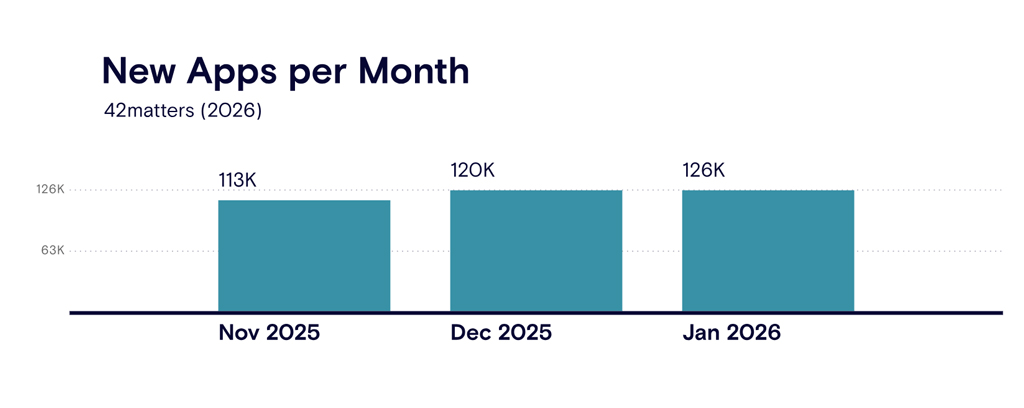
- The number of new apps added increased steadily from 113,000 in November 2025 to 126,000 in January 2026.
- December 2025 recorded 120,000 new apps, representing an increase of 7,000 apps from November.
- App additions grew by another 6,000 between December 2025 and January 2026.
- Over the full period, monthly app launches rose by 13,000, equivalent to approximately 11.5% growth.
- January 2026 had the highest monthly total, with 126,000 new apps entering the market.
- The consistent month-over-month increase indicates sustained developer activity and continued expansion of the mobile app ecosystem.
Mobile App User Demographics
- Gen Z and Millennials account for over 70% of active smartphone app users worldwide.
- Younger users spend 5.5 to 6.5 hours in mobile apps daily, compared to 3 hours for older age groups.
- Over 65% of consumer mobile users across all age demographics engage with AI chatbot apps weekly.
- Entertainment, communication, shopping, and finance apps drive more than 85% of total global app usage time.
- Subscription-based non-gaming apps generated a 23.7% year-over-year increase in revenue, led by productivity and streaming tools.
- The average smartphone user interacts with mobile apps 58 times per day, accumulating 4 hours and 37 minutes of daily engagement.
- More than 60% of consumer access to AI services now occurs through mobile apps rather than desktop interfaces.
- Mobile devices account for over 75% of internet usage across emerging markets in Asia, Africa, and Latin America.
Mobile App Usage by Country
- India remains the world’s largest mobile app download market with roughly 25 billion annual downloads.
- The United States leads the global app market by projected revenue, expected to generate $317.39 billion during 2026.
- China’s mobile ecosystem continues to rank among the world’s largest, recording 113 billion app downloads annually.
- India surpassed $1 billion in annual in-app purchase revenue during 2025.
- India’s annual in-app purchase revenue is projected to reach $1.25 billion by the end of 2026.
- Mature markets like the United States, Japan, and South Korea generate higher revenue per user, projected to reach $138.10 in the US by 2030.
- Emerging economies continue driving download growth, while developed markets like North America contribute a larger 30% share of global app revenue.
- Mobile payments and financial services continue expanding rapidly across Asia-Pacific markets, which captured a 52.92% global app revenue share in 2025.
- South Korea demonstrates extreme mobile market maturity with 95% of its adult population currently owning a smartphone.
Mobile App Usage by Age Group
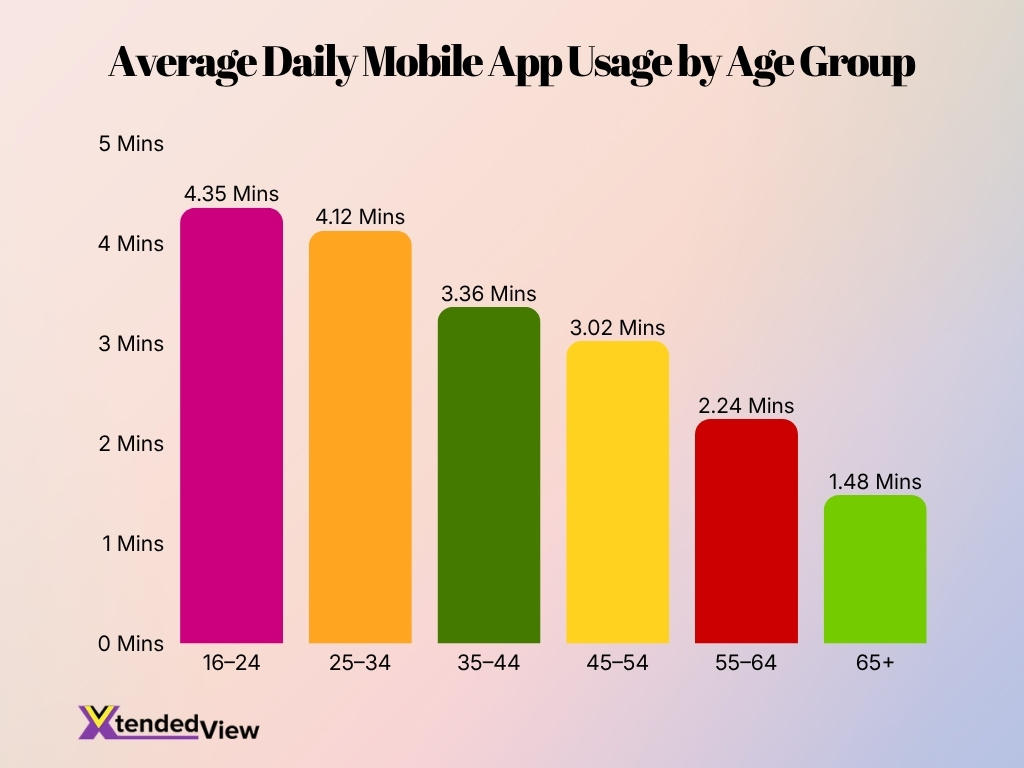
- Users aged 16–24 record the highest mobile app usage at 4 hours 35 minutes per day.
- The 25–34 age group follows closely, spending an average of 4 hours 12 minutes daily on mobile apps.
- Daily usage falls to 3 hours 36 minutes among users aged 35–44.
- Adults aged 45–54 spend approximately 3 hours 2 minutes per day using mobile applications.
- The 55–64 age group averages 2 hours 24 minutes of daily mobile app usage.
- Users aged 65 and older spend the least time on apps, averaging 1 hour 48 minutes per day.
- The gap between the youngest and oldest groups is 2 hours 47 minutes per day, highlighting a strong age-based usage divide.
- Overall, the data shows a clear pattern in which mobile app engagement decreases as age increases.
Mobile App Usage by Gender
- Over 80 million women in developing regions adopted mobile internet and digital services in 2025.
- 1.5 billion women across these regions are now using mobile internet despite a persistent 12% gender gap.
- Women aged 18 to 24 show 47% higher engagement than men on e-commerce and quick commerce apps.
- Female users spend an average of 35.2 minutes per day on shopping apps compared to 24.8 minutes for men.
- E-commerce platforms currently report a dominant female user audience share ranging between 54% and 61%.
- About 44% of female gamers play exclusively on mobile devices compared to just 27% of male gamers.
- The gender split among US mobile gamers remains nearly even, with women making up about 46% of all players.
- Generative AI app adoption among women tripled recently and is projected to reach parity with men by the end of 2025.
- Among current generative AI app users, approximately 34% of women interact with the technology at least once a day.
Global App Downloads by Category
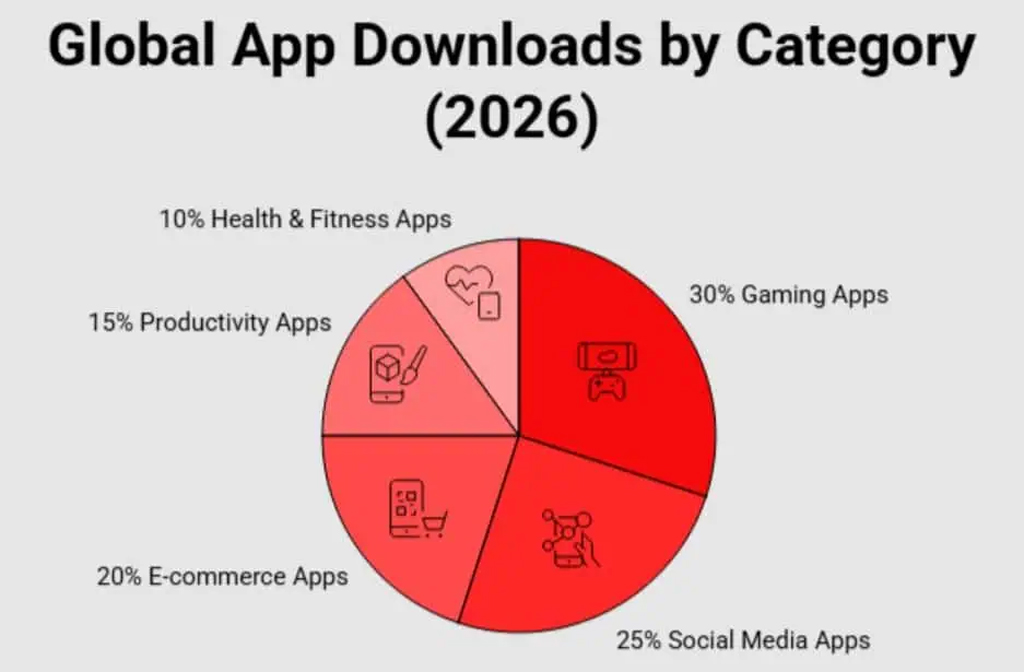
- Gaming apps lead global downloads with a 30% share, making them the largest app category in 2026.
- Social media apps account for 25% of downloads, placing them second and highlighting continued demand for online communication and content sharing.
- E-commerce apps represent 20% of global downloads, showing that mobile shopping remains a major part of consumer app activity.
- Productivity apps hold a 15% share, reflecting steady demand for tools that support work, organization, and daily task management.
- Health and fitness apps contribute 10% of downloads, making them the smallest category in the chart despite growing interest in digital wellness.
- Together, gaming and social media apps generate 55% of all downloads, indicating that entertainment and social engagement dominate the mobile app market.
- The top three categories, gaming, social media, and e-commerce, collectively account for 75% of global app downloads.
Mobile App Engagement Statistics
- Globally, consumers spent 5.3 trillion hours engaging with mobile apps during 2025.
- The average mobile user spent approximately 3.6 hours per day using applications.
- Total global app engagement increased by 3.8% year over year despite stalled download growth.
- The average user actively engaged with 34 different apps per month but used only 10 daily.
- Consumer engagement translated to $167 billion in global in-app purchase revenue during 2025.
- Users spent a massive 48 billion hours interacting with Generative AI applications in 2025.
- The average smartphone user keeps approximately 80 applications installed on their device at once.
- Social media applications captured the most attention with nearly 2.5 trillion hours of global usage.
- Subscription models drive long-term engagement and account for 95% of all mobile app revenue.
Mobile App Store Statistics
- Approximately 2.33 million apps were available through Google Play as of April 28, 2026.
- The Apple App Store offered about 2.26 million apps on the same date, leaving the two largest stores close in total catalog size.
- Another annual market review counted 2.42 million apps and games in the Apple App Store during 2025. Differences between estimates reflect removal dates, regional availability, and counting methods.
- Google Play’s catalog fell by approximately 1.8 million listings, or 47%, between early 2024 and April 2025 as quality rules became stricter.
- Google blocked more than 2.36 million policy-violating apps from publication during 2024.
- In 2025, Google rejected another 1.75 million apps that failed to meet its policies and closed more than 80,000 developer accounts.
- Google also stopped 255,000 apps from gaining unnecessary access to sensitive user data in 2025.
- Apple terminated 193,000 developer accounts over fraud concerns and rejected more than 138,000 developer enrollment attempts in 2025.
- Apple operates its app marketplace across 175 countries and regions, giving developers access to a broad international distribution network.
Mobile App Retention Statistics
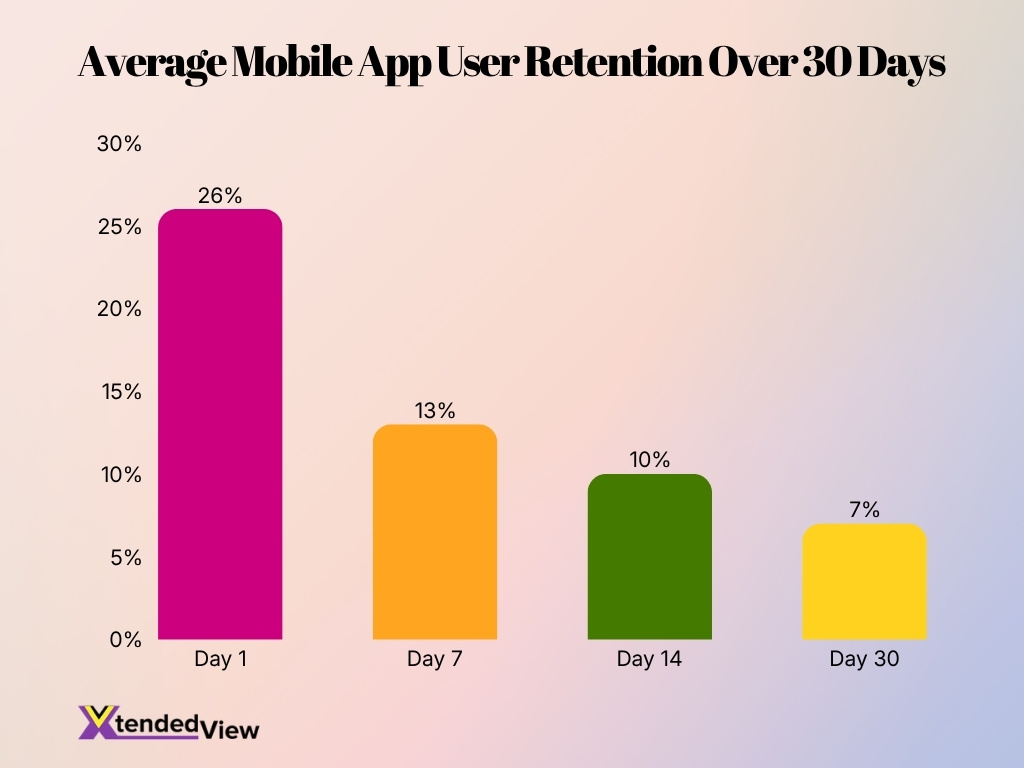
- Across app categories, average user retention falls to about 26% on Day 1, 13% on Day 7, and 10% by Day 14.
- Only around 7% of users typically remain active 30 days after installing an app, which shows how quickly most apps lose new users.
- An analysis covering 31 app categories placed average Day 1 retention at 25.3% in 2025.
- The median app retains roughly 4% of users by Day 30 in 2026, although performance varies sharply by category.
- Strong social apps can achieve Day 30 retention of 15% to 20%, placing them well above the overall market median.
- Fintech apps can retain approximately 10% to 15% of users after 30 days when they provide recurring financial value.
- Productivity apps can reach 10% to 18% Day 30 retention, while gaming apps often record a lower range of 4% to 8%.
- E-commerce apps generally retain only 3% to 6% of users by Day 30, reflecting purchase cycles that do not always require daily app use.
- Annual subscription plans commonly retain more than 50% to 60% of subscribers after 12 months in stronger categories, outperforming monthly and weekly plans.
Mobile App Monetization Statistics
- Global in-app purchase revenue reached $167 billion in 2025, rising 10.6% year over year as spending grew faster than downloads.
- In-app purchases are projected to generate approximately $475.84 billion in 2026 when broader app-market estimates include purchases across major app segments.
- Paid app downloads are expected to contribute only about $6.9 billion in 2026, making them a small part of the overall monetization mix.
- Subscriptions, in-app purchases, and advertising remain the main monetization methods, while many publishers now combine them within a hybrid model.
- Annual subscriptions generally deliver stronger 12-month retention than monthly or weekly plans, with leading cohorts retaining 50% to 60% or more.
- Games, social platforms, and productivity tools continue to rely heavily on in-app purchases because publishers can match offers to user activity.
- Non-gaming applications surpassed games in consumer spending during 2025, supported by subscription services and AI products.
- Mobile games still generated approximately $82 billion in in-app purchase revenue during 2025, showing that gaming remains a major spending category.
- The wider mobile application market is forecast to grow from about $322.6 billion in 2026 to $885.3 billion by 2033, based on a narrower market definition than some app-economy forecasts.
Mobile App Advertising Statistics
- Global app marketing expenditure reached approximately $109 billion in 2025, combining user-acquisition and remarketing campaigns.
- User-acquisition campaigns accounted for $78 billion of 2025 app marketing expenditure.
- Remarketing represented the remaining $31 billion, showing that marketers invest heavily in bringing existing users back to their apps.
- Global user-acquisition spending had already reached $65 billion in 2024, an increase of about 5% from the prior year.
- Earlier forecasts placed worldwide app-install advertising expenditure at $94.9 billion for 2025, following an expected 20% recovery from the industry downturn.
- Mobile app ad inventory recorded a 29% global invalid-traffic rate in Q2 2025, based on an analysis of 120 billion impressions across 16 markets.
- A 2025 field experiment found that every $100 in mobile advertising generated 37 paid installs and an additional three organic installs.
- Because paid campaigns also produced organic installs, the experiment estimated that mobile app advertising was 7.5% more effective than paid-install metrics alone suggested.
- A major 2026 fraud study examined more than 100 billion installs across 246,000 apps to measure how fraudulent activity affected 2025 campaign performance.
Global App Store and Google Play Spending
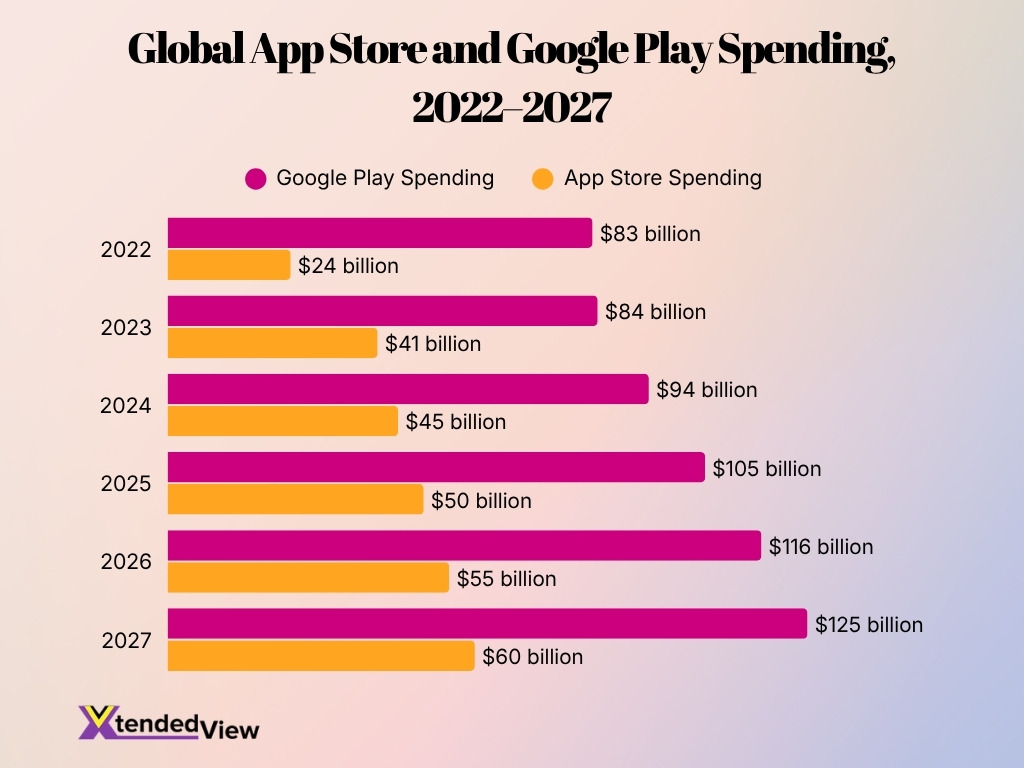
- Combined consumer spending across both app stores is projected to rise from $107 billion in 2022 to $185 billion in 2027, representing growth of nearly 73%.
- Google Play remains the larger platform throughout the forecast period, with spending increasing from $83 billion in 2022 to $125 billion in 2027.
- App Store spending is expected to grow much faster, climbing from $24 billion in 2022 to $60 billion in 2027, an increase of 150%.
- Total spending is forecast to cross $150 billion in 2025, when Google Play and the App Store generate $105 billion and $50 billion, respectively.
- The largest annual increase occurs between 2022 and 2023, when combined spending rises by $18 billion, from $107 billion to $125 billion.
- Google Play spending is projected to surpass $100 billion in 2025, while App Store spending reaches the $50 billion milestone in the same year.
- The App Store’s share of combined spending increases from approximately 22% in 2022 to more than 32% in 2027, indicating stronger relative growth.
- By 2027, Google Play is expected to generate $65 billion more in consumer spending than the App Store, despite the App Store’s faster growth rate.
Mobile App Security Statistics
- 62% of organizations surveyed in 2025 said their mobile applications had suffered a security breach during the previous year.
- Although breaches remained common, 93% of respondents believed their existing mobile app protections were sufficient.
- Affected organizations reported an average of nine mobile security incidents per year, indicating that many teams face repeated attacks rather than isolated events.
- Malware affected 52% of surveyed organizations, while 45% reported data breaches. Unauthorized access and credential theft each affected 37%.
- 74% of development teams said pressure to release products quickly could weaken mobile application security.
- Attacks targeting Android smartphone users rose 29% in the first half of 2025 compared with the first half of 2024.
- Security systems identified 815,735 new malicious or unwanted mobile installation packages during 2025, although that figure fell by nearly one-third from 2024.
- Google Play Protect scanned more than 350 billion apps per day in 2025 and detected 27 million potentially harmful apps installed from outside the official store.
- A study of 10 leading Android fitness apps, representing 237 million downloads, found insecure encryption in six apps, while two communicated with about 230 external domains each.
- A 2026 analysis of 41 mobile games found that location-data disclosures had a 56.1% inconsistency rate when researchers compared store declarations with observable app behavior.
Frequently Asked Questions (FAQs)
The global mobile app market is projected to generate $739.61 billion in total revenue in 2026, with a CAGR of 8.17% through 2031.
Global mobile app downloads are forecast to reach 528.48 billion in 2026.
Consumers spent a record $167 billion on in-app purchases in 2025, representing 10.6% year-over-year growth.
Users spent 5.3 trillion hours on mobile apps in 2025, averaging approximately 3.6 hours per user per day.
India ranked first globally with approximately 25 billion mobile app downloads in 2025, making it the world’s largest app download market.
Conclusion
Mobile applications enter the year with record consumer spending, stronger AI adoption, and deeper engagement across commerce, finance, entertainment, education, and health care. However, retention and security remain major challenges, as most apps lose users quickly and many organizations continue to report breaches. The strongest mobile businesses will pair useful products with clear monetization, efficient advertising, measurable retention, and security controls built into development.
