


The rise of the digital nomad lifestyle is reshaping how and where people work, and how they choose to live. From software developers coding on a beach in Bali to marketing consultants managing clients from Lisbon cafés, the ability to operate remotely is creating new possibilities for individuals and companies alike. In one instance, a U.S.-based tech firm hired engineers who moved to Portugal under a digital nomad visa; in another, a freelance writer based in India supports U.S. clients while living in Chiang Mai. These shifts reflect the global impact of location-independent work.
Editor’s Choice
Here are seven key statistics that capture the current state of the digital nomad phenomenon:
- > 40 million people worldwide identify as digital nomads in 2025.
- 18.1 million of them are based in the United States.
- 56% of digital nomads are men.
- 90%+ hold higher-education qualifications.
- The average income for many digital nomads is around $120,000+ per year.
- Millennials (born 1981‑1996) represent nearly half of the digital nomad population.
- Growth since 2019 shows a > 140% increase among U.S. digital nomads.
Recent Developments
- The global count of digital nomads has climbed from about 35 million in 2023 to over 40 million in 2025.
- In the U.S., the number rose to 18.1 million in 2024, up about 4.7% from 2023.
- The rate of growth since the pandemic has slowed; early years saw triple-digit growth, now the increase is more modest.
- More countries are launching dedicated digital nomad visa programs to attract remote workers, reflecting policy shifts.
- Companies are adapting by offering remote-work options across borders, increasing mobility services, and infrastructure.
- Independent contractors and freelancers among nomads continue to grow in proportion, while traditional employee nomads have slightly declined.
- The technology ecosystem enabling remote work, co-working spaces, digital payments, and global connectivity has matured, making nomadism more accessible.
What Is a Digital Nomad?
- A digital nomad is someone who uses digital technologies to perform work and lives in a location-independent way.
- This can include freelancers, remote employees, entrepreneurs, or independent contractors working from anywhere with internet access.
- The lifestyle involves combining travel or relocation with professional work, often moving between countries or regions.
- Some digital nomads maintain a primary home base but travel frequently, while others change their base regularly or live full-time abroad.
- Two key enablers, reliable internet connectivity and remote-work-friendly tools/services.
- Legal, tax, and visa issues often differentiate a casual remote worker from someone truly nomadic.
- The term has evolved beyond hobby travel to being part of mainstream workforce mobility strategies.
Global Digital Nomad Statistics
- Estimates put the global digital nomad population at between 40 million and 60 million in 2025.
- The U.S. alone accounts for about 18.1 million of those nomads.
- In the U.S., growth since 2019 has been about 147% among digital nomads.
- Globally, growth slowed after the initial surge; recent annual growth is closer to 2% in some regions.
- The U.S. share of the global nomad population is roughly 44% according to some sources.
- Asia‑Pacific, Latin America, and Europe are increasingly influential but still lag behind North America in share.
- Many countries now appear in indices ranking “nomad-friendly” destinations based on visas, cost, connectivity, and lifestyle.
- Remote-work infrastructure is a growing differentiator between destinations for nomads, driving location decisions.
Growth of American Digital Nomads
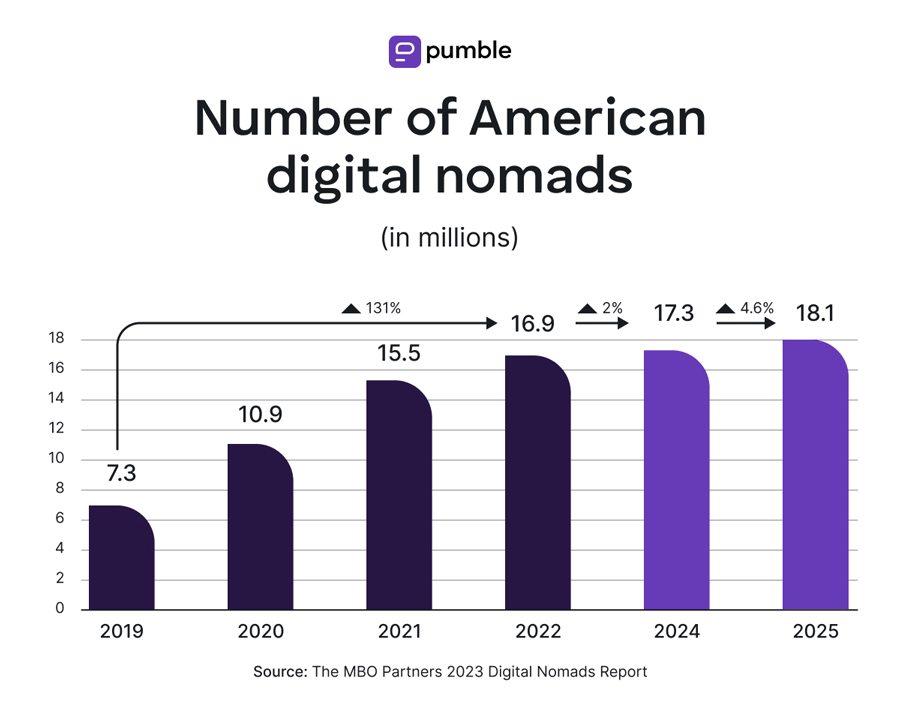
- Rapid Growth: The number of American digital nomads has increased dramatically from 7.3 million in 2019 to a projected 18.1 million in 2025, a 148% overall increase over six years.
- Pandemic Acceleration: The biggest surge occurred between 2019 and 2021, jumping 131% from 7.3 million to 15.5 million. This aligns with the rise of remote work during and after the COVID-19 pandemic.
- Continued but Slower Growth:
- 2021 → 2022: Increased from 15.5M to 16.9M, about 9% growth.
- 2022 → 2024: Growth slowed to 2% (to 17.3M).
- 2024 → 2025: Expected to rise by 4.6%, reaching 18.1M.
- Steady Expansion: Even after the initial boom, the trend shows consistent year-over-year increases, suggesting that location-independent work remains a strong lifestyle choice.
- Data Source: All figures are based on The MBO Partners 2023 Digital Nomads Report, visualized by Pumble.
Digital Nomad Demographics
- The average age of digital nomads globally in 2025 is around 36 years, with the majority falling between 25 and 40.
- Millennials (born 1981–1996) make up the largest group, accounting for nearly 47% of the global digital nomad population.
- Gen Z nomads (under 27 years old) now represent about 21%, showing rising adoption among younger professionals.
- Gen X (born 1965–1980) makes up approximately 23%, often combining established careers with newfound location freedom.
- Baby Boomers (born before 1965) account for about 6–9% of digital nomads, a steadily growing segment fueled by semi-retirement and remote consulting.
- Among U.S. digital nomads, the gender breakdown is roughly 56% male, 43% female, and 1% identifying as nonbinary or other.
- More than 90% of digital nomads have obtained higher education (bachelor’s degree or above), with over 30% holding advanced degrees (Master’s or PhD).
- The community is highly international, with nomads from North America, Western Europe, Australia, and Southeast Asia representing the majority, but South America and Africa are emerging.
- A significant portion (over 40%) are single and travel solo, while 33% are in relationships and 15% travel with families or children.
- Most nomads (around 70%) speak two or more languages, with English being the dominant working language across borders.
Age Distribution of Digital Nomads
- Nearly 47% of digital nomads are in their 30s (aged 30‑39) in 2025.
- Millennials constitute around 37% of the community; Gen Z and older generations make up the remainder.
- For many older participants (Gen X/Boomers), nomadism is becoming more feasible as remote-work norms settle.
- The average age of a digital nomad is reported at about 36 years globally.
- Younger nomads (under 30) increasingly adopt the lifestyle, which is shifting the age profile slightly downward.
- In the U.S., employees-turned-nomads tend to be slightly older than freelancers in the same lifestyle.
- Duration of nomadic life, about 24% have been nomads for more than 5 years, indicating long-term commitment.
Gender Breakdown of Digital Nomads
- In 2025, one survey reports 78% male and 22% female among digital nomads.
- Another source cites a gender split of 61% male and 39% female globally as of early 2024.
- Some earlier data indicated 56% male and 43% female, with 1% identifying as transgender in 2023.
- Female representation is growing gradually, but men continue to dominate, especially in tech-heavy nomad roles.
- Among female digital nomads in one 2025 report, “Women are more present in creative fields like marketing (16%) and blogging (8%)”.
- Safety, income opportunities, and remote work access are frequently referenced as factors influencing this gender gap.
- The disparity is most pronounced in high-earning nomad subsets (tech/engineering), where male dominance remains strong.
- While many sources show male dominance, one alternative estimate claimed near parity (50.2% male / 49.8% female), though it appears less current.
Educational Background of Digital Nomads
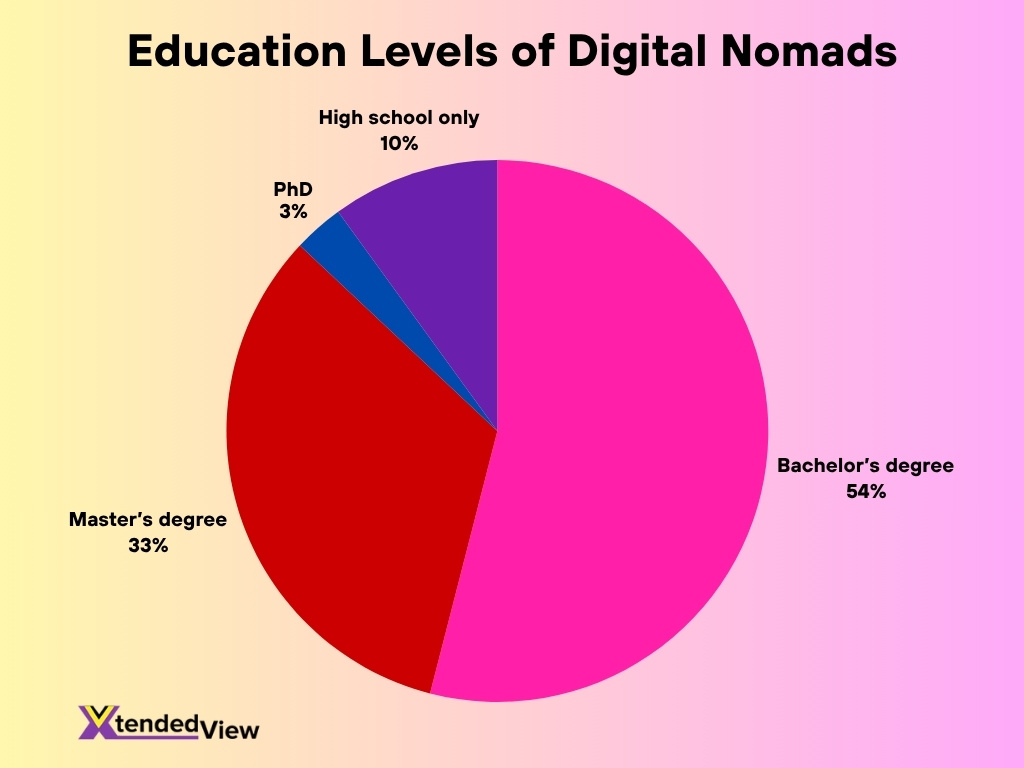
- About 90% of digital nomads report completing higher education (bachelor’s or above).
- Among them, 54% hold a bachelor’s degree, 33% a master’s degree, and 3% a PhD.
- Only around 10% of digital nomads have just a high-school diploma.
- One study stated that in 2024, 91% of nomads held higher education, with 54% bachelor’s, 34% master’s, and 3% PhD.
- Higher educational attainment correlates with higher earnings among nomads, according to several reports.
- The prevalence of educated nomads reflects how location-independent work often requires digital, professional, or service skills.
- Educational background may also influence destination choice, visa eligibility, and self-employment capacity among nomads.
- Given the high education levels, many nomads also take continuing online courses or certifications to maintain remote-friendly careers.
Popular Professions for Digital Nomads
- In 2025, the average annual income of digital nomads is reported at $124,000, with a median of around $85,000.
- A breakdown of income ranges, 35% earn $100,000–250,000, 34% earn $50,000–100,000, 6% earn under $25,000.
- Among main professions, software development (19%), creative services (14%), education (9%), sales/marketing/PR (9%).
- One source notes that in 2025, the average annual income range €58,000–€128,000 for nomads, with the highest earners in development, data analysis, and product management.
- Professions dominating among men tend to be IT/development (e.g., software dev, web dev), among women, more often marketing, creative, UI/UX design.
- Freelance writers, digital marketers, virtual tutors, and remote business consultants are among the growing non-tech nomad professions.
- Nomads increasingly hold full-time remote jobs for companies (not just freelancing) in sectors like product management, design, and analytics.
Types of Employment for Digital Nomads
- In 2025, about 56% of digital nomads hold traditional full-time employment with companies, while the remainder are freelancers, contractors, or business owners.
- One survey estimates that 69% of nomads earn between $50,000 and $250,000 per year, suggesting many hold stable remote roles.
- While self-employment remains significant, data show a rising share of company-employed nomads over the last few years.
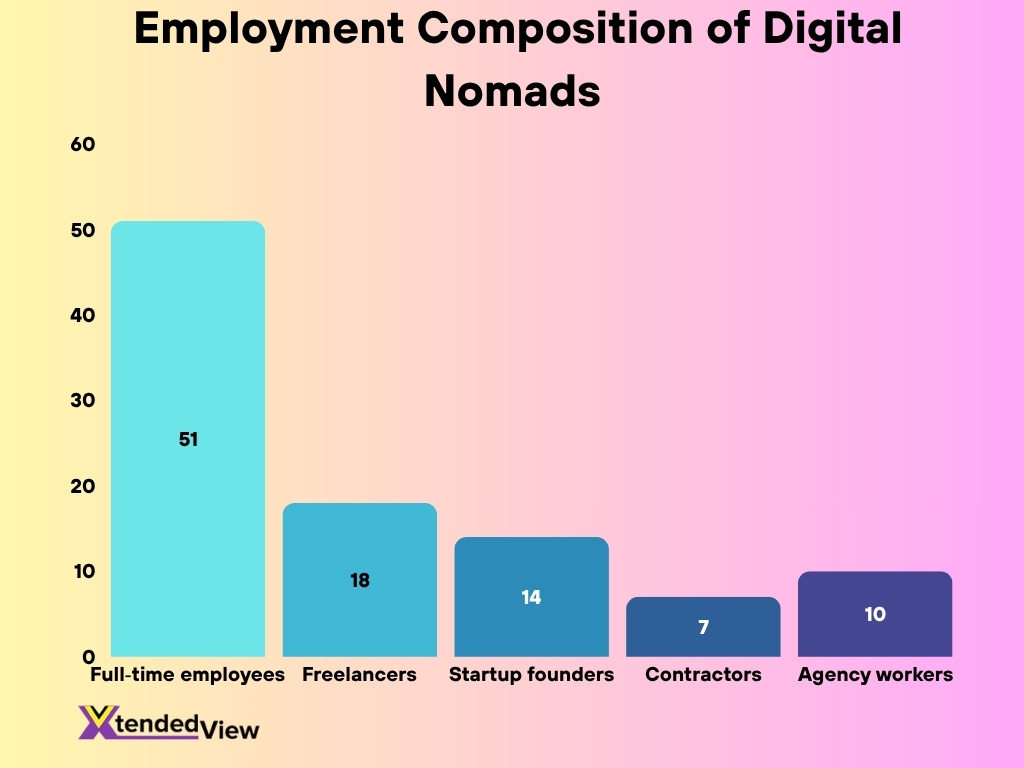
- In one 2025 study, 51% were full-time employees, 18% freelancers, 14% startup founders, 7% contractors, 10% agencies.
- A significant portion of nomads combine roles, e.g., remote employed + freelance side projects or business ownership.
- Company-employee nomads often benefit from employer-provided infrastructure (internet stipends, global mobility allowances), making nomadism more feasible.
- Employment type often correlates with location independence and security; freelancers may travel more freely, and employees may face time-zone or contract constraints.
- Employment type influences visa, tax, and legal considerations; employed nomads may leverage their employer’s global mobility program, whereas freelancers must manage all compliance themselves.
Digital Nomad Income Levels
- The global average income for digital nomads in 2025 is reported at about $123,762 per year, with $85,000 median.
- Income distribution: 34% earn $50,000–100,000, 35% earn $100,000–250,000, 8% earn $250,000–1 million, 2% earn over $1 million, 6% earn less than $25,000.
- In one report, about 79% of nomads earn more than $50,000 annually.
- Another note, 46% of nomads report household income of $75,000+ in certain markets.
- Nomads often leverage lower cost-of-living locations while earning higher income from higher-wage markets.
- A high income does not guarantee a standard of living; the cost of destination, travel frequency, and tax/legal setup all impact net outcomes.
- The nominal income figures suggest that for many nomads, the lifestyle is financially viable rather than a budget experiment.
Where Digital Nomads Work From
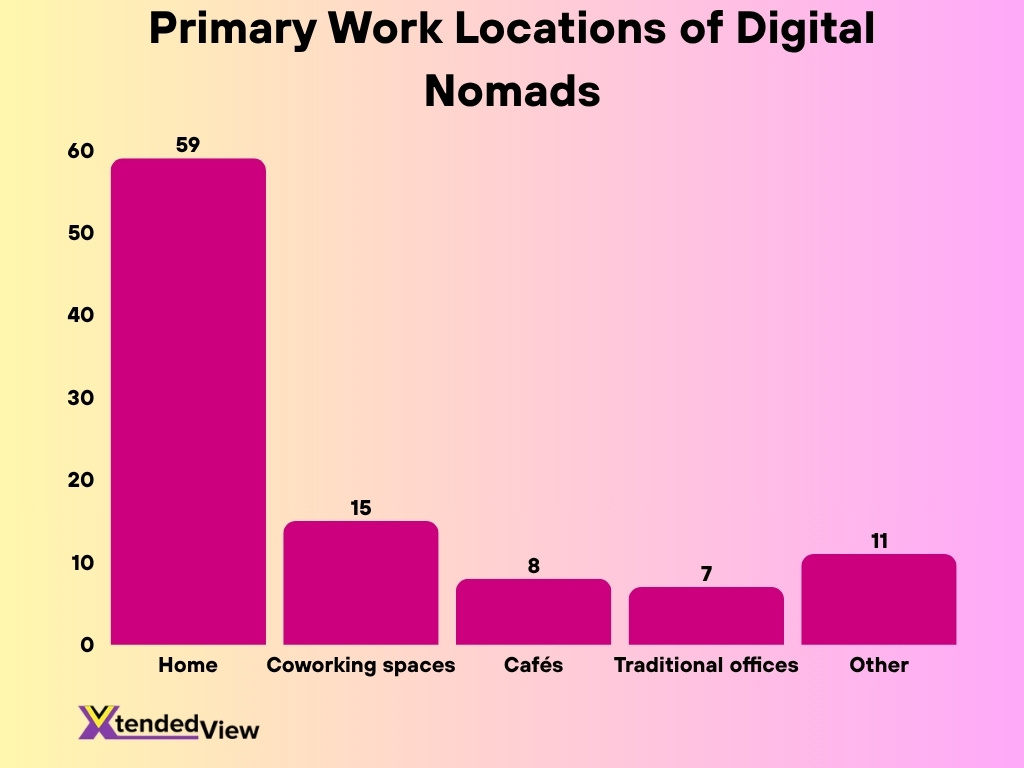
- As of 2025, 59% of digital nomads prefer working from home, rental or Airbnb accommodations rather than coworking spaces or cafés.
- Working from coworking spaces accounts for 15% of nomads, cafés 8%, traditional offices 7%, and other varied locations 11%.
- On average, 41% of nomads work full-time (40+ hrs/week), 37% work 30‑40 hrs/week, 17% work 10‑30 hrs/week, 5% less than 10 hrs/week.
- The stay-length trend, many nomads spend 2 months in one city on average, indicating a slower pace of movement.
- The shift toward “slow travel” means nomads select longer stays at fewer destinations, improving the stability of the work environment.
- Nomads often cite reliable internet, work-friendly accommodations, and time-zone alignment as key factors in deciding where to work from.
- Multiple sources show that while coworking and cafés remain part of the ecosystem, the predominant work location is private accommodation, underscoring mainstream acceptance of the lifestyle.
Best Digital Nomad Visa Programs
- Over 66 countries offered dedicated digital nomad visa (DNV) programs in 2025, reflecting global competition for remote-work talent.
- Approximately 91% of tracked nomad/remote-worker visas were launched after 2020, showing the rapid post-pandemic policy wave.
- Spain ranks first and the United Arab Emirates second among countries for nomad-friendly programs.
- Entry requirements vary significantly; for example, the Portugal D8 nomad visa requires proof of income of around €3,480/month for freelancers or remote employees.
- Some visas provide paths to longer stays or residency, e.g., certain Spanish and Portuguese programs allow renewal up to 5 years.
- Visa application costs differ; for instance, Spain’s nominal fee is about $70‑80, Estonia’s €80‑100, while other destinations charge more.
- With rising demand, some less traditional destinations are entering this space, e.g., Cyprus began offering a nomad visa in 2025 with an initial cap for non‑EU/UK citizens.
- These visa programs are reshaping migration, tourism, housing, and tax ecosystems as remote workers bring income, spend locally, and challenge regulatory norms.
Technology, Tools, and Remote Work Platforms
- Roughly 79% of digital nomads say their job depends on digital technology, versus about 56% for non-nomads.
- Around 59% of nomads prefer to work from a home office or long-stay rental, while coworking spaces account for about 15%, and cafés about 8% of primary work locations.
- A growing share of nomads report utilizing tools like Slack, Zoom, Notion, and Asana to coordinate remote work across time zones, one survey noted early-adopter status at 79%.
- Broadband stability, latency, and coworking infrastructure are increasingly cited as top criteria in destination decision-making.
- VPN usage among nomads is high due to data privacy and international connectivity needs.
- The trend toward “workation” (work + vacation) is rising; many platforms now provide extended stays designed for remote workers, combining productivity and travel.
- Employers adopting global remote talent are investing in monitoring and collaboration tools, which in turn gives nomads a wider choice of platforms and benefits.
Digital Nomad Lifestyle and Preferences
- About 57% of nomads say their work-life balance improved after adopting the lifestyle.
- Around 76% report higher overall life satisfaction since becoming nomads.
- However, 25‑33% say they have trouble completely unplugging outside work hours, pointing to hybrid work/time-zone stress.
- Approximately 26‑40% report feelings of loneliness or isolation at certain times, despite travel and flexibility.
- A strong majority (53%) say they prioritise lifestyle flexibility over higher pay, signalling a value shift in this segment.
- Nomads increasingly choose longer stays, 42% have been nomads for less than 1 year, 33% for 1–5 years, and 24% for 5+ years, showing increasing duration commitment.
- Housing preferences lean toward well-equipped long-stay rentals rather than transient hotel stays.
- Community amenities (meetups, coliving, coworking) are growing in importance as lifestyle enablers rather than pure travel tactics.
Work Habits and Hours of Digital Nomads
- One survey found 70% of digital nomads work 40 hours or less per week, suggesting flexibility rather than overwork.
- Breakdown: 41% work 40+ hrs/week, 37% work 30–40 hrs/week, 17% work 10–30 hrs/week, 5% less than 10 hrs/week.
- A significant portion of nomads maintain what appears to be full-time employment while being location independent.
- Time-zone alignment remains a key constraint; many nomads choose destinations ensuring workable overlap with home-based clients/employers.
- Travel rhythm impacts work hours; during relocation phases or high-travel times, many report working fewer hours or having interruptions vs settled stays.
- Some nomads adopt time-block schedules to manage work hours around local exploration.
- Employers increasingly expect outcome-based work rather than hours logged, aligning better with nomadic patterns of flexibility and asynchronous collaboration.
Housing and Homeownership Trends
- 54% of nomads reported owning a home, while 46% do not, suggesting a significant share maintain assets at home base even while mobile.
- Bookings for stays of 28+ nights nearly doubled post-pandemic for remote/nomad travelers in one U.S. rental study.
- Many digital nomads leverage geo-arbitrage, earning in stronger currencies (USD, EUR) while living in lower-cost regions.
- The rise of coliving and extended rental communities is becoming an alternative to traditional homeownership for many nomads.
- Some countries hosting nomads are experiencing local housing impacts.
- While owning property can anchor a nomad doorway home, many opt to lease or Airbnb to maintain flexibility.
- Legal/residency implications are evolving; some visa programs now require proof of housing or residence abroad.
Digital Nomad Trends and Future Outlook
- Forecasts indicate a 35%+ growth in the digital nomad population between 2022 and 2025.
- As remote work becomes more accepted, nomadism is shifting from niche to mainstream.
- The “slow-travel nomad” model is gaining traction.
- Challenges remain, including visa complexity, tax obligations, connectivity, healthcare, and isolation remain barriers.
- Technology improvements (5G, global coworking, travel infrastructure) are lowering the friction for location-independent decision-making.
- Countries and cities are increasingly competing for nomads as long-stay visitors and talent inflows.
- Environmental and sustainability considerations are emerging.
- The future may see hybrid models, semi-nomads who maintain a home base.
Frequently Asked Questions (FAQs)
Between 40 million and 60 million people globally.
Around 44% of digital nomads are from the United States.
Approximately 34% earn in that income range.
Roughly 90% hold higher‑education qualifications.
About 56% of digital nomads are male.
Conclusion
The landscape of digital nomadism reflects more than just a trend; it’s a significant shift in how and where people work. From over 60 countries offering dedicated nomad visa programs to fully remote professionals earning six-figure incomes while living abroad, the lifestyle has matured into a viable model for many. However, it isn’t without trade-offs; maintaining discipline, managing time zones, handling housing, tax, and community issues remain essential.
As companies adapt and countries compete for global talent, we’re likely to see further evolution in tools, infrastructure, and policy that will shape the next phase of remote, location-independent work.
