


Agile has evolved from a niche software development approach into a core business strategy that shapes how organizations operate in fast-moving markets. Today, companies use Agile not only to accelerate product development but also to improve collaboration, respond to customer feedback, and adapt to constant change. For example, technology firms rely on Agile to release software updates in shorter cycles, while marketing teams use it to test and optimize campaigns in real time.
As competition intensifies and customer expectations rise, Agile enables businesses to deliver value faster while maintaining flexibility. These statistics highlight how Agile continues to transform industries, improve outcomes, and drive innovation, inviting you to explore the full landscape of Agile adoption.
Editor’s Choice
- 97% of organizations now use Agile development methods in some form, signaling near-universal adoption.
- Agile projects show a 75% success rate, compared to 56% for traditional methods.
- 86% of teams have adopted Agile practices, reflecting steady growth across industries.
- 81% of Agile teams use Scrum or a Scrum hybrid approach.
- The Agile tools market is projected to reach $48.75 billion in 2025, with continued growth ahead.
- 65% of organizations now implement scaled Agile frameworks for large projects.
- 95% of professionals say Agile remains critical to their operations despite emerging trends like AI.
Recent Developments
- 74% of organizations now use hybrid Agile models, blending Agile with other frameworks.
- 42% of companies formally report using hybrid Agile-DevOps approaches.
- The Agile transformation market is expected to grow at a CAGR of 18.5% through 2029.
- 61% of companies use Agile to support both software delivery and digital transformation initiatives.
- 32% of Agile practitioners now link OKRs to epics for executive-level tracking.
- 94% of organizations report internal support for Agile marketing initiatives.
- 58% of business leaders prioritize Agile adoption as a strategic initiative.
- Agile focus is shifting from speed to business value delivery, reflecting evolving priorities.
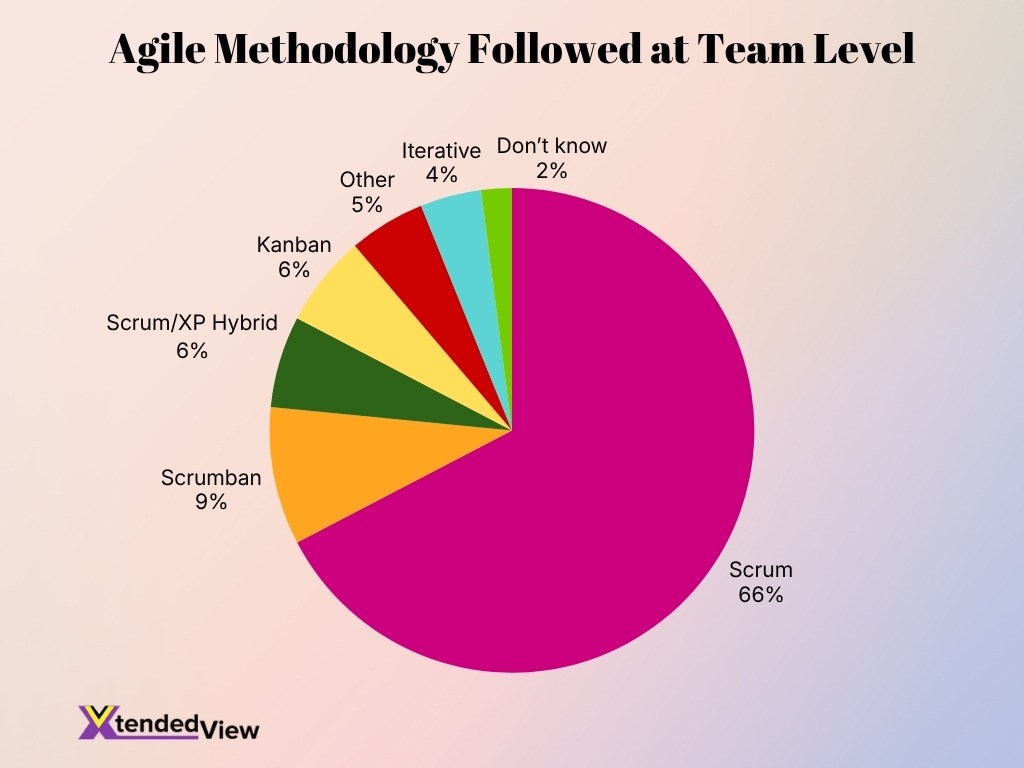
Agile Methodology Adoption at the Team Level
- Scrum dominates adoption, with a massive 66% of teams following it, making it the clear industry standard.
- Scrumban ranks second at 9%, showing a growing preference for hybrid flexibility between Scrum and Kanban.
- Both Scrum/XP Hybrid and Kanban hold 6% each, indicating moderate adoption of specialized or workflow-focused approaches.
- Only 5% of teams use other methodologies, suggesting limited experimentation beyond mainstream frameworks.
- Iterative approaches account for just 4%, highlighting a decline in traditional iterative models compared to Agile frameworks.
- A small 2% of respondents are unsure, reflecting a minimal lack of awareness about Agile practices.
- The data shows a strong concentration toward Scrum (66%), with all other methodologies collectively making up just 34%.
- There is a clear gap of 57 percentage points between Scrum and the next closest methodology (Scrumban at 9%).
- Hybrid models (Scrumban + Scrum/XP) together account for 15%, signaling a trend toward customization of Agile practices.
- Overall, the ecosystem is highly Scrum-centric, with alternative frameworks playing a supporting but niche role.
Global Agile Adoption Statistics
- Around 97% of global organizations report using Agile in some capacity.
- 71% of organizations use Agile in their software development lifecycle.
- 24.6% of companies formally use Agile project management practices.
- Hybrid adoption continues to rise, with 31.5% of companies combining Agile and traditional methods.
- 73% of organizations plan to increase hybrid project management usage over the next five years.
- Agile adoption spans industries, with 90% of organizations undergoing digital transformation tied to Agile practices.
- 86% of teams globally now operate using Agile frameworks.
- Only 18% of organizations have fully implemented Agile across all teams, indicating ongoing maturity gaps.
- 50% of organizations report that less than half of their teams are fully Agile.
Agile at Scale and Framework Adoption Statistics
- 65% of organizations implement Agile at scale across multiple teams.
- SAFe (Scaled Agile Framework) is used by 35% of enterprises, making it the most popular scaling framework.
- 25% of organizations use custom scaling frameworks tailored to their needs.
- Large enterprises report 2x higher adoption of scaling frameworks compared to small businesses.
- 49% of organizations struggle with scaling Agile effectively across departments.
- Agile at scale improves cross-team collaboration by over 35%.
- 58% of enterprises say scaling Agile improves delivery consistency.
- Multi-team Agile environments report 20% higher productivity gains compared to single-team Agile setups.
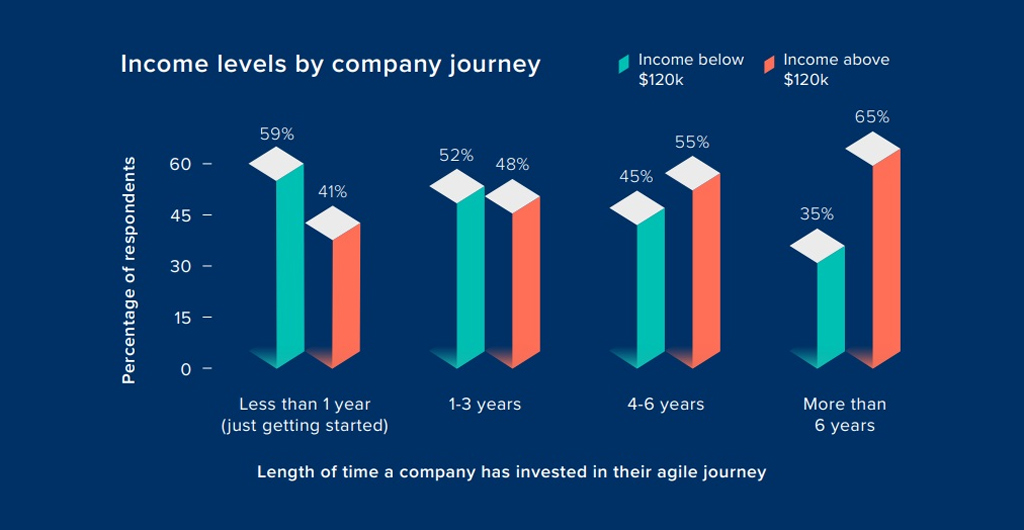
Income Growth Trends Across Agile Journey
- Companies in the early stage (less than 1 year) show a majority of respondents earning below $120k (59%), compared to 41% above $120k.
- As organizations move into the 1–3 years stage, income distribution becomes more balanced, with 52% below $120k and 48% above $120k.
- In the 4–6 years phase, a noticeable shift occurs, with higher-income respondents (55%) surpassing lower-income groups (45%).
- Companies with more than 6 years of agile experience show the strongest results, where 65% earn above $120k, while only 35% remain below $120k.
- The data highlights a clear positive correlation between agile maturity and higher income levels.
- There is a 24 percentage point increase in high-income respondents, rising from 41% (early stage) to 65% (6+ years).
- Conversely, lower-income representation declines significantly by 24 percentage points, dropping from 59% to 35% over time.
- The turning point occurs between 3–6 years, where higher income begins to dominate.
- Long-term agile adoption is strongly associated with improved financial outcomes and revenue growth potential.
- Overall, the data suggest that sustained investment in agile practices leads to measurable economic benefits.
Agile vs Traditional Project Management Statistics
- Agile projects achieve a 75% success rate, compared to 56% for traditional methods.
- 64% of Agile projects meet their goals versus 49% in traditional project management.
- Traditional waterfall projects fail twice as often as Agile initiatives.
- Agile teams are 28% more successful in delivering on time than traditional teams.
- 71% of organizations say Agile improves project visibility compared to traditional models.
- Agile projects are 2x more likely to meet business objectives than waterfall projects.
- 60% of companies report better alignment with business goals using Agile.
- Traditional methods still dominate in regulated industries, with over 40% hybrid adoption.
Agile Project Success and Failure Rates
- Agile projects have a 75% success rate, while only 16% of projects fail completely.
- 58% of organizations report higher project success after adopting Agile.
- Agile projects are 3x less likely to fail compared to waterfall projects.
- 11% of Agile projects are considered failures, compared to 29% for traditional methods.
- 42% of companies say Agile improved project predictability.
- Projects using Agile report higher stakeholder satisfaction rates by 30%+.
- 52% of Agile teams consistently deliver projects on time and within scope.
- Agile adoption reduces project risk by over 20%, especially in complex environments.
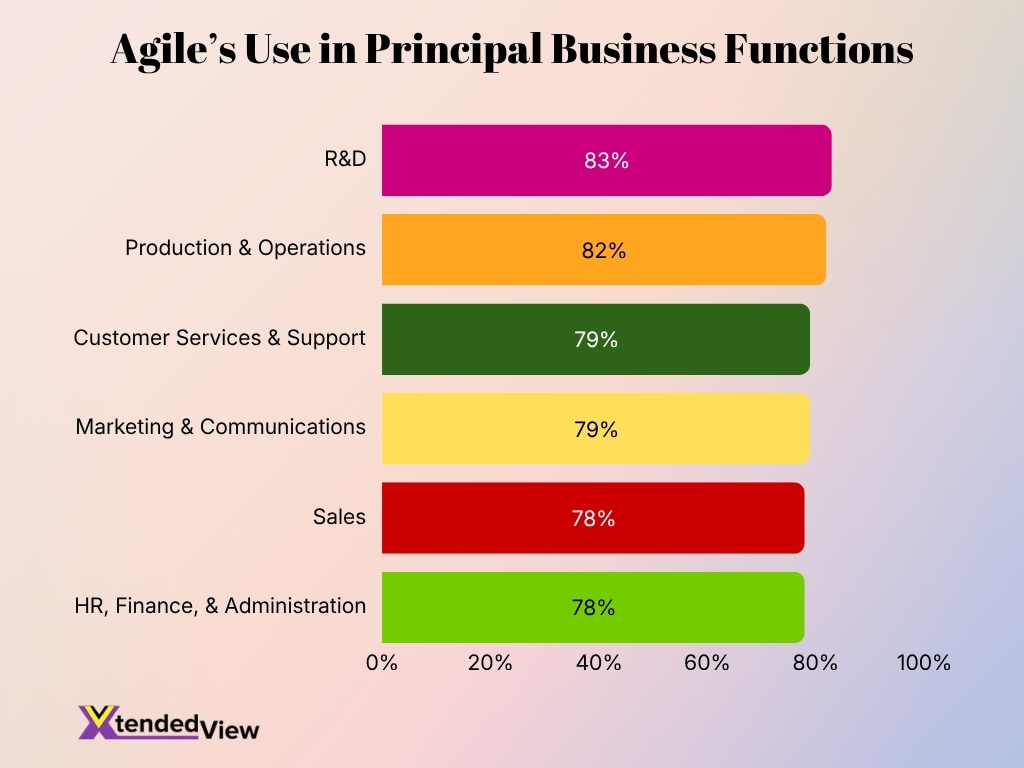
Agile Adoption Across Key Business Functions
- R&D leads Agile adoption with 83% of respondents using Agile, making it the most Agile-driven function in organizations.
- Production & Operations closely follows at 82%, highlighting Agile’s strong role in improving efficiency and process optimization.
- Customer Services & Support shows high adoption at 79%, indicating Agile’s impact on enhancing customer experience and responsiveness.
- Marketing & Communications also records 79%, reflecting Agile’s growing importance in campaign flexibility and faster go-to-market strategies.
- Sales teams adopt Agile at 78%, demonstrating its value in improving pipeline management and deal velocity.
- HR, Finance, & Administration report 78% adoption, showing Agile is expanding beyond core technical teams into back-office functions.
- The adoption gap across all functions is minimal, ranging from 78% to 83%, suggesting widespread enterprise-level Agile integration.
- Over 4 out of 5 functions have nearly 80%+ adoption, reinforcing Agile as a standard operating model across departments.
- The data indicates Agile is no longer limited to IT or development but is now a cross-functional business strategy.
Time-to-Market and Delivery Speed Statistics
- Agile teams reduce time-to-market by 37% on average.
- 87% of organizations say Agile improves their ability to respond to market changes quickly.
- Companies using Agile report 20% to 50% faster product delivery cycles.
- Agile adoption enables shorter release cycles, often reducing release time from months to weeks.
- 63% of teams release products more frequently after adopting Agile.
- Continuous delivery practices tied to Agile reduce deployment time by up to 60%.
- Agile teams complete tasks 25% faster than traditional teams on average.
- 49% of companies cite faster time-to-market as the top benefit of Agile.
Product Quality and Defect Reduction Statistics
- Agile practices reduce product defects by up to 40% compared to traditional methods.
- 61% of organizations report improved software quality after Agile adoption.
- Continuous testing in Agile reduces bug-fixing costs by over 30%.
- 52% of Agile teams report fewer critical defects in production releases.
- Agile teams detect defects earlier, reducing rework by 25% or more.
- 48% of organizations say Agile improves product reliability significantly.
- Iterative development cycles reduce defect leakage rates by 35%.
- Agile teams using automated testing see 50% faster bug resolution times.
Agile Effectiveness Across Organization Sizes
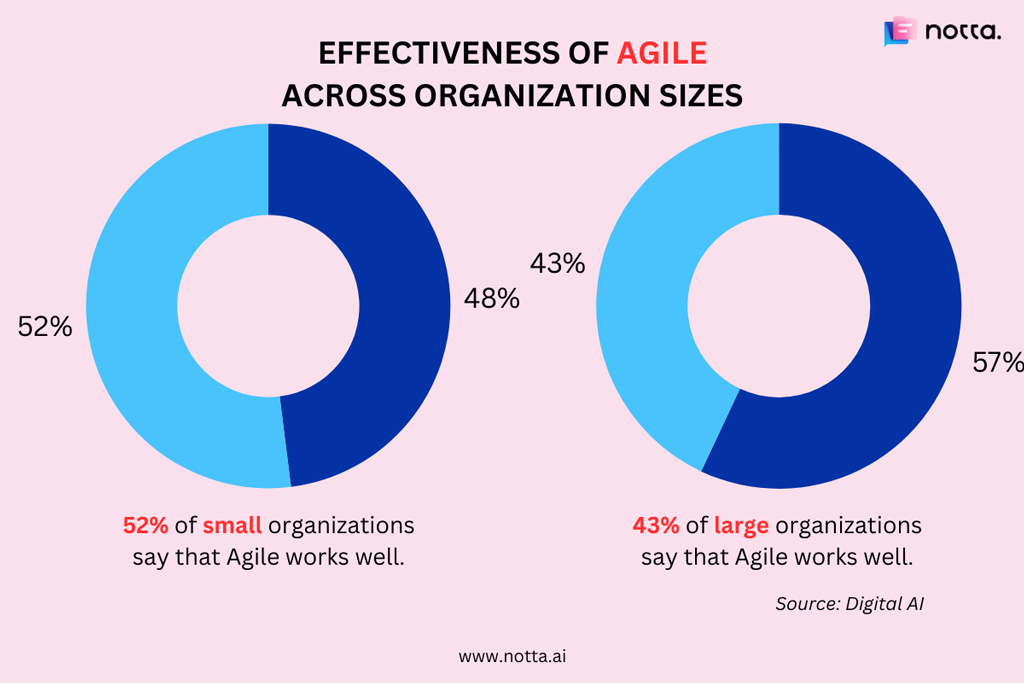
- 52% of small organizations report that Agile works well, indicating a majority positive sentiment among smaller teams.
- In contrast, 48% of small organizations feel Agile does not work well, showing a fairly balanced split in effectiveness.
- Only 43% of large organizations say Agile works well, highlighting lower success rates compared to smaller companies.
- A higher 57% of large organizations report that Agile does not work well, suggesting significant challenges at scale.
- There is a 9 percentage point gap between small (52%) and large (43%) organizations in Agile success perception.
- Larger organizations are more likely to struggle with Agile adoption, possibly due to complex structures, hierarchy, and scaling issues.
- Smaller organizations tend to experience better Agile outcomes, likely because of greater flexibility, faster decision-making, and leaner teams.
- The data indicates that organizational size directly impacts Agile effectiveness, making scaling Agile frameworks a critical factor for enterprise success.
Customer Satisfaction and NPS Statistics
- 80% of Agile projects report higher customer satisfaction compared to traditional methods.
- Agile-driven organizations see a 30% increase in Net Promoter Score (NPS) on average.
- 63% of customers prefer companies that release updates frequently through Agile cycles.
- Agile teams incorporating customer feedback loops improve satisfaction by 25% or more.
- 71% of organizations report better alignment with customer needs using Agile practices.
- Agile product teams see 20% higher user retention rates due to continuous improvements.
- 68% of companies say Agile improves customer experience delivery.
- Frequent releases enabled by Agile increase customer trust and engagement by over 35%.
Employee Engagement and Job Satisfaction Statistics
- 84% of Agile team members report higher job satisfaction compared to traditional teams.
- Agile environments improve employee engagement by up to 30%.
- 59% of Agile practitioners say they feel more empowered in decision-making roles.
- Teams practicing Agile report better work-life balance due to iterative planning cycles.
- 70% of Agile employees feel their contributions are more visible and valued.
- Agile teams show higher retention rates, reducing turnover by approximately 15%.
- 62% of employees say Agile improves transparency and trust within teams.
- Cross-functional Agile teams increase employee skill development opportunities by 40%.
Agile Usage by Industry
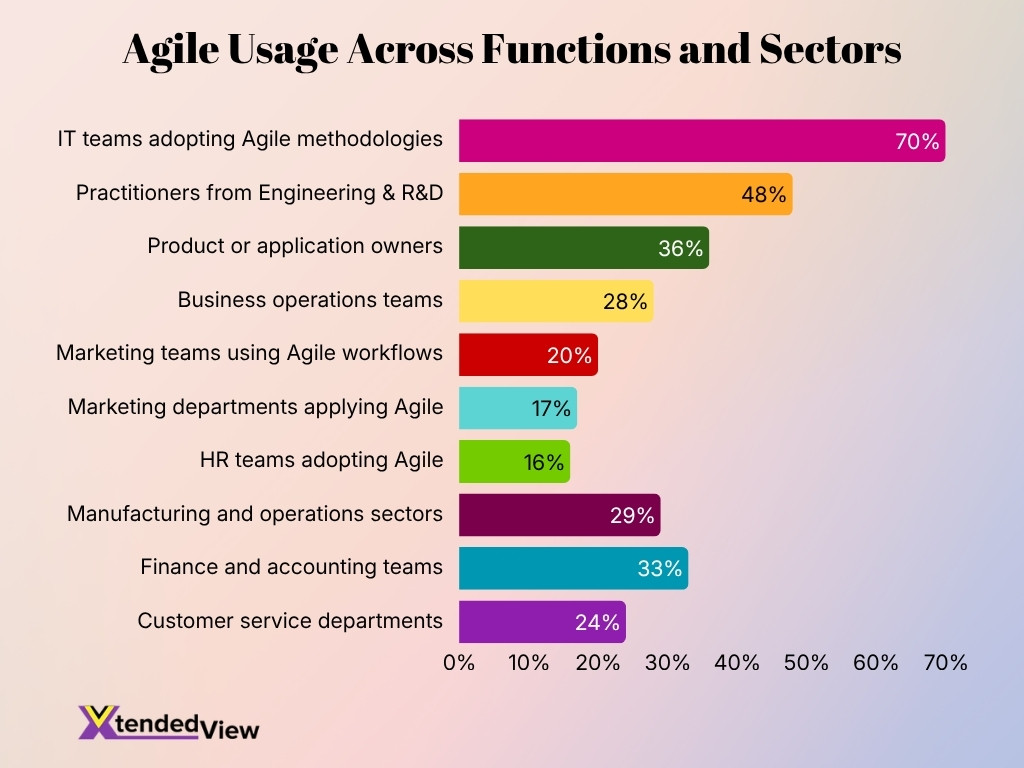
- 70% of IT teams have adopted Agile methodologies.
- 48% of Agile practitioners come from Engineering and R&D teams, the largest share.
- 36% of Agile users are product or application owners.
- 28% of business operations teams have implemented Agile practices.
- 20% of marketing teams currently use Agile workflows.
- 17% of marketing departments actively apply Agile frameworks.
- 16% of HR teams have adopted Agile, showing steady expansion beyond tech.
- 29% of manufacturing and operations sectors use Agile, reflecting industrial growth.
- 33% of finance and accounting teams report partial Agile implementation.
- 24% of customer service departments utilize Agile for faster response cycles.
Business Value and ROI from Agile
- 60% of organizations report increased revenue after adopting Agile.
- Agile adoption improves ROI by 20% to 30% across projects.
- 55% of executives cite improved business alignment as a key benefit of Agile.
- Agile reduces operational costs by 15% to 25% due to efficiency gains.
- Organizations using Agile report higher project profitability rates by 25%.
- 64% of companies say Agile helps prioritize high-value features more effectively.
- Agile-driven businesses experience faster revenue realization cycles, often within months instead of years.
- 47% of organizations report measurable improvements in financial performance after Agile adoption.
Agile in Digital Transformation Initiatives
- 90% of digital transformation initiatives leverage Agile methodologies.
- 61% of organizations use Agile to drive digital transformation projects.
- Agile-based transformations increase the success rates of digital initiatives by over 30%.
- 70% of CIOs consider Agile essential for digital transformation strategies.
- Agile enables faster adoption of emerging technologies like AI and cloud, with 50% quicker implementation timelines.
- Organizations using Agile in transformation projects see improved innovation rates by 40%.
- 66% of enterprises say Agile enhances adaptability during digital change initiatives.
- Agile-driven transformations reduce failure rates in digital programs by over 25%.
Challenges and Barriers in Agile Adoption
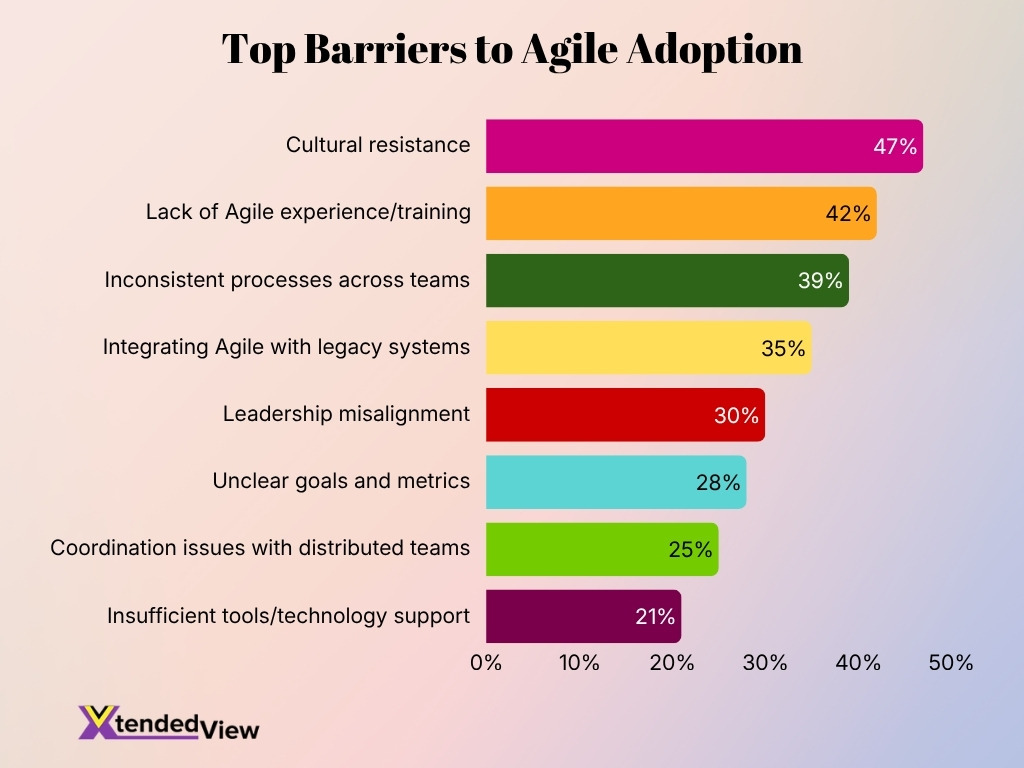
- 47% of organizations cite cultural resistance as the biggest barrier to Agile adoption.
- 42% of teams struggle with a lack of Agile experience or training.
- 39% of organizations report inconsistent processes across teams as a major issue.
- 35% of companies face challenges integrating Agile with legacy systems.
- Leadership misalignment affects 30% of Agile transformations.
- 28% of teams cite unclear goals and metrics as a barrier to Agile success.
- Distributed teams create coordination challenges for 25% of Agile organizations.
- 21% of companies report insufficient tools or technology support as a limiting factor.
Future Outlook for Agile Adoption
- The Agile market is expected to grow at a CAGR of 18%+ through 2030.
- 78% of organizations plan to expand Agile adoption beyond IT into business functions.
- Agile combined with AI-driven tools is projected to increase productivity by up to 40%.
- 65% of companies will adopt hybrid Agile models as the default approach.
- Agile adoption in non-IT departments is expected to grow by over 25% by 2027.
- 72% of executives believe Agile will remain central to business strategy.
- Cloud and DevOps integration with Agile will drive faster deployment cycles by 50%+.
- Agile maturity models will become more standardized, improving adoption success rates globally.
Frequently Asked Questions (FAQs)
Around 97% of organizations use Agile methodologies in some capacity.
Agile projects have a 75% success rate, compared to 56% for traditional approaches.
Approximately 81% to 87% of Agile teams use Scrum or Scrum-based frameworks.
The Agile software market is expected to reach $14.7 billion by 2032, growing at a 13.9% CAGR.
About 74% of organizations now use hybrid or blended Agile approaches.
Conclusion
Agile has firmly established itself as a foundational approach for organizations seeking speed, adaptability, and continuous improvement. The data across adoption, performance, and business impact shows clear advantages, including faster time-to-market, improved product quality, stronger customer satisfaction, and better alignment with strategic goals. At the same time, challenges such as cultural resistance, scaling complexities, and skill gaps remind organizations that successful Agile adoption requires more than just processes; it demands a shift in mindset and leadership.
Looking ahead, the integration of Agile with emerging technologies like AI, cloud computing, and DevOps will further strengthen its role in modern business operations. Organizations that invest in refining their Agile practices today will be better positioned to innovate, compete, and grow in an increasingly dynamic environment.
