


AMD enters the year with record revenue, rapidly expanding data center sales, and a broader role in AI infrastructure. Its chips now support real-world workloads ranging from hyperscale AI model training and cloud computing to enterprise PCs, gaming systems and embedded industrial applications. In particular, large AI deployments and rising EPYC server adoption show how AMD has moved beyond the traditional PC processor market. Explore the statistics below for a clearer view of AMD’s latest financial momentum.
AMD generated $34.64 billion in revenue during 2025, up 34% from $25.79 billion in 2024. In Q1 2026, AMD revenue reached $10.25 billion, representing 38% year-over-year growth from $7.44 billion. Q2 2026 revenue climbed to a record $11.54 billion, up 50% from $7.69 billion in Q2 2025. AMD generated $21.79 billion during the first six months of 2026, compared with $15.12 billion during the same period of 2025, an increase of roughly 44%.
Data Center revenue reached $6.72 billion in Q2 2026, more than double the $3.24 billion recorded one year earlier. AMD’s processors and accelerators serve large-scale AI infrastructure, while Ryzen processors support consumer and enterprise PCs; these are two major real-world applications driving current demand. AMD expects Q3 2026 revenue of approximately $13 billion, plus or minus $300 million, which would represent about 41% year-over-year growth at the midpoint.
Editor’s Choice
- AMD recorded $11.54 billion in Q2 2026 revenue, its highest quarterly revenue reported through August 2026 and 50% more than a year earlier.
- Data Center revenue increased 107% year over year to $6.72 billion in Q2 2026, making it AMD’s largest business area during the quarter.
- Data Center represented approximately 58% of company revenue in Q2 2026, highlighting the growing weight of AI accelerators and EPYC server CPUs in AMD’s sales mix.
- AMD’s GAAP net income reached $2.30 billion in Q2 2026, up 163% from $872 million in Q2 2025.
- Q2 2026 diluted GAAP EPS climbed to $1.38, compared with $0.54 in the prior-year quarter.
- Full-year 2025 Data Center revenue reached $16.64 billion, up 32% from $12.58 billion in 2024.
- AMD’s 2025 net income increased 164% to $4.34 billion, while diluted EPS rose 165% to $2.65.
- AMD and Meta agreed to deploy up to 6 gigawatts of AMD Instinct GPUs, with first-gigawatt shipments scheduled to begin in the second half of 2026.
- AMD’s earlier agreement with OpenAI also covers 6 gigawatts of GPU deployments, starting with 1 gigawatt of MI450 Series infrastructure in the second half of 2026.
- AMD projects its addressable market across AI, data center, PC and embedded computing to reach roughly $2 trillion by 2030.
Recent Developments
- In July 2026, AMD launched its Instinct MI400 Series GPUs, expanding its accelerator lineup for generative AI and high-performance computing.
- AMD also introduced 6th Gen EPYC processors in July 2026 as part of its next-generation data center platform portfolio.
- The company launched AMD Helios, its first rack-scale AI platform, and said the system can deliver up to 30% more inference tokens per dollar than competing infrastructure under its stated comparison.
- AMD’s Meta partnership calls for up to 6 gigawatts of Instinct GPU capacity across multiple product generations, with the first deployment built around a custom MI450-based GPU.
- Meta’s first 1-gigawatt deployment will also use 6th Gen EPYC CPUs, the Helios rack-scale architecture and ROCm software.
- AMD issued Meta a performance-based warrant covering up to 160 million AMD shares, with vesting tied to deployment, shipment and performance milestones.
- AMD’s OpenAI agreement likewise includes a warrant for up to 160 million shares, with tranches linked to deployment scale and commercial milestones.
- The first OpenAI deployment will involve 1 gigawatt of Instinct MI450 Series GPUs and is scheduled to begin during the second half of 2026.
- In Q1 2026, AMD also expanded its Ryzen AI portfolio, including new enterprise-focused processors and embedded AI products aimed at PCs, industrial systems and edge computing.
- AMD entered the second half of 2026 expecting Data Center sales to accelerate further, following the segment’s 107% Q2 year-over-year revenue increase.
AMD Revenue Growth and Forecast Statistics
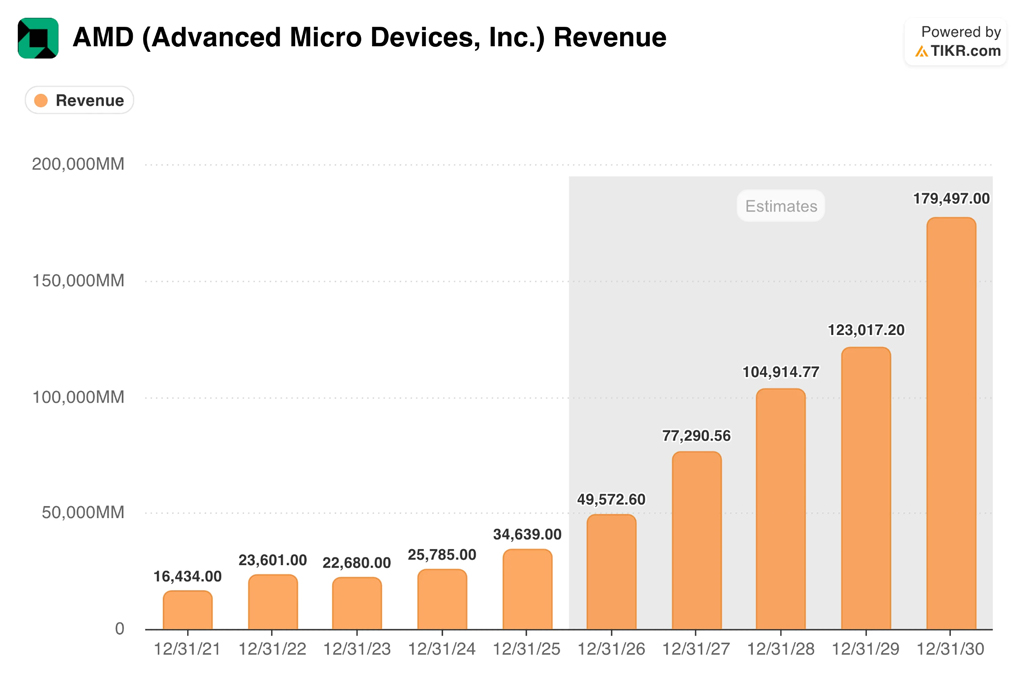
- AMD’s revenue increased from $16.43 billion in 2021 to $34.64 billion in 2025, representing growth of more than 110% over four years.
- Revenue climbed sharply to $23.60 billion in 2022, before declining slightly to $22.68 billion in 2023.
- AMD returned to growth in 2024, generating $25.79 billion, followed by a substantial increase to $34.64 billion in 2025.
- Revenue is estimated to reach approximately $49.57 billion in 2026, about 43% higher than the 2025 figure.
- AMD’s revenue is projected to jump to $77.29 billion in 2027, representing roughly 56% year-over-year growth.
- By 2028, AMD could surpass the $100 billion annual revenue milestone, with estimated revenue of $104.91 billion.
- Revenue is forecast to rise further to $123.02 billion in 2029, an increase of about 17% from 2028.
- By 2030, AMD’s annual revenue is projected to reach approximately $179.50 billion, more than 5 times its 2025 revenue.
- Overall, the estimates suggest AMD could add nearly $145 billion in annual revenue between 2025 and 2030, indicating a dramatic expansion in its revenue base.
AMD Revenue Breakdown by Business Segment
- Data Center revenue totaled $16.64 billion in 2025, accounting for roughly 48% of AMD’s $34.64 billion annual revenue.
- Client and Gaming generated $14.55 billion in 2025, up 51% from $9.65 billion in 2024.
- Within that segment, Client revenue reached $10.64 billion in 2025, compared with $7.05 billion during 2024.
- Gaming revenue totaled $3.91 billion in 2025, representing 51% growth from $2.60 billion in 2024.
- Embedded revenue came to $3.45 billion in 2025, down about 3% from $3.56 billion in 2024.
- In Q2 2026, Data Center contributed $6.72 billion, compared with $3.84 billion from Client and Gaming and $977 million from Embedded.
- Q2 2026 Client revenue increased to $3.06 billion from $2.50 billion one year earlier, a rise of approximately 23%.
- Gaming revenue moved in the opposite direction, declining 31% year over year to $779 million in Q2 2026 as semi-custom revenue decreased.
- Embedded revenue increased approximately 19% year over year to $977 million in Q2 2026 from $824 million.
- During the first six months of 2026, Data Center generated $12.49 billion, Client and Gaming produced $7.45 billion, and Embedded contributed $1.85 billion.
AMD Quarterly Earnings and EPS Statistics
- Q2 2026 GAAP diluted EPS reached $1.38, a 156% increase from $0.54 in Q2 2025.
- Non-GAAP diluted EPS came to $1.66 in Q2 2026, compared with $0.48 one year earlier.
- Q1 2026 GAAP diluted EPS was $0.84, while non-GAAP diluted EPS reached $1.37.
- Q1 non-GAAP EPS increased 43% year over year, from $0.96 in Q1 2025 to $1.37 in Q1 2026.
- Sequentially, Q2 2026 GAAP diluted EPS rose 64% from $0.84 in Q1 to $1.38.
- Q2 non-GAAP diluted EPS increased 21% sequentially, from $1.37 to $1.66.
- GAAP net income rose from $1.38 billion in Q1 2026 to $2.30 billion in Q2, a sequential increase of roughly 66%.
- Non-GAAP Q2 net income reached $2.76 billion, up 253% from $781 million in Q2 2025.
- AMD’s full-year diluted EPS reached $2.65 in 2025, representing approximately 165% growth from the previous year.
- Q2 2026 operating income increased to $1.99 billion GAAP and $3.09 billion non-GAAP, reflecting stronger revenue and Data Center profitability.
AMD Gross Margin and Profitability Trends
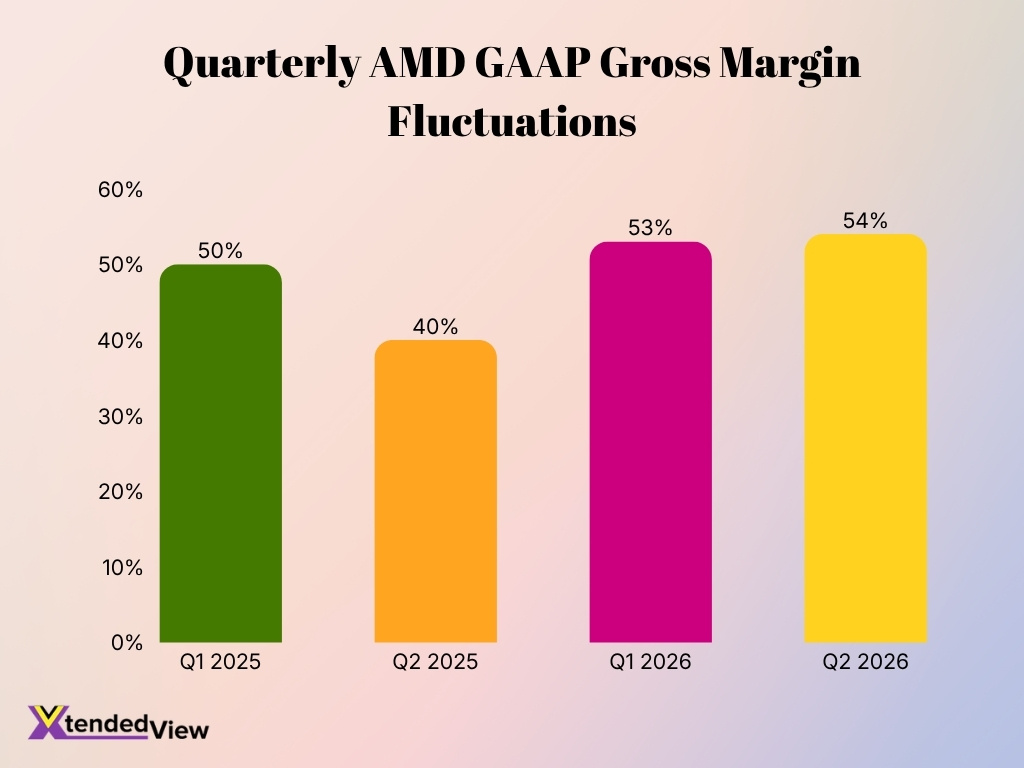
- AMD’s annual GAAP gross margin increased to 50% in 2025, compared with 49% in 2024.
- The 2025 gross margin included approximately $440 million in net inventory and related charges associated with export controls affecting Instinct MI308 products.
- Q1 2026 GAAP gross margin improved to 53%, up from 50% in Q1 2025.
- Q1 2026 non-GAAP gross margin reached 55%, compared with approximately 54% in the prior-year quarter.
- Q2 2026 GAAP gross margin rose sharply to 54%, compared with 40% in Q2 2025.
- The unusually low Q2 2025 comparison reflected $800 million in inventory and related charges tied to U.S. export controls on MI308 accelerators.
- Q2 2026 non-GAAP gross margin reached 56%, up 13 percentage points from 43% in Q2 2025.
- Q2 2026 Data Center operating income reached $2.10 billion, reversing a $155 million segment operating loss recorded a year earlier.
- For the first six months of 2026, AMD generated $3.47 billion in GAAP operating income, compared with $672 million during the first half of 2025.
- AMD expects its Q3 2026 non-GAAP gross margin to remain around 56%, suggesting that the stronger profitability profile seen in Q2 could continue into the next quarter.
AMD Market Share in CPU Industry
- AMD captured 30% of worldwide x86 CPU unit shipments in Q1 2026, up 5.6 percentage points year-over-year.
- AMD’s overall x86 CPU revenue share reached 38.1% in Q1 2026, outpacing its total unit share.
- AMD held a record 29.2% of x86 CPU unit shipments at the close of 2025.
- AMD’s total x86 CPU revenue share stood at 35.4% in Q4 2025.
- AMD gained 2.7 percentage points in x86 revenue share between Q4 2025 and Q1 2026.
- Client processor revenue reached $10.6 billion in 2025, climbing 51% from $7.1 billion in 2024.
- Ryzen unit shipments grew 15% in 2025, alongside a 31% increase in average selling prices.
- Client processor revenue generated $3.06 billion in Q2 2026, marking a 23% year-over-year increase.
AMD Desktop and Laptop Processor Market Share
- AMD held 33.2% of desktop x86 CPU unit shipments in Q1 2026, compared with 28% a year earlier.
- Desktop CPU revenue share reached 37.6% in Q1 2026, meaning AMD earned a larger portion of desktop processor revenue than its unit share alone suggested.
- AMD had finished Q4 2025 with 36.4% desktop CPU unit share, so its Q1 2026 share declined 3.2 percentage points sequentially despite remaining higher year over year.
- Desktop CPU revenue share reached 42.6% in Q4 2025, compared with only 28% approximately one year earlier.
- AMD’s mobile CPU unit share climbed to a record 28.3% in Q1 2026, strengthening its position in notebooks and other mobile PCs.
- Mobile CPU revenue share reached 28.9% in Q1 2026, slightly exceeding AMD’s mobile unit share.
- AMD had held 26% of mobile CPU units in Q4 2025, meaning its share increased by 2.3 percentage points in only one quarter.
- AMD generated a record $3.1 billion in client revenue during Q2 2026, helped by record mobile processor revenue and continued Ryzen market-share gains.
- Client processor unit shipments increased roughly 29% year over year in Q2 2026, even as product mix shifted toward mobile and lower-priced models.
AMD Data Center Revenue Growth Statistics
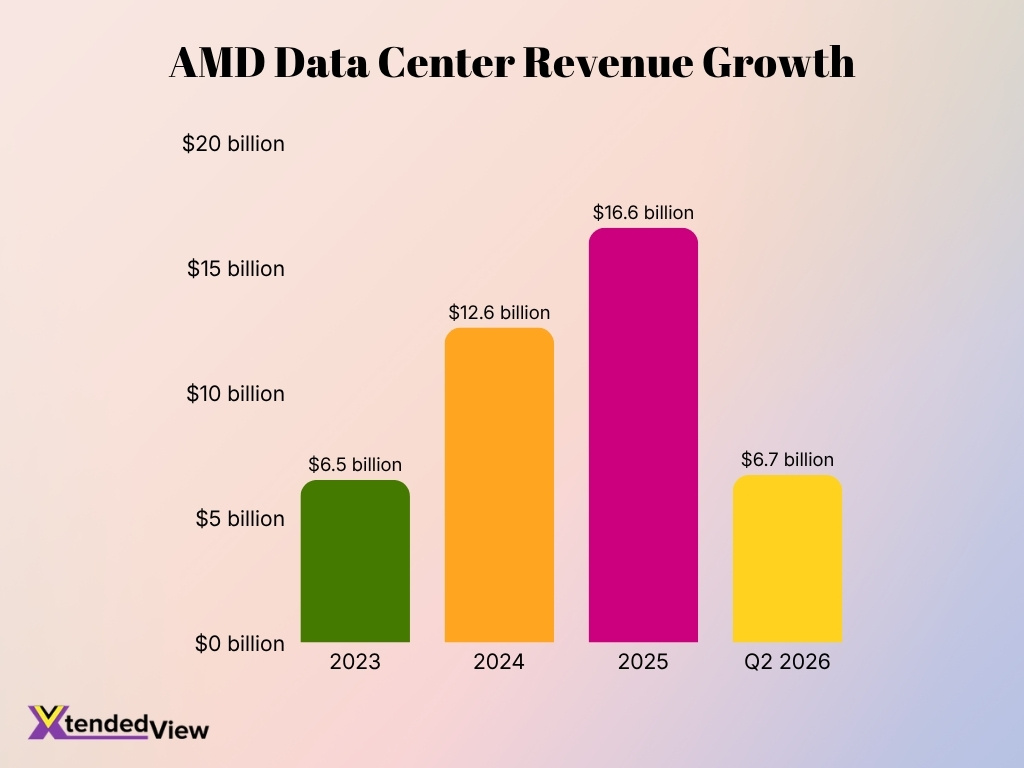
- AMD’s data center revenue increased from $6.5 billion in 2023 to $12.6 billion in 2024, representing a substantial 93.8% year-over-year increase.
- In 2025, AMD’s data center business generated $16.6 billion, up approximately 31.7% compared with the previous year.
- Between 2023 and 2025, AMD’s annual data center revenue expanded by more than 155%, adding roughly $10.1 billion in revenue within two years.
- AMD reported $6.7 billion in data center revenue in Q2 2026 alone, already exceeding the company’s entire $6.5 billion data center revenue in 2023.
- The figures highlight the rapid expansion of AMD’s data center business, with revenue rising from $6.5 billion in 2023 to a quarterly level of $6.7 billion by Q2 2026.
AMD Server CPU Revenue Share
- AMD reached a record 46.2% of x86 server CPU revenue in Q1 2026, its strongest reported position in the server processor market.
- AMD’s server CPU unit share reached 33.2% in Q1 2026, meaning roughly one in three x86 server processors shipped during the quarter came from AMD.
- Server revenue share increased 4.9 percentage points quarter over quarter, from 41.3% at the end of 2025.
- On a year-over-year basis, AMD added 6.8 percentage points of server CPU revenue share by Q1 2026.
- AMD’s Q4 2025 server unit share stood at 28.8%, up from 25.7% one year earlier.
- The gap between AMD’s Q1 2026 server revenue share and unit share was 13 percentage points, reflecting a richer EPYC product mix and stronger average selling values.
- Intel retained approximately 66.8% of x86 server CPU units in Q1 2026, while AMD held the remaining 33.2%.
- However, Intel’s implied server CPU revenue share was approximately 53.8%, leaving AMD less than 8 percentage points away from parity in revenue terms.
- AMD’s server CPU revenue performance in Q2 2026 then reached another quarterly record, while cloud and enterprise EPYC sales each increased more than 70% year over year.
AMD AI and Accelerator Chip Revenue
- AMD does not separately report total Instinct accelerator revenue, but it said Instinct sales more than doubled year over year in Q2 2026 as MI350 Series adoption expanded.
- Instinct GPUs contributed to Data Center revenue of $5.8 billion in Q1 2026, when the segment grew 57% from the previous year.
- In Q4 2025 alone, AMD generated approximately $390 million from MI308 GPU sales to China after receiving authorization for some shipments.
- U.S. export restrictions on MI308 products led AMD to record approximately $440 million in net inventory and related charges for full-year 2025.
- AMD’s agreement with OpenAI covers deployments of up to 6 gigawatts of Instinct GPU capacity, beginning with a 1-gigawatt MI450 deployment scheduled for the second half of 2026.
- AMD’s expanded Meta agreement also covers as much as 6 gigawatts of Instinct GPUs, with the initial 1-gigawatt deployment using a custom MI450-based accelerator.
- In Q2 2026, AMD announced another strategic agreement covering up to 2 gigawatts of MI450 Series GPUs deployed in Helios rack-scale systems.
- Combined, the disclosed OpenAI, Meta and additional Q2 2026 commitments represent potential deployments totaling as much as 14 gigawatts of AMD AI GPU infrastructure over multiple years.
- AMD’s Data Center operating margin reached 31% in Q2 2026, as the rising contribution from EPYC and Instinct products improved the economics of its data center business.
- AMD reported record Instinct GPU sales for full-year 2025 as MI350 Series products ramped, although the company did not disclose a separate annual dollar total for accelerators.
AMD GPU and Graphics Card Market Share
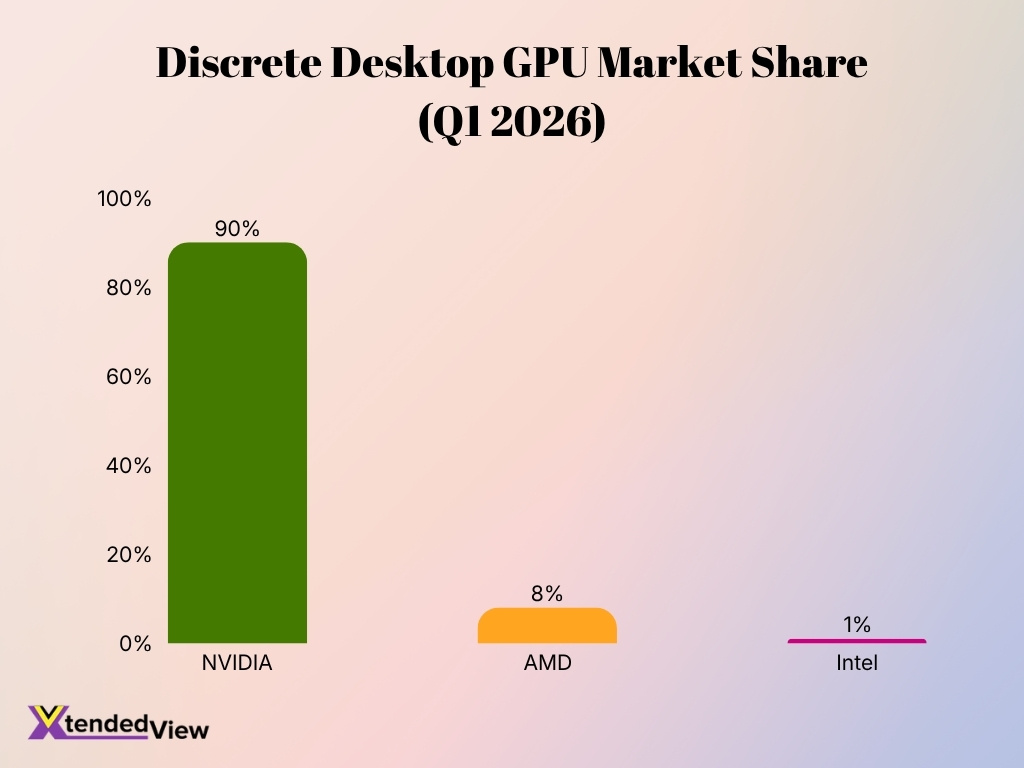
- AMD held approximately 8% of the discrete desktop graphics add-in-board market in Q1 2026, leaving it a distant second to the market leader.
- Global discrete desktop graphics-board shipments reached roughly 11.8 million units in Q1 2026, giving context to AMD’s share of that market.
- Total graphics-card shipments declined 0.6% quarter over quarter in Q1 2026 but increased 28.3% from the same period of 2025.
- AMD’s discrete graphics share changed by only about 0.04 percentage point sequentially in Q1 2026, indicating little movement from the revised Q4 2025 base.
- Across all PC graphics processors, including integrated GPUs, AMD held roughly 18% unit share in Q4 2025, compared with 15% in Q3.
- Total PC GPU shipments reached approximately 70.3 million units in Q1 2026, down 7.5% sequentially but 2% higher year over year.
- Desktop graphics shipments increased 11% year over year in Q1 2026, while notebook graphics shipments declined about 1.5%.
- AMD’s 2025 Gaming revenue rose 51% to $3.9 billion, with stronger Radeon GPU demand contributing alongside higher semi-custom sales.
- In Q2 2026, however, gaming graphics revenue declined year over year as higher component costs raised graphics-card prices and weighed on consumer demand.
- The discrete graphics-board market is forecast to contract at roughly a 3.3% compound annual rate through 2029, creating a tougher volume environment for AMD’s Radeon business.
AMD Gaming Console Chip Statistics
- AMD’s Gaming business generated $3.9 billion in 2025, up 51% from $2.6 billion in 2024 as semi-custom console sales recovered.
- Gaming revenue reached $1.12 billion in Q2 2025, a 73% increase from $648 million one year earlier, supported by higher semi-custom and Radeon sales.
- By Q2 2026, Gaming revenue had fallen to $779 million, a 31% year-over-year decline as current-generation consoles moved further into their product cycle.
- Sequentially, Gaming revenue still increased about 8% from Q1 to Q2 2026, supported by stronger semi-custom sales despite weaker Radeon shipments.
- PlayStation 5, which uses a custom AMD processor combining Zen CPU and Radeon graphics technology, had surpassed 95 million cumulative worldwide shipments by June 30, 2026.
- PlayStation 5 shipments totaled 16 million units during fiscal 2025, compared with 18.5 million in fiscal 2024, illustrating the maturing console cycle affecting semi-custom chip demand.
- Another 1.6 million PlayStation 5 consoles shipped during April-June 2026, down from 2.5 million in the comparable 2025 quarter.
- AMD secured a multi-year agreement to develop custom chips for the next generation of Xbox devices, including consoles, PCs and handheld systems.
- The next-generation Xbox console, known as Project Helix during development, will use a custom AMD SoC and targets roughly an order-of-magnitude improvement in ray-tracing capability compared with the existing design.
- Current PlayStation 5 and Xbox Series systems both rely on custom AMD processors built around Zen 2 CPU and RDNA 2 graphics architectures, giving AMD a central silicon role across the two major high-performance console platforms.
AMD Research and Development Spending
- AMD spent $8.09 billion on research and development in 2025, up from $6.46 billion in 2024. That represented a 25% annual increase as the company expanded its AI and high-performance computing programs.
- R&D spending increased by approximately $1.64 billion in a single year between 2024 and 2025, with higher employee-related costs driving much of the increase.
- AMD spent $5.87 billion on R&D in 2023, meaning annual research spending rose about 38% between 2023 and 2025.
- In Q1 2026, R&D expenses reached $2.40 billion, up 39% from $1.73 billion in Q1 2025. AMD linked the increase primarily to higher headcount supporting AI and long-term growth projects.
- Q2 2026 R&D spending rose another 33% year over year to $2.53 billion, compared with $1.89 billion during Q2 2025.
- AMD invested $4.93 billion in R&D during the first half of 2026, 36% more than the $3.62 billion spent during the first six months of 2025.
- First-half 2026 R&D spending equaled approximately 22.6% of AMD’s $21.79 billion in revenue, illustrating the scale of product-development investment relative to current sales.
- R&D stock-based compensation reached $779 million during the first half of 2026, up 36% from $572 million in the comparable 2025 period.
- AMD spent about $2.13 on R&D for every $10 of Q2 2026 revenue, based on $2.53 billion of research spending and $11.54 billion of quarterly sales.
- The company attributes rising R&D expenses partly to expanding engineering headcount for its AI strategy, which includes Instinct accelerators, EPYC processors, ROCm software, networking products and rack-scale systems.
AMD Employee Count and Workforce Growth
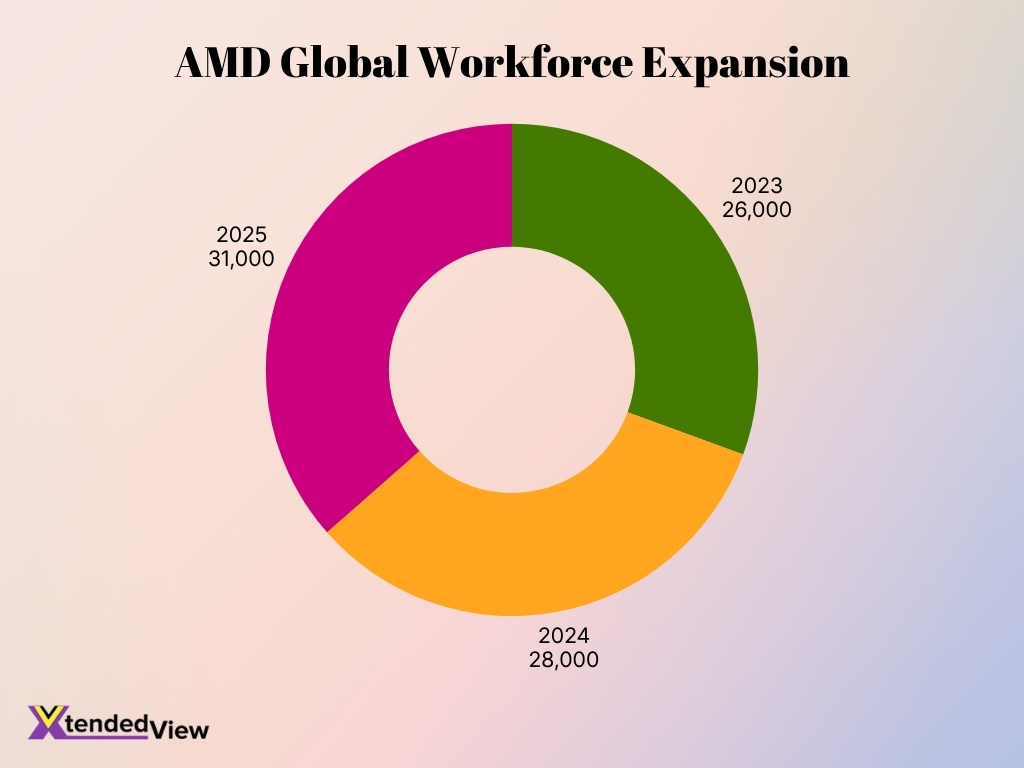
- AMD reported approximately 31,000 employees worldwide at the end of 2025, its latest formally disclosed annual workforce count.
- The workforce increased from approximately 28,000 employees in 2024, adding about 3,000 positions in one year.
- That increase represents roughly 10.7% workforce growth between year-end 2024 and year-end 2025.
- AMD employed approximately 26,000 people at the end of 2023, meaning its workforce expanded by about 5,000 employees, or 19%, over the following two years.
- From 2023 to 2024 alone, AMD added roughly 2,000 employees, equivalent to workforce growth of about 7.7%.
- AMD’s 2024 corporate workforce disclosures covered more than 28,300 employees, broadly consistent with its approximately 28,000 year-end workforce reported in regulatory filings.
- The company’s 2024 employee survey achieved a 93% global response rate, providing a broad participation base for its internal workforce measurements.
- AMD continued increasing headcount into 2026, citing employee growth as a primary factor behind the 39% rise in Q1 R&D expenses and the 33% increase in Q2 R&D costs. It has not yet published a new total global employee count for mid-2026.
- AMD’s workforce expanded by approximately 5,000 people from 2023 through 2025 while annual revenue grew from $22.68 billion in 2023 to $34.64 billion in 2025.
AMD Stock Performance and Valuation Metrics
- AMD shares closed at $514.39 on Aug. 14, 2026, following a 6.5% gain during that trading session.
- At that price, AMD’s market capitalization stood at approximately $840 billion, placing its equity value well above its level at the start of 2026.
- AMD stock had gained roughly 140% year to date through Aug. 14, 2026, reflecting investor expectations for rapid AI and data center growth.
- The stock was up approximately 184% over one year as of Aug. 14, significantly exceeding its year-to-date gain because shares had traded much lower during the second half of 2025.
- AMD’s 52-week trading range stretched from approximately $149.22 to $584.73, a difference of more than $435 per share.
- Shares reached a 52-week high of $584.73 on June 30, 2026, before trading about 12% below that level in mid-August.
- AMD’s trailing price-to-earnings ratio was approximately 131 times earnings on Aug. 14, 2026, using a $514.39 share price and $3.94 of trailing EPS.
- For comparison, AMD ended 2025 at an estimated trailing P/E multiple near 80 times earnings, meaning its valuation multiple expanded substantially as the stock rallied during 2026.
- The stock had risen approximately 148% over six months through Aug. 14, while its five-year gain reached about 365%.
- AMD’s market capitalization of roughly $840 billion remained below NVIDIA’s approximately $5.45 trillion valuation in mid-August 2026, although it stood substantially above Intel’s roughly $542 billion.
AMD vs Intel and NVIDIA Market Share
- AMD captured 30% of x86 CPU unit shipments in Q1 2026, leaving Intel with approximately 70%. AMD’s share increased 5.6 percentage points from a year earlier.
- On a revenue basis, AMD held 38.1% of the overall x86 CPU market in Q1 2026, implying approximately 61.9% for Intel.
- In server processors, AMD reached 33.2% unit share, while Intel retained about 66.8% of x86 server CPU shipments.
- AMD’s server position looked considerably stronger by revenue: EPYC processors captured 46.2% of x86 server CPU revenue in Q1 2026, leaving Intel at approximately 53.8%.
- AMD captured 33.2% of desktop CPU units and 37.6% of desktop processor revenue in Q1 2026.
- In mobile processors, AMD held 28.3% unit share and 28.9% revenue share, while Intel retained slightly more than 70% of both measurements.
- The discrete desktop graphics market shows a very different competitive picture. In Q1 2026, NVIDIA controlled approximately 90% of graphics add-in-board shipments, compared with 8% for AMD and about 1% for Intel.
- AMD’s 8% discrete desktop GPU share remained unchanged from Q4 2025, while NVIDIA also held about 90% and Intel roughly 1% in both quarters.
- Estimated Q1 2026 discrete graphics shipments translated to roughly 10.7 million NVIDIA GPUs, 1 million AMD GPUs, and 100,000 Intel GPUs, based on approximately 11.82 million total units.
- Therefore, AMD’s competitive position varies sharply by market: it approached half of x86 server CPU revenue, but held less than one-tenth of discrete desktop GPU shipments in early 2026.
AMD Financial Performance Highlights
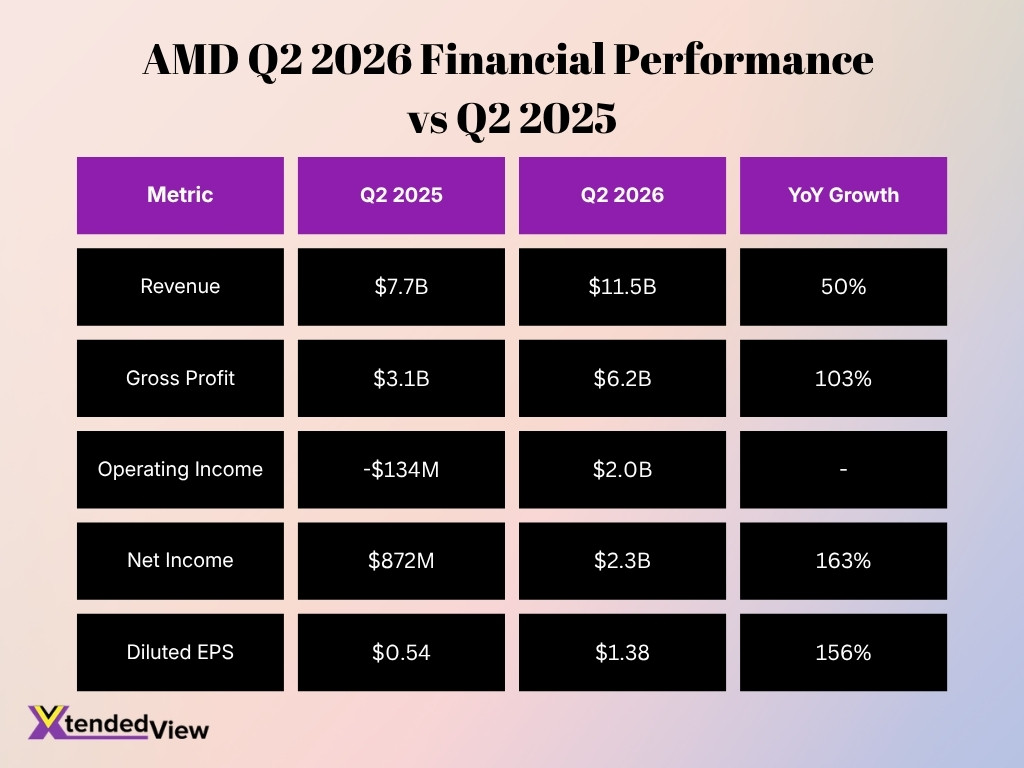
- AMD reported Q2 2026 revenue of $11.5 billion, up 50% year over year from $7.7 billion in Q2 2025.
- Gross profit more than doubled, rising 103% from $3.1 billion to $6.2 billion over the same period.
- AMD achieved a major profitability turnaround, moving from an operating loss of $134 million in Q2 2025 to $2.0 billion in operating income in Q2 2026.
- Net income surged 163% year over year, climbing from $872 million to approximately $2.3 billion.
- Diluted earnings per share reached $1.38, representing 156% growth from $0.54 in Q2 2025.
- Overall, AMD recorded strong double-digit to triple-digit growth across its key financial metrics, with profit growth significantly outpacing revenue growth.
AMD Product Launch and Roadmap Statistics
- AMD launched its 6th Gen EPYC processors in July 2026, expanding its server CPU portfolio for cloud, enterprise, AI and high-performance computing workloads.
- The 6th Gen EPYC family, previously code-named “Venice,” entered production on 2-nanometer process technology in May 2026, making it the first high-performance computing product AMD identified as reaching production ramp on that process.
- AMD introduced the Instinct MI400 Series in July 2026, including MI455X accelerators designed for large-scale AI training and inference.
- Earlier MI400 specifications called for as much as 432 GB of HBM4 memory, 19.6 TB/s of memory bandwidth and up to 40 petaflops of FP4 performance.
- The Helios rack-scale design supports as many as 72 Instinct GPUs in one scale-up domain, combining accelerators, EPYC CPUs, networking and ROCm software in an integrated architecture.
- OpenAI expects its first Helios systems to come online in Q4 2026, with deployments accelerating during 2027.
- AMD plans to launch Instinct MI500 Series GPUs in 2027, continuing an annual accelerator release cadence with new compute, memory and interconnect technologies.
- The roadmap extends to MI600 Series GPUs in 2028, paired with future rack-scale infrastructure as AMD targets yearly platform upgrades.
- AMD plans three Zen 7-based EPYC server CPU families, “Florence,” “Ferrara” and “Fidenza”, for 2028, followed by Zen 8-based “Ravenna” processors in 2030.
- AMD expects the combined addressable market for its data center, AI, PC and embedded computing products to reach approximately $2 trillion by 2030, providing the commercial backdrop for its product roadmap.
Frequently Asked Questions (FAQs)
AMD reported a record $11.54 billion in Q2 2026 revenue, up 50% year over year.
AMD’s Data Center segment generated approximately $6.72 billion, up 107% year over year and accounting for about 58% of total revenue.
AMD reached a record 46.2% share of x86 server CPU revenue in Q1 2026, while its server CPU unit share reached 33.2%.
AMD spent $8.09 billion on R&D in 2025, up 25% from $6.46 billion in 2024.
AMD had approximately 31,000 employees worldwide as of Dec. 27, 2025.
Conclusion
AMD entered the second half after generating $21.79 billion in first-half revenue, putting the company on a substantially higher revenue trajectory than in 2025. Its investment profile reflects that expansion: first-half R&D spending reached $4.93 billion, 36% higher than the comparable 2025 period. AMD’s latest annual workforce count reached 31,000 employees, approximately 19% higher than its workforce two years earlier.
The company made its largest competitive gains in servers, reaching 46.2% of x86 server processor revenue in Q1 2026. By contrast, Radeon remained a smaller competitor in discrete desktop graphics, where AMD held about 8% market share compared with NVIDIA’s roughly 90% in Q1 2026. Investor expectations rose sharply alongside AMD’s AI growth: shares were up about 140% in 2026 through Aug. 14 and valued the company at roughly $840 billion.
AMD’s roadmap now stretches through 2030, covering annual Instinct accelerator generations, future Zen 7 and Zen 8 EPYC processors, rack-scale Helios systems and increasingly integrated networking. Taken together, the statistics show a company shifting its center of gravity toward AI infrastructure and data centers while continuing to compete across PCs, gaming, embedded computing and graphics.
