



Hearing loss affects millions of people across the United States and billions worldwide, making it one of the most common long-term health conditions. It influences communication, workplace productivity, education outcomes, and healthy aging. Healthcare providers use hearing technologies to improve quality of life, while employers and public health agencies invest in prevention programs to reduce hearing-related disabilities. The statistics below highlight the latest trends, prevalence rates, and demographic patterns shaping the hearing health landscape.
Editor’s Choice
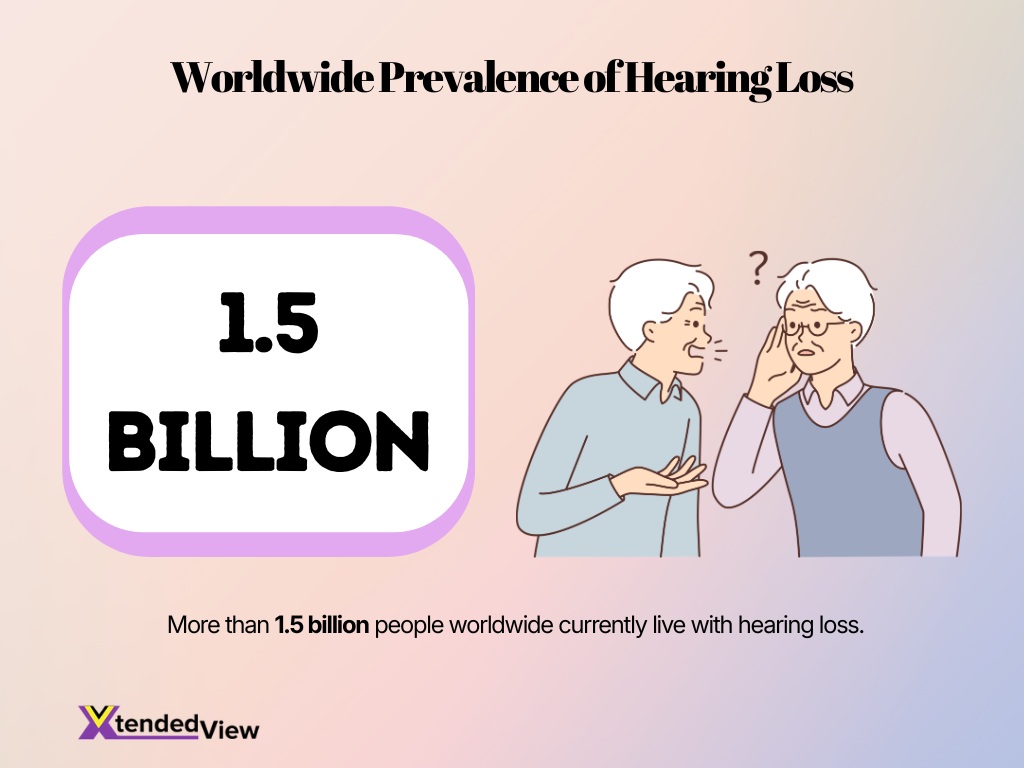
- More than 1.5 billion people worldwide currently live with some degree of hearing loss, representing nearly 20% of the global population.
- Approximately 430 million people globally have disabling hearing loss that requires rehabilitation services.
- By 2050, nearly 2.5 billion people are projected to experience hearing loss worldwide.
- Around 700 million people are expected to require hearing rehabilitation by 2050.
- In the United States, 1 in 8 people aged 12 and older have hearing loss in both ears.
- About 37.5 million U.S. adults report some level of hearing difficulty.
- More than 98% of U.S. newborns receive hearing screening shortly after birth.
Recent Developments
- In March 2026, global health estimates reaffirmed that hearing loss affects more than 1.5 billion people, emphasizing its growing public health burden.
- Current projections indicate a 56% increase in global hearing loss cases between 2019 and 2050.
- Research published in 2025 estimated 1.545 billion hearing loss cases worldwide in 2021.
- Global studies released in 2025 identified hearing loss as one of the leading contributors to disability among aging populations.
- Updated U.S. surveillance data show more than 6,000 infants born in 2022 were identified with permanent hearing loss.
- Recent workforce data indicate that approximately 11% of all U.S. workers report hearing difficulty.
- Around 20% of noise-exposed workers tested in the U.S. show material hearing impairment.
- Studies published during 2025 found that hearing loss prevalence remains higher among men than women across most regions.
- Researchers reported nearly 9.9 million cases of complete hearing loss globally by 2021.
Global Hearing Loss Prevalence
- More than 1.5 billion people worldwide currently live with hearing loss.
- Hearing loss affects approximately one in five people globally.
- Around 430 million individuals have hearing loss severe enough to require rehabilitation services.
- Global prevalence reached approximately 1.546 billion cases in 2021.
- More than 1.17 billion people worldwide have mild hearing loss.
- Hearing loss prevalence is generally higher among males than females in global datasets.
- The number of people with disabling hearing loss is projected to exceed 700 million by 2050.
- Global projections indicate nearly 2.5 billion people could have hearing loss by 2050.
- Hearing loss is present in every region and country worldwide, making it one of the most widespread chronic health conditions.
United States Hearing Loss Statistics
- Approximately 37.5 million U.S. adults report hearing difficulties.
- Around 15% of U.S. adults experience some trouble hearing.
- More than 50 million Americans have some degree of hearing loss.
- An estimated 72.9 million Americans were living with hearing loss in 2019 according to disease burden modeling.
- Hearing loss accounts for roughly 22.2% of the U.S. population under broader prevalence estimates.
- About 30 million Americans aged 12 and older have hearing loss in both ears.
- Hearing loss ranks as the third most common chronic physical condition in the United States.
- Men are nearly twice as likely as women to experience hearing loss between ages 20 and 69.
- Federal projections suggest the number of Americans with hearing loss could reach 73.5 million by 2060.
Hearing Loss in Children and Young Adults
- More than 98% of newborns in the United States undergo hearing screening.
- Over 6,000 infants born in 2022 were identified with permanent hearing loss.
- The prevalence of permanent hearing loss among screened newborns was 1.7 per 1,000 births in 2022.
- Approximately 1 in 500 infants are born with or develop hearing loss during early childhood.
- More than 5.1 million U.S. children and teens aged 6–19 have some degree of hearing loss.
- Over 10% of children and teens between the ages of 6 and 19 experience measurable hearing loss.
- The World Health Organization estimates that 1 billion young adults worldwide are at risk of avoidable hearing loss from unsafe listening practices.
- Research has found that roughly 20% of people in their 20s already show signs of permanent hearing loss or tinnitus.
- Early identification and intervention significantly reduce language and educational delays among children with hearing loss.
Hearing Loss by Age Group
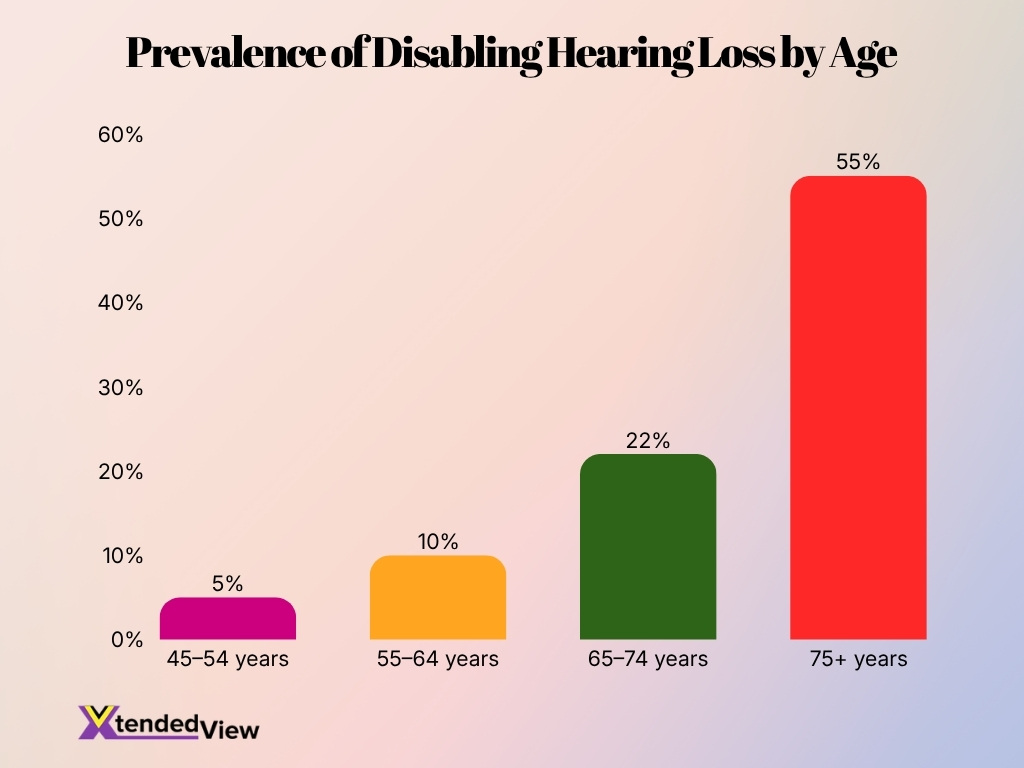
- About 5% of adults aged 45–54 have disabling hearing loss.
- The prevalence rises to 10% among adults aged 55–64.
- Approximately 22% of adults aged 65–74 have disabling hearing loss.
- Around 55% of adults aged 75 and older experience disabling hearing loss.
- One in three adults aged 65–74 lives with hearing loss.
- Nearly one in two adults aged 75+ experiences hearing loss.
- Among U.S. adults, hearing difficulty affects 6.3% of those aged 18–44.
- Hearing difficulty increases to 13.6% among adults aged 45–64.
- Among adults aged 65 and older, 26.8% report hearing difficulties.
Noise-Induced and Occupational Hearing Loss
- Approximately 22 million U.S. workers face hazardous occupational noise exposure each year.
- Nearly 12% of all U.S. workers report hearing difficulty, according to occupational health surveillance data.
- About 24% of hearing difficulty among workers can be attributed directly to occupational noise exposure.
- Roughly 20% of noise-exposed workers have a material hearing impairment.
- Around 53% of noise-exposed workers do not wear hearing protection consistently on the job.
- Manufacturing workers experience hearing loss rates that are nearly twice the national average in several industrial sectors.
- The mining sector reports some of the highest occupational hearing loss prevalence rates, with estimates exceeding 24% among workers.
- The World Health Organization estimates that over 1 billion young people aged 12–35 remain at risk of hearing loss due to unsafe recreational listening habits.
- Research estimates that 48 million Americans have experienced hearing loss linked partly to noise exposure.
- Studies show that prolonged exposure above 85 decibels significantly increases the risk of permanent hearing damage.
Veterans and Service-Related Hearing Loss
- Hearing loss remains one of the most common service-connected disabilities among U.S. veterans.
- More than 1.3 million veterans receive disability compensation for hearing loss.
- Over 2.9 million veterans receive disability benefits for tinnitus, making it the most common service-connected disability.
- Hearing loss and tinnitus together account for millions of disability claims processed annually by the Department of Veterans Affairs.
- Military personnel often encounter noise levels exceeding 140 decibels from weapons systems and explosives.
- Studies indicate that combat arms occupations have substantially higher hearing loss rates than non-combat roles.
- Research has found that veterans are more likely to experience hearing difficulties than non-veterans of similar ages.
- Service members deployed to combat zones show elevated risks of both hearing loss and tinnitus due to repeated blast exposure.
Global Hearing Aid Market Share by Company
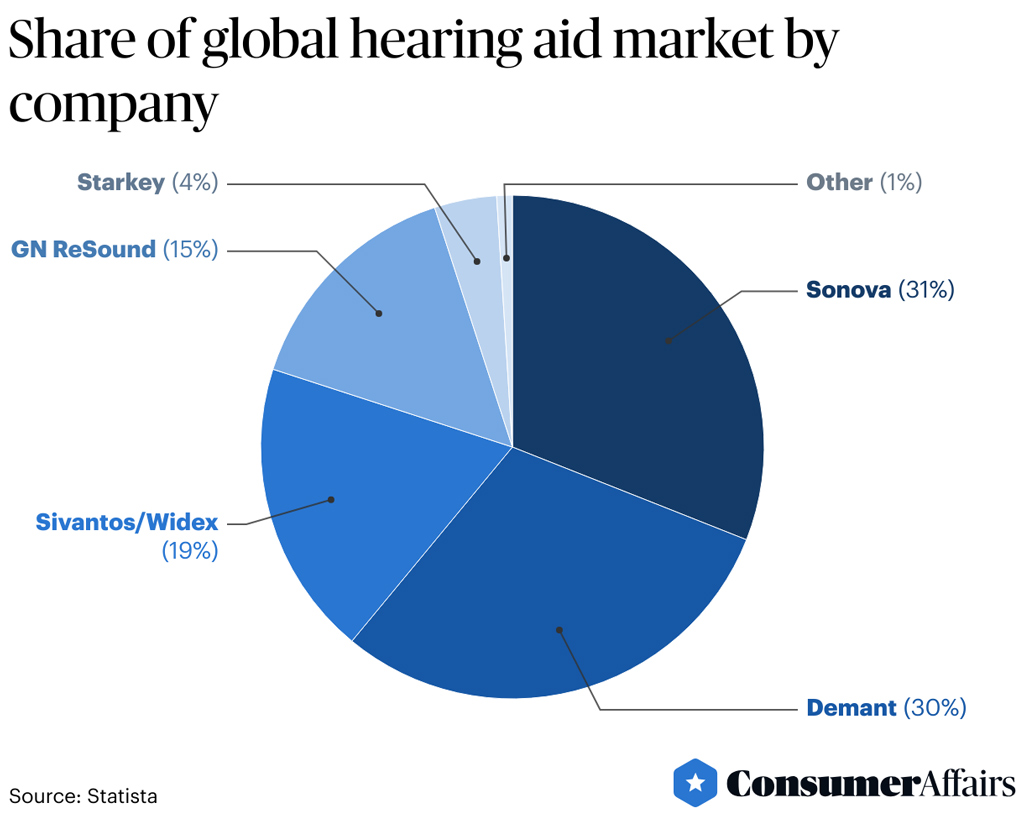
- Sonova led the global hearing aid market with a 31% share, making it the largest company in the industry.
- Demant closely followed with 30% market share, holding nearly one-third of the global market.
- Sivantos/Widex accounted for 19% of the market, ranking as the third-largest hearing aid provider.
- GN ReSound captured 15% market share, securing a strong position among leading manufacturers.
- Starkey held a 4% share, representing a smaller but notable portion of the global market.
- The Other category contributed just 1%, highlighting the dominance of major hearing aid companies.
- The top two companies, Sonova and Demant, controlled 61% of the global hearing aid market combined.
- The top four manufacturers accounted for 95% of the global market, indicating a highly concentrated industry.
Hearing Aid Adoption and Usage Rates
- Only 30% of adults aged 70 and older with hearing loss have ever used hearing aids.
- Just 16% of affected adults aged 20 to 69 currently utilize hearing devices.
- Globally, fewer than 20% of people who actively need hearing aids actually wear them.
- Nearly 28.8 million adults in the United States could directly benefit from hearing aids.
- Device adoption jumps to 65% for severe hearing loss compared to just 10% for mild impairment.
- The average person waits 5 to 7 years to seek treatment and adopt hearing aids.
- Over 70% of non-adopters cite high out-of-pocket costs as their primary barrier to purchase.
- Men remain roughly two times more likely than women to experience loss and use hearing aids.
- Proper professional counseling and follow-up care can boost successful device uptake by over 50%.
- The recent rollout of OTC hearing aids aims to increase first-time adoption by up to 40%.
Demographics of Hearing Aid Users
- Approximately 14.4% of adults aged 65 and older use hearing aids, forming the majority demographic of all users.
- Device ownership increases drastically with age, reaching 26.7% for those aged 75 to 84 and 39.5% for those 85 and older.
- Roughly 9.2% of men over age 45 wear hearing aids compared to just 5.5% of women in the same demographic.
- Adults with moderate-to-severe hearing loss are substantially more likely to seek treatment compared to the baseline 16% adoption rate for general hearing loss.
- Older adults in the highest income brackets are up to 66% more likely to purchase hearing aids than those in the lowest tiers.
- Nearly 29.2% of Medicare beneficiaries aged 71 and older use hearing devices, reflecting high adoption among retired populations.
- College-educated individuals and those with comprehensive health coverage report utilization rates as high as 79%.
- Lower-income and underserved rural populations face 2.7 times higher odds of abandoning their hearing aids entirely due to affordability barriers.
- Adults who completed a formal hearing test within the past four years are nearly three times more likely to become regular hearing aid users.
Global Hearing Aids Market Revenue Forecast
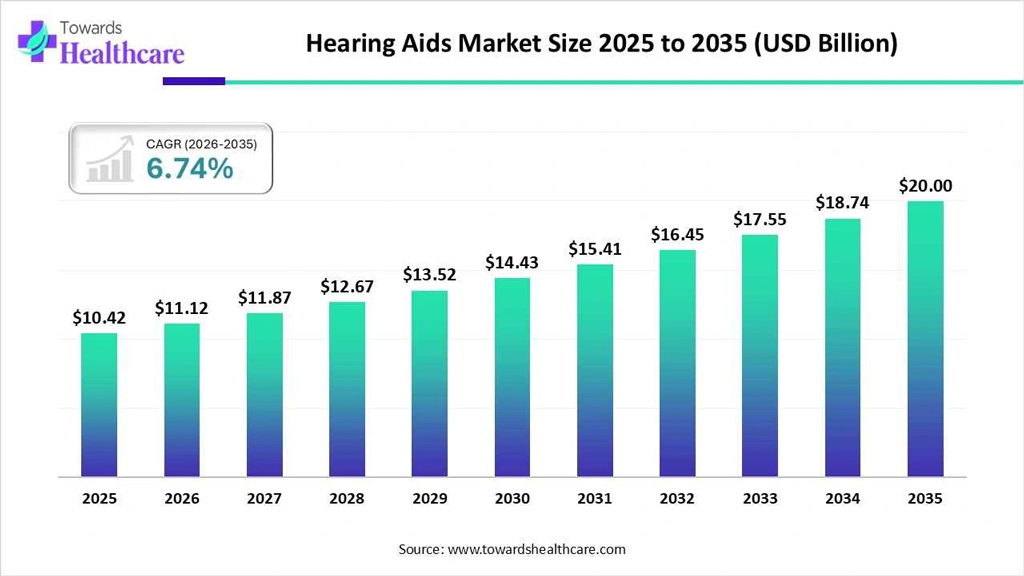
- The global hearing aids market is projected to grow from $10.42 billion in 2025 to $20.00 billion by 2035, nearly doubling in size.
- The market is expected to register a strong 6.74% CAGR between 2026 and 2035.
- Market revenue is forecast to surpass $15 billion by 2031, reaching $15.41 billion.
- By 2030, the hearing aids industry is projected to achieve a market value of $14.43 billion.
- The market is expected to add more than $9.58 billion in value between 2025 and 2035.
- The annual market size is forecast to increase from $11.12 billion in 2026 to $17.55 billion in 2033.
- The industry is projected to exceed $18 billion in 2034, reaching $18.74 billion.
- The hearing aids market is expected to cross the $16 billion milestone in 2032, totaling $16.45 billion.
Hearing Aid Costs and Financial Barriers
- Traditional prescription hearing aids average $4,672 per pair, with premium full-service packages exceeding $7,000.
- Surveys indicate that 49% of individuals cite affordability as the primary financial barrier to receiving hearing care.
- Purchasing a single $2,500 hearing aid would represent a catastrophic healthcare cost for 77% of Americans experiencing functional hearing loss.
- Medicare explicitly excludes routine hearing devices, forcing nearly 100% of out-of-pocket expenses onto older adult beneficiaries.
- Adults leaving their hearing loss untreated face 46% higher total healthcare costs, averaging $22,434 per person over a decade.
- The median income for prescription hearing aid owners is 16% higher than for non-owners, reflecting significantly lower adoption in lower-income households.
- Bundled professional services, cleanings, and follow-up adjustments push the average total cost of ownership to $4,700.
- While third-party insurance motivates 25% of purchases, over three-quarters of Americans still lack the coverage needed to afford devices.
- Over-the-counter (OTC) hearing aids provide a budget-friendly alternative, with 71% of OTC users paying under $500 per pair.
Over-the-Counter (OTC) Hearing Aid Statistics
- The global over-the-counter hearing aids market size is projected to reach $1.74 billion by 2030.
- The North American region accounted for the largest global market share of 35.2% in 2022.
- The average price for a pair of entry-level OTC hearing aids ranges between $900 and $2,000 in 2025.
- The digital hearing aids segment generated the largest global revenue share of 93.3% in 2022.
- Physical retail stores accounted for a major distribution channel market share of 39.7% in 2022.
- The receiver-in-canal segment is expected to capture over 34.2% of the total market share by 2035.
- The U.S. OTC hearing aids market was valued at $272.1 million in the year 2025.
- Brick-and-mortar distribution dominated U.S. OTC sales with a revenue share of 58.6% in 2025.
Hearing Aid Brand Prescription Trends in the U.S.
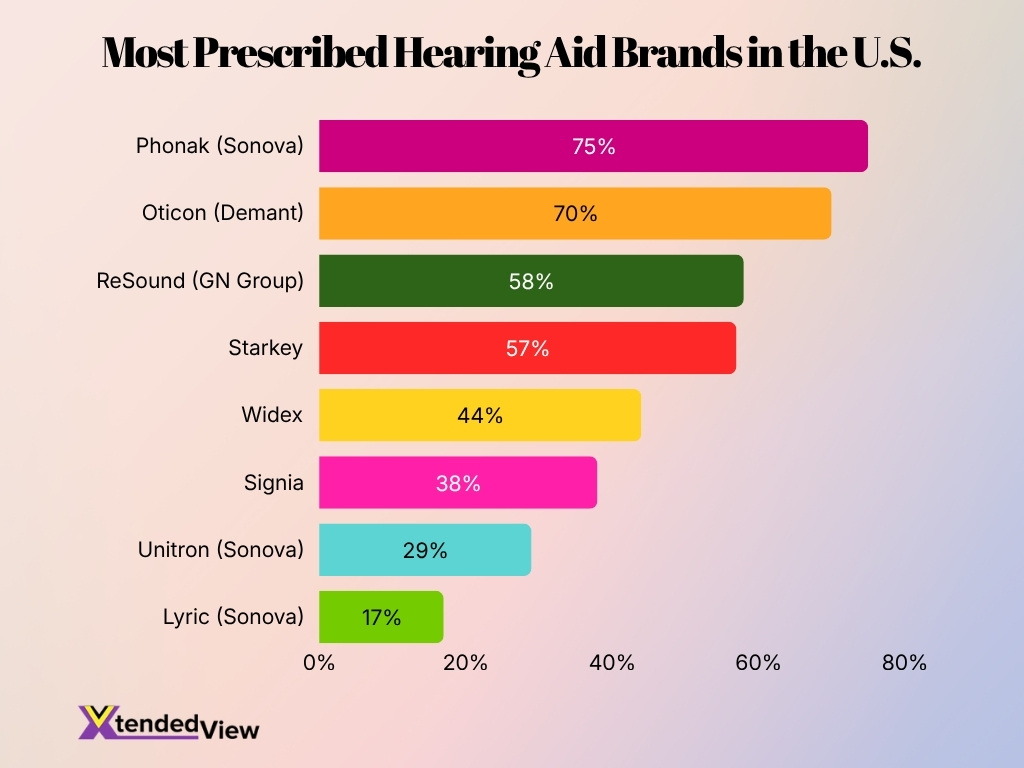
- Phonak (Sonova) leads all brands, with a 75% prescription frequency among hearing care professionals.
- Oticon (Demant) ranks second, being prescribed by 70% of hearing aid providers.
- ReSound (GN Group) secures third place with a strong 58% prescription rate.
- Starkey closely follows ReSound, with 57% of professionals prescribing the brand.
- Widex is prescribed by 44% of hearing specialists, placing it in the mid-tier.
- Signia records a 38% prescription frequency, trailing the leading hearing aid brands.
- Unitron (Sonova) is prescribed by 29% of professionals, less than half the rate of Phonak.
- Lyric (Sonova) has the lowest prescription frequency at 17% among the listed brands.
- The gap between the most and least prescribed brands is 58 percentage points (75% vs. 17%).
- Sonova-owned brands dominate the list, with Phonak, Unitron, and Lyric all appearing in the rankings.
AI-Powered Hearing Aid Statistics
- The global AI hearing aid market was valued at $3.12 billion in 2024 and is projected to reach $7.51 billion by 2034.
- AI-powered devices currently account for nearly 65% of all premium hearing aid sales globally.
- Advanced AI hearing systems can make up to 80 million adjustments per hour to optimize sound in real time.
- AI-based noise reduction algorithms improve speech understanding in noise by up to 30% compared to traditional methods.
- By 2028, AI-assisted auto-calibration is expected to improve user satisfaction scores by over 35%.
- Over 60% of new hearing aid users in 2024 prioritized self-adjusting AI features and mobile app integration.
- AI-based learning models reduce manual audiologist interventions by nearly 28%, lowering long-term care costs.
- AI-enabled behind-the-ear devices account for approximately 44% of user adoption due to their higher processing capacity.
- Worldwide demand for AI hearing solutions is projected to expand at a steady 9.2% CAGR over the next decade.
Tinnitus Statistics and Hearing Aid Relief
- More than 25 million Americans experience tinnitus lasting at least five minutes during the previous year.
- Approximately 10% to 15% of adults worldwide experience tinnitus symptoms.
- Tinnitus is the most common service-connected disability among U.S. veterans, affecting over 2.9 million recipients.
- Around 90% of people with chronic tinnitus also have measurable hearing loss.
- Studies show that hearing aids can reduce tinnitus perception for many individuals by amplifying environmental sounds.
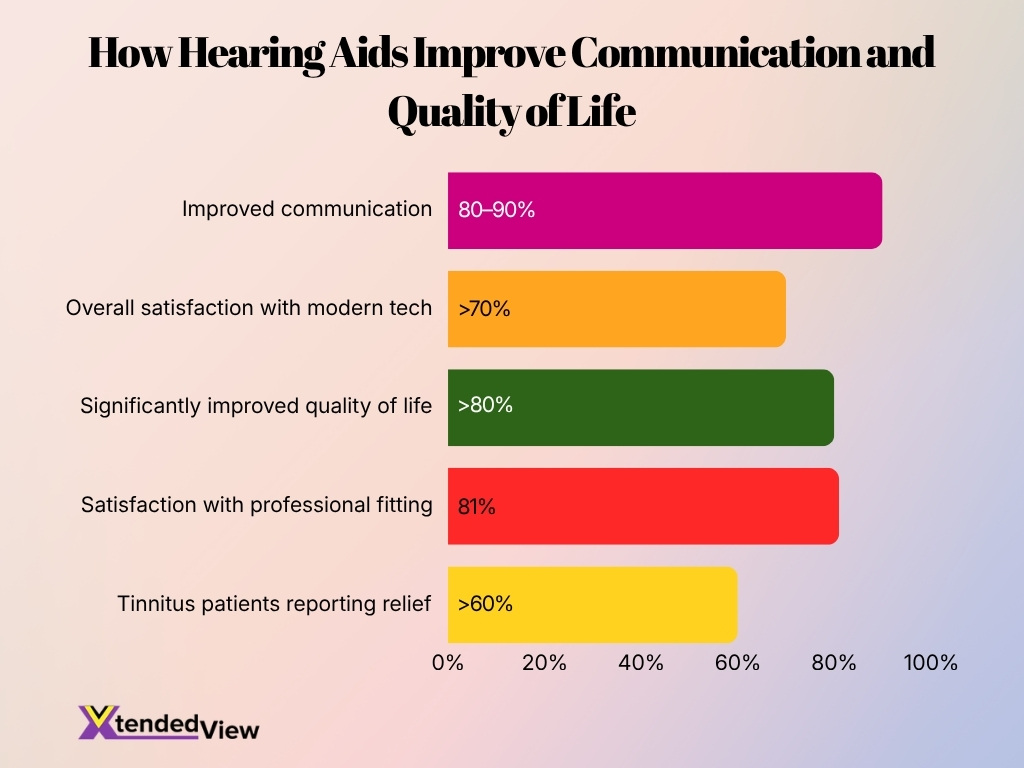
- Research reviews indicate that more than 60% of tinnitus patients report noticeable relief from hearing aid use.
- Approximately 22% of adults aged 65 and older report tinnitus symptoms.
- Hearing aids equipped with tinnitus masking programs have become increasingly common in premium device categories.
- Clinical studies continue to support hearing aids as a first-line intervention for patients experiencing both hearing loss and tinnitus.
Hearing Aid Effectiveness and User Satisfaction
- Approximately 80% to 90% of users experience improved communication after consistent device usage.
- More than 70% of current owners report overall satisfaction with modern hearing technology.
- Over 80% of frequent users state that their devices significantly improve their quality of life.
- Patients receiving professional fitting report an 81% satisfaction rate, substantially outperforming self-managed care.
- Close to 70% of individuals experience enhanced social engagement and reduced communication barriers.
- Consistent usage is associated with a 32% lower risk of experiencing severe depression or isolation.
- Using hearing devices reduces the risk of income loss by 90% to 100% for those with mild impairment.
- Nearly 60% of recent adopters cite Bluetooth connectivity as a highly valued daily feature.
Health and Cognitive Impacts of Untreated Hearing Loss
- Untreated hearing loss accounts for 8% of global dementia cases, making it the largest modifiable risk factor.
- Individuals with severe, untreated hearing loss have up to a five times higher risk of developing dementia.
- Seniors with untreated hearing loss experience a 30% to 40% faster rate of cognitive decline.
- Even a mild 25-decibel hearing impairment triples the risk of experiencing an accidental fall.
- Older adults lacking hearing treatment are 57% more likely to suffer from episodes of severe depression.
- Untreated auditory decline is associated with a 47% increased risk of experiencing profound social isolation.
- Using hearing aids can slow the progression of cognitive decline by nearly 48% in high-risk older adults.
- Unmanaged hearing loss can lead to a loss of annual income by up to $30,000 due to reduced workplace productivity.
Economic Cost of Untreated Hearing Loss
- Unaddressed hearing loss costs the global economy an estimated $980 billion annually.
- Societal costs stemming from social isolation and communication difficulties reach $456.5 billion each year.
- Health-care sector expenditures for children and adults account for approximately $314 billion of the total economic burden.
- Lost productivity due to unemployment and premature retirement represents $182.5 billion in annual financial losses.
- Quality of life losses make up 47% of the total global economic cost of untreated hearing impairment.
- Individuals with unaddressed hearing loss can experience an annual income reduction of up to $30,000.
- A mere 5% reduction in the prevalence of hearing loss could yield global savings of $49 billion.
- Low- and middle-income countries bear a disproportionate burden, accounting for 57% of these global economic costs.
- Utilizing hearing aids can reduce the risk of income loss by 90 to 100% for those with mild impairment.
- Economic costs specifically attributed to children aged 0–14 account for 6.5% of the overall financial burden.
Frequently Asked Questions (FAQs)
The global hearing aids market is valued at approximately $10.35 billion in 2025 and is projected to reach $14.42 billion by 2030, growing at a 6.8% CAGR.
Globally, only about 17% of people who could benefit from hearing aids currently use them, leaving a significant treatment gap.
More than 430 million people worldwide are estimated to have disabling hearing loss that may require hearing rehabilitation services.
Recent studies report a hearing aid adoption rate of approximately 42.5% among individuals with hearing difficulty when hearing aids and personal sound amplification devices are combined.
The global OTC hearing aids market was valued at about $996 million in 2025 and is forecast to reach $1.8 billion by 2035, expanding at a 6.1% CAGR.
Conclusion
Hearing loss continues to affect hundreds of millions of people worldwide and tens of millions of Americans, making it one of the most significant public health challenges. The latest data show rising prevalence rates, growing demand for hearing aids, expanding OTC availability, and rapid innovation through AI-powered hearing technologies. At the same time, untreated hearing loss remains linked to cognitive decline, social isolation, lower workforce participation, and nearly $1 trillion in annual global economic costs.
As populations age and awareness increases, hearing healthcare is becoming a larger priority for healthcare systems, employers, policymakers, and consumers. Continued investment in screening, affordability initiatives, hearing aid adoption, and advanced hearing technologies will play a critical role in improving outcomes for millions of people over the coming decades.
