


Dashboard cameras have evolved from niche accessories into mainstream vehicle safety tools. Drivers use them to document accidents, protect themselves against insurance fraud, and capture evidence during legal disputes. At the same time, commercial fleets rely on dash cams to improve driver behavior, reduce liability costs, and strengthen safety programs. As AI, cloud connectivity, and vehicle telematics become more common, dash cams are playing a larger role across both consumer and business transportation. Explore the latest dashboard camera statistics to understand how adoption, market growth, and consumer preferences are shaping the industry.
Editor’s Choice
- The global dashboard camera market is projected to reach approximately $5.96 billion in 2026, up from $5.40 billion in 2025.
- Around 30% of U.S. drivers now use a dash cam, representing roughly 69 million motorists.
- Nearly 36% of drivers without a dash cam say they are likely to purchase one within the next 12 months.
- About 40% of dash cam owners have recorded a crash or traffic incident.
- Roughly 50% of drivers who captured an incident later used the footage during an insurance claim.
- 70% of drivers believe dash cams should come pre-installed in new vehicles.
- The global automotive dashcam market is forecast to grow from $4.40 billion in 2026 to $6.55 billion by 2033.
Recent Developments
- AI-enabled dash cams are becoming a major growth driver as fleets increasingly seek real-time driver monitoring and risk detection capabilities.
- New premium dash cam models now offer 4K front and rear recording, expanding video quality standards across the market.
- Cloud-connected dash cams increasingly support live vehicle tracking, instant event uploads, and remote monitoring features.
- AI-powered fleet dash cams have helped reduce crash rates by as much as 73% in some commercial deployments.
- Insurance providers are increasingly recognizing dash cam footage as supporting evidence during claims investigations.
- EV-specific dash cam demand is rising rapidly, with the segment expected to grow at a 16.1% CAGR through 2033.
- Built-in dash cam functionality continues expanding across new vehicle models as automakers respond to consumer demand.
- Advanced parking surveillance systems now allow dash cams to monitor vehicles while parked and send alerts to owners remotely.
- Dual-facing and cabin-facing cameras are becoming standard among commercial fleets, with 63% of surveyed fleets reporting in-cab camera usage in 2025.
Dashboard Camera Market Growth Highlights
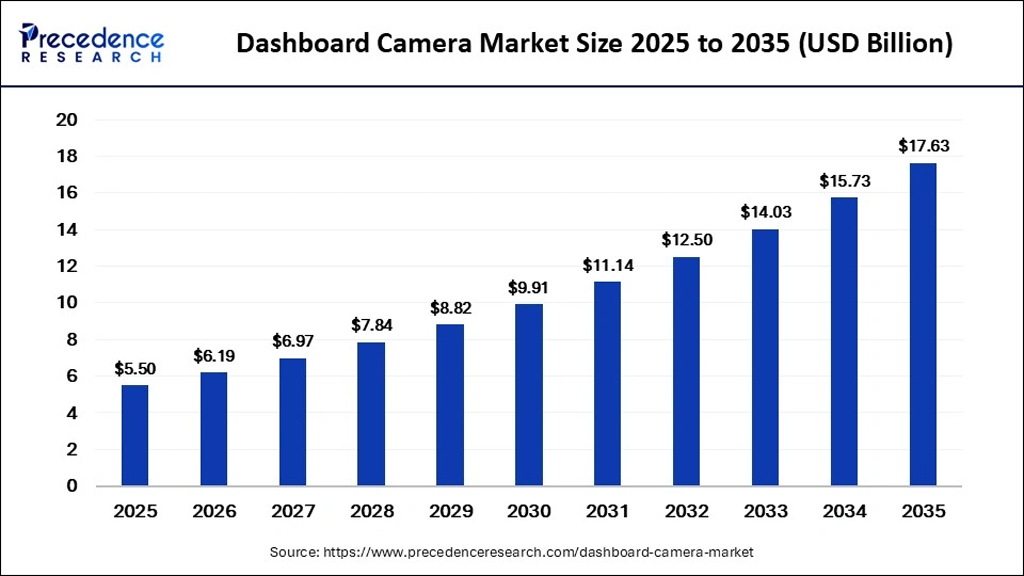
- The global dashboard camera market is projected to grow from $5.50 billion in 2025 to $17.63 billion by 2035, adding more than $12.1 billion in market value over the decade.
- Market size is expected to increase by 12.5% from $5.50 billion in 2025 to $6.19 billion in 2026.
- By 2028, the dashboard camera industry is forecast to reach $7.84 billion, crossing the $7 billion milestone.
- The market is projected to surpass $8.82 billion in 2029, reflecting strong consumer and commercial fleet adoption.
- In 2030, the industry is expected to exceed $9.91 billion, approaching the $10 billion mark.
- The dashboard camera market is forecast to cross $11.14 billion in 2031, nearly doubling its 2025 value within six years.
- By 2032, global market revenue is projected to reach $12.50 billion, highlighting sustained growth momentum.
- The market is expected to expand to $14.03 billion in 2033, representing an increase of more than $8.5 billion compared to 2025.
- Dashboard camera revenue is forecast to climb to $15.73 billion in 2034, driven by rising demand for vehicle safety and evidence recording.
- By 2035, the market is projected to reach a record $17.63 billion, making it more than 3.2 times larger than its 2025 size.
- The industry is expected to add approximately $1–2 billion in new revenue annually during the latter half of the forecast period.
- The strongest absolute growth is anticipated between 2034 and 2035, when market value is projected to increase by $1.90 billion in a single year.
- Between 2025 and 2030, the market is forecast to grow by 80.2%, rising from $5.50 billion to $9.91 billion.
- Over the full 2025–2035 period, the dashboard camera industry is expected to expand by approximately 220.5%, highlighting robust long-term growth potential.
Dash Cam Adoption and Ownership Rates
- 30% of U.S. drivers currently own or regularly use a dash cam.
- This ownership level translates to roughly 69 million American drivers.
- 36% of non-owners indicate they are likely to purchase a dash cam within one year.
- Urban drivers report 40% adoption, significantly above the national average.
- Rural drivers show a lower ownership rate of 19%.
- Gig-economy drivers lead adoption, with 53% using dash cams.
- Drivers spending more than five hours weekly on the road report 41% adoption, compared with 19% among low-mileage drivers.
- Earlier consumer surveys found ownership of around 16% in 2025, highlighting how quickly adoption has accelerated.
- 70% of drivers support factory-installed dash cams in new vehicles.
Primary Reasons for Purchasing a Dash Cam
- 40% of dash cam owners have successfully captured a traffic collision to secure undeniable proof.
- Over 75% of motorists use recorded footage to efficiently resolve and support insurance claims.
- Nearly 39% of buyers purchased their device directly after experiencing a previous accident or close call.
- Fleet operators report a 33% improvement in safer driving behavior to reduce their legal exposure.
- Commercial fleets experience up to a 34% reduction in insurance premiums by supplying video evidence.
- Gig workers lead with 53% adoption to document passenger interactions and avoid liability disputes.
- More than 65% of the market is driven by personal vehicles seeking parking surveillance and theft protection.
- Around 70% of drivers want factory-installed cameras to continuously document the rise in road rage incidents.
- About 30% of users rely on GPS-enabled systems to submit speed and timestamp evidence to authorities.
Dash Cam Usage by Driver Type Statistics
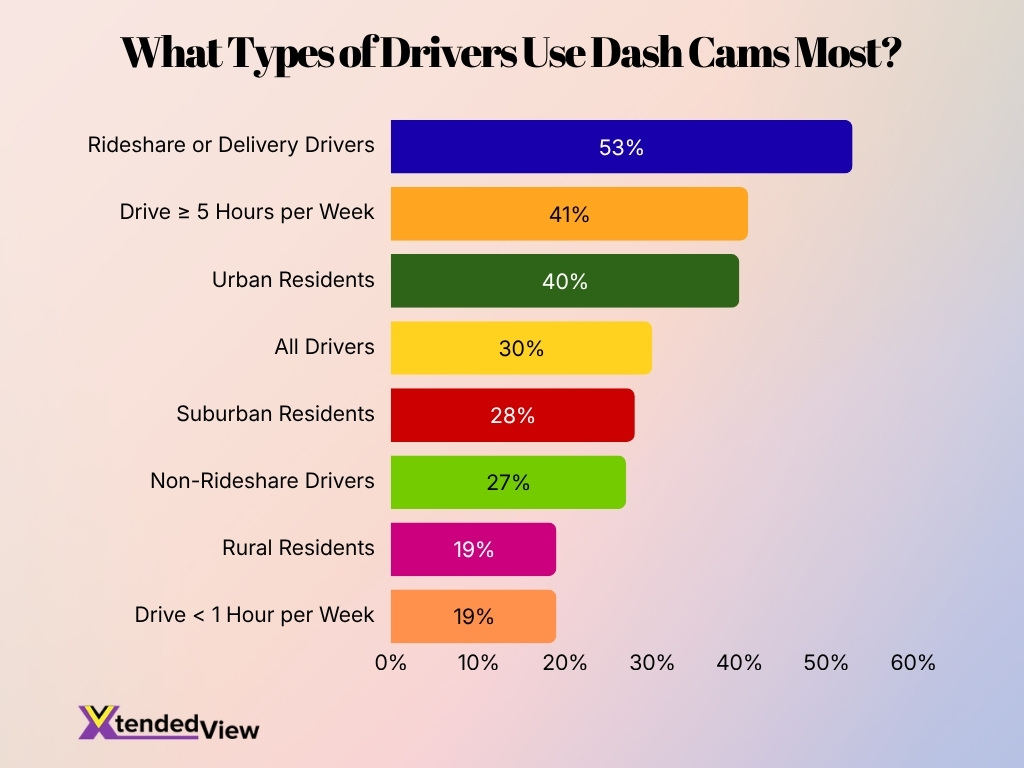
- Rideshare and delivery drivers have the highest dash cam adoption rate, with 53% using a dash cam, significantly above the overall average.
- Among all U.S. drivers, 30% report using a dash cam, indicating that nearly 1 in 3 drivers have adopted the technology.
- Urban residents show strong dash cam usage, with 40% using the devices, reflecting higher adoption in densely populated areas.
- Drivers who spend 5 or more hours on the road each week have a dash cam usage rate of 41%, highlighting the link between driving frequency and adoption.
- Suburban residents have a dash cam adoption rate of 28%, slightly below the national average of 30%.
- Non-rideshare drivers report a usage rate of 27%, which is roughly half the rate seen among rideshare and delivery drivers.
- Dash cam ownership is lowest among rural residents, with only 19% using the devices.
- Drivers who spend less than 1 hour per week driving also have a dash cam adoption rate of 19%, matching that of rural residents.
- The gap between rideshare/delivery drivers (53%) and non-rideshare drivers (27%) is 26 percentage points, showing that professional driving significantly increases dash cam adoption.
- Drivers who spend 5+ hours driving weekly (41%) are more than twice as likely to use a dash cam as those driving less than 1 hour per week (19%).
- The difference between urban (40%) and rural (19%) residents is 21 percentage points, suggesting location plays a major role in dash cam usage.
- Overall, dash cam adoption is highest among drivers with greater road exposure, including professional drivers, frequent drivers, and urban motorists.
Common Barriers to Dash Cam Adoption
- 32% of drivers who do not own a dash cam cite cost as the primary reason for delaying a purchase.
- Around 27% of non-users believe they do not drive enough to justify buying a dash cam.
- Nearly 24% of respondents report concerns about installation complexity and cable management.
- Privacy concerns remain significant, with roughly 20% of drivers expressing discomfort about constant video recording.
- More than 18% of consumers worry about data security when using cloud-connected dash cams.
- Limited awareness remains a challenge, as approximately 17% of drivers report not knowing enough about dash cam benefits.
- Some drivers cite legal uncertainty regarding audio and video recording laws across different states.
- Roughly 15% of potential buyers believe their existing vehicle safety systems already provide sufficient protection.
- Battery drain concerns continue to discourage purchases of dash cams with parking-monitoring features.
Vehicle Safety and Accident Recording Statistics
- Approximately 40% of dash cam owners report capturing a collision, near miss, or traffic-related incident.
- More than 6 million police-reported crashes occur annually in the United States, creating a large potential use case for dashboard cameras.
- Traffic crashes result in over 42,000 annual fatalities in the U.S., reinforcing demand for incident documentation technologies.
- Dash cam footage is increasingly used to reconstruct accident sequences and determine fault.
- Approximately 50% of drivers who recorded an accident later used the footage during the insurance claim process.
- Rear-end collisions account for roughly 29% of all U.S. crashes, making forward-facing dash cams particularly valuable.
- Fleet operators report improved event documentation after implementing vehicle camera systems.
- Multi-camera systems that record front, rear, and cabin views are increasingly used to capture comprehensive incident evidence.
- Dash cam recordings often provide timestamped GPS and speed information that supplements accident investigations.
Driver Support for Standard Dash Cam Installation
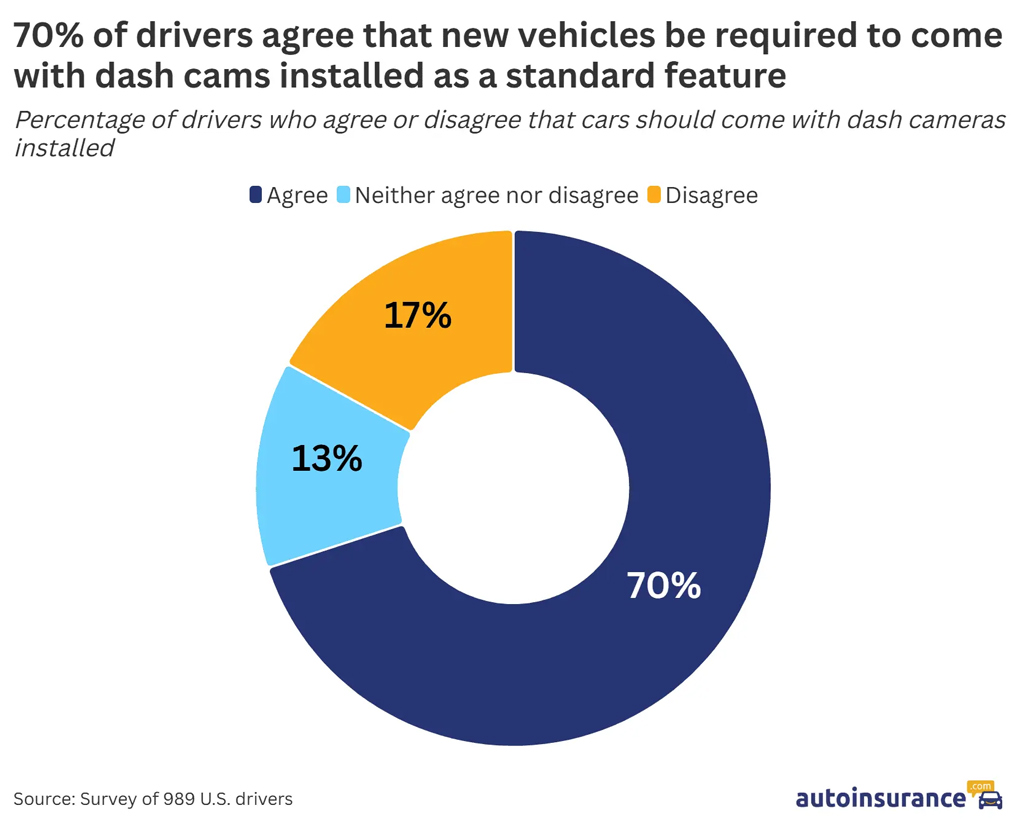
- 70% of drivers agree that new vehicles should come with dash cameras installed as a standard feature, indicating strong consumer support for built-in recording technology.
- Only 17% of respondents disagree with mandatory dash cam installation, showing that opposition remains relatively limited.
- 13% of drivers neither agree nor disagree, suggesting a small portion of consumers remain undecided on the issue.
- Support for standard dash cams is more than four times higher than opposition (70% vs. 17%).
- The gap between drivers who support and oppose the measure stands at 53 percentage points, highlighting a clear majority consensus.
- Nearly 7 in 10 drivers favor integrating dash cams into new vehicles by default, reflecting growing demand for vehicle safety and evidence-capturing technologies.
- The combined share of neutral and opposing respondents is 30%, less than half the proportion of those who support the feature.
- Results from the survey of 989 U.S. drivers suggest that dash cams are increasingly viewed as an essential vehicle safety and security tool.
- The findings indicate that consumers may be receptive to automakers offering factory-installed dash cameras as a standard rather than an optional feature.
- Growing support for built-in dash cams could influence future vehicle design, insurance partnerships, and road safety regulations.
Impact of Dash Cams on Insurance Claims
- Roughly 20% of dash cam owners have used their footage for an insurance claim.
- Claims with dash cam footage settle 35% faster than those without video.
- Drivers with dash cams are 40% more likely to win disputed claims.
- Commercial fleets with dash cams see incidents become 86% less expensive.
- Up to 75% of users resolve their insurance disputes using recorded footage.
- Some insurers offer premium discounts of up to 10% for approved dash cams.
- Clear video evidence resolves most disputed claims in just 24 to 72 hours.
- Dash cams help avoid false at-fault rulings that cause a 47% rate increase.
- Auto insurance fraud causes $29 billion in losses, making cameras vital.
Role of Dash Cams in Legal Cases and Disputes
- Nearly 16% of all drivers actively use a dash cam in their personal vehicles.
- Exactly 20% of dash cam owners rely on footage to settle an insurance claim.
- Around 12% of users have submitted video evidence to support a legal case.
- Almost 39% of camera purchases are driven by a previous traffic accident.
- The global dash cam industry is growing at a 9.6% annual rate through 2030.
- Nearly 33% of unequipped drivers believe recorded footage would have helped their legal dispute.
- Drivers without dash cams are 6% more likely to experience a vehicle collision.
- Only 10% of individual drivers proactively install cameras to fight fraudulent claims.
- Approximately 66% of surveyed motorists have experienced at least one accident requiring objective evidence.
Dash Cam Effectiveness in Accident Prevention
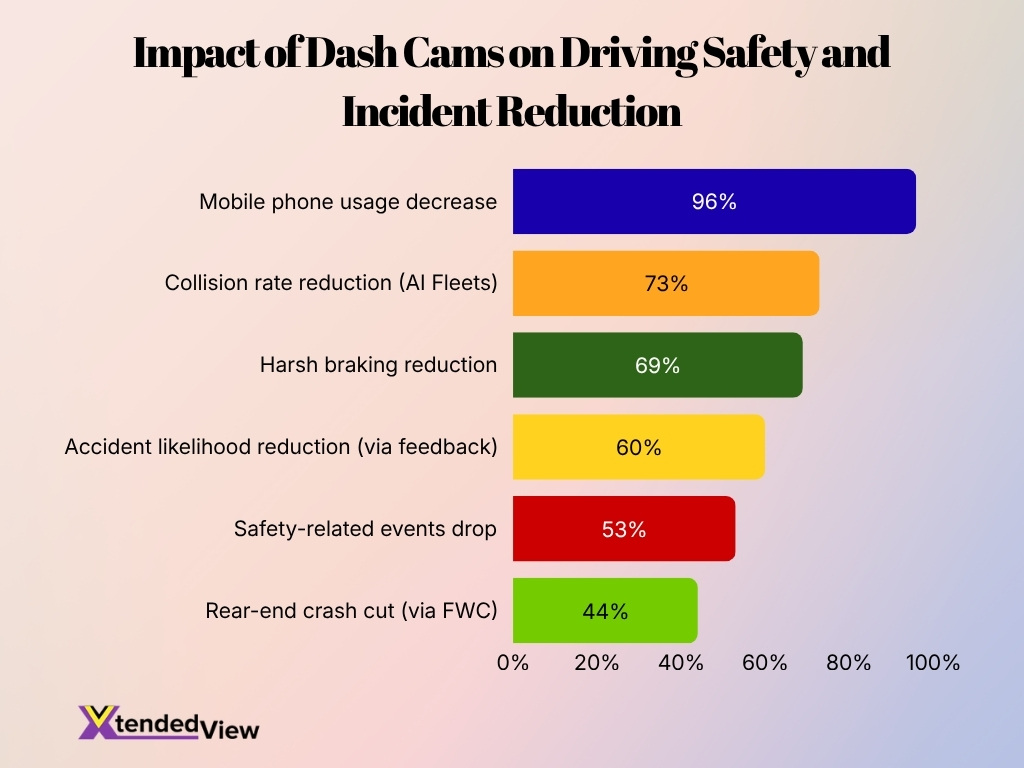
- AI-powered fleet dash cams have helped reduce collision rates by up to 73% over 30 months of monitored operations.
- Fleets using in-cab video systems with coaching report a 53% drop in safety-related driving events.
- Real-time alerts for distracted driving can decrease driver mobile phone usage by up to 96%.
- Commercial fleets deploying video telematics have reported a 69% reduction in harsh braking and turning incidents.
- Forward collision warning systems in modern dash cams can cut rear-end crashes by up to 44%.
- Operations utilizing dash cam driver feedback programs are 60% less likely to experience vehicle accidents.
- Dual-facing dash cams reduce crash rates two times more effectively than front-facing cameras alone.
- Vehicle insurance claims supported by dash cam footage are settled approximately 35% faster than those without.
- Roughly 40% of standard dash cam owners have successfully captured a crash or significant traffic event on video.
Commercial Fleet Dash Cam Statistics
- More than 70% of large commercial fleets use video telematics or dash cam technology.
- Around 63% of surveyed fleets reported using inward-facing cameras in 2025.
- Fleets deploying AI-enabled dash cams report collision reductions of up to 73%.
- Over 87% of commercial crashes result from avoidable driver error or risky driving.
- Utilizing dash cams with driver feedback reduces accident-related costs by 86%.
- Fleets with dual-facing AI dash cams experience a 96% decrease in mobile phone usage.
- Comprehensive AI driver monitoring leads to a 69% decrease in harsh driving events.
- Insurers offer 10% to 20% premium reductions for fleets with video-verified driver scores.
- The global video telematics market is projected to reach 14.28 million units by 2031.
- More than 50% of companies successfully use dash cam footage to exonerate drivers.
Rideshare Driver Dash Cam Statistics
- Approximately 53% of gig-economy drivers currently report using a dash cam.
- Vehicles equipped with dash cams report a 22% reduction in staged accident fraud.
- Nearly 40% of all dash cam users have successfully captured a crash on video.
- Exactly 50% of drivers who record a crash submit the video footage for insurance claims.
- Installing a dash cam can result in up to a 34% reduction in annual insurance premiums.
- Rideshare platforms report that drivers face 68% of reported misconduct cases, driving camera usage.
- Fleet industry studies show a 33% improvement in safer driving behavior with active cameras.
- Global connected in-vehicle dash cams are projected to reach 78.4 million units by 2032.
Dashboard Camera Market by Region
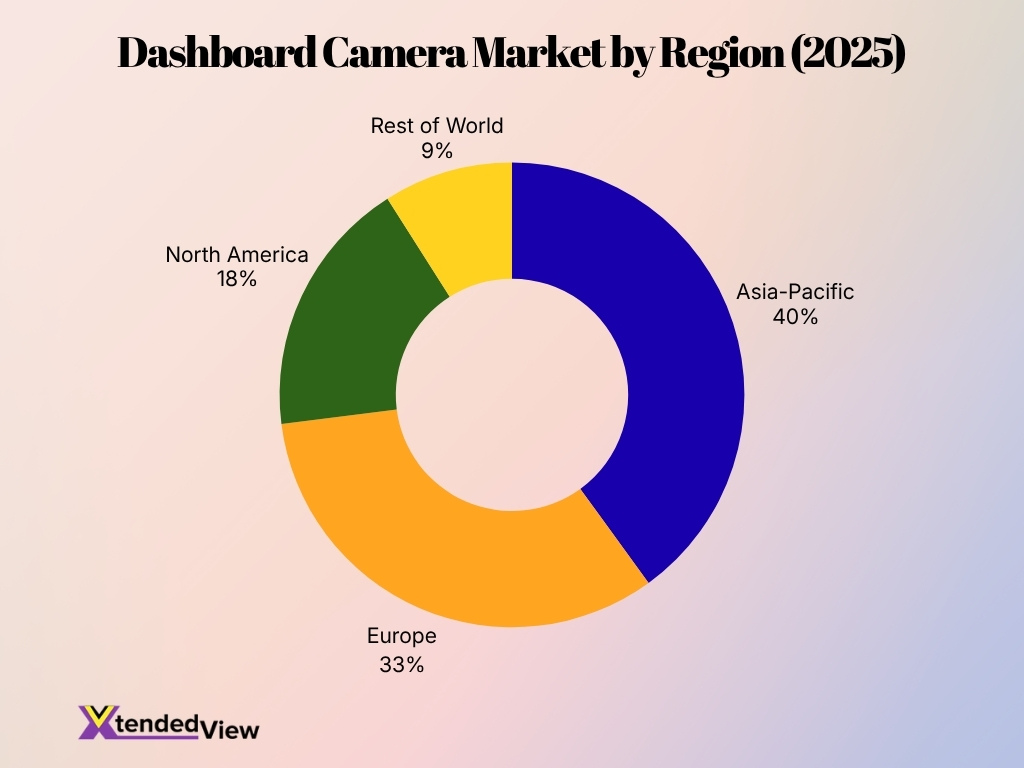
- Asia-Pacific leads the global dashboard camera market with a 40% share, making it the largest regional market in 2025.
- Europe accounts for 33% of the market, representing nearly one-third of global dash cam demand.
- Together, Asia-Pacific and Europe hold 73% of the worldwide market, highlighting their dominance in dash cam adoption and sales.
- North America captures 18% of the global market, positioning it as the third-largest regional market.
- The Rest of World segment contributes 9%, indicating that dash cam penetration remains relatively lower outside the major regions.
- Asia-Pacific’s 40% share is 7 percentage points higher than Europe’s 33%, showing a clear market leadership advantage.
- The market share of Asia-Pacific is more than double that of North America (18%), underscoring stronger adoption across Asian countries.
- Combined, North America and the rest of the world account for 27% of the global market, significantly less than Europe alone.
- The concentration of market share in Asia-Pacific and Europe suggests these regions are key drivers of dash cam innovation, manufacturing, and consumer adoption.
- The regional distribution indicates that future growth opportunities may exist in North America and emerging markets, where overall market penetration remains comparatively lower.
Dashboard Camera Revenue Statistics
- Global dashboard camera revenue is projected to reach approximately $5.96 billion in 2026.
- Industry revenue stood near $5.40 billion in 2025, reflecting strong year-over-year growth.
- Revenue is forecast to climb to $9.76 billion by 2031.
- Another market projection estimates revenue could exceed $10.75 billion by 2034.
- The cloud-connected dash cam segment is generating a growing share of industry revenue due to subscription-based services.
- Fleet camera deployments contribute a substantial portion of recurring software and analytics revenue.
- Premium 4K and AI-enabled devices continue increasing average selling prices across the market.
- North America and Asia-Pacific collectively account for the majority of global dashboard camera revenue.
- Commercial transportation remains one of the highest-value customer segments for dash cam providers.
Market Share Statistics
- Single-channel dashcams currently lead the product architecture with a massive 71.30% revenue share driven by simple installation.
- Dual-channel configurations are experiencing rapid expansion globally and are projected to grow at a 10.78% CAGR through 2031.
- Smart AI-integrated units represent the fastest-growing technology segment, registering an impressive 11.83% CAGR.
- Personal vehicle applications continue to dominate the consumer sector, accounting for 65.20% of total global units.
- Commercial fleet segments exhibit the steepest upward trajectory and are expanding at a robust 10.92% CAGR.
- Online distribution channels are capturing a significantly growing percentage of purchases with an estimated 11.60% CAGR.
- Factory-installed OEM dashcams are accelerating widespread consumer uptake and adding a 1.50% boost to market growth.
- Shipments of AI-powered fleet safety solutions and intelligent camera systems recently experienced a massive 31% growth.
- The overall global dashboard camera market size is officially forecast to reach $6.44 billion by 2026.
AI Dash Cam Feature Adoption Statistics
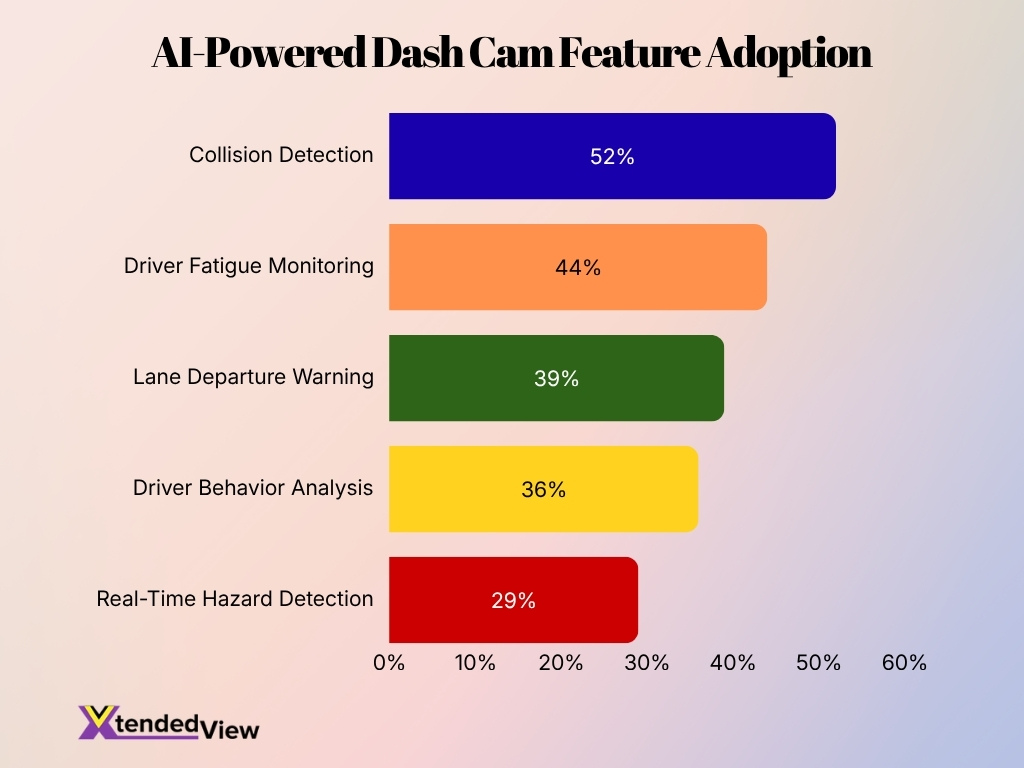
- Collision Detection is the most widely adopted AI feature, with 52% of dash cam users relying on it to help identify and avoid potential accidents.
- Driver Fatigue Monitoring has reached 44% adoption, highlighting growing demand for technologies that improve driver safety during long journeys.
- Lane Departure Warning is used by 39% of users, making it one of the most common advanced driver assistance features in modern dash cams.
- Driver Behavior Analysis has an adoption rate of 36%, showing increased interest in monitoring driving habits such as speeding, harsh braking, and rapid acceleration.
- Real-Time Hazard Detection is currently utilized by 29% of users, reflecting an emerging trend toward proactive road risk identification.
- The adoption gap between the most popular feature, Collision Detection (52%), and the least adopted feature, Real-Time Hazard Detection (29%), is 23 percentage points.
- More than 4 in 10 users have adopted Driver Fatigue Monitoring, emphasizing the importance of reducing drowsy driving incidents.
- Three AI features, Collision Detection (52%), Driver Fatigue Monitoring (44%), and Lane Departure Warning (39%), have achieved adoption rates close to or above 40%.
- Safety-focused capabilities dominate the market, with the top AI features primarily designed to prevent accidents and improve driver awareness.
- The data indicates that AI-powered dash cams are increasingly evolving from simple recording devices into intelligent driver assistance systems with advanced safety functions.
Connected and Cloud-Based Dash Cam Statistics
- The global market for cloud-connected dash cams is projected to surpass $3 billion by 2027.
- Over 60% of modern commercial fleets now utilize cloud-based video platforms for daily operations.
- Utilizing real-time cloud coaching reduces overall fleet accident rates by up to 50%.
- Nearly 75% of premium dash cameras feature remote live-view and instant cloud capabilities.
- Fleets using connected camera systems typically experience up to a 25% reduction in insurance premiums.
- Around 80% of fleet managers consider automated video uploads a mandatory feature for safety.
- Consumer demand for instant parking alerts has driven a 40% increase in cloud subscription sales.
- Advanced cloud-enabled dash cams decrease false claim investigation times by more than 80%.
Future Trends in the Dash Cam Industry
- The global dashboard camera market is projected to grow at a 12.60% CAGR, reaching $17.63 billion by 2035.
- Smart and AI-integrated dash cams are forecast to expand rapidly, registering an 11.83% CAGR through 2031.
- The OEM distribution segment for built-in systems is expected to see peak growth at a 15% CAGR from 2026 to 2035.
- The 4K dashcam segment is anticipated to register the fastest technology growth at a 19.5% CAGR between 2026 and 2035.
- The commercial vehicle segment for fleet operators is expected to grow at a notable 13.5% CAGR over the next decade.
- The aftermarket distribution channel accounted for a substantial majority of global sales with a 68% market share in 2025.
- Passenger vehicles currently dominate the dashboard camera industry, contributing the highest market share of 58% in 2025.
- The full HD dashcams segment held a major technology market share of 36% in 2025.
- The Asia-Pacific region dominated the global landscape, accounting for a leading 38% market share in 2025.
Frequently Asked Questions (FAQs)
The global dashboard camera market is projected to reach $5.96 billion in 2026.
Approximately 30% of U.S. drivers, or about 69 million motorists, currently use a dash cam.
Around 36% of drivers without a dash cam say they are likely to purchase one within the next 12 months.
About 40% of dash cam owners report capturing a crash or traffic-related incident on their device.
The dashboard camera market is forecast to grow at a 10.36% CAGR between 2026 and 2031.
Conclusion
Dashboard cameras have become an important part of modern vehicle safety, insurance documentation, and fleet risk management. The industry continues to expand as consumers seek greater protection on the road and businesses invest in technologies that reduce accidents and liability costs. Market growth remains strong across North America, Europe, and Asia-Pacific, while AI-powered analytics and cloud connectivity are reshaping how dash cams deliver value. Looking ahead, continued advances in video quality, automation, and connected vehicle ecosystems are expected to drive adoption even further throughout the remainder of the decade.
