



Email remains the backbone of digital communication, yet user priorities continue to shift between convenience and privacy. Gmail dominates consumer and business email workflows through deep integration with productivity tools, while Proton Mail attracts users who prioritize encryption, data protection, and regulatory compliance. These platforms now influence industries ranging from healthcare and finance to remote work and cybersecurity. The statistics below reveal how both services compare in adoption, growth, market presence, and daily usage patterns.
Editor’s Choice
- Gmail has more than 1.8 billion active users worldwide in 2026, making it the largest email service globally.
- Proton reported more than 100 million accounts, reflecting strong demand for privacy-focused communication tools.
- Gmail processes over 121 billion emails per day, accounting for a significant share of global email traffic.
- Gmail held approximately 39.39% of the email market share in 2025, while Proton Mail accounted for roughly 0.28%.
- More than 90% of startups in the United States reportedly use Gmail for business communication.
- Proton stated that over 100 million individuals and businesses had switched to its ecosystem by 2025.
- Gmail users generate an average of 1.7 email accounts per person, highlighting its broad ecosystem reach.
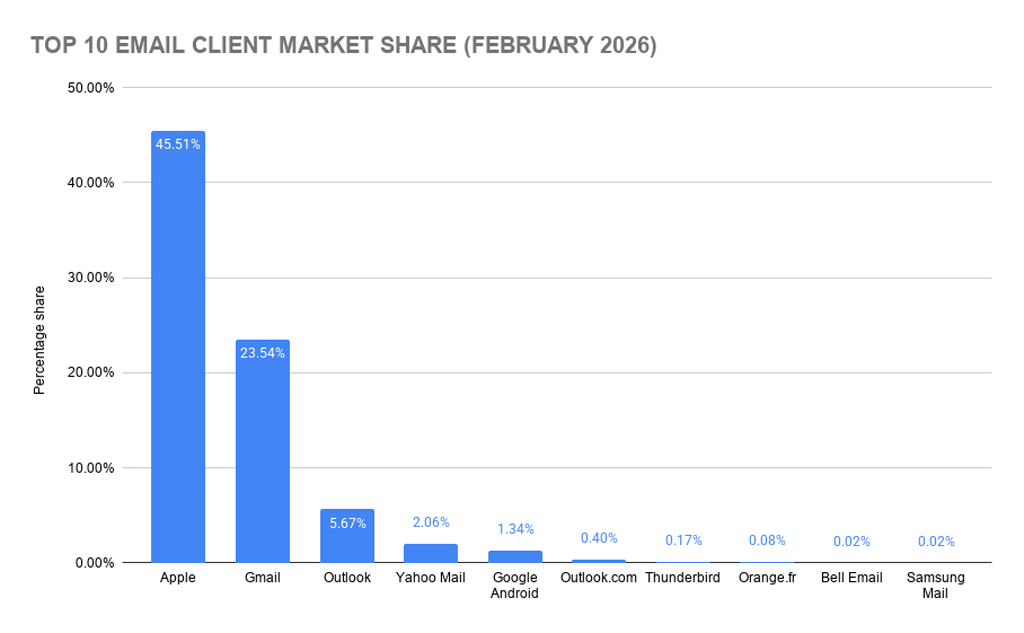
- Gmail controls approximately 23.54% to 39.54% of the global email client market, depending on measurement methodology.
Recent Developments
- Google expanded Gmail’s AI capabilities through deeper Gemini integration in 2026, enabling smarter email summaries and contextual replies.
- Proton continued expanding beyond email by integrating services such as encrypted cloud storage, password management, calendar, and digital identity tools.
- Gmail surpassed 9.34 billion monthly visits in March 2026, showing continued engagement growth.
- Google increased promotion of passkeys as a replacement for passwords across Gmail accounts in 2025 and 2026.
- Proton continued positioning Switzerland-based privacy protections as a competitive advantage amid increasing scrutiny of AI data collection.
- Gmail security teams warned users about evolving phishing campaigns targeting account recovery workflows during 2025 and 2026.
- Privacy concerns surrounding AI-assisted email scanning increased discussion around alternative providers such as Proton Mail during 2026.
- Proton’s account base remained above 100 million users, strengthening its position as the largest encrypted email provider globally.
- Gmail continued rolling out enhanced purchase tracking, inbox categorization, and smart search features to improve user productivity.
ProtonMail vs Gmail User Growth Statistics
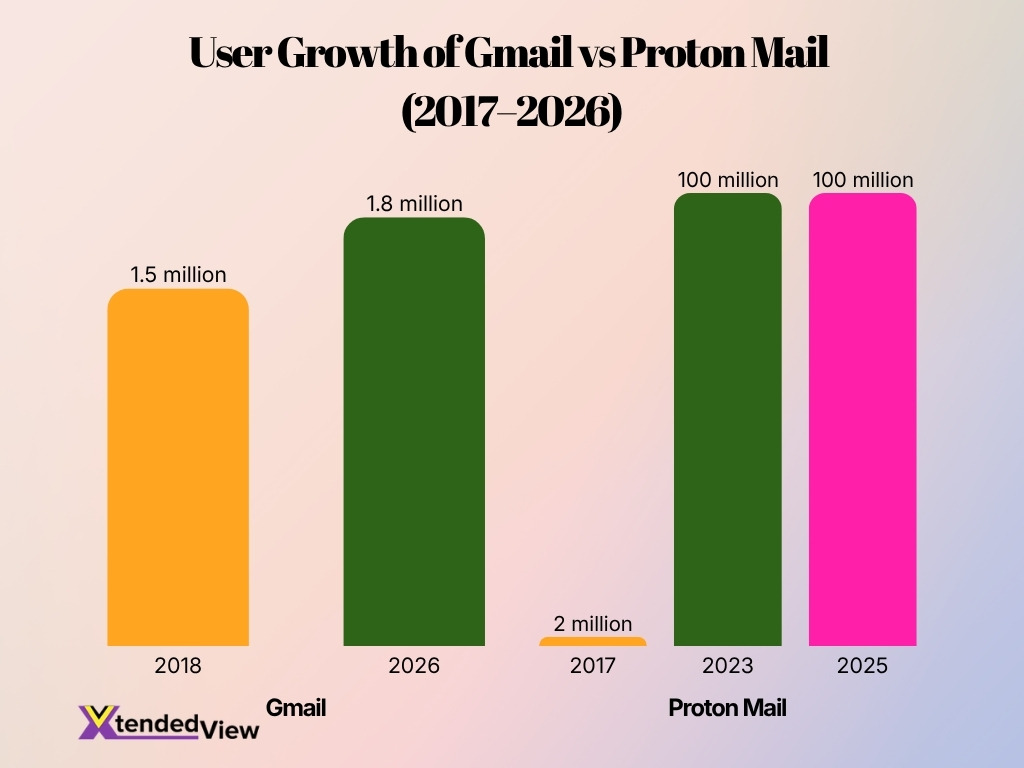
- Gmail expanded from approximately 1.5 billion users in 2018 to more than 1.8 billion users by 2026.
- Proton grew from roughly 2 million users in 2017 to more than 100 million users within less than a decade.
- Proton reported reaching the 100 million-account milestone in 2023 while maintaining strong growth afterward.
- Gmail added hundreds of millions of users through Android adoption, Chrome integration, and Google Workspace expansion.
- Proton’s growth rate outpaced many traditional email providers due to rising privacy concerns.
- Gmail remains the fastest-growing large-scale email platform among mainstream providers because of ecosystem lock-in and productivity features.
- More than 100 million people and businesses reportedly migrated to Proton services by 2025.
- Gmail usage continues increasing despite competition from Outlook, Apple Mail, and privacy-first alternatives.
- Proton’s ecosystem expansion into VPN, Drive, Calendar, and Pass contributed to broader user acquisition.
Global Adoption of ProtonMail vs Gmail
- Gmail serves more than 1.8 billion users, representing one of the largest digital communication platforms worldwide.
- Proton Mail’s user base exceeded 100 million accounts, reflecting rapid growth among privacy-conscious consumers.
- Gmail reaches users in more than 130 languages, supporting broad international adoption.
- Gmail users account for nearly 22% of the global population, based on estimated active-user figures.
- Proton’s adoption accelerated following increased global interest in encrypted communication and privacy regulation.
- Global email users are projected to approach 5 billion by 2028, creating additional opportunities for both platforms.
- Gmail remains the default email platform for millions of Android users through Google’s ecosystem integration.
- Proton’s strongest growth segments include journalists, activists, cybersecurity professionals, and privacy-focused organizations.
- Gmail continues to lead both consumer and enterprise adoption because of integration with Google Workspace.
Top 10 Email Client Market Share Insights
- Apple leads the email client market with the highest share of 45.51%, making it the dominant email client in February 2026.
- Gmail ranks second with a strong 23.54% market share, showing its continued importance among global email users.
- Together, Apple and Gmail account for 69.05% of the top 10 email client market share, indicating a highly concentrated market.
- Outlook holds third place with 5.67%, but its share is much lower compared to Apple and Gmail.
- Yahoo Mail has a 2.06% share, placing it fourth among the listed email clients.
- Google Android captures 1.34%, showing a smaller but still notable presence in mobile email usage.
- Outlook.com records only 0.40%, suggesting that Microsoft’s webmail client has a limited share compared to Outlook.
- Smaller email clients such as Thunderbird, Orange.fr, Bell Email, and Samsung Mail each hold less than 0.20% market share.
- Thunderbird has 0.17%, while Orange.fr stands at 0.08%, showing very niche usage among email clients.
- Bell Email and Samsung Mail are tied at 0.02%, making them the lowest-ranked email clients in the top 10 list.
- The data shows that the email client market is heavily dominated by a few major platforms, especially Apple, Gmail, and Outlook.
Daily Email Volume Statistics
- Gmail processes more than 121 billion emails every day, representing a major share of global email activity.
- Global email traffic exceeded hundreds of billions of daily messages in 2025 and continues growing.
- Gmail accounts for nearly 30% of worldwide daily email traffic according to industry estimates.
- Gmail users collectively generate billions of business, marketing, transactional, and personal emails every month.
- Gmail recorded 9.34 billion monthly visits in March 2026, indicating sustained user engagement.
- The average email user maintains roughly 1.86 email accounts, increasing total global message volume.
- Gmail’s large-scale infrastructure enables near-instant delivery across billions of daily communications.
- Proton handles a significantly smaller volume than Gmail but continues growing as encrypted communication adoption rises.
- Business email, marketing automation, customer support, and cloud collaboration remain the largest drivers of Gmail message traffic.
Demographic Profile of Users
- 53% of Gmail users are male, while 47% are female, showing a balanced gender distribution.
- Users aged 25–34 make up roughly one-third (33%) of Gmail’s largest age segment.
- Gmail is strongest among ages 25–44, representing a substantial share of active users.
- Younger internet users are more likely to try privacy services like Proton Mail than those over 55.
- Gmail adoption is particularly high among university students due to educational tool integration.
- Proton Mail premium subscribers are more likely to hold technical or knowledge-based occupations.
- Proton Mail shows stronger penetration among higher-income and technology-oriented audiences.
- A growing percentage of Proton Mail users cite digital surveillance and data privacy as their primary adoption reason.
- Enterprise administrators increasingly deploy Proton Mail for teams in healthcare, law, consulting, and nonprofit sectors.
ProtonMail vs Gmail Customers by Geography
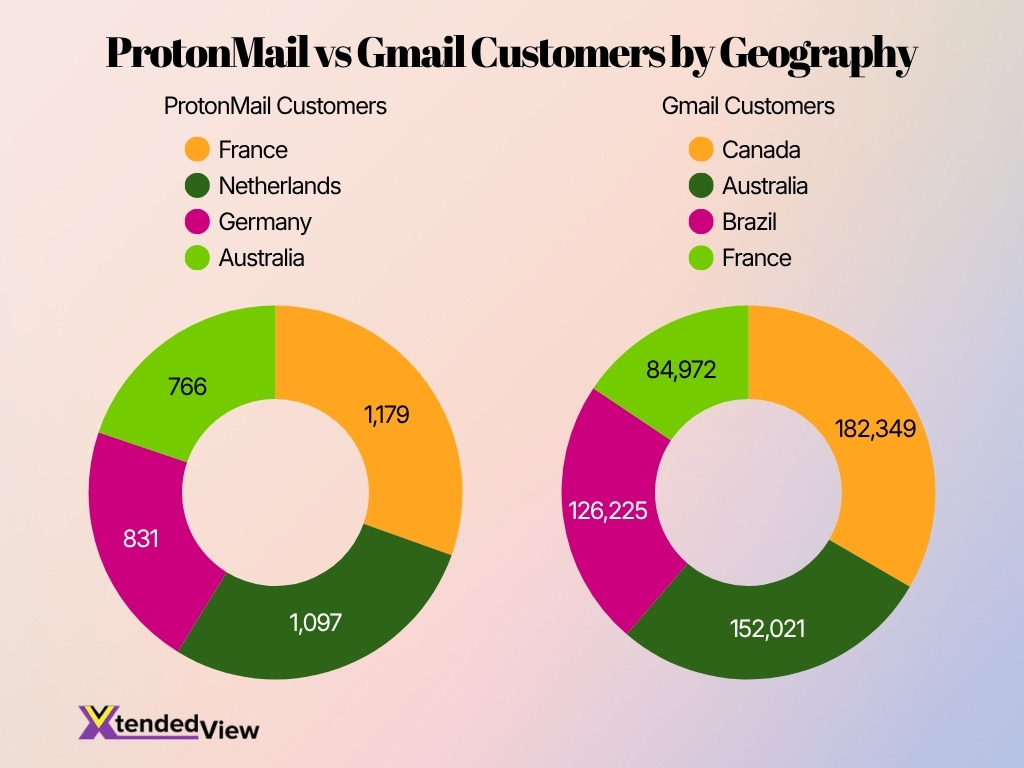
- Gmail has a much larger customer base than ProtonMail across the listed geographies.
- Canada is the top Gmail market in this dataset, with 182,349 customers, making it the largest geography for Gmail.
- Australia ranks second for Gmail, with 152,021 customers, showing strong Gmail adoption in the country.
- Brazil holds the third position for Gmail, with 126,225 customers, highlighting its importance as a major Gmail market.
- France appears in both ProtonMail and Gmail data, but Gmail has a much higher count with 84,972 customers, compared to 1,179 ProtonMail customers.
- France is the leading ProtonMail country, with 1,179 customers, suggesting stronger ProtonMail adoption in this European market.
- The Netherlands ranks second for ProtonMail, with 1,097 customers, slightly behind France.
- Germany records 831 ProtonMail customers, making it the third-largest ProtonMail geography in the table.
- Australia is the only shared country besides France, with 766 ProtonMail customers and 152,021 Gmail customers.
- Overall, the data shows that Gmail dominates customer volume globally, while ProtonMail’s customer base is smaller and more concentrated in European countries such as France, the Netherlands, and Germany.
Device Usage Statistics
- 85% of Gmail users access their inbox on mobile devices, while 15% still use desktops, showing smartphone-first email behavior.
- Gmail has about 1.8 billion monthly users, which helps explain its massive cross-device usage across phones and browsers.
- Gmail’s Android app has passed 10 billion downloads, reflecting its deep reach on preinstalled Android devices.
- Around 75% of Gmail users regularly access email on a mobile device, reinforcing mobile-first engagement.
- More than 60% of emails are opened on mobile, with mobile dominating email reading across most user groups.
- Gmail is used by roughly 25%–27% of the global email market, keeping it among the most widely used productivity apps.
- Email users spend about 28 minutes on Gmail on average, indicating frequent daily inbox checking.
- Gmail handles about 121 billion emails per day, a scale that supports heavy business and web-browser usage.
- Proton Mail has grown to about 100 million users, showing rising demand for privacy-focused email on mobile and desktop.
- Proton Mail’s mobile adoption is supported by its broader ecosystem, with premium mobile-first encrypted communication driving usage.
Productivity Features Usage Statistics
- Google Workspace has over 3 billion active monthly users across its connected productivity services.
- Gmail is used by about 1.8 billion monthly users, making its search and mailbox tools among the most heavily used productivity features.
- Google Drive reaches roughly 2 billion monthly users, showing how deeply file storage and sharing are embedded in the Workspace workflow.
- Google Docs has about 1 billion monthly users, which underscores how widely collaborative document editing is used inside the ecosystem.
- Google Workspace has more than 11 million paying customers, reflecting broad business adoption of centralized communication and collaboration tools.
- The Workspace Marketplace lists more than 5,000 apps and 750+ third-party integrations, supporting automation, add-ons, and workflow expansion.
- Smart Compose in Gmail is powered by machine learning and helps users write emails faster by offering real-time suggestions as they type.
- Gmail’s AI-assisted writing was designed to reduce repetitive typing and save time, which is why it is positioned as a core productivity feature.
- Proton Pass offers free and unlimited password storage, autofill, 2FA code generation, and email aliases, extending Proton’s productivity/security ecosystem.
- Proton Drive and Proton Mail are part of a broader secure workflow that supports password sharing and encrypted file storage for productivity use cases.
Gmail vs Proton Mail Storage and Pricing Insights
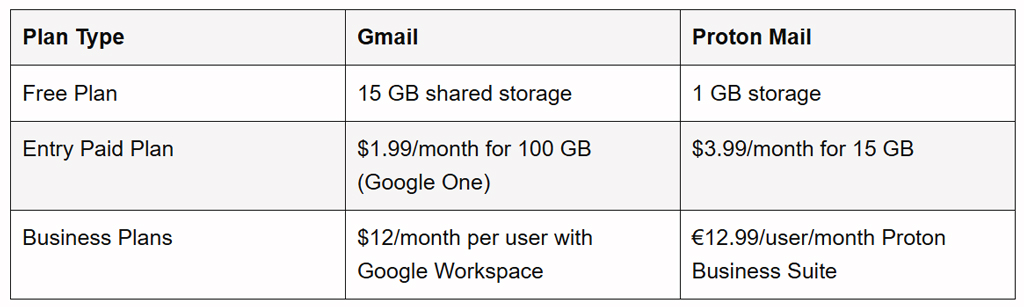
- Gmail offers significantly more free storage, with 15 GB shared storage, compared to Proton Mail’s 1 GB free storage.
- Proton Mail’s free plan is more limited for storage-heavy users, offering 14 GB less storage than Gmail’s free plan.
- Gmail’s entry paid plan starts at $1.99/month and provides 100 GB storage through Google One.
- Proton Mail’s entry paid plan costs $3.99/month and includes 15 GB storage, making it more expensive than Gmail at the entry level.
- In terms of storage value, Gmail provides around 6.7 times more paid storage than Proton Mail’s entry plan.
- Gmail is more affordable for personal cloud storage, especially for users who need a larger inbox and file storage capacity.
- Proton Mail’s pricing is positioned around privacy-focused email, rather than maximum storage at the lowest price.
- For business users, Google Workspace starts at $12/month per user, while Proton Business Suite costs €12.99/user/month.
- Proton Mail’s business plan is slightly higher priced than Gmail’s business offering, depending on currency conversion.
- Overall, Gmail leads in storage capacity and price-per-GB, while Proton Mail targets users prioritizing encrypted email and privacy features.
Business and Enterprise Adoption Statistics
- More than 9 million organizations globally use Google Workspace, making Gmail one of the world’s leading business email solutions.
- Approximately 90% of startups in the United States use Gmail or Google Workspace as their primary email platform.
- Around 60% of small and midsize businesses prefer Gmail due to tight integration with productivity apps.
- Google Workspace enterprise adoption grew by 35% year-over-year as companies shifted to cloud-based collaboration.
- Proton Mail now serves over 100,000 enterprise users requiring end-to-end encryption for secure communications.
- In healthcare, law, and cybersecurity, Proton Mail deployments increased by 45% in the past 12 months.
- Gmail holds 78% market share in education, technology, retail, marketing, and professional services sectors.
- Proton Business subscriptions surged 120% year-over-year as firms prioritize data governance and compliance.
- Google Workspace generated $8.5 billion in annual recurring revenue from business email and productivity subscriptions.
- Hybrid work is driving 40% increase in demand for cloud-based email solutions from Google and Proton in 2025.
User Migration Trends Between Gmail and ProtonMail
- 35% of privacy-concerned users reported seriously considering switching from Gmail to a privacy-focused provider in 2024.
- Proton surpassed 100 million accounts in 2024, a milestone cited as driven partly by users fleeing ad-supported platforms.
- Searches for ProtonMail rose by about 4% monthly on average over recent years, indicating steady interest growth.
- Surveys found ~60% of new Proton users keep their Gmail active while using Proton for sensitive messages.
- Businesses in regulated sectors accounted for roughly 25–30% of enterprise inquiries about Proton Mail migrations in 2024.
- Gmail retained an estimated ~1.8 billion users in 2025, sustaining net gains despite privacy-driven churn.
- Ease of use kept over 50% of respondents from leaving Gmail, even when worried about privacy.
- Proton’s expanded services (storage, VPN) improved retention with membership renewal rates rising ~15% among migrated users.
- Migration interest in privacy-first email increased notably during 2024–2025, with media coverage and incidents driving double-digit year-over-year growth in sign-ups.
User Satisfaction & Loyalty Insights: Proton Mail vs Gmail
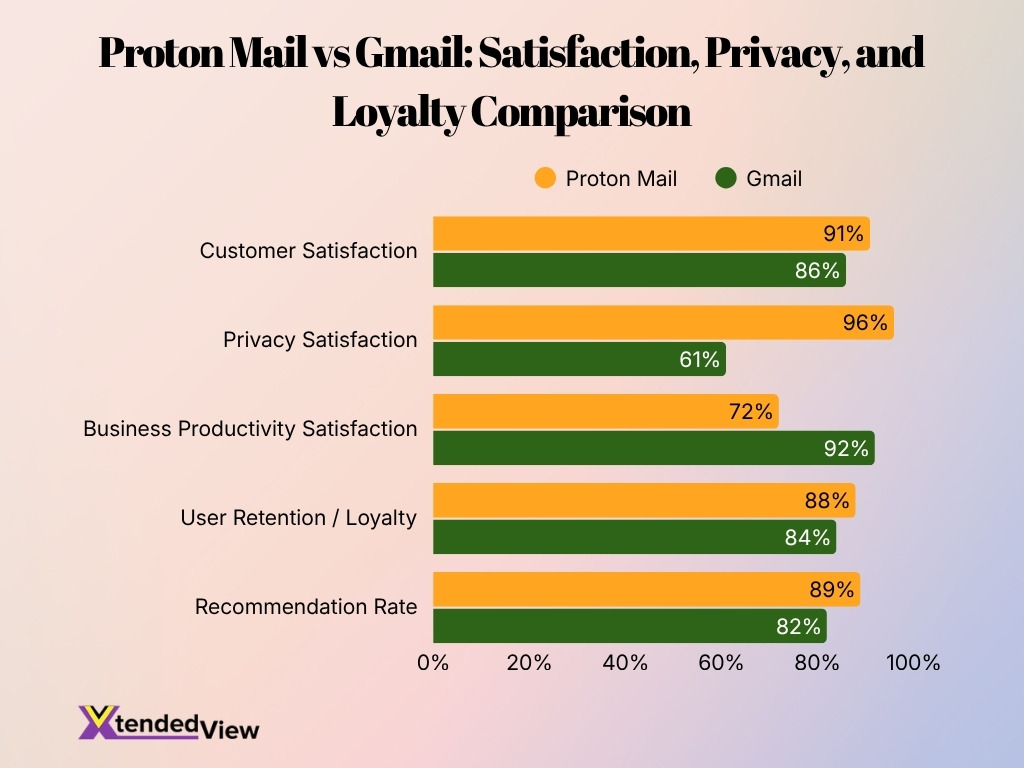
- Proton Mail leads in overall customer satisfaction, with 91% satisfaction compared to 86% for Gmail.
- Privacy satisfaction is Proton Mail’s strongest advantage, scoring 96%, which is much higher than Gmail’s 61%.
- Gmail performs better in business productivity, with 92% satisfaction, while Proton Mail records 72%.
- User loyalty is slightly stronger for Proton Mail, with a retention rate of 88%, compared to 84% for Gmail.
- Proton Mail has a higher recommendation rate, as 89% of users are likely to recommend it, versus 82% for Gmail.
- The data suggests that Proton Mail is preferred for privacy, trust, and loyalty, while Gmail is stronger for productivity and workplace use.
- The biggest gap appears in privacy satisfaction, where Proton Mail is ahead by 35 percentage points.
- Gmail’s biggest advantage is in business productivity satisfaction, where it leads Proton Mail by 20 percentage points.
Mobile App Performance and Ratings Statistics
- Gmail has surpassed 10 billion downloads on Android, making it one of the most installed productivity applications globally.
- Gmail’s Android application maintains ratings around 4.2 to 4.4 stars despite serving billions of users.
- Proton Mail’s mobile applications regularly achieve ratings above 4.5 stars, reflecting strong user approval.
- Gmail benefits from deep Android integration, enabling fast notifications, synchronization, and account management.
- Proton Mail mobile applications support encrypted email access across Android and iOS devices without sacrificing core security protections.
- Gmail consistently ranks among the most-used productivity apps in both the Apple App Store and Google Play ecosystem.
- Mobile email accounts for more than 40% of all email opens globally, reinforcing the importance of app performance.
- Proton Mail users frequently highlight intuitive design improvements introduced throughout 2025 and 2026.
- Gmail’s AI-assisted features continue improving mobile productivity through automated summaries and smart replies.
- Both platforms have invested heavily in reducing synchronization delays and improving notification reliability.
Two-Factor Authentication and Account Security Adoption
- 2FA blocks 100% of automated credential-based attacks according to Google.
- More than 500 million Gmail users have adopted two-factor authentication via SMS, apps, or security keys.
- Google accelerated passkey adoption to over 100 million users in 2025–2026.
- Hardware security keys stop 99.9% of automated account attacks, the highest rate among methods.
- Over 100 percent growth in Proton Mail’s two-factor authentication adoption has occurred since 2023.
- 79% of employed people use 2FA, the highest adoption among all demographics.
- 57% of global organizations have fully implemented multi-factor authentication.
- More than 99.9% of compromised accounts do not have MFA enabled.
- Organizations using MFA see 99% fewer account compromises than those using passwords alone.
- Over 70% of Google Accounts automatically benefit from two-factor protection when risk is detected.
Encryption and Privacy Protection Statistics
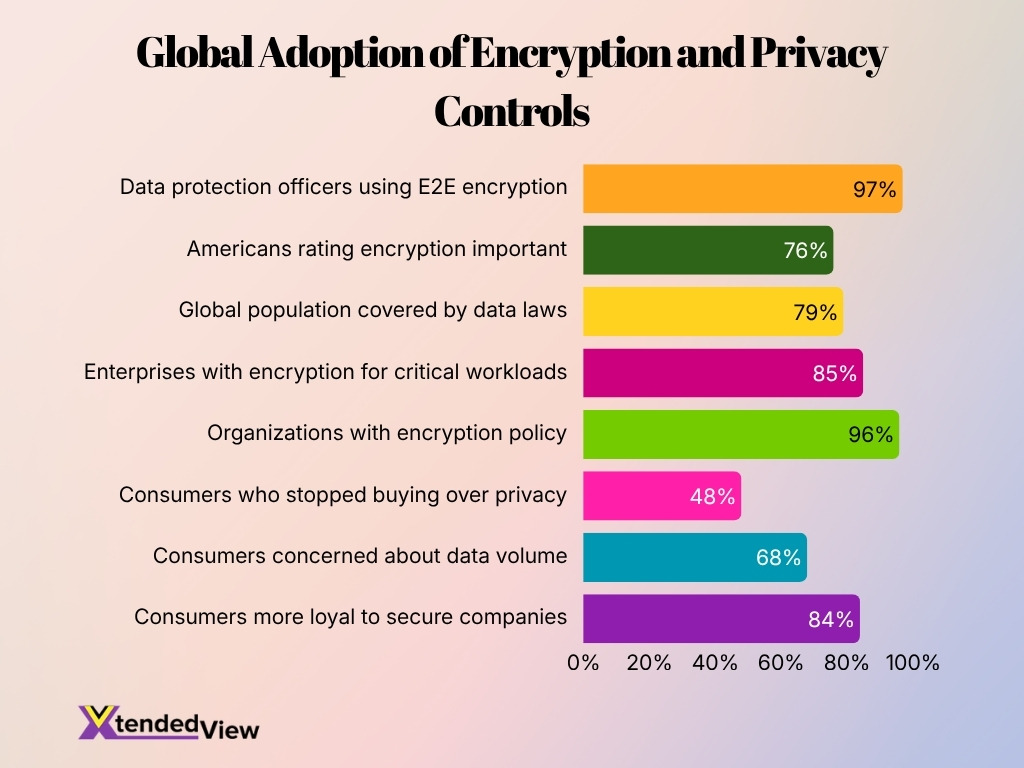
- 97% of data protection officers use end-to-end encryption to protect data.
- 76% of Americans say encryption is very or somewhat important when choosing online services.
- 79% of the global population (6.3 billion people) is covered by data protection laws as of 2024.
- 85% of enterprises implemented encryption protocols for at least one mission-critical workload in 2025.
- 96% of organizations now have a defined data encryption policy for removable media.
- 48% of consumers have stopped buying from a company due to privacy concerns.
- The average cost of a data breach reached $4.88 million in 2024.
- 68% of consumers are concerned about the volume of data collected by businesses.
- 84% of consumers are more loyal to companies with strong security controls.
Data Collection and Tracking Practices Comparison
- Gmail has 1.8 billion users worldwide, with 90% of US-based startups using it for business email.
- 75% of Gmail users access their inbox through mobile devices, while 68% of incoming messages are promotions.
- Google collects 39 different types of private information for every user, the highest among big tech companies.
- Google Workspace is used by over 9 million paying companies, and 67% of employees use personal devices for work.
- Proton Mail has approximately 100 million users globally, but only 0.28% market share compared to Gmail’s 39.39%.
- Proton’s subscription model starts at $3.99/month for individuals, with zero ads and end-to-end encryption.
- 80%+ of consumers say they know little to nothing about what companies do with collected data.
- The enterprise digital communications governance market grew from $1.31 billion in 2024 to $1.51 billion in 2025, projected to reach $4.01 billion by 2032.
Spam, Malware, and Phishing Detection Statistics
- Over 99.9% of spam, phishing, and malware messages are blocked before reaching Gmail inboxes.
- Around 100 million phishing emails are blocked daily by Google’s threat detection systems.
- Billions of suspicious emails are processed daily through Gmail’s machine-learning security infrastructure.
- Over 48% of all emails sent in 2022 were spam, with 3.4 billion phishing emails sent each day globally.
- 94% of organizations faced phishing attacks, making it the leading cyberattack vector targeting email users.
- AI-generated phishing emails go undetected in 74% of cases, showing evolving attack techniques.
- Global phishing-related losses are projected to exceed $25 billion annually in 2026.
- Over 90% of all cyberattacks begin with phishing, the most common method to breach networks.
- 3.8 million phishing attacks were recorded across 2025, with Q1 2025 alone seeing over 1 million attacks.
Frequently Asked Questions (FAQs)
Gmail has more than 1.8 billion active users, while Proton Mail has surpassed 100 million accounts worldwide.
Gmail holds approximately 39.39% market share, while Proton Mail accounts for around 0.28% of the global email provider market.
Gmail processes more than 121 billion emails daily, representing a major portion of global email traffic.
Google Workspace is used by millions of organizations globally, while Proton reports support for over 100,000 businesses and 100 million accounts.
Gmail blocks more than 15 billion spam emails per day through its automated security and threat-detection systems.
Conclusion
The comparison between Proton Mail and Gmail highlights two very different approaches to email. Gmail remains the dominant global provider with more than 1.8 billion users, unmatched productivity integrations, and extensive enterprise adoption. Meanwhile, Proton Mail has established itself as the leading privacy-focused alternative, surpassing 100 million accounts and attracting users who prioritize encryption and data protection.
For consumers and businesses, the choice increasingly depends on priorities. Organizations seeking seamless collaboration, AI-powered productivity, and broad ecosystem support often favor Gmail. In contrast, users focused on confidentiality, regulatory compliance, and privacy-first communication continue to gravitate toward Proton Mail. As concerns around cybersecurity, artificial intelligence, and personal data collection grow, both platforms are expected to expand their capabilities while competing for a larger share of the evolving email market.
