


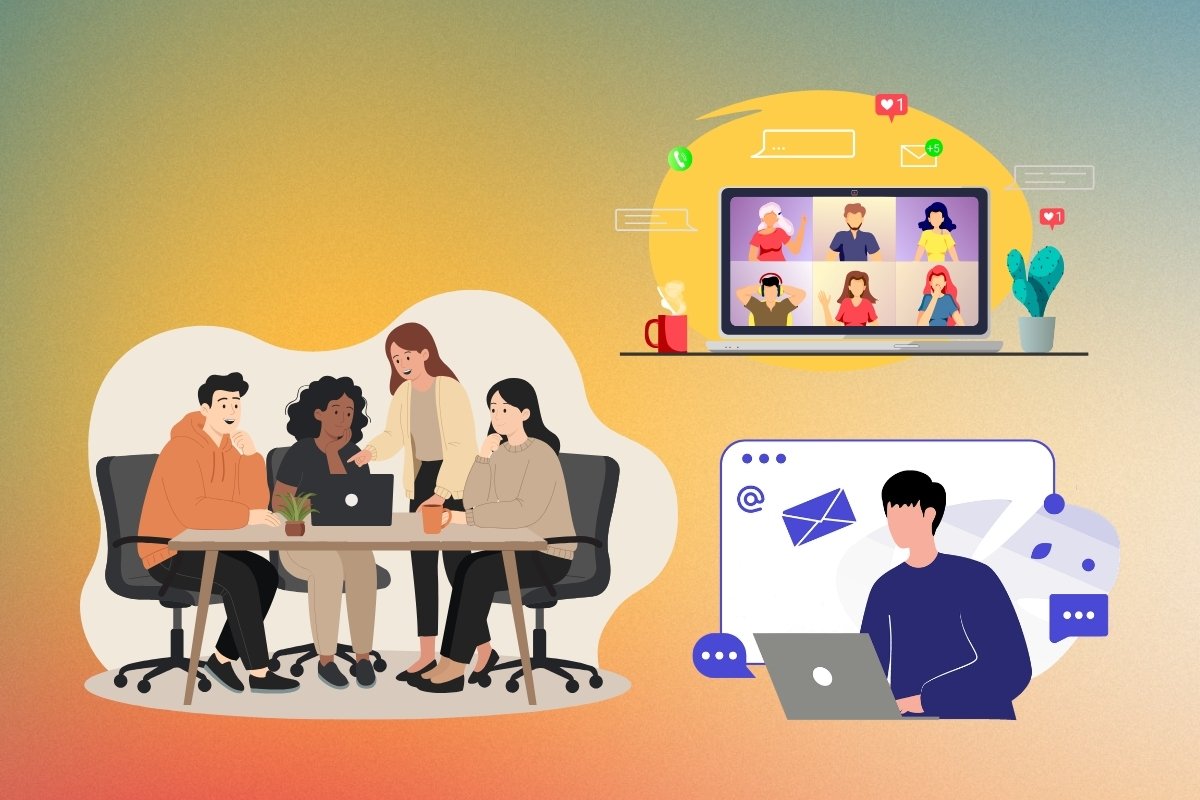
Workplace communication sits at the core of how modern organizations operate, from coordinating hybrid teams to aligning leadership with frontline employees. In industries like healthcare and tech, clear communication directly impacts patient safety, product delivery speed, and customer satisfaction. As companies scale remote work and adopt tools like Slack or Microsoft Teams, the stakes for getting communication right continue to rise. Let’s explore the latest workplace communication statistics and see what the data reveals about performance, engagement, and business outcomes.
Editor’s Choice
- 86% of employees cite poor communication as a leading cause of workplace failures.
- Ineffective communication costs U.S. businesses up to $1.2 trillion annually.
- Companies with strong communication practices are 25% more productive.
- Disengaged employees cost the global economy $438 billion in lost productivity.
- Only 26% of employees are engaged at work in the 2026 reports.
- 68% of organizations that improved communication saw better employee engagement.
- Miscommunication can cost $54,860 per senior employee annually.
Recent Developments
- AI-driven communication tools are becoming a top priority for internal comms teams in 2026.
- Employee engagement remains the primary strategic goal for 42% of communication teams.
- 84% of business leaders now use more communication channels than ever before.
- Hybrid work has increased reliance on written communication by 18% year over year.
- Only 27% of leaders believe their teams are fully aligned, while just 9% of employees agree.
- 79% of internal communicators say employee engagement is their top priority.
- Workplace communication strategies are shifting toward employee experience and a well-being focus in 2026.
- 74% of employees say they receive the right amount of information from employers.
Overall Workplace Communication Trends
- 97% of employees say communication impacts their daily task efficiency.
- 66% of leaders experience miscommunication at least once daily.
- 48% of leaders report multiple communication breakdowns per day.
- 100% of employees report experiencing miscommunication at least once weekly.
- 84% of organizations now juggle multiple communication tools simultaneously.
- Around 70% of employees say better communication would boost productivity.
- 75% of employees say communication directly impacts job satisfaction.
- 57% of employees say better communication reduces misunderstandings.
- Workplace communication complexity continues to rise with hybrid and distributed teams.
Impact of Poor Workplace Communication
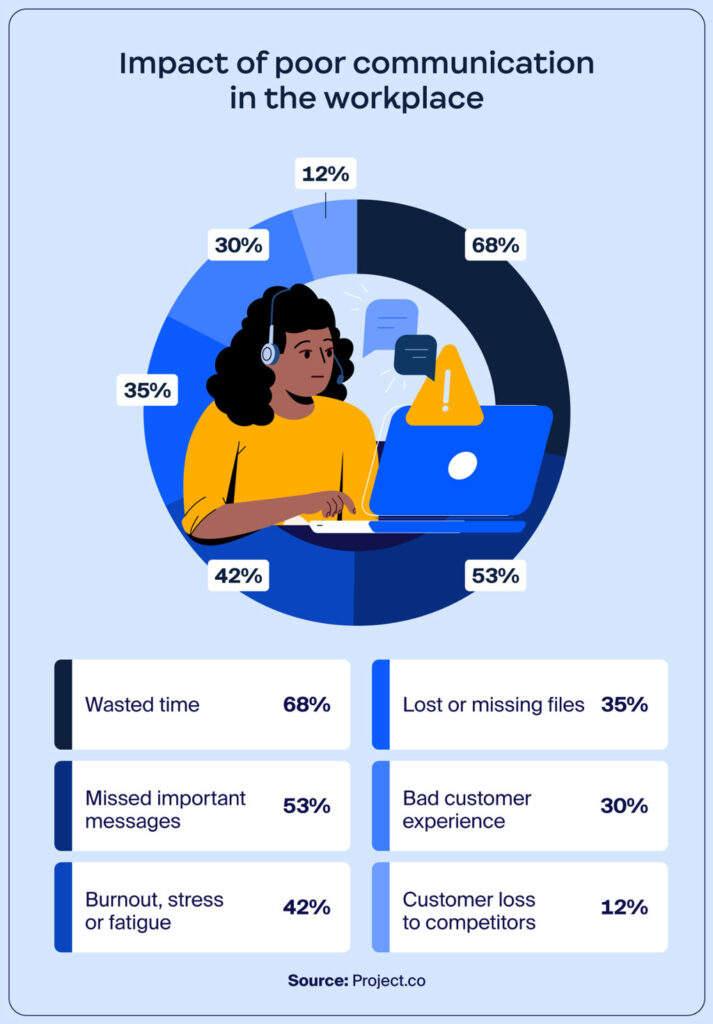
- 68% of employees report wasted time, making it the most significant consequence of poor workplace communication.
- 53% experience missed important messages, highlighting serious gaps in information flow and alignment.
- 42% suffer from burnout, stress, or fatigue, indicating a strong link between communication issues and employee well-being.
- 35% deal with lost or missing files, showing inefficiencies in document management and collaboration systems.
- 30% report a bad customer experience, demonstrating how internal communication failures directly impact customer satisfaction.
- 12% of businesses lose customers to competitors, revealing the long-term revenue risk associated with poor communication.
Communication and Employee Productivity
- Employees spend 19% of their workweek searching for information due to poor communication.
- Improved communication and collaboration tools can raise productivity by up to 25%.
- 64% of business leaders report lost productivity due to ineffective communication.
- Workers lose an average of 5 hours per week waiting for information or clarification.
- 72% of employees say clear communication boosts their productivity.
- Organizations with effective communication are 3.5 times more likely to outperform peers.
- 86% of employees cite lack of collaboration or communication as a reason for workplace failures.
- Teams using structured communication tools report 20–30% faster project completion rates.
- Employees who feel well-informed are 2.8 times more productive than those who don’t.
Communication and Employee Engagement
- Only 26% of employees globally feel engaged at work.
- Companies with strong internal communication see 4.5x higher employee engagement.
- 74% of employees feel more engaged when leadership communicates transparently.
- 85% of employees say they feel most motivated when communication is consistent.
- 80% of employees want more frequent communication from their managers.
- Teams with high engagement show 21% higher profitability.
- 68% of employees say they disengage when communication is unclear.
- Regular feedback and communication improve engagement levels by 3.6 times.
- Employees who receive daily communication updates are more than twice as engaged as those who don’t.
Workplace Communication Benefits
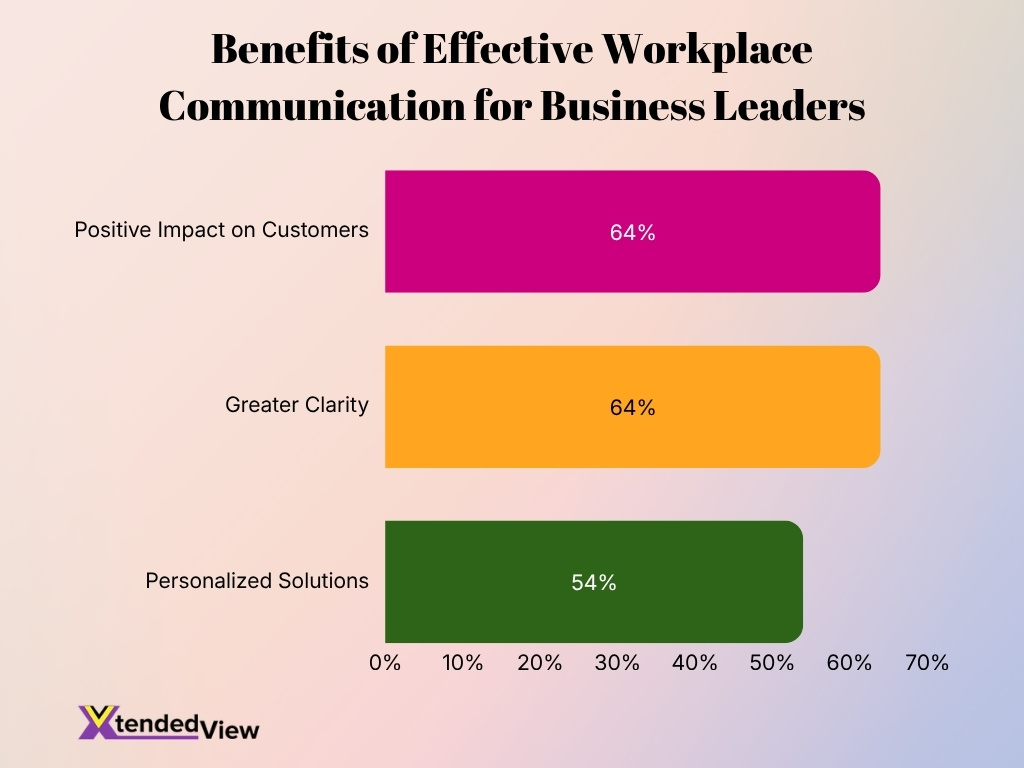
- 64% of business leaders report a positive impact on customers, highlighting how effective communication directly improves customer experience and satisfaction.
- Another 64% emphasize greater clarity, indicating that clear communication helps reduce misunderstandings and enhances overall workplace efficiency.
- 54% of leaders say it enables personalized solutions, showing that strong communication allows businesses to better understand and meet individual customer needs.
- The data reveals that customer impact and clarity are the top benefits, both tied at 64%, making them the most significant outcomes of effective communication.
- While slightly lower, personalization (54%) still represents a major competitive advantage, especially in customer-centric industries.
- Overall, the statistics demonstrate that effective workplace communication is a critical driver of business success, influencing both internal operations and external customer relationships.
Communication and Employee Morale and Trust
- 58% of employees trust companies that communicate openly during change.
- 69% of employees say transparency builds stronger workplace trust.
- Poor communication reduces morale for over 40% of employees.
- Employees who trust leadership are 5 times more likely to stay with the company.
- 63% of employees say a lack of communication lowers their job satisfaction.
- Teams with strong communication report 50% higher morale levels.
- 74% of employees say clear communication improves trust in leadership.
- Employees with high trust levels show 76% more engagement and 40% less burnout.
- 47% of employees report that unclear communication causes workplace stress and distrust.
Communication and Employee Wellbeing and Burnout
- 41% of employees report burnout due to unclear communication or expectations.
- Employees experiencing poor communication are 2.5 times more likely to report high stress.
- 60% of workers say unclear communication contributes to workplace anxiety.
- Clear communication reduces burnout risk by up to 23%.
- Employees who feel informed are 70% less likely to experience workplace stress.
- 54% of employees say communication overload contributes to burnout.
- Workers who receive regular updates report 30% better mental well-being.
- 65% of employees say unclear roles and expectations increase stress levels.
- Companies with strong communication cultures report lower absenteeism by 41%.
Workplace Communication Trends and Tool Usage Insights
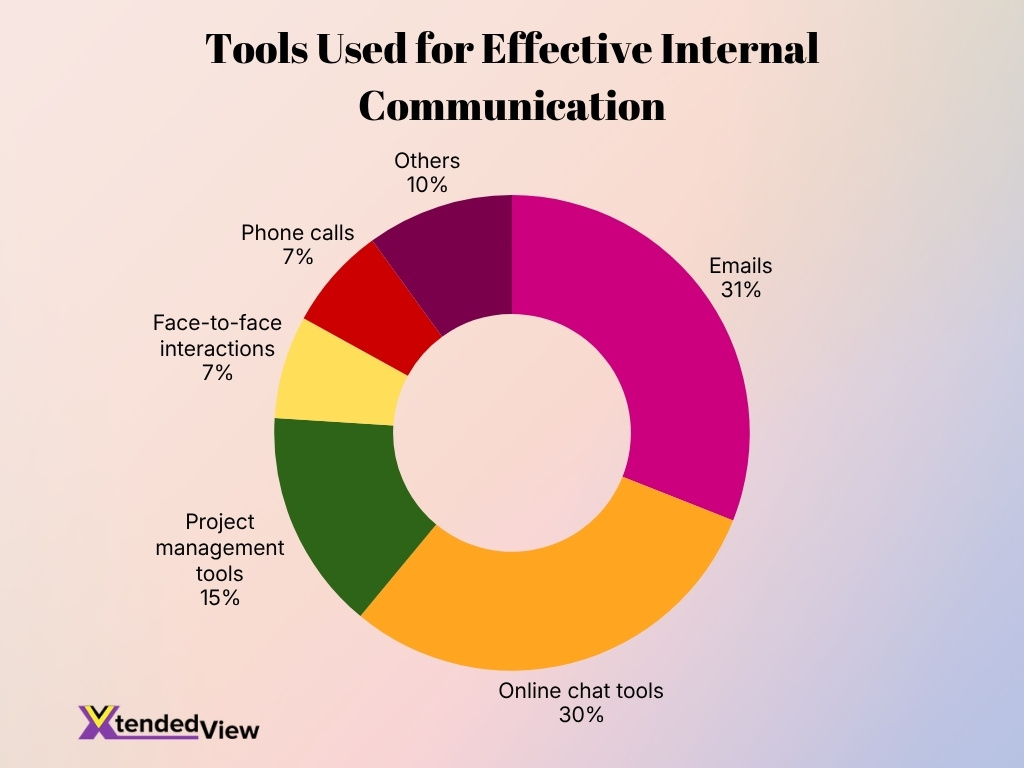
- Emails lead usage at 31%, making them the most dominant communication channel for formal and documented exchanges.
- Online chat tools are nearly equal at 30%, showing a strong preference for instant, real-time communication in teams.
- Combined, emails and chat tools account for 61%, highlighting a clear shift toward digital-first communication environments.
- Project management tools contribute 15%, reinforcing their importance in task tracking, collaboration, and workflow management.
- Traditional communication methods like face-to-face interactions (7%) and phone calls (7%) have relatively low adoption, indicating reduced reliance on offline communication.
- The “Others” category at 10% suggests organizations are also using specialized or emerging tools beyond mainstream platforms.
- Overall, digital communication tools (emails, chat, project tools) dominate with 76%, emphasizing the rise of remote work and hybrid collaboration models.
Most Used Workplace Communication Channels
- Email remains the top workplace channel, with 4.6 billion users worldwide in 2025.
- 86% of business professionals prefer email for work communication.
- 93% of professionals check their email daily, showing how deeply it is built into work routines.
- Teams users receive about 153 messages per workday, making chat a major daily channel.
- Workers also get around 117 emails per day, so most workplaces run on at least two heavy communication streams.
- Slack users reported a 91% improvement in remote work ability after adoption, highlighting the role of instant messaging.
- More than 75% of remote workers spend 1–10 hours per week in meetings, keeping video and live calls important.
- 62% of remote workers communicate across multiple time zones, increasing the need for flexible channels.
- 44% of employees prefer asynchronous communication, especially for updates that do not need immediate replies.
- Email still accounts for 60% of workers’ preferred business communication over phone calls, messaging apps, and social media.
Effectiveness of Different Communication Channels
- Face-to-face communication is 34 times more effective than email for persuasion.
- 55% of communication impact comes from body language, highlighting in-person effectiveness.
- Video communication improves message retention by up to 95% compared to text.
- 68% of employees say instant messaging speeds up decision-making.
- Email remains effective for documentation, with 83% of professionals relying on it for record-keeping.
- 70% of employees say meetings are often inefficient despite being widely used.
- Asynchronous communication improves productivity by 20–30% in remote teams.
- 62% of employees prefer a mix of communication channels rather than relying on one.
- Companies that optimize channel selection see up to 25% higher efficiency.
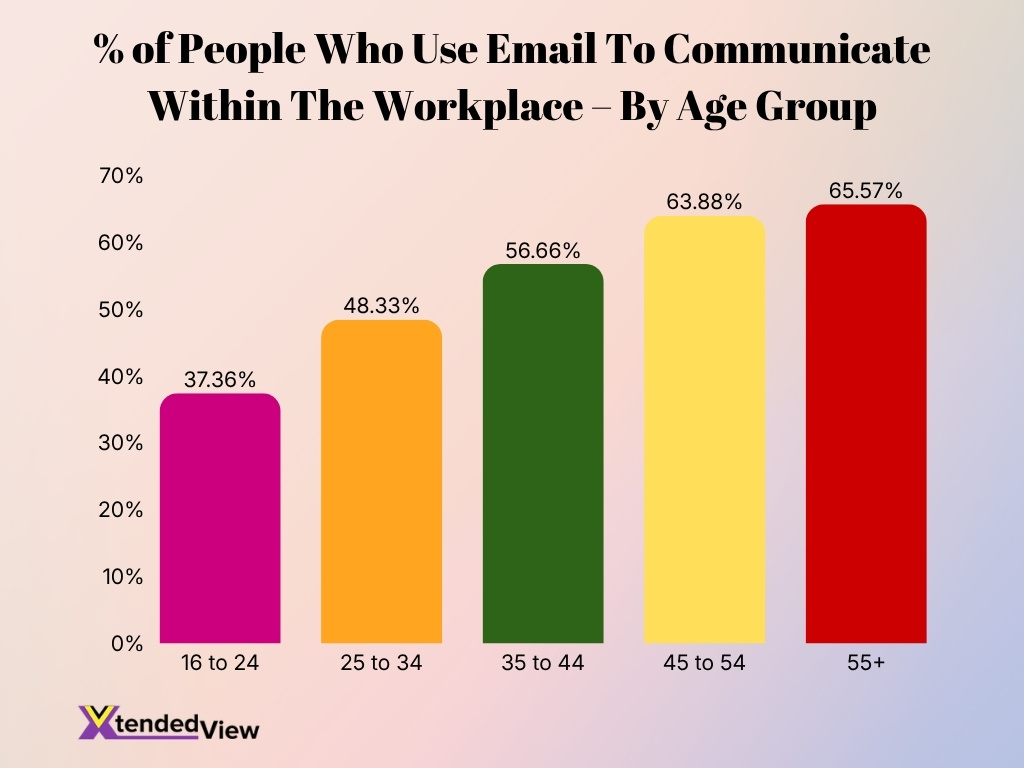
Workplace Email Usage Trends by Age Group
- Email usage increases consistently with age, showing a clear generational preference in workplace communication.
- The lowest adoption is among younger employees aged 16–24 (37.36%), indicating they rely more on alternative tools like chat or collaboration platforms.
- Usage rises significantly in the 25–34 age group to 48.33%, suggesting a transition phase where email becomes more relevant professionally.
- A majority of professionals aged 35–44 (56.66%) actively use email, marking the point where email becomes a primary communication channel.
- Email usage peaks among older employees, with 45–54 at 63.88% and 55+ at 65.57%, highlighting a strong preference for traditional communication methods.
- There is a 28.21 percentage point gap between the youngest (16–24) and oldest (55+) groups, reflecting a significant generational divide in communication styles.
- The data suggests organizations must adopt a multi-channel communication strategy to effectively engage both younger and older employees.
- Increasing reliance on tools like instant messaging among younger workers may gradually reduce email dominance in future workplaces.
Email Communication in the Workplace
- 347 billion emails are sent and received daily worldwide in 2026.
- The average office worker receives 120+ emails per day.
- Employees spend about 28% of their workweek managing emails.
- 86% of professionals still consider email their primary communication tool.
- Poor email communication leads to increased response delays for 64% of employees.
- 47% of employees say unclear emails cause confusion or rework.
- Email overload contributes to 35% of workplace stress cases.
- 81% of professionals check email outside work hours, impacting work-life balance.
- Structured email practices improve response efficiency by up to 20%.
Video Meetings and Conferencing at Work
- Video conferencing usage increased by 500%+ since 2020.
- 89% of employees say video helps them feel more connected than audio calls.
- Workers spend an average of 18 hours per week in meetings.
- 71% of professionals say meetings are often unproductive.
- Video meetings improve understanding of complex topics by up to 90%.
- 58% of employees prefer video calls for team collaboration.
- “Zoom fatigue” affects 49% of remote workers.
- Companies using structured meeting agendas see 30% higher efficiency.
- Hybrid teams rely on video conferencing as a primary communication channel in over 80% of cases.
Instant Messaging Response Time Statistics at Work
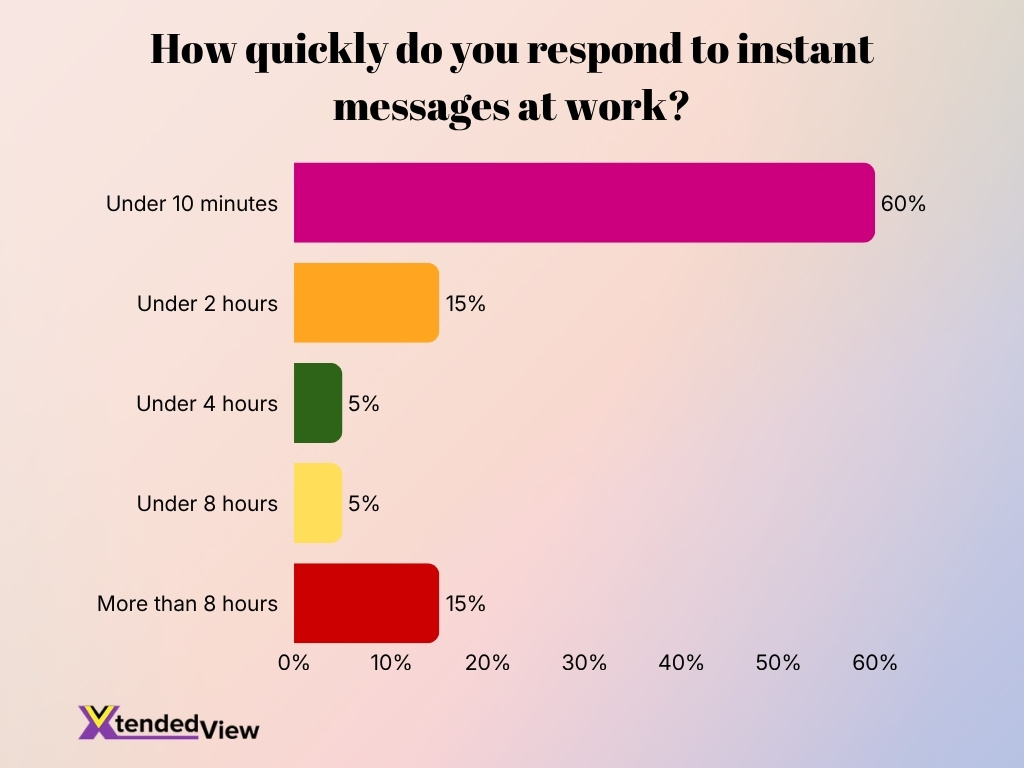
- A significant 60% of employees respond within 10 minutes, highlighting a strong culture of real-time communication in modern workplaces.
- Only 15% respond within 2 hours, indicating that most professionals prioritize immediate replies over delayed responses.
- A very small portion, around 5% each, takes up to 4 hours or 8 hours, suggesting that slow response times are uncommon in fast-paced work environments.
- Interestingly, 15% of employees take more than 8 hours to respond, pointing to potential communication gaps or asynchronous work patterns.
- Overall, nearly 75% of workers respond within 2 hours, reinforcing the expectation of quick turnaround times in workplace messaging.
- The data clearly shows that speed is a key factor in workplace communication, with the majority favoring instant or near-instant replies.
In-Person vs Digital Communication at Work
- Face-to-face communication is 34 times more effective than email for persuasion.
- 55% of communication impact comes from nonverbal cues.
- 62% of employees prefer a mix of in-person and digital communication.
- Digital communication now accounts for over 70% of workplace interactions.
- 68% of employees say digital tools improved collaboration across locations.
- In-person meetings are still preferred for critical discussions by 76% of professionals.
- 44% of employees say digital communication increases misunderstandings.
- Hybrid workplaces report higher flexibility satisfaction rates by 35%.
- Companies balancing both methods see higher productivity gains of up to 25%.
Communication in Hybrid and Remote Teams
- 58% of U.S. employees work in hybrid roles in 2026.
- Remote workers are 35–40% more productive when communication is structured.
- 87% of remote employees feel more connected with effective communication tools.
- Poor communication is cited as the top challenge by 52% of remote workers.
- 74% of companies plan to maintain hybrid work long-term.
- Teams using asynchronous communication see up to 30% productivity gains.
- 69% of managers say managing remote communication is more challenging than in-office.
- Remote employees report 20% higher job satisfaction with clear communication structures.
- Companies investing in remote communication tools see lower turnover rates by 25%.
Key Insights from Global Business Languages
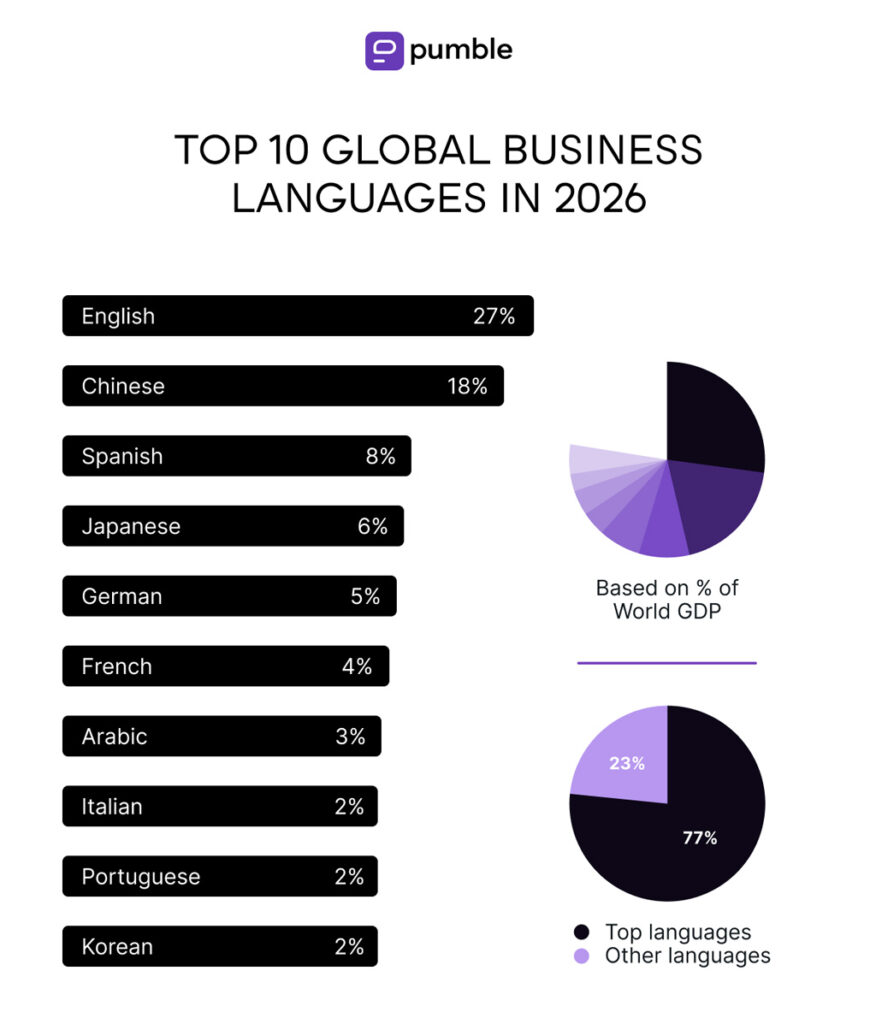
- English dominates globally, accounting for the largest share at 27% of world GDP, making it the most critical language for international business communication.
- China ranks second with 18%, highlighting its growing economic influence and importance in global trade and manufacturing.
- There is a significant drop after the top two, with Spanish at 8%, indicating a strong but comparatively smaller economic footprint.
- Japanese (6%) and German (5%) continue to be vital due to their strong industrial and export-driven economies.
- European languages collectively remain influential, with German (5%), French (4%), Italian (2%), and Portuguese (2%) contributing notably to global GDP.
- French holds 4%, reflecting its importance across multiple regions, especially in Europe and Africa.
- Arabic (3%) underscores the economic relevance of the Middle East, particularly in energy markets.
- Asian languages (Chinese, Japanese, and Korean) together contribute a substantial share, reinforcing Asia’s growing economic dominance.
- The bottom three languages (Italian, Portuguese, and Korean) each hold 2%, showing a relatively equal but smaller contribution.
- The Top 10 languages together account for a massive 77% of global GDP, demonstrating how a limited number of languages dominate global business.
- Meanwhile, all other languages combined represent only 23%, indicating a highly concentrated economic landscape.
- Overall, the data highlights a concentration of economic power in a few key languages, making them essential for businesses aiming for global expansion.
Communication Across Time Zones and Distributed Teams
- 62% of global teams now operate across multiple time zones.
- Employees in distributed teams spend 15% more time coordinating schedules.
- Asynchronous communication adoption has increased by over 40% since 2022.
- 71% of distributed teams rely on shared documentation tools for collaboration.
- Time zone differences cause delays for 48% of global teams.
- Teams that adopt async workflows report 30% faster turnaround times.
- 67% of employees say flexible communication improves cross-border collaboration.
- Companies with global teams report higher innovation rates by 20%.
- Clear documentation reduces miscommunication in distributed teams by up to 25%.
Leadership Communication Effectiveness
- 72% of employees say effective communication from leaders increases trust.
- Only 46% of employees believe leaders communicate clearly.
- Transparent leadership communication improves engagement by up to 70%.
- 80% of employees want more frequent communication from leadership.
- Leaders who communicate well are 3 times more likely to retain employees.
- 69% of managers feel unprepared to communicate effectively with teams.
- Companies with strong leadership communication report higher profitability by 21%.
- 63% of employees say leadership communication directly impacts company culture.
- Organizations that invest in leadership communication training see 30% improvement in team alignment.
Frequently Asked Questions (FAQs)
U.S. businesses lose over $2 trillion per year due to ineffective communication.
Around 86% of employees and executives cite poor communication as a primary cause of workplace failures.
Poor communication costs between $9,284 and $30,000 per employee annually.
Knowledge workers spend about 20 hours per week on written communication tasks.
About 79% of employees say communication quality directly impacts their understanding of organizational goals.
Conclusion
Workplace communication continues to shape how organizations perform, compete, and retain talent. From email overload to the rise of instant messaging and hybrid collaboration, the data shows a clear pattern: communication quality directly impacts productivity, engagement, and business outcomes.
Companies that invest in structured communication strategies, leadership transparency, and the right mix of tools consistently outperform their peers. As workplaces become more distributed and digital, refining communication practices will remain a critical lever for growth and resilience.
