



Zoom has become a core tool for modern communication, powering everything from remote work meetings to virtual classrooms and telehealth consultations. Businesses rely on it to connect distributed teams, reduce travel costs, and maintain productivity across time zones, while schools and healthcare providers use it to deliver real-time learning and patient care without physical limitations. Its role extends beyond simple video calls, shaping how organizations operate in a digital-first environment.
As hybrid work and virtual services continue to grow, Zoom’s data reveals how communication habits are evolving at scale. Let’s explore the latest statistics to understand its growth, usage patterns, and real-world impact.
Editor’s Choice
- Zoom hosts over 300 million daily meeting participants globally, reflecting its massive scale in real-time communication.
- The platform generated approximately $4.67 billion in annual revenue (FY 2026).
- Zoom controls about 55.9% of the global video conferencing market, maintaining a leadership position.
- Users spend a combined 3.3 trillion minutes annually in Zoom meetings, highlighting deep engagement.
- Zoom serves over 504,000 business customers worldwide, including enterprises and SMBs.
- The company reported over $1 billion in net profit in 2024, showing sustained profitability.
- Zoom’s daily users surged from 10 million (2019) to 300+ million, a growth of nearly 30x.
Recent Developments
- Zoom introduced AI-driven tools like AI Companion, enhancing meeting summaries and productivity features.
- In FY 2026 Q3, Zoom generated $1.23 billion in quarterly revenue, reflecting stable enterprise demand.
- Zoom’s enterprise segment continues to grow, with revenue increasing by around 6% year-over-year.
- The company forecast quarterly revenue between $1.22 billion and $1.23 billion in 2026, indicating steady performance.
- Zoom has expanded beyond meetings into contact centers, phone systems, and workplace collaboration tools.
- AI adoption is driving growth, with companies reporting 27% revenue increases from AI-enabled CX tools.
- Zoom continues stock buybacks, repurchasing $1.6 billion worth of shares in FY 2026.
- Hybrid work adoption remains strong, with 63% of leaders using hybrid work models supported by tools like Zoom.
What is Zoom?
- Zoom is a cloud-based video conferencing platform used for meetings, webinars, and collaboration.
- Founded in 2011, Zoom has evolved into a full communication suite including chat, phone, and AI tools.
- The platform supports HD video, screen sharing, and real-time messaging, enabling remote collaboration.
- Zoom enables businesses to reduce travel costs, with video conferencing saving companies thousands annually per employee (industry estimates).
- It plays a key role in remote work, telemedicine, and online education ecosystems.
- Zoom integrates with third-party apps, allowing developers to build tools within its ecosystem.
- The platform offers both free and subscription-based plans, supporting individuals and enterprises.
- Zoom Phone and Zoom Contact Center expand their capabilities beyond meetings into enterprise communications.
Zoom User Statistics
- Zoom supports 300 million+ daily active users, including both free and paid accounts.
- The platform has grown to over 500 million registered users globally.
- Zoom experienced a 2,900% growth in users during the pandemic, one of the fastest in tech history.
- Over 89% of users rely on Zoom for work-related activities, indicating strong enterprise adoption.
- Zoom has tens of millions of paid subscribers, with enterprise plans driving revenue growth.
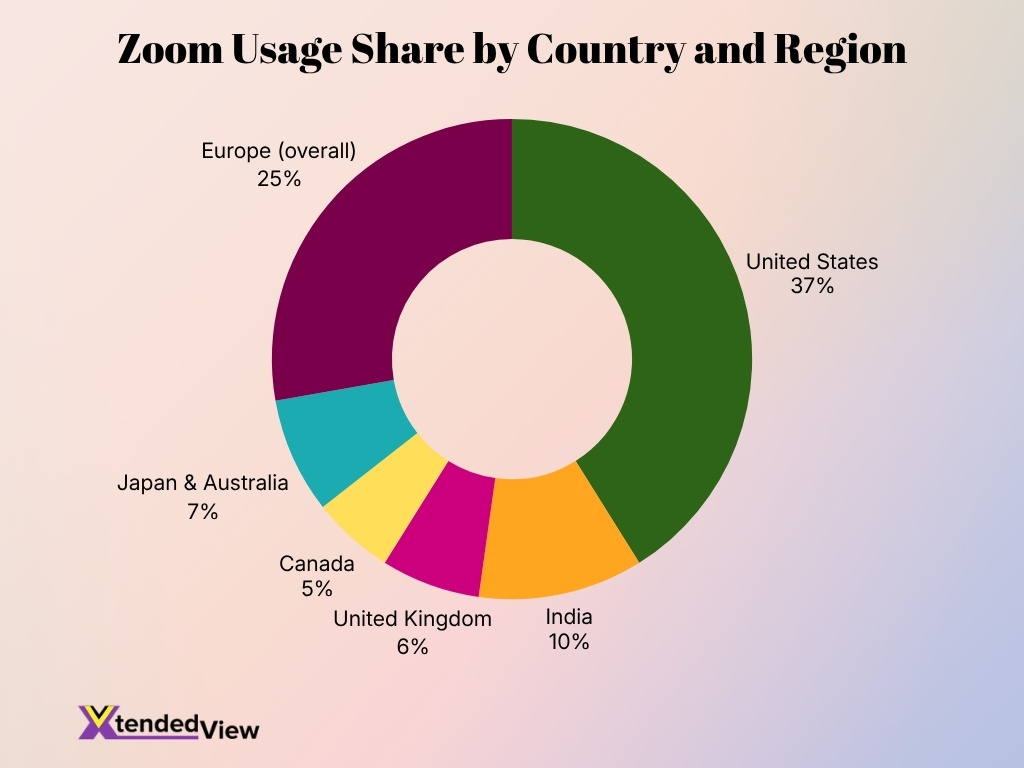
- The U.S. contributes around 37% of Zoom’s total traffic, making it the largest market.
- Zoom users collectively join billions of meetings annually, reflecting consistent engagement.
- The platform remains most popular among the 25–34 age group (nearly 30%), showing strong adoption among working professionals.
Zoom Usage by Country and Region
- The United States accounts for approximately 37% of Zoom traffic, the highest globally.
- India contributes around 10% of Zoom users, making it one of the fastest-growing markets.
- The United Kingdom represents about 6% of global Zoom usage.
- Canada accounts for nearly 5% of total Zoom users.
- Japan and Australia collectively contribute over 7% of global traffic.
- Emerging markets in Southeast Asia have seen over 40% growth in Zoom adoption since 2022.
- Europe represents nearly 25% of total Zoom usage, driven by hybrid work adoption.
- Latin America has experienced 30%+ growth in Zoom usage, especially in education and SMBs.
- Africa’s Zoom adoption is growing steadily, with internet penetration increases driving usage by over 20% annually.
Daily Meeting Participants Statistics
- Zoom supports over 300 million daily meeting participants, a figure that has remained stable since its pandemic peak.
- During peak periods, Zoom recorded over 500 million daily meeting participants globally.
- Users host approximately 3 trillion+ meeting minutes annually, showing sustained engagement.
- The average Zoom meeting lasts between 30 to 60 minutes, depending on business use cases.
- More than 60% of meetings include video participation, highlighting a preference for face-to-face interaction.
- Around 40% of users attend multiple meetings daily, especially in corporate environments.
- Zoom webinars can host up to 50,000 attendees, making it a preferred platform for large-scale events.
- Over 70% of organizations use video conferencing daily, with Zoom as a primary tool.
- The U.S. accounts for the highest share of daily participants, contributing over 35% of global meetings.
Monthly Active Users and Registered Accounts
- Zoom has surpassed 500 million registered users worldwide, reflecting global adoption.
- Monthly active users (MAUs) are estimated at 350 million+ globally.
- Zoom saw a 65% increase in MAUs between 2020 and 2022, with steady retention afterward.
- Over 192,000 enterprise customers contribute significantly to active usage.
- Zoom’s free-tier users make up approximately 70% of total accounts, highlighting freemium adoption.
- Paid subscribers account for a smaller share but generate over 80% of total revenue.
- Zoom’s user base in the U.S. exceeds 150 million registered accounts, making it the largest market.
- The platform continues to onboard millions of new users annually, particularly in emerging markets.
- Zoom Rooms deployments grew by over 40% year-over-year, contributing to MAU growth.
Communication Preferences Across Generations
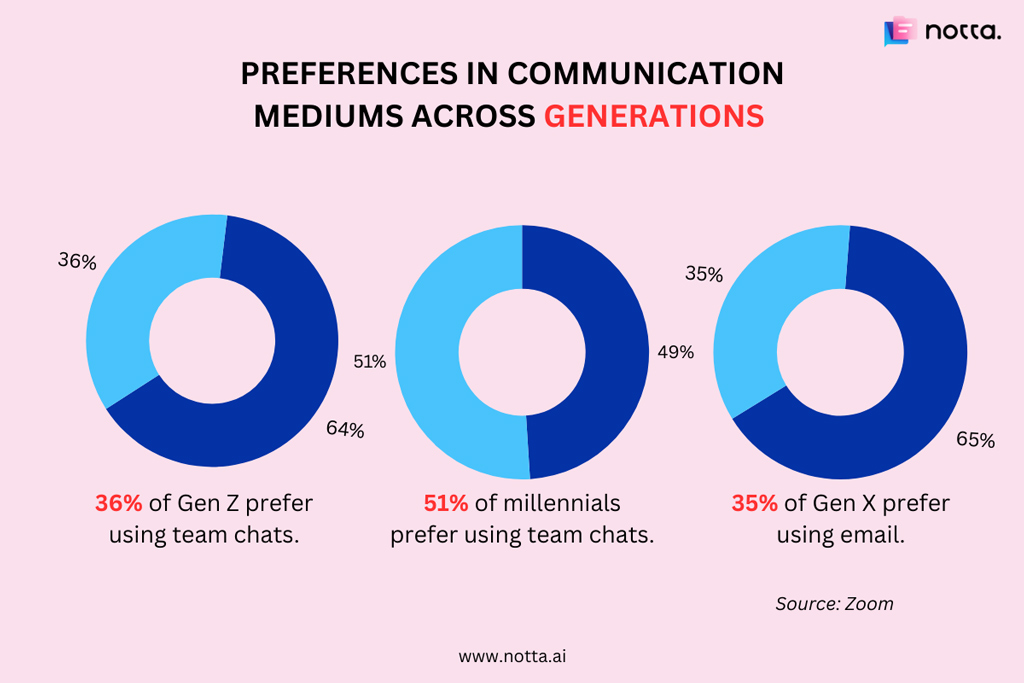
- Gen Z shows a strong inclination toward email, with 64% preferring email compared to only 36% using team chats, indicating a more structured communication preference than expected.
- Millennials demonstrate the most balanced behavior, with 51% preferring team chats and 49% opting for email, highlighting their adaptability across both communication mediums.
- Gen X leads in team chat adoption, where a significant 65% prefer team chats, while only 35% rely on email, suggesting a shift toward faster, real-time communication in this group.
- Team chats dominate among older working professionals, as both Millennials (51%) and Gen X (65%) show higher adoption compared to Gen Z.
- Email remains highly relevant across all generations, with at least 35%+ usage in every group, proving it is still a critical communication channel despite the rise of chat tools.
- The largest gap is seen in Gen X, where there is a 30% difference between team chat and email preferences, indicating a clear communication preference trend.
- Gen Z has the lowest adoption of team chats (36%), making them the least inclined toward collaborative chat tools among the three generations.
- Cross-generational differences highlight evolving workplace communication trends, with younger users not necessarily favoring chat tools as strongly as assumed, while older groups increasingly embrace them.
Zoom User Demographics
- The largest user group falls within the 25–34 age range, accounting for nearly 30% of users.
- Users aged 35–44 make up around 25% of the total user base, reflecting strong mid-career adoption.
- Approximately 52% of Zoom users are male, while 48% are female.
- Over 70% of users have at least a college degree, indicating professional usage dominance.
- Around 89% of users rely on Zoom for work-related communication.
- Students represent a significant segment, with over 20% of users using Zoom for education.
- High-income households (earning $75K+) account for over 60% of Zoom users in the U.S.
- Remote workers make up a major share, with over 58% of employees working remotely using Zoom weekly.
- Zoom adoption among freelancers and gig workers has increased by over 35% since 2021.
Usage of Zoom by Device and Platform
- Around 45% of Zoom users access the platform via desktop devices, making it the dominant access point.
- Mobile usage accounts for approximately 40% of Zoom sessions, driven by remote work flexibility.
- Tablet usage contributes around 15% of total Zoom sessions.
- Zoom’s mobile app has surpassed 500 million downloads on Android alone.
- The iOS app consistently ranks among the top business apps in the App Store.
- Zoom Rooms (hardware-based conferencing systems) grew by over 40% year-over-year.
- Web-based Zoom usage accounts for about 20% of sessions, especially among casual users.
- Over 70% of enterprise users prefer desktop applications for stability and features.
- Mobile-first regions show higher engagement rates, with users joining more frequent but shorter meetings.
Zoom Usage by Industry and Business Size
- Over 90% of Fortune 500 companies use Zoom, highlighting strong enterprise penetration.
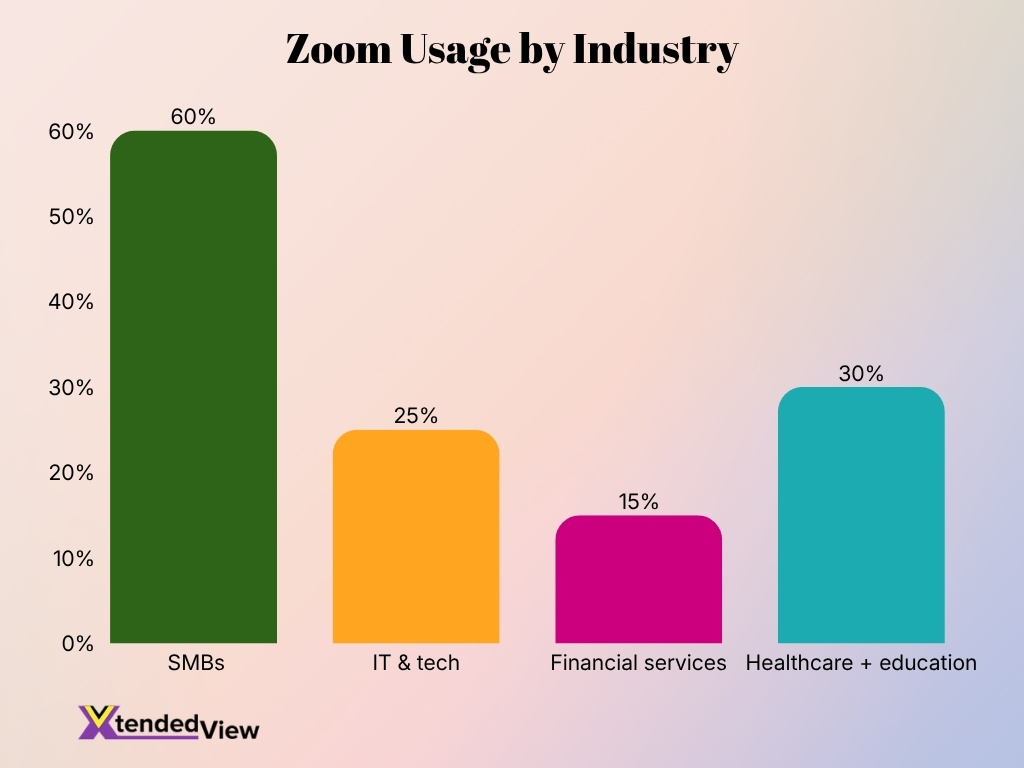
- Small and medium businesses (SMBs) account for over 60% of Zoom’s customer base.
- The IT and tech sector represents 25% of Zoom’s enterprise users.
- Financial services contribute around 15% of Zoom usage, especially for client meetings.
- The healthcare and education sectors combined account for over 30% of total usage.
- Startups increasingly rely on Zoom, with over 70% using it as a primary communication tool.
- Enterprises with over 1,000 employees generate the majority of Zoom’s revenue share.
- Nonprofits and government organizations have increased usage by over 25% since 2021.
- Hybrid workplaces report higher productivity (up to 20%) when using video conferencing tools like Zoom.
Zoom Usage in Education
- Over 300,000 schools globally use Zoom for virtual learning.
- During the peak pandemic years, Zoom supported over 90,000 educational institutions.
- Around 70% of universities in the U.S. used Zoom for remote classes.
- Students spend an average of 5–7 hours weekly on Zoom classes.
- Zoom’s breakout rooms feature is used by over 60% of educators to facilitate group learning.
- Hybrid learning models have increased Zoom usage in education by over 35% post-2022.
- Zoom integrates with LMS platforms like Canvas and Blackboard, used by millions of students globally.
- K-12 institutions account for a growing share, with over 50% adoption in developed countries.
- Educational webinars and virtual events hosted on Zoom have increased by over 45% year-over-year.
Adoption of Zoom in Healthcare and Public Services
- Over 70% of U.S. healthcare providers adopted telehealth tools like Zoom during and after the pandemic.
- Zoom for Healthcare supports HIPAA-compliant video consultations, making it suitable for secure patient care.
- Telehealth visits stabilized at 10–15% of all outpatient visits in 2024–2025, many powered by video platforms.
- Government agencies increased video conferencing usage by over 25% since 2021, with Zoom as a key provider.
- Public sector organizations use Zoom for virtual court hearings, public meetings, and remote services.
- More than 50% of hospitals globally use video conferencing tools for internal collaboration and patient care.
- Zoom usage in mental health services grew by over 40%, enabling remote therapy sessions.
- In rural areas, telehealth adoption increased access to care by up to 38%, often relying on Zoom-based platforms.
- Public sector training and onboarding sessions conducted via Zoom increased by over 30% post-2022.
Zoom Revenue Statistics
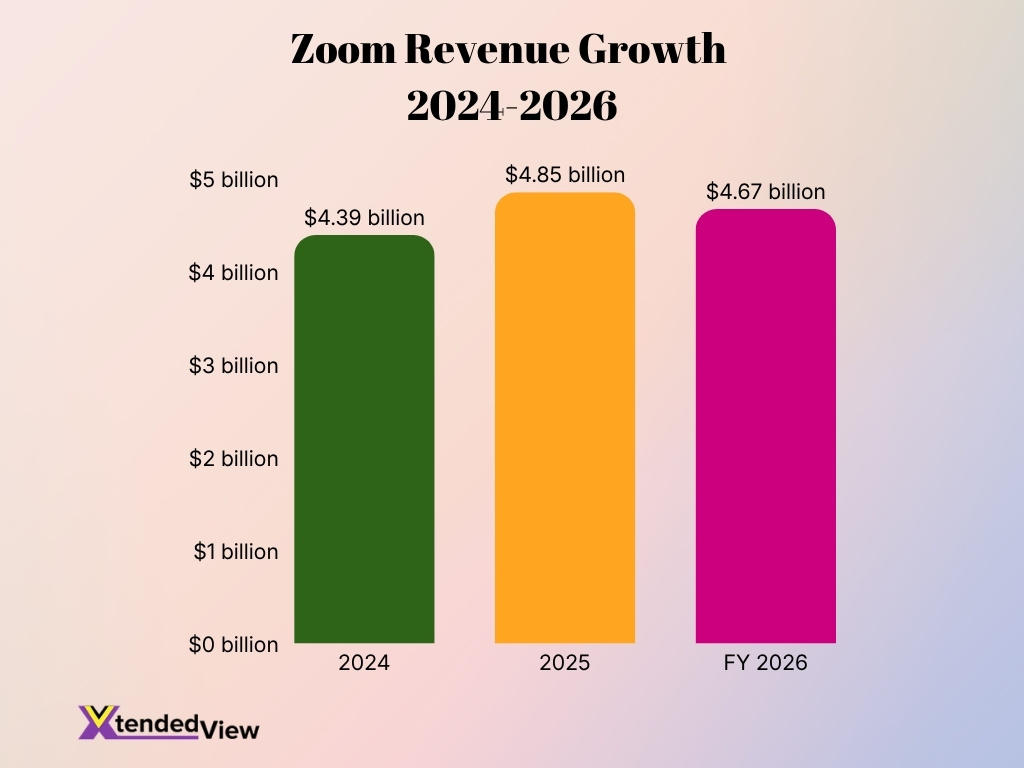
- Zoom reported approximately $4.67 billion in revenue for FY 2026, reflecting steady growth.
- Revenue grew from $4.39 billion in 2024 to $4.85 billion in 2025, showing consistent expansion.
- Zoom’s net income exceeded $1 billion in 2024, maintaining profitability.
- The company generated $1.23 billion in quarterly revenue (Q3 FY 2026).
- Subscription services account for over 95% of total revenue, emphasizing recurring income.
- Enterprise customers contribute the majority of revenue, with higher contract values than SMBs.
- Zoom invested heavily in R&D, spending over $800 million annually on innovation.
- International markets contribute approximately 30% of total revenue, showing global reach.
- Zoom’s revenue growth rate stabilized at 5–7% annually post-pandemic, indicating maturity.
Free vs Paid Zoom Users
- Approximately 70% of Zoom users are on the free plan, reflecting strong freemium adoption.
- Paid users contribute over 80% of Zoom’s total revenue, highlighting monetization efficiency.
- Zoom offers free meetings with a 40-minute limit for group sessions, driving upgrades for businesses.
- Enterprise plans include advanced features like AI tools, cloud recording, and analytics dashboards.
- The number of paid enterprise customers exceeded 192,000 globally.
- Zoom’s average revenue per user (ARPU) increased by over 10% year-over-year in 2025.
- Subscription tiers range from $14.99/month for Pro plans to enterprise-level pricing, supporting scalability.
- Small businesses account for a significant share of upgrades, with over 60% converting from free to paid plans.
- Zoom’s add-on services like webinars and phone systems generate additional recurring revenue streams.
Zoom Virtual Background Preferences
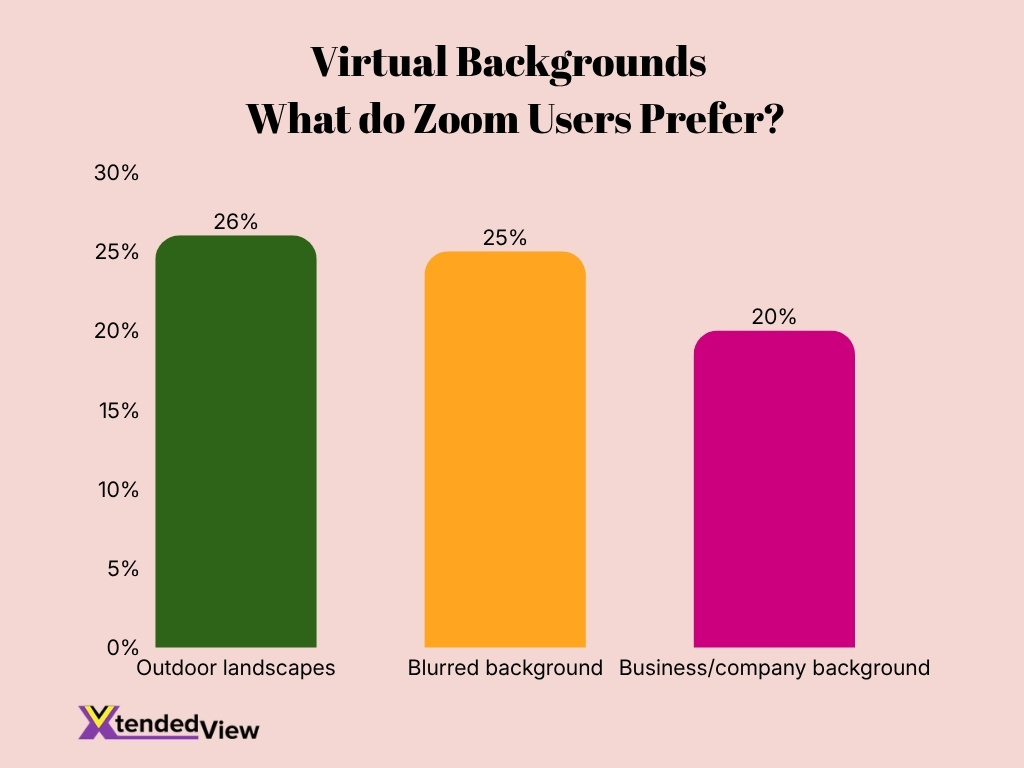
- Outdoor landscapes lead the trend, preferred by 26% of users, making them the most popular virtual background choice.
- A close second, blurred backgrounds account for 25%, showing strong demand for privacy-focused and distraction-free settings.
- Business/company backgrounds are chosen by 20%, indicating a significant share of users prefer professional branding or formal meeting environments.
- The narrow gap of just 1% between outdoor and blurred backgrounds highlights nearly equal preference between aesthetics and functionality.
- Overall, preferences suggest a balance between visual appeal (outdoor scenes) and practical use (blurred backgrounds and professional setups).
Business Customers and Enterprise Statistics for Zoom
- Zoom serves over 504,000 business customers worldwide, including SMBs and enterprises.
- The company has more than 192,000 enterprise customers contributing to revenue growth.
- Over 90% of Fortune 500 companies use Zoom, reinforcing its enterprise dominance.
- Zoom’s enterprise segment accounts for over 55% of total revenue, driven by large contracts.
- Businesses with 10+ employees represent the fastest-growing customer segment.
- Zoom Phone adoption grew by over 100% year-over-year, expanding enterprise communication solutions.
- Large enterprises generate higher retention rates (over 85%), ensuring recurring revenue.
- Hybrid work models have driven increased enterprise usage by 20% since 2022.
- Zoom’s customer base spans industries like tech, finance, education, and healthcare, ensuring diversified demand.
Zoom Market Share in Video Conferencing
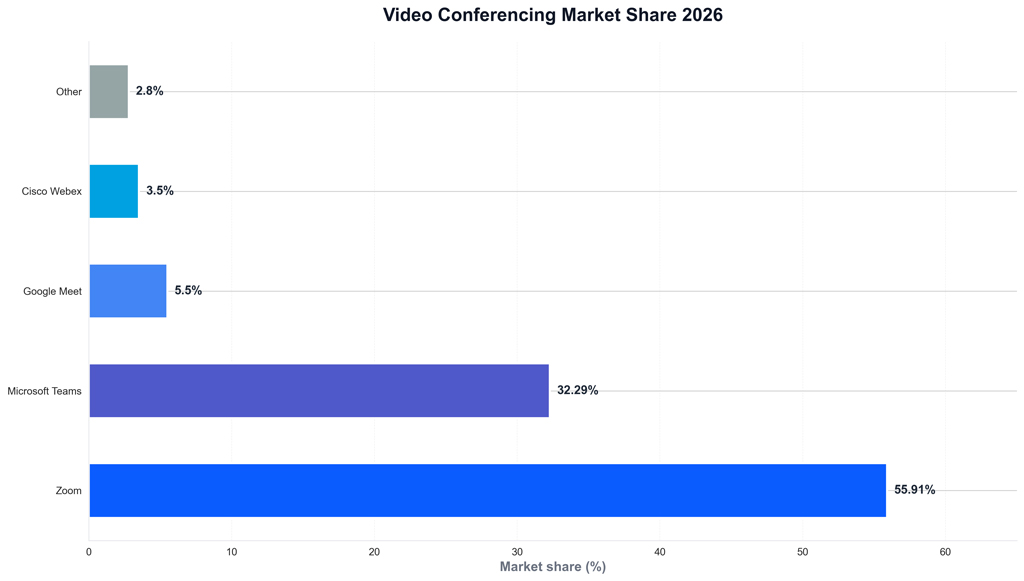
- Zoom dominates the market with a massive 55.91% share, holding more than half of the global video conferencing market.
- Microsoft Teams ranks second with 32.29%, making it the strongest competitor but still trailing Zoom by over 23 percentage points.
- Google Meet captures a modest 5.5%, indicating limited market penetration compared to the top two players.
- Cisco Webex holds 3.5%, showing a relatively small share despite being an established enterprise solution.
- The “Other” category accounts for 2.8%, highlighting minimal fragmentation outside major platforms.
- The top two platforms (Zoom + Microsoft Teams) together control a dominant 88.2% of the market, signaling a highly concentrated industry.
- There is a steep drop after the top two players, with all other platforms individually holding less than 6% share.
- The data reflects a duopoly-like structure, where Zoom leads and Microsoft Teams follows, while competitors struggle to scale significantly.
Zoom AI and Feature Adoption Statistics
- Zoom AI Companion adoption grew rapidly, with over 30% of enterprise users enabling AI features.
- AI-powered meeting summaries reduce note-taking time by up to 50%.
- Over 60% of businesses plan to increase AI usage in collaboration tools, including Zoom.
- Zoom’s smart recording and transcription features are used by over 45% of paid users.
- AI-driven customer experience tools improved engagement metrics by up to 27%.
- Automated captions and translations support 30+ languages, enhancing accessibility.
- Zoom Phone adoption continues to grow, with over 7 million paid seats globally.
- Webinar and virtual event tools have seen over 40% adoption growth among enterprises.
- Integration with apps like Slack and Salesforce boosts productivity for over 50% of enterprise users.
Future Outlook and Forecasted Zoom Statistics
- Zoom’s revenue is projected to reach $5.5 billion by 2027, driven by enterprise growth.
- The video conferencing market is expected to grow at a CAGR of 10–12% through 2030.
- Hybrid work adoption is forecast to stabilize at over 60% of organizations globally.
- AI-driven collaboration tools will account for over 40% of platform usage by 2028.
- Zoom aims to expand its enterprise offerings, targeting higher ARPU growth in large organizations.
- Emerging markets are expected to drive over 35% of new user growth.
- Zoom Phone and Contact Center products are projected to grow by 20% annually.
- Increased demand for virtual events could push webinar usage up by 50% over the next five years.
- Competition from Microsoft Teams and Google Meet will intensify, but Zoom is expected to maintain a leading market share above 50%.
Key Insights on the Biggest Triggers of Zoom Anxiety
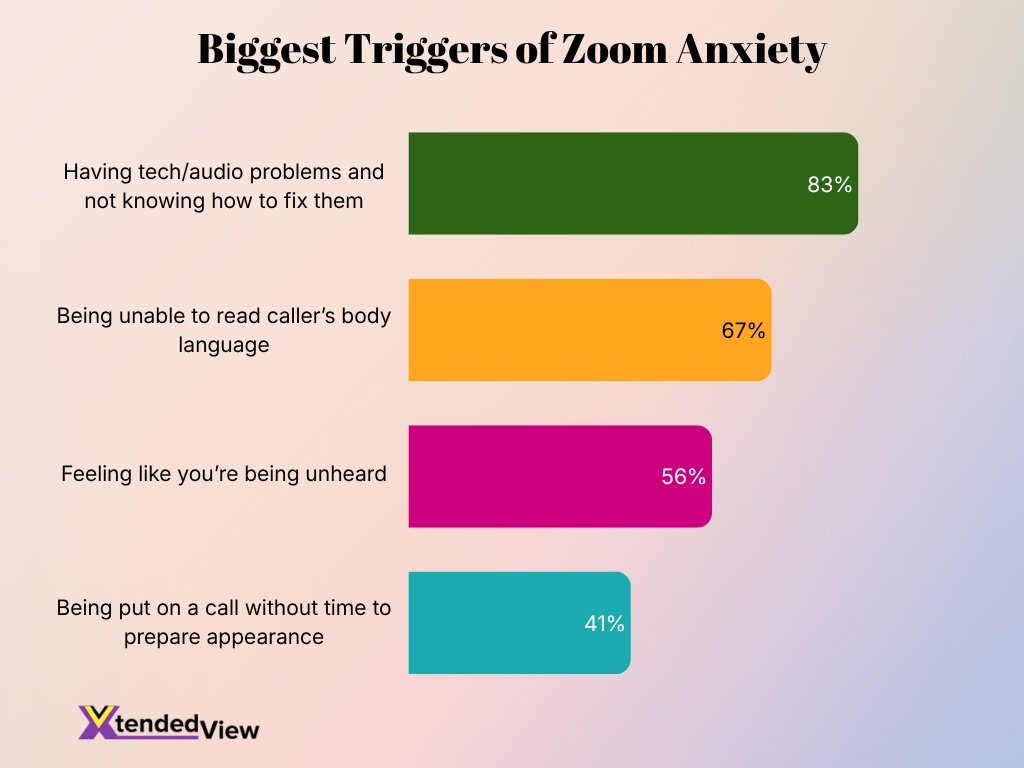
- The leading cause of Zoom anxiety is technical/audio issues, with a striking 83% of users reporting stress when they can’t fix tech problems quickly.
- A significant 67% of users feel anxious due to the inability to read body language, highlighting the limitations of virtual communication.
- Over half of respondents (56%) experience anxiety from feeling unheard, indicating challenges in engagement and communication clarity during calls.
- 41% of users report stress when they are put on calls without time to prepare their appearance, reflecting concerns around professional presentation and readiness.
- The data clearly show that technical difficulties and communication barriers are the top contributors to virtual meeting anxiety.
- Overall, more than 2 out of 3 users struggle with either tech issues or lack of non-verbal cues, making these the most critical pain points in Zoom usage.
Frequently Asked Questions (FAQs)
Zoom has around 300 million daily active users worldwide.
Zoom holds approximately 55.9% of the global video conferencing market share.
Zoom reported about $4.87 billion in annual revenue for FY 2026.
Zoom has surpassed 500 million total registered users worldwide.
Zoom serves over 504,000 business customers globally.
Conclusion
Zoom continues to anchor modern communication, with hundreds of millions of daily users and a strong foothold in enterprise collaboration. Its steady expansion into AI-powered features, telephony, and customer experience tools shows a clear shift from a meeting platform to a broader communication ecosystem. Businesses now depend on Zoom not just for meetings, but for workflows that support hybrid teams, virtual events, and customer interactions. At the same time, education and healthcare sectors continue to integrate Zoom into their core operations, reinforcing its long-term relevance.
As competition intensifies and technology evolves, Zoom’s ability to innovate and adapt will shape its future position. For businesses, educators, and policymakers, these statistics highlight both its current influence and the direction of digital communication in the years ahead.
