



The open‑source kernel Linux powers everything from smartphones to supercomputers. In business and developer spheres alike, its influence stretches far beyond hobbyist deployments. For example, major cloud services deploy Linux at scale, and automotive systems increasingly rely on Linux‑based embedded platforms.
Editor’s Choice
- Linux’s global desktop operating system share reached approximately 4.1% in June 2025.
- In the U.S., Linux crossed the 5.0% desktop market share threshold in mid‑2025.
- The global Linux operating system market size was valued at $21.97 billion in 2024 and is projected to reach $26.41 billion in 2025.
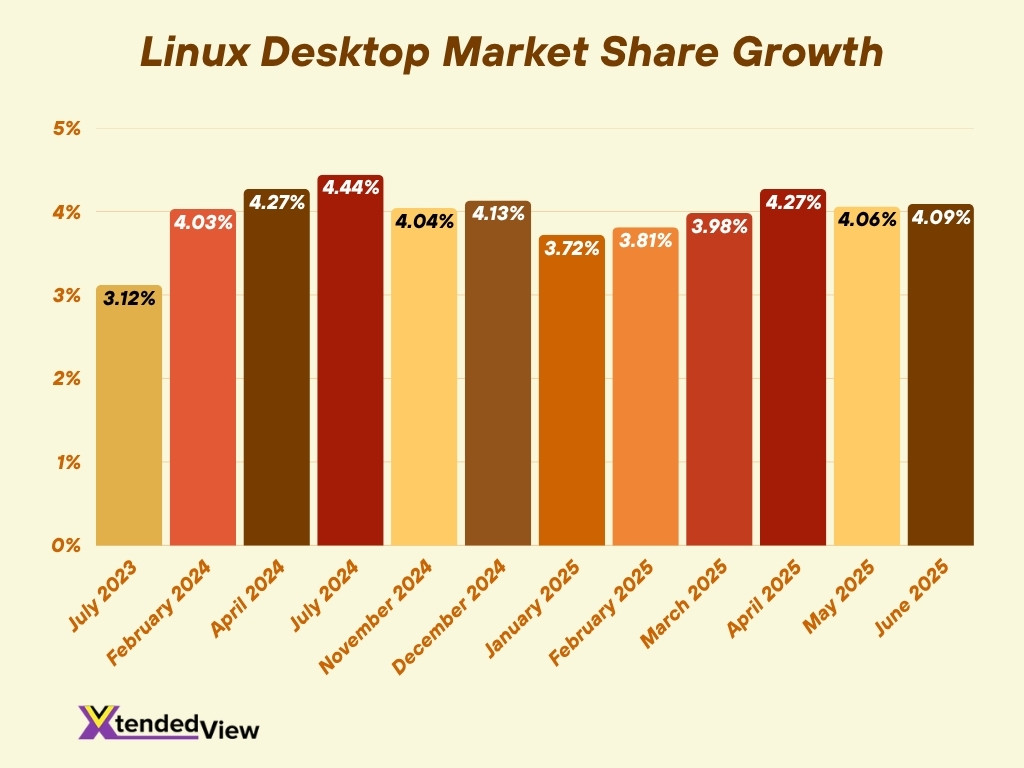
- On desktops globally, Linux hit 4.45% share in July 2024, up from 3.12% the year prior.
- Linux now powers 49.2% of all cloud workloads globally (Q2 2025).
- Web‑server metrics show Linux in use on roughly 57.5% of all websites whose OS is known.
- The desktop Linux market continues to grow despite being relatively small in absolute size, hitting approximately. 4.06% of the desktop OS market in May 2025.
Recent Developments
- Linux’s share of the desktop OS market surged to 4.44% in July 2024, after being at 3.12% in July 2023.
- By June 2025, Linux in the U.S. stood at about 5.03% of desktop OS usage.
- Monthly data show Linux desktop share at 3.72% (Jan 2025), 3.81% (Feb), 3.98% (Mar), 4.27% (Apr), 4.09% (Jun) globally.
- In February 2024, Linux breached the 4% mark globally on desktops for the first time.
- A forecast suggests Linux’s desktop share could hit 5% by early 2025 if trends hold.
- The cloud and infrastructure sectors report large Linux uptakes, with Linux powering 49.2% of global cloud workloads as of Q2 2025.
- Linux’s use in web hosting remains dominant, with approximately 57.5% of websites (where the OS is known) running on Linux.
- The global Linux operating‑system market value and forecast show robust growth, from $21.97 billion in 2024 to $26.41 billion in 2025.
Global Linux Usage Statistics
- As of May 2025, Linux held about 4.06% of the global desktop OS market.
- In the U.S., Linux’s desktop share reached 5.04% in June 2025.
- In July 2024, Linux had a global desktop share of 4.45%, up from 3.12% in July 2023.
- Linux’s use on websites is roughly 57.5% of all websites (known OS).
- Linux powers about 49.2% of global cloud workloads as of Q2 2025.
- Desktop growth over time shows February 2024 4.03% share, July 2024 4.44%.
- Linux server OS share is around 62.7% globally.
- Monthly desktop share (global) in 2025 includes April 4.27%, May 4.06%.
Linux Operating System Global Market
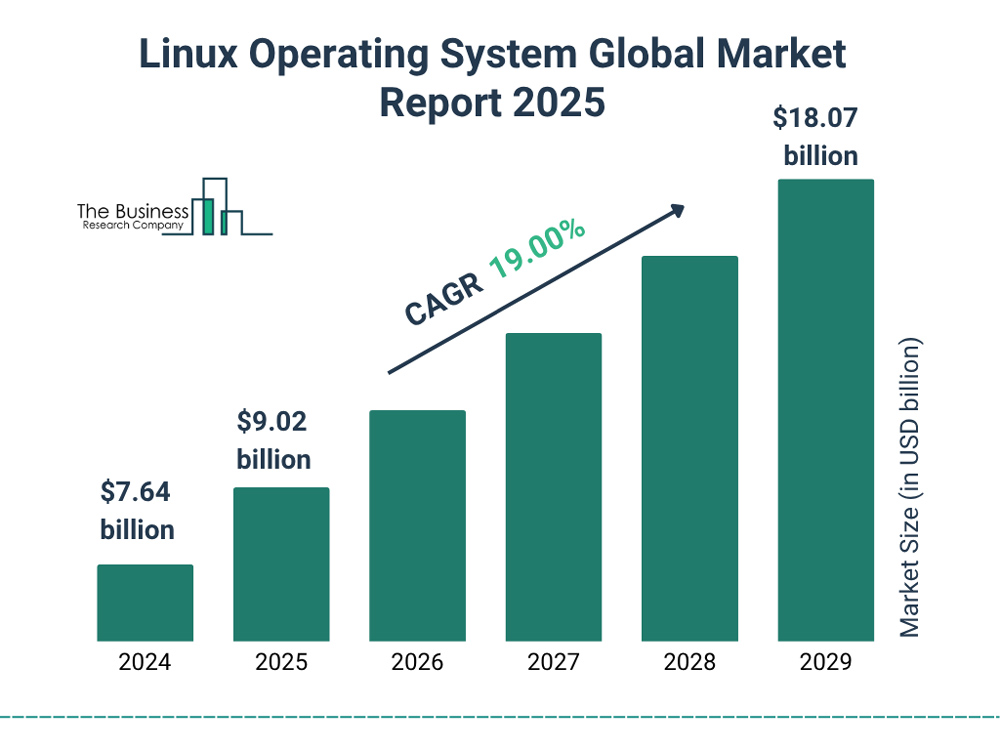
- The global Linux operating system market was valued at $7.64 billion in 2024, reflecting strong enterprise and cloud adoption worldwide.
- Market size increased to $9.02 billion in 2025, highlighting rising demand for open-source, secure, and scalable operating systems.
- In 2026, the Linux OS market is estimated to reach approximately $10.73 billion, driven by growing usage in cloud computing and DevOps environments.
- The market is projected to expand further to around $12.77 billion in 2027, supported by increased adoption across IT infrastructure and data centers.
- By 2028, the global Linux OS market revenue is expected to climb to nearly $15.20 billion, fueled by enterprise digital transformation and cost efficiency benefits.
- The market is forecast to reach $18.07 billion by 2029, demonstrating sustained long-term growth across industries.
- Overall, the Linux operating system market is projected to grow at a strong CAGR of 19.00% from 2024 to 2029, underscoring its rapid expansion and rising global relevance.
Linux Desktop Market Statistics
- Linux globally reached 4.45% desktop OS share in July 2024.
- Global desktop share figures include Dec 2024 4.13%, Nov 2024 4.04%.
- In the U.S., the Linux desktop share reached 5.03% in June 2025.
- Some reports list global desktop share at 3.7% for Linux (2025).
- The monthly growth pattern shows Linux desktop share rising from 3.72% (Jan 2025) to 4.27% (Apr 2025).
- In India, the Linux desktop share is around 16.21% in July 2024.
- Desktop share remains much lower than Windows (70%+ globally), but the growth pace is notable.
- Tracking methodologies vary, and many reports caution against direct comparisons across datasets.
Linux Mobile Market Statistics
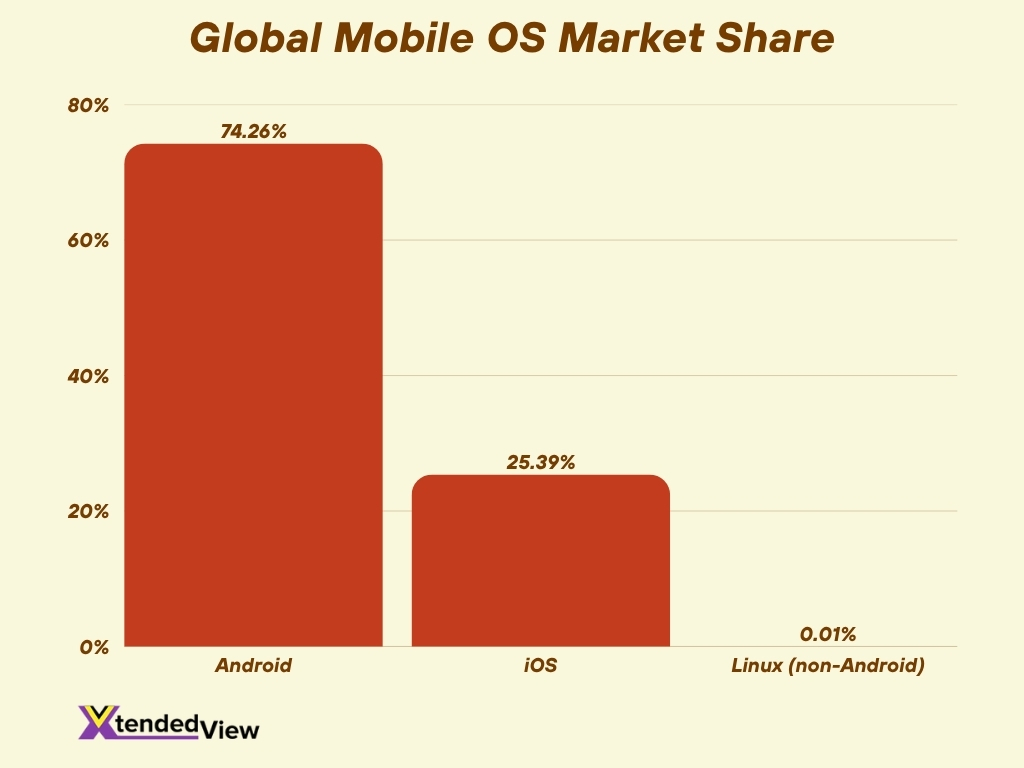
- The mobile operating system market worldwide (June 2024–June 2025) shows Android at 74.26%, iOS at 25.39%, and Linux (non‑Android mobile OSes) at about 0.01%.
- Android is based on the Linux kernel, so 80% or more of smartphones are ultimately Linux-kernel-based.
- Android holds “over 72%” of the global mobile market, highlighting the Linux kernel’s ubiquity.
- “Desktop‐style Linux mobile OS” sits at 0.01% market share in 2025.
- The tiny direct share of “Linux mobile OS” (0.01%) reflects the dominance of Android/iOS platforms.
- Android plus ChromeOS‑based machines exceed Windows in certain categories.
- The mainstream mobile‑OS battle remains Android vs. iOS, with limited Linux distribution penetration.
- The Linux kernel has a huge mobile presence, but Linux as a user-facing mobile OS remains marginal.
Linux in Cloud Computing
- As of Q2 2025, Linux powers 49.2% of all global cloud workloads.
- 90% of public‑cloud workloads run on Linux.
- On Microsoft Azure, more than 60% of VM cores and marketplace services are built on Linux.
- Cloud infrastructure growth correlates with Linux adoption due to its flexibility and open‑source model.
- AWS, Google Cloud, and Azure rely heavily on Linux.
- Linux’s role in the cloud is primarily backend scale, not desktop.
- Linux is the default OS for containers, VMs, and microservices.
Linux in Server Infrastructure
- Linux (and Unix‑like) leads the server OS market globally, with a share of around 62.7%.
- 96.3% of the world’s top one million web servers run on Linux.
- Linux desktop OS share is 3.7%, but Linux dominates server infrastructure.
- Linux is vital for large‑scale, high‑availability deployments.
- Containers, Kubernetes, and microservices reinforce Linux’s lead.
- Linux’s dominance in server infrastructure supports growth across sectors.
- Linux remains the standard OS in server‑side environments.
Linux in Supercomputers
- In 2025, all of the top 500 supercomputers globally will run on Linux.
- Each of the top 10 machines in June 2025 uses Linux distributions.
- Linux’s total dominance in supercomputers has continued since 2017.
- Linux is the default choice in high‑performance computing due to performance and reliability.
- Research institutions and HPC centres use Linux nearly universally.
- Linux’s role in supercomputers signals deep adoption.
- While niche, supercomputer stats show Linux’s technical credibility.
Linux in Embedded Systems and IoT
- The global embedded Linux market is estimated at $0.48 billion in 2025 and projected to reach about $0.90 billion by 2035 (CAGR ≈ 6.57%).
- Embedded Linux is used in 44‑46% of embedded‑systems applications.
- The Linux kernel is ubiquitous in IoT devices such as routers, appliances, and industrial sensors.
- Developers prefer Linux in embedded systems due to its flexibility and community support.
- Linux gives scale in non‑traditional computing environments.
- Embedded Linux grows more slowly than desktop or cloud, at 6.5% CAGR.
- Linux is the go‑to OS in connected devices and edge systems.
Popular Linux Distributions by Market Share
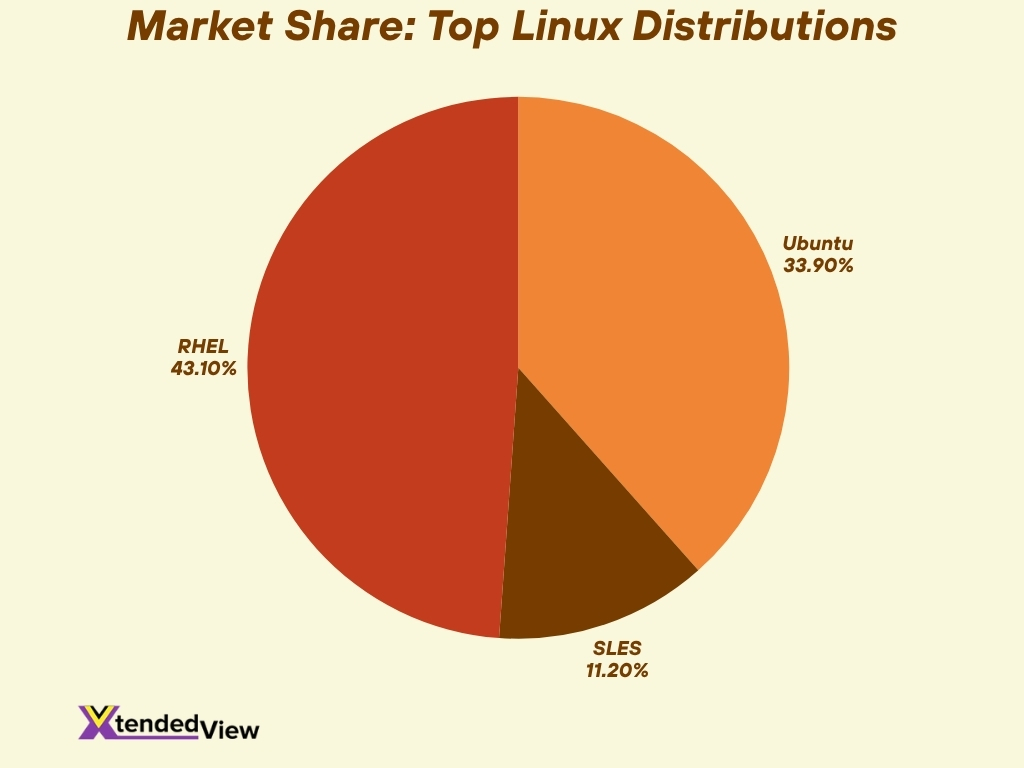
- Ubuntu leads all Linux distributions with 33.9% market share in 2025.
- The Linux kernel codebase has over 34 million lines of code and 11,000+ contributors.
- There are over 600 active Linux distributions.
- Ubuntu and Debian dominate in web servers.
- Distribution diversity is a key strength of the Linux ecosystem.
- Popular distributions like Ubuntu or Debian are standard in enterprise environments.
- The ecosystem continues to evolve with well-supported community and commercial options.
Professional Developer Adoption of Linux
- 78.5% of developers worldwide use Linux either as a primary or secondary OS in 2025.
- Developer usage outpaces consumer desktop share significantly.
- 25–30% of professional developers use Linux as their main OS.
- Linux is key in DevOps, data science, cloud, and containers.
- Linux skills are increasingly important in hiring.
- Many developers contribute to distributions or the kernel, reinforcing adoption.
- Developer preference shows Linux’s centrality to modern workflows.
Linux Kernel Development Statistics
- The Linux kernel code base exceeded 40 million lines by the end of 2024.
- Version 6.15 included 14,612 changesets, making it the busiest release since 6.7.
- Unique authors in 2024 numbered 4,807, slightly down from previous years.
- Kernel development includes thousands of contributors globally.
- Over 240,000 configurations were indexed across versions 4.13 → 5.8.
- Real‑time support (PREEMPT_RT) was merged into the mainline kernel by mid‑2024.
- Top companies continue to drive large‑scale kernel contributions.
- Kernel development is active and accelerating.
Linux in Gaming
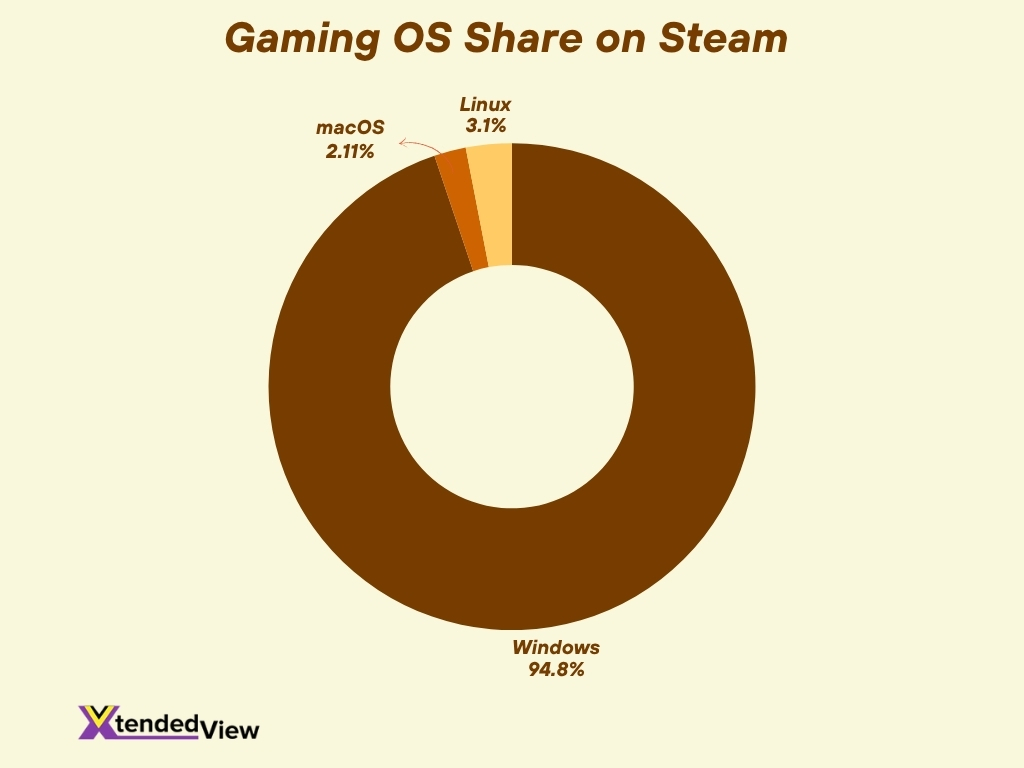
- Steam users on Linux reached 3.05% in 2025, up from 2%.
- About 27% of Linux Steam users run SteamOS.
- Windows remains dominant at ≈ 94.84%, with macOS at 2.11%.
- Proton enables many Windows games to run on Linux.
- Steam Deck and handhelds help drive Linux gaming share.
- Challenges remain with anti‑cheat systems and game support.
- Linux gaming is growing, but remains a niche.
- For developers, Linux is an opportunity with ongoing limitations.
Linux in Enterprise and Business
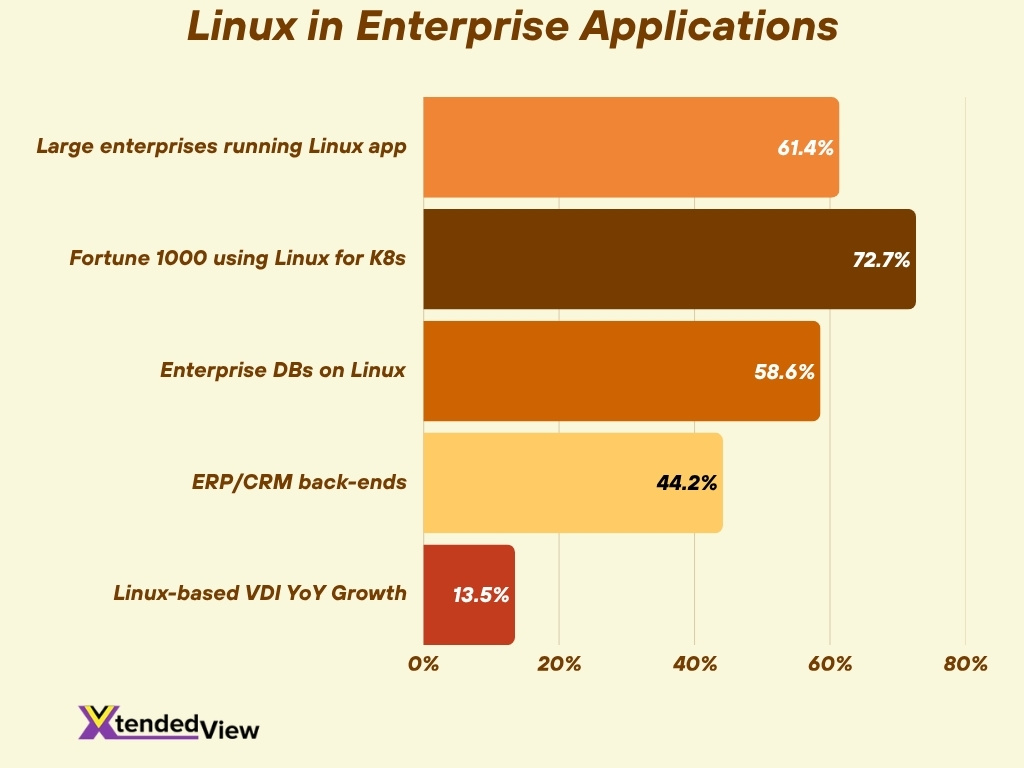
- 61.4% of large enterprises run at least one mission‑critical application on Linux.
- RHEL holds 43.1% of the enterprise Linux server market.
- SLES holds about 11.2%, strong in manufacturing and retail.
- 58.6% of enterprise databases run on Linux.
- 72.7% of Fortune 1000 companies use Linux for Kubernetes.
- Linux on mainframes holds 19.3% of global usage.
- ERP/CRM back‑ends use Linux in 44.2% of cases.
- Linux‑based VDI platforms grew 13.5% YoY in remote firms.
Linux in the Government Sector
- Governments adopt Linux to reduce vendor lock‑in and boost sovereignty.
- A national ministry transitioned from proprietary OS to Linux+LibreOffice in 2025.
- Linux in government is widely used but not always statistically quantified.
- Linux supports cost control, security, and digital sovereignty goals.
- Governments use open‑source certification programs for skills validation.
- Linux is used in public‑sector servers, networks, and cloud stacks.
- Government Linux adoption is forecast to rise through 2028.
- Linux is ideal for modernizing legacy infrastructure without vendor dependency.
Linux in Web Hosting and Websites
- 57.8% of websites (with identifiable OS) run on Linux‑based hosting.
- Linux dominates in global web servers, often over 50%.
- 47.7% of the top 1,000 websites globally use Linux.
- Linux is favored for hosting due to stability, cost, and ecosystem.
- Most of the Internet is backed by Linux, though not always visible.
- Linux hosting offers strong uptime and low cost for businesses.
- Linux is a foundational OS in Internet architecture.
Growth Rate and Market Projections
- The global Linux OS market was $21.97 billion in 2024, projected at $26.41 billion in 2025 with a CAGR ≈ of 20.9%.
- Alternate forecasts show growth from $7.64 billion to $9.02 billion (CAGR ≈ 18.1%).
- India’s Linux OS market is projected to grow from $575.68 million to $3.38 billion by 2035.
- North America held about 37.32% of the global Linux OS market in 2024.
- The Linux software market is projected to grow from $6.3 billion in 2025 to $14.5 billion by 2032.
- Developer and enterprise adoption drives Linux’s internal growth.
- Strong adoption in the server, cloud, and IoT sectors supports expansion.
- Linux offers an open‑source market with rising global traction.
Frequently Asked Questions (FAQs)
About 4.06% of the global desktop OS market share.
Approximately 5.03% of U.S. desktop operating systems.
Around 58.1% of websites whose OS is known.
Expected to reach about $9.1 billion in 2025 with a CAGR of 19.8%.
100% of the top 500 supercomputers are reported to run on Linux.
Conclusion
The statistics paint a clear picture: Linux is no longer a fringe OS for hobbyists. It powers mission‑critical infrastructure in cloud, servers, web hosting, and embedded systems; professional developers adopt it in large numbers; and the kernel continues to evolve with strong community and corporate support. Desktop and gaming adoption remain modest compared to incumbents, yet they are growing. Meanwhile, enterprise, government, and web‑infrastructure segments show significant traction.
As businesses and IT teams evaluate operating‑system strategies, Linux offers a compelling mix of flexibility, cost-effectiveness, and ecosystem maturity. Explore the full article to dig deeper into how Linux’s rising footprint touches every corner of the technology stack.
