


Generative AI (Gen AI) has surged from the fringes of research labs into real-world business operations and daily life. From content creation in marketing teams to code optimization in developer workflows, organizations are finding practical use cases that extend well beyond experimentation. For example, media companies are using Gen AI to automate video production, while software firms deploy it to accelerate development cycles. The statistics below unlock how this shift is taking shape and why it matters. Dive into the full article to explore the data.
Editor’s Choice
- 71% of organizations report actively using Gen AI in at least one business function in 2025, up from 65% in early 2024.
- The global Gen AI market is valued between $44.9 billion and $66.9 billion for 2025, depending on the source.
- Private investment into Gen AI reached $33.9 billion globally in 2024, an 18.7% increase over 2023.
- Gen AI traffic (enterprise) surged by 890%, indicating rapid usage growth in active environments.
- Worldwide spending on Gen AI is expected to total $644 billion in 2025, up ~76% from 2024.
- In the U.S., approximately 51% of adults reported having used AI to answer questions or for other tasks.
- 65% of Gen AI users are Millennials or Gen Z, and 72% are employed full-time.
Recent Developments
- The 2025 Stanford HAI AI Index Report logged $33.9 billion in global private investment into Gen AI in 2024.
- Enterprise Gen AI traffic rose approximately 890% year-on-year, showing widespread rollout across corporate environments.
- 88% of global organizations are actively measuring the value derived from AI adoption, suggesting more rigorous tracking of ROI.
- Only 6% of organizations had not begun exploring Gen AI, implying 94% are either using or investigating it.
- The U.S. market for generative AI is estimated at $7.41 billion in 2024, with a projection to reach $302.31 billion by 2034.
- Software remains the dominant segment in Gen AI, capturing over 65.5% of revenue share in 2024 across technology components.
- The code-generation segment alone is forecasted to grow at a CAGR of 53% from 202 to –2029, highlighting the specialization of Gen AI modalities.
- Geographically, North America held approximately 41% of the revenue share for Gen AI in 2024.
- The gap between Gen AI expectations and reality is becoming clearer; many deployments are still experimental rather than fully operational.
Generative AI Adoption Statistics
- 71% of organizations are using Gen AI in one or more business functions as of 2025.
- 78% of organizations use AI (broader category) in at least one function in 2024, up from 72% earlier in the year.
- Among companies with more than $500 million in annual revenues, Gen AI usage expands across more functions than in smaller firms.
- 63% of Gen AI-using organizations report generating text outputs, over one-third generate images, and more than one-quarter generate code.
- The number of organizations yet to begin exploring Gen AI stands at only 6%.
- In the U.S., 51% of adults say they’ve used AI to look something up or help make decisions.
- 65% of Gen AI users are Millennials or Gen Z.
- The adoption jump from 2017 to 2025 shows AI usage climbing from ~20% of companies to 78%.
- The U.S. Gen AI market alone is expected to grow from $7.41 billion in 2024 to over $302 billion by 2034, indicating widespread future adoption.
Generative AI Market Growth
- The global Generative AI market is projected to grow rapidly over the next several years.
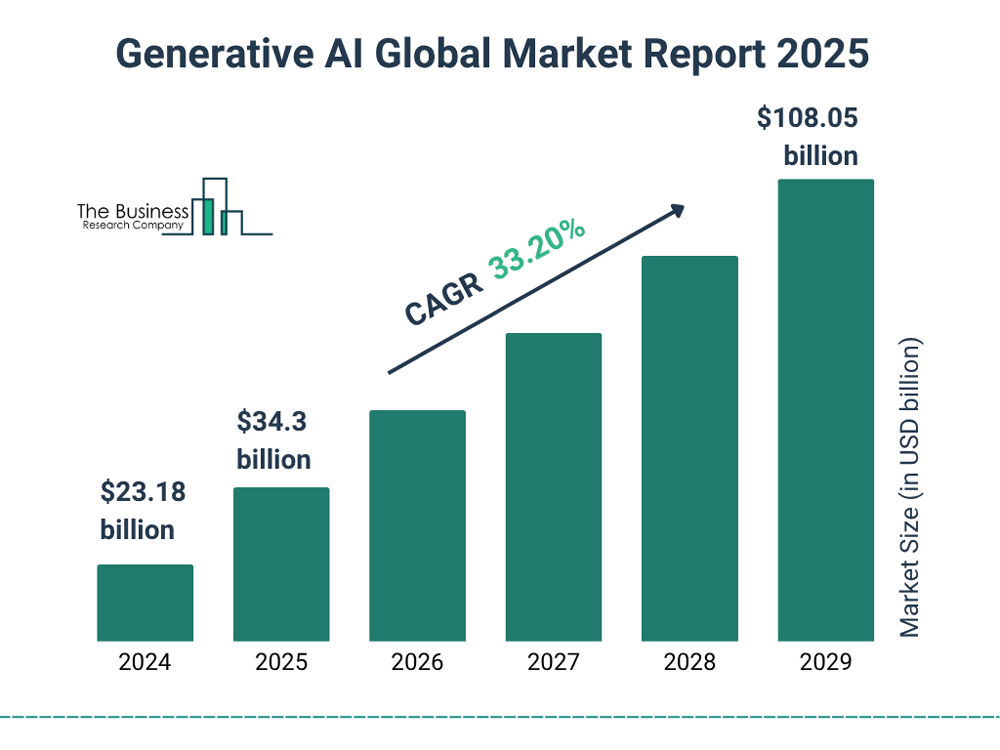
- Market value expected to rise from $23.18 billion in 2024 to $34.3 billion in 2025.
- By 2029, the market is forecasted to reach $108.05 billion, showing strong long-term momentum.
- Impressive CAGR of 33.20% highlights sustained industry expansion and accelerating adoption.
- Growth looks consistent year-over-year, with a clear upward trajectory across 2024–2029.
- Increasing demand driven by applications across business automation, content creation, research & development, and productivity tools.
- The data signals a major shift in global tech investment and competitive advantage toward AI-powered innovation.
Generative AI Usage Statistics
- 71% of organizations report using generative AI in one or more business functions as of 2025.
- 78% of organizations use AI (broader category) in at least one function in 2024, up from 72% earlier in the year.
- Among companies with more than $500 million in annual revenues, generative AI usage expands across more functions than in smaller firms.
- 63% of generative AI‑using organizations report generating text outputs; over one‑third generate images; more than one‑quarter generate code.
- Only 6% of organizations have yet to begin exploring generative AI.
- In the U.S., 51% of adults say they’ve used AI to look something up or help make decisions.
- 65% of generative AI users are Millennials or Gen Z.
- The jump in adoption from 2017 to 2025 shows usage rising from ~20% of companies to 78%.
- The U.S. generative AI market alone is expected to grow from USD 7.41 billion in 2024 to over USD 302 billion by 2034, signalling widespread future adoption.
Generative AI Tools Usage Statistics
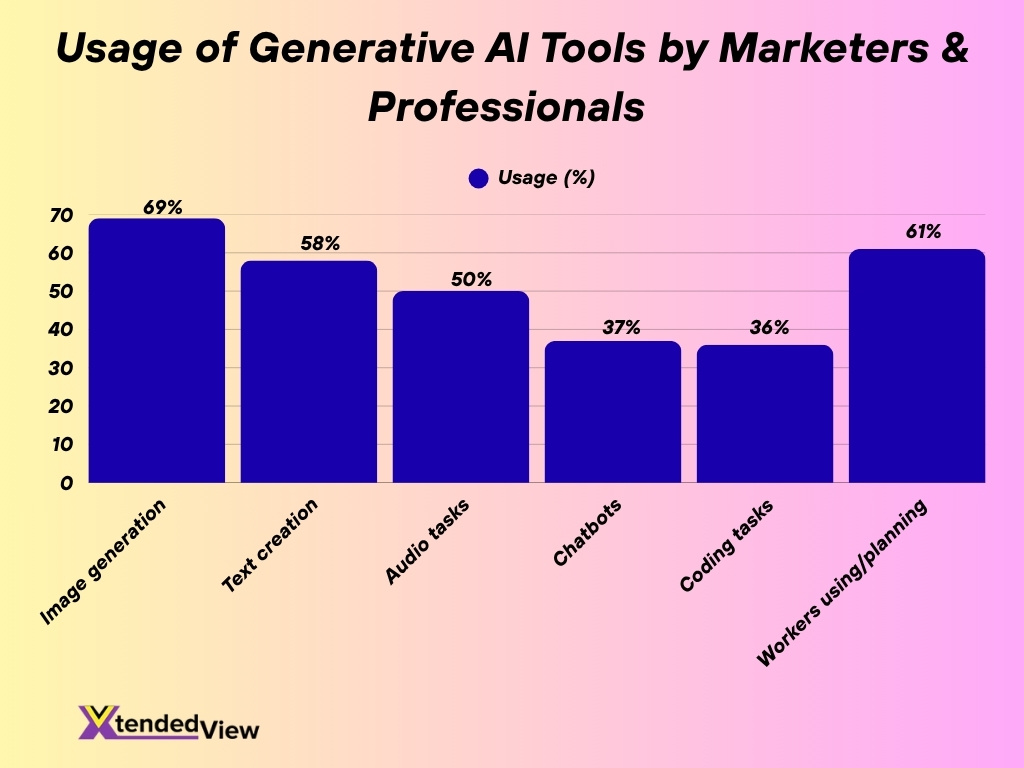
- In 2025, 69% of marketers use generative AI for image generation, with 58% using it for text creation, 50% for audio, 37% for chatbots, and 36% for coding tasks.
- 61% of workers currently use or plan to use generative AI in their roles.
- Among those planning to use generative AI, only 46% say they know how to use trusted data sources securely.
- 60-72% of professionals working on creative tasks now use general AI assistants, and 25-32% also use specialized generative AI tools in 2025.
- Tools such as ChatGPT, Claude, and Midjourney dominate usage, with ChatGPT holding the majority market share among chatbots.
- Among enterprises, 84% of business leaders recognize generative AI’s potential to unlock innovation, yet 75% say adoption is challenging, and 69% say most projects do not reach operational use.
- 86% of IT leaders expect generative AI will soon be essential to their organization.
- 73% of marketing departments already use generative AI, primarily in image and text workflows.
- Chatbots using generative AI in business saved an average of 2 hours 20 minutes per day in early 2025.
- 54% of workers worry that generative AI outputs are inaccurate, and 73% believe it introduces new security risks.
Generative AI Business Adoption Statistics
- As of 2025, 71% of organizations report regularly using generative AI in at least one business function, up from 65% earlier in 2024.
- 94% of organizations have either adopted or begun exploring generative AI; only 6% say they have not begun exploring it.
- For companies with more than 5,000 employees, adoption is about twice as likely compared with smaller companies.
- 47% of U.S. executives say generative AI is boosting productivity in their firms.
- 88% of surveyed organizations say they measure value from AI adoption, showing a shift to quantifying impact.
- In supply-chain and inventory-management functions, two-thirds of businesses reported revenue increases due to generative AI between July 2023 and July 2024.
- 85% of business leaders expect to use generative AI for low-value tasks by the end of 2025, 77% plan to use it in customer service, and 74% for analytics.
- 78% of organizations use AI (general category) in at least one business function in 2024, including generative AI.
Companies Leading in Generative AI Adoption
- Companies with advanced digital maturity are twice as likely to adopt generative AI as less mature peers.
- Amazon reported over 1,000 generative-AI services in progress in mid-2025.
- 51% of marketers already use generative AI, and another 22% plan to use it soon.
- In finance teams, 82% express optimism about AI’s impact on their department in 2025.
- Early adopters in customer service and support show usage plans at 77% by the end of 2025.
- 69% of organizations say most of their generative AI projects don’t reach live use.
- Large tech vendors dominate the ecosystem of tools and services, shaping the vendor landscape significantly.
Benefits of Generative AI for Businesses
- 47% of U.S. executives say generative AI is already boosting productivity in their organizations.
- 40% of business usage is for content creation, and 31% for customer interaction analytics.
- 93% of marketing teams use generative AI to generate content, and 81% use it for faster insights.
- Two-thirds of firms reported revenue increases from generative AI use between mid-2023 and mid-2024.
- 88% of organizations measure value derived from adoption, illustrating a shift toward outcome focus.
- 73% of marketing departments have adopted it for images and text, showing creative workflow benefits.
- 67% of workers expect generative AI to help them get more out of other technology investments.
- 34% of employees expect to use generative AI for more than 30% of tasks in less than a year.
- Businesses using generative AI report faster time-to-market and lower costs in strategic functions.
Risks and Challenges of Generative AI
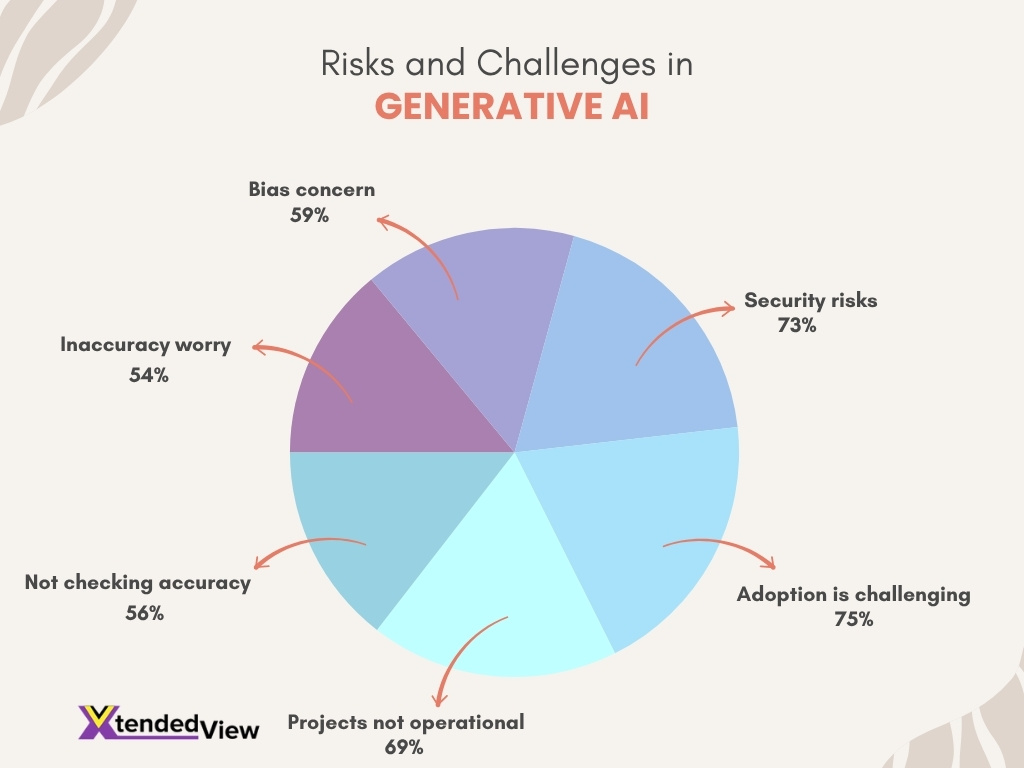
- 54% of workers worry that generative AI outputs are inaccurate, and 59% worry they are biased.
- 73% of respondents believe generative AI introduces new security risks.
- 75% of business leaders say adoption of generative AI is challenging, 69% say most projects don’t reach operational use.
- Only 46% of workers who plan to use generative AI say they know how to use it with trusted data sources.
- 56–57% of employees admitted to not checking the accuracy of AI-produced output, a similar share concealed AI usage.
- Governance and skill gaps remain major hurdles; many organizations lack formal policies for generative AI usage.
- 44% of marketers say they are waiting for more established solutions before implementing AI.
- Data privacy and regulatory compliance issues loom large; leaders emphasize the need for controls as AI scales.
Impact of Generative AI on Workplace Dynamics
- 13% of employees report that they already use generative AI for more than 30% of their daily tasks, whereas only 4% of executives believe that to be the case.
- 34% of employees expect to use generative AI for more than 30% of tasks within the next year, and 37% expect this within 1-5 years.
- 91% of businesses use at least one AI technology in 2025, and 54% specifically mention generative AI usage.
- Administrative workers using AI could save ≈ 3.5 hours per week on repetitive tasks.
- 58% of employees use AI regularly at work, 31% use it weekly or daily.
- Millennials and Gen Z lead in weekly AI tool usage compared with older cohorts.
- 39% of sales professionals worry they will lose their jobs if they don’t learn how to use generative AI at work.
- Generative AI is shifting job roles from purely operational tasks to more AI-enabled collaboration and oversight, making upskilling critical.
Generative AI Applications Across Industries
- Over 80% of retail and CPG firms are either using or piloting generative AI projects as of 2025, underscoring broad industry interest.
- The global generative-AI in retail market is valued at approximately. $1.02 billion in 2025 and is projected to reach about $17.27 billion by 2034 (CAGR ~37%).
- In healthcare, ~86% of organizations report extensive use of AI in 2025, with many explicitly deploying generative-AI tools.
- Healthcare executives more than 80% expect generative AI to have a moderate to significant impact on their organizations in 2025.
- In the BFSI sector, the global generative AI market is valued at $1.38 billion in 2024 and estimated to reach $1.90 billion in 2025.
- 79% of law-firm professionals use AI tools in 2025 (same as 2024).
- Many industry analyses show generative AI moving from pilot phase to full-scale operation across sectors, signaling its maturation.
- Use-cases vary across industries, retail uses for content generation and personalization, healthcare for diagnostics and drug-discovery, finance for risk and client analytics, and legal for document drafting.
- Generative AI is no longer niche but is becoming embedded in core operations.
Generative AI in Healthcare
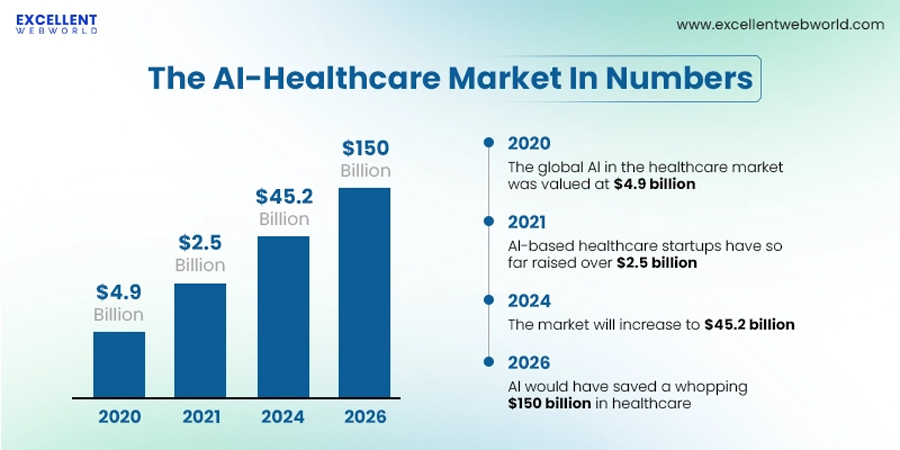
- The global AI in healthcare market was valued at $4.9 billion in 2020
- In 2021, AI-driven healthcare startups collectively raised over $2.5 billion
- Market size expected to surge to $45.2 billion by 2024, signaling rapid adoption
- By 2026, AI is projected to help save $150 billion in healthcare costs
- Data highlights exponential growth and increasing trust in AI-powered medical technologies
- Rising investments and adoption point to AI becoming a core driver of healthcare innovation, efficiency, and cost reduction
Generative AI in Finance & Banking
- 75% of banks with over $100 billion in assets are expected to have full AI strategies by 2025.
- Only about 8% of banks were developing generative AI systematically in 2024; by 2025, 78% had a tactical approach.
- The global generative AI in BFSI market was valued at $1.38 billion in 2024 and is projected to grow to $13.57 billion by 2032 (CAGR ~32.5%).
- Use-cases include credit-risk scoring, fraud detection, automated trading, AML/KYC, and personalized marketing.
- Some banks anticipate up to 70% gross cost reduction in certain categories via AI, though net decreases of ~15-20% are realistic.
- Generative AI enables faster decision-making, better customer experience, and improved risk management in finance.
- Challenges remain around data privacy, model risk, and regulatory compliance.
Generative AI in Law
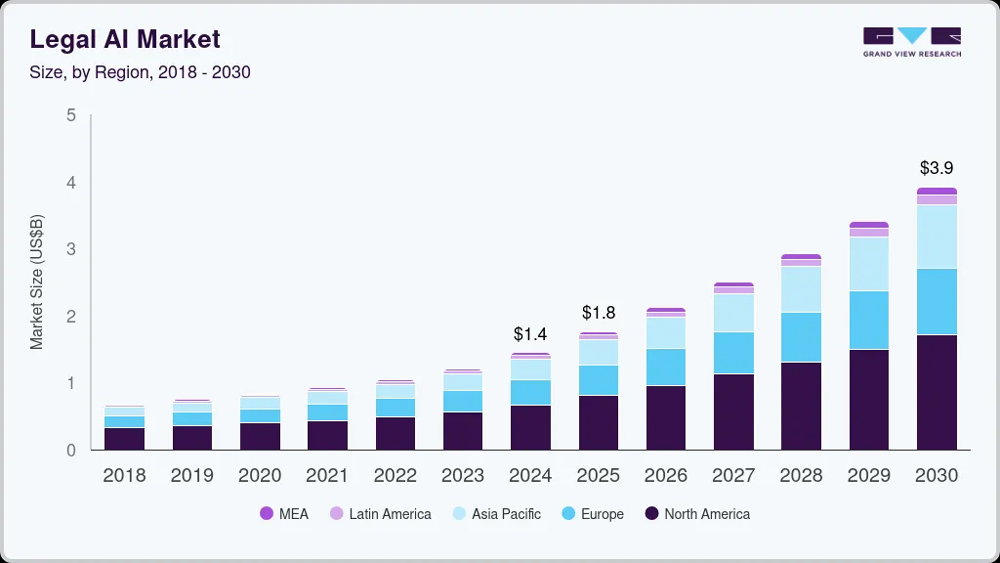
- The Legal AI market is experiencing strong and steady growth across all global regions.
- Market value expands from under $1 billion in 2018 to a projected $3.9 billion by 2030.
- Rapid growth phase begins around 2024, reaching $1.4 billion, and continues accelerating through 2025 at $1.8 billion.
- Major growth drivers include increased adoption of AI-based legal research, contract automation, litigation analytics, e-discovery, and compliance tools.
- North America remains the largest market contributor throughout the timeline, followed by Europe and Asia Pacific.
- Emerging markets like Latin America and MEA (Middle East & Africa) demonstrate gradual but consistent adoption.
- The data reflects rising demand for AI-powered efficiency, predictive analytics, and cost-reduction technologies within legal services.
Generative AI in Retail
- More than 50% of retailers believe generative AI is a strategic differentiator in 2025.
- Retail use-cases: 60% use generative AI for marketing content generation, 44% for predictive analytics, 42% for personalized marketing, 41% for customer segmentation, 40% for digital shopping assistants.
- Retail market size for generative AI, $1.01568 billion in 2025, projected to grow to $17.27 billion by 2034 at ~37% CAGR.
- Many retailers expect 21-50% return on investment within three years of AI deployment.
- Generative-AI supports creative workflows such as virtual fitting rooms, 3D product design, and rapid prototyping.
- Personalization and supply-chain optimization via generative AI are key focus areas for retail leadership in 2025.
- Retail leaders emphasize measurable metrics like conversion-rate uplift and inventory-accuracy improvements.
ROI from Generative AI Investments
- The average ROI for generative-AI investments is 3.7× for every $1 invested.
- Early adopters report productivity improvements of 15%–30%, with some achieving up to 80% gains.
- 62% of companies expect >100% ROI from agentic AI investments, with U.S. firms averaging ~192%.
- About 92% of early adopters see ROI on AI initiatives.
- Enterprises that integrate generative AI across multiple functions yield higher ROI than siloed pilots.
- ROI improves when measurable metrics are defined upfront and deployments target value creation rather than experimentation.
Barriers to Generative AI Adoption
- 45% of organizations globally cite workforce skills and capabilities as the top challenge to implementing generative AI.
- 75% of customers express concerns about data security risks introduced by generative AI.
- Nearly 53% of sales representatives report uncertainty on how to extract value from generative AI.
- In manufacturing, 44% of leaders cite “hallucinations” as a deployment risk.
- Many organizations find that <30% of generative-AI experiments progress from pilot to production.
- Governance, ethics, and regulatory compliance continue to be significant obstacles to scaling generative AI.
- Data-infrastructure readiness, model-risk management, and integration into business-process flows continue to slow adoption.
Frequently Asked Questions (FAQs)
Approximately USD 33.9 billion, up about 18.7% from 2023.
Around 71% of organizations.
Market size projected at USD 37.89 billion in 2025, with a CAGR of about 44.2% from 2025 to 2034.
A CAGR of 41.53% between 2025–2030.
Approximately 73% of marketing departments.
Conclusion
Generative AI is no longer a fringe experiment; across industries from healthcare and finance to retail and law, we see clear movement from pilot projects toward operational solutions. Organizations report meaningful ROI, enhanced productivity, and strategic benefits. Yet the journey is uneven, and adoption barriers such as skills gaps, data governance, and regulatory complexity persist.
As companies move beyond hype and into disciplined deployment, those that pair value-led use-cases with responsible implementation are likely to lead.
