


Diversity in technology is no longer simply a corporate buzzword; it’s a measurable business imperative and cultural benchmark. In sectors like software development and artificial intelligence, organisations are seeing the impact of having teams with varied backgrounds, experiences, and perspectives. For example, tech companies tapping into diverse talent pools are gaining access to new markets and improving innovation cycles. Meanwhile, educational programs that increase access for women and underrepresented minorities illustrate how talent development translates into workforce change. Read on to explore a data‑driven view of where the tech industry stands.
Editor’s Choice
- In 2025, women comprise roughly 27.6% of the global tech workforce.
- Tech companies in the top quartile for racial and ethnic diversity are 35% more likely to earn above‑average profits.
- Just 21% of U.S. software developer positions are held by women as of 2024,25.
- Around 83% of employers report having a diversity, equity, and inclusion (DEI) initiative in place in 2025, up from 67% in 2023.
- Only 17% of tech companies have a female CEO in 2025.
- The most common firm trajectory holds that white male representation declines slowly while minority representation grows only modestly.
- In U.S. computing roles, only 3% are African‑American women.
Recent Developments
- In early 2025, major tech firms like Adobe announced they would discontinue specific diversity hiring targets, marking a shift in how DEI strategy is framed.
- A 2025 corporate governance report notes that U.S. public companies are increasingly narrowing their publicly disclosed workforce diversity metrics while still tracking internally.
- According to the 2025 CompTIA “State of the Tech Workforce” report, workforce diversity and emerging tech job metrics are now central to industry data sets.
- The LeadDev Engineering Leadership Report finds that while 56% of tech organisations still view DEI as a priority, 18% believe the focus is now being deprioritised.
- Over the last year, the number of companies voluntarily reporting expanded diversity metrics has been impacted by political and regulatory shifts in the U.S.
- Meta, Amazon, and other major tech companies have publicly scaled back certain DEI programmes, citing changing legal landscapes.
- Employee‑survey data suggest that job seekers increasingly evaluate corporate diversity when choosing employers; 76% of women and 83% of Asian Americans report doing so.
- Many tech education and training programs are expanding access for underrepresented groups, reflecting a shift toward talent pipeline interventions.
General Diversity in Tech Statistics
- White workers account for roughly 62% of the U.S. technology workforce, Black Americans make up about 7%, and Hispanic/Latinx workers make up about 8%.
- Asian professionals hold about 34% of tech jobs in the U.S., while Hispanic or Latino workers make up 5.9%.
- In U.S. tech support roles, Black workers represent 13%, yet hold only 6% of web‑developer jobs.
- The most common diversity trajectory across firms (81.7%) is a slow decline in white male and white female employment, with only modest growth for minority groups.
- Employees from lower‑income backgrounds fill approximately 30% of entry‑level tech jobs in certain markets, yet represent only ~9% of tech workers in other regional markets (e.g., UK).
- About 76% of women and 83% of Asian Americans say an organisation’s commitment to diversity influences whether they accept a job.
- A 2025 review shows tech organisations in the U.S. are increasing transparency around wage, job‑posting, and workforce composition data.
- Teams in the top quartile for racial/ethnic diversity are 35% more likely to have above‑average financial performance.

Gender Diversity in Tech
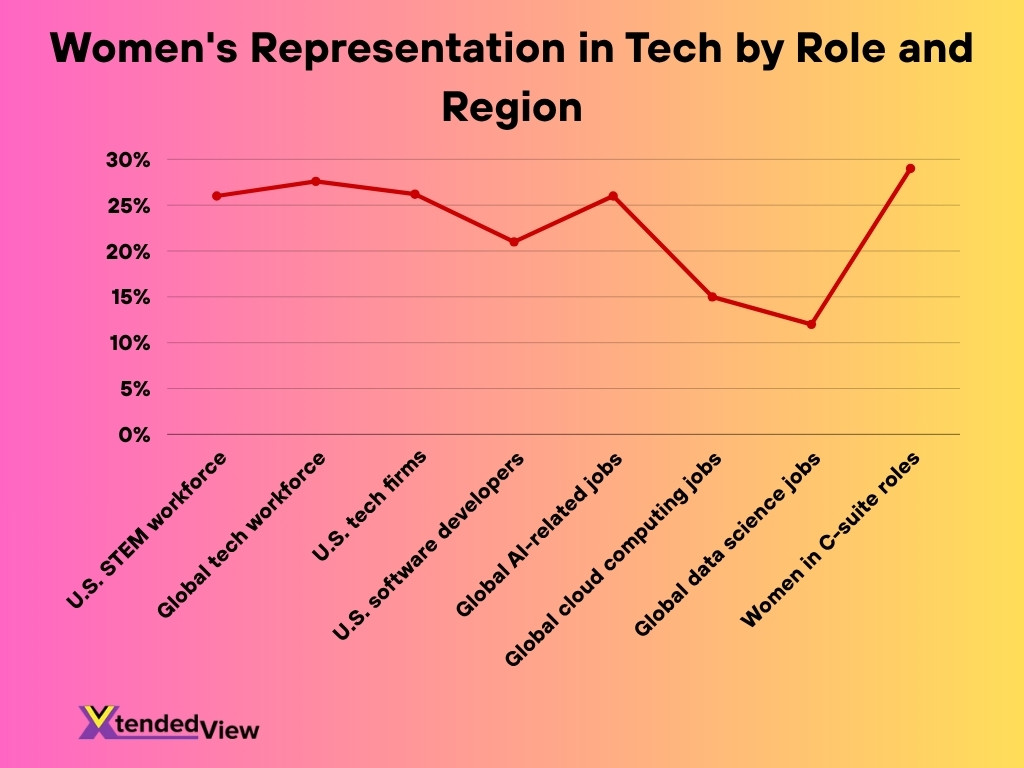
- As of 2025, women represent about 26% of the U.S. STEM workforce and around 24% of core technical roles such as computing and engineering.
- A recent article reports that roughly 27.6% of the global tech workforce is female.
- In tech firms with over 10,000 employees, women’s representation is reported at 26.2%.
- Women hold about 21% of U.S. software developer roles as of 2024,25.
- Women hold approximately 26% of global AI‑related jobs; representation falls to 15% in cloud computing and 12% in data science.
- In the U.S., the ratio of men to women tech employees is around 3:1 overall and 4:1 in technical roles at many companies.
- About 50% of women in tech exit the industry by age 35 (global survey).
- Female representation in leadership (C‑suite) roles rose from 17% in 2015 to 29% in 2024 across corporate roles.
Women’s Representation in Tech Roles
- In the U.S., the average female share of employed software engineers is around 25.1%.
- Women make up nearly 46% of data science and analytics roles in the U.S.
- In lower‑level technical repair jobs (e.g., computer, ATM repair), women held only 9,880 jobs in 2023,24, roughly 11% of that field.
- Among Fortune 500 tech firms, just 3 had a female CEO in 2023.
- Women hold about 8% of Chief Technology Officer (CTO) roles in tech companies.
- Women hold 39% of senior manager/director roles in corporate settings in 2024 (up from 32% in 2015).
- The proportion of women founding tech companies is just about 11% of all founding teams.
- Women of colour (Black and Latinx women) in U.S. tech hold approximately 2.2% and 1.9% of positions, respectively.
Gender Pay Gap in Tech
- In the U.S. tech industry, women now earn about $0.83 for every dollar men earn in comparable roles (uncontrolled gap) as of 2025.
- When adjusting for job title, education, experience, and location (controlled gap), women in the U.S. earn approximately $0.99 for every dollar men earn; a gap remains.
- Globally, women in tech frequently earn between 10 % and 20 % less than men in similar roles and experience levels.
- According to one data set, women in computer science roles earn about 94 % of what men earn, narrower than in many STEM areas.
- A U.S. report shows women’s average annual earnings at about 85 % of men’s across all occupations, tech included.
- Pay transparency and legislation have helped in some metros. In 2025, 13 major U.S. metro regions will have closed the controlled pay gap.
- Despite some progress, one source estimates equal pay in the U.S. tech industry will still take 130+ years at the current pace.
- Reports indicate the gap often widens for women of colour and women in senior or specialised technical roles.
Racial and Ethnic Diversity in Tech
- Tech companies in the U.S. that sit in the top 25 % for racial and ethnic diversity are 35 % more likely to have above‑average financial returns.
- In the U.S., Black workers hold roughly 13 % of technology support roles but only about 6 % of web‑developer roles.
- Hispanic or Latino professionals comprise approximately 5.9 % of the U.S. tech workforce.
- In STEM fields by highest degree, only about 25 % of Black or African American and 31 % of Hispanic workers with an S&E degree work in S&E occupations, compared to 52 % of Asian workers and 35 % of White workers.
- Among U.S. major tech metro areas (2023), women’s share of tech employment ranged around 24 %–30 % depending on region, e.g., Washington D.C. metro shows approx. 24.2 %–26.7 % females in tech roles.
- The dominant “diversity trajectory” in most firms (81.7 %) shows a slow decline in White male and White female representation, little change for Black & Hispanic women, and modest growth for Asian men and women.
- Many tech companies still report large management‑level representation gaps; in some regions, only around 14 % of senior tech roles are held by ethnic minorities.
- Despite increasing educational attainment among minority groups, workforce and leadership representation lag.
LGBTQ+ Representation in Tech
- Estimates suggest around 2–3 % of the tech workforce in general identify as LGBTQIA+, though data is limited.
- The Human Rights Campaign Foundation’s Corporate Equality Index for 2025 provides benchmark scores for how tech employers treat LGBTQ+ employees, indicative of growing, but still modest, corporate focus.
- Job postings in the U.S. referencing neurodiversity (often overlapping with LGBTQ+ inclusion efforts) rose to 1.3 % of all postings by December 2024, up from 0.5 % in 2018.
- A survey found that more than 40 % of large tech firms now have employee resource groups (ERGs) or networks for LGBTQIA+ staff.
- Several reports indicate that LGBTQ+ tech employees are less likely to receive promotions compared with their non‑LGBTQ+ peers; one figure suggests they were 20 % less likely.
- Intersectionality adds further challenge; LGBTQ+ women of colour, for example, face compounded under‑representation and advancement barriers (data limited but highlighted in recent commentary).
- Despite representation challenges, corporate awareness of LGBTQ+ inclusion in tech is increasing, though many employees still report concerns around career progression and identity safety at work.
Disability and Neurodiversity in Tech
- People with disabilities make up around 12% of the U.S. working-age population, but only 4–5% of the tech workforce reports having a disability.
- An estimated 15–20% of the global population is neurodivergent, including conditions like ADHD, autism and dyslexia, yet less than 2% of tech companies publicly report neurodivergent hiring data.
- In 2025, only about 3% of job postings in tech explicitly mention accessibility accommodations or inclusive language.
- Research shows that neurodivergent individuals often excel in roles that require pattern recognition, focus or unconventional problem-solving, such as cybersecurity and data analytics.
- Many companies now support neurodiversity through Employee Resource Groups (ERGs) or mentorships, but implementation remains inconsistent.
- Remote and flexible work arrangements have been a key enabler for disabled and neurodivergent talent, increasing participation rates by an estimated 35% in some firms.
- Studies suggest inclusive hiring programs tailored for neurodivergent candidates can reduce attrition rates by up to 30%.
- The UK and Australian governments have introduced incentives for hiring neurodivergent employees in tech, showing a broader international push for inclusion.
- Fewer than 1 in 5 companies offer specific training for managers to support neurodivergent employees, even among Fortune 500 tech firms.
- Individuals with invisible disabilities continue to under-report due to fear of discrimination, suggesting actual workforce representation is higher than recorded.
Age Diversity in Tech
- The average age of a U.S. tech worker is 38 years, but workers over 45 often report higher barriers to entry and advancement.
- Only about 15% of job postings in the tech industry are filled by candidates over 50, though they make up more than 20% of the workforce.
- A 2025 industry survey found that 68% of older tech workers feel they have experienced age-related bias in hiring.
- Tech startups have an average employee age of 30, and hiring tends to favour early-career talent over experienced professionals.
- Workers over 40 are underrepresented in many coding bootcamp outcomes, despite showing similar or better job performance after hiring.
- Age-diverse teams in product development were found to be 25% more likely to meet deadlines and avoid costly design errors.
- Career switchers into tech from other industries often face implicit bias, even when completing certifications or tech degrees.
- Inclusion of age-diverse mentors has been shown to boost onboarding success for Gen Z engineers in hybrid work cultures.
- Compensation disparities increase with age, especially among women, suggesting compounding diversity challenges.
- Firms with formal age inclusion strategies saw 15% higher retention of senior-level staff and better knowledge continuity.
Social Mobility in the Tech Industry
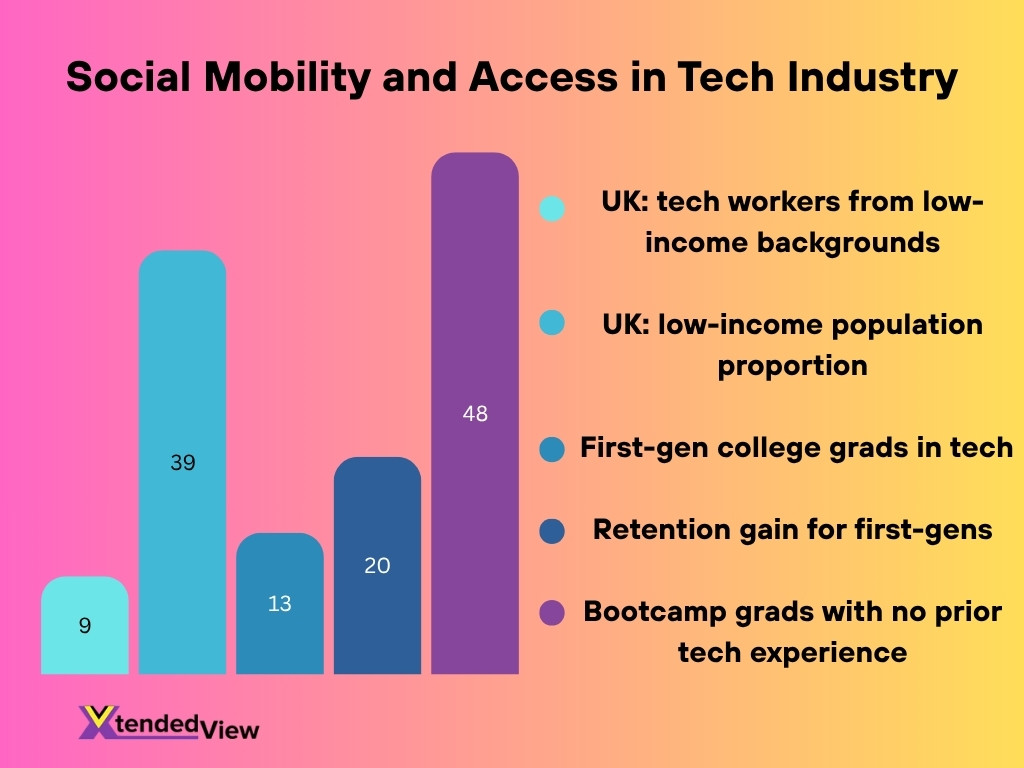
- In the UK, only about 9% of tech workers come from low-income backgrounds, though those groups represent nearly 40% of the population.
- U.S. data shows that workers from lower-income families are 60% less likely to enter high-skill tech roles without targeted support or apprenticeships.
- Tech employers offering tuition reimbursement, paid internships, or early-career scholarships increase hiring diversity by 28% on average.
- Bootcamps and accelerated training programs have increased access for nontraditional candidates, with 48% of bootcamp graduates reporting no prior tech experience.
- Social mobility correlates with geographic location, with rural and inner-city communities underrepresented in major tech hubs.
- First-generation college students represent only about 13% of tech employees but show 20% higher retention once hired.
- Apprenticeship-based pathways such as Year Up and TechHire are narrowing access gaps, with over 80% job placement rates.
- Socioeconomic diversity in entry-level hiring predicts higher innovation metrics in teams within two years.
- Workers from high-poverty zip codes face a 40–50% longer job search in tech roles than those from affluent areas, even with similar skills.
- Targeted interventions like mentorship, housing stipends, or food security programs for tech interns from low-income families are becoming more common in 2025.
Diversity in Tech Leadership
- Only about 18% of executive-level tech leaders are women, with even lower figures for technical C-suite roles like CTO or CIO.
- Black and Hispanic executives together hold less than 7% of leadership roles in tech firms with over 1,000 employees.
- LGBTQ+ representation in leadership remains under 3% in publicly reported data, though internal surveys suggest slightly higher figures.
- Asian professionals are overrepresented in engineering but underrepresented in VP+ roles, especially in decision-making positions.
- Just 17% of tech CEOs globally are women, and fewer than 5% are women of colour.
- Internal leadership pipelines often lack diversity; many promotions to executive ranks occur from narrow recruiting pools.
- Tech firms with diversity on their boards are 43% more likely to outperform their peers in profitability.
- Leadership development programs that include mentoring for underrepresented groups show a 22% increase in promotion rates.
- Some firms have begun tying executive compensation to diversity goals, though adoption remains below 10% industry-wide.
- In 2025, more than 40% of Fortune 100 tech companies published detailed diversity metrics for leadership teams for the first time.
Diversity by Region or Country
- In Europe, the Regional Gender Gap Report shows that the region has achieved a 76.3% gender‑parity score in the workforce as of early 2025, ahead of North America.
- Latin America and the Caribbean achieved a parity score of 74.3%, while Southern Asia reported one of the lowest at 63.4%.
- According to the Global Tech Talent Guidebook 2025, Latin America, Canada, and the Asia‑Pacific region saw the fastest five‑year growth in tech talent among 75 global hubs; the U.S. and Europe were among the slowest growth markets.
- In the U.K., about 25% of all tech workers are from ethnic minority backgrounds, but only 14% are in senior tech posts.
- In the U.S., one study found that Hispanic/Latinx workers make up about 9% of the tech workforce, though they comprise about 18.8% of the overall U.S. labour force.
- Surveys show that in the U.K., only 6% of tech employees report having a disability, despite ~23% of working‑age adults having one.
- Some regions are updating metrics; the U.S. OECD report recorded workforce composition by nationality, gender, and age as of December 2024 for its member countries.
- In Canada and the U.S., tech talent remains heavily concentrated among White and Asian males, while Hispanic and Black professionals remain underrepresented.
- Emerging markets such as Bengaluru (India) were recently ranked among the world’s top tech hubs, reflecting region‑level shifts in tech talent distribution.

Diversity and Inclusion by Company
- Companies in the top 25 % for racial and ethnic diversity are 35% more likely to outperform competitors financially.
- One report noted that firms that ignore inclusion face 2.5× higher turnover and 50% lower capacity to attract top talent.
- Only about 15% of tech companies have a dedicated diversity & inclusion (D&I) strategy at the executive level, according to recent tracking.
- Women make up roughly 18% of technology‑industry leadership roles across companies in one data set.
- Fewer than 4% of tech‑company leaders have combined diversity traits (ethnicity + gender) in one dataset.
- A U.K. industry study found that companies in the bottom quartile for both gender and ethnic diversity in executive teams were 66% less likely to outperform financially.
- Large-scale tech firms report that less than 10% of their C‑suite tech roles are occupied by women of colour.
- Despite public announcements, some major companies (e.g., ASML) dropped formal diversity targets for U.S. operations in 2025 while maintaining them elsewhere.
- In many organisations, diversity initiatives still centre on recruitment rather than systemic retention and advancement of diverse talent.
The Role of Education in Tech Diversity
- A recent review finds that STEM education remains pivotal in closing the tech‑industry diversity gap through early engagement, mentoring, and inclusive curricula.
- In the U.S., a 2025 workforce‑education report notes that firms with higher proportions of talent holding degrees from underrepresented backgrounds show stronger innovation metrics.
- Programs offering paid internships and financial support for low‑income students appear in ~70% of tech internship offerings in some regions.
- In the U.K., only about 9% of tech workers come from low‑income backgrounds, despite those backgrounds constituting ~39% of the population.
- Student‑level research in software engineering indicates that role models and mentoring improve retention for underrepresented students in tech education.
- The share of undergraduate computer science degrees awarded to women has fallen from ~ 37% in 1985 to about 20% today in some regions.
- Inclusive education methods show that gender‑diverse and nationality‑diverse teams do not perform worse and may perform better.
- Skill‑based hiring and up‑skilling initiatives (66% of companies globally report boosting this) are cited as a major lever in tech diversity.
Retention and Turnover of Diverse Talent
- A 2025 survey by ISACA found that 1 in 3 tech professionals switched jobs in the past two years, and 74% of firms identify retention of tech talent as a key concern.
- Employee turnover costs across industries reach approximately $2.9 trillion annually, with replacement costs ranging from 30‑400% of salary.
- Diverse and inclusive companies report they have 2.5× lower turnover when an inclusive culture is embedded versus firms with token diversity.
- In the IT talent‑trends 2025 report, 42% of IT professionals reported they were actively exploring new job opportunities.
- Firms that reduce turnover through inclusive management record up to 40% lower departure rates among diverse employees.
- Among organisations restructuring their workforce in 2025, ~89% reported that redesigning roles and job architecture is critical to retention.
- Employees from underrepresented backgrounds often cite a lack of advancement, mentorship, and inclusive management as top factors in leaving roles.
Barriers to Diversity in Tech
- One study shows the share of Black, Latina, and Native American women in U.S. tech roles dropped from 4.6% to 4.1% between 2018,2022.
- Over‑reliance on hiring targets without structural change frequently leads to tokenism and resentment rather than real inclusion.
- Fewer than 10% of major tech companies report that women occupy more than a quarter of core technical roles.
- Under‑representation is strongly tied to socio‑economic background, e.g., only ~9% of tech workers in the U.K. come from low‑income backgrounds.
- Management and culture barriers persist; ~72% of women in tech report experiencing “bro culture” at work.
- Structural pay gaps remain, e.g., white women earn about 82.9% of what their male counterparts make, Asian women about 79.9%.
- Non‑inclusive leadership teams are linked with lower financial performance (66% less likely to outperform).
- Educational pipelines are uneven; fewer underrepresented students enrol, complete, and persist in STEM pathways.
Business Impact of Diversity in Tech
- Companies scoring high on diversity and inclusion show 2.5× greater growth in cash flow per employee compared to less diverse peers.
- Firms with gender‑diverse top management are reported to be up to 25% more profitable than those without such diversity.
- Diverse teams are 70% more likely to capture new markets, according to one workforce‑diversity report.
- Inclusion‑driven companies report higher employee engagement. One survey found 76% of women, 77% of Hispanics, and 83% of Asian Americans consider an organisation’s DEI stance when choosing an employer.
- The U.S. technology workforce report by CompTIA (2025) emphasises diversity as a key metric in job postings, wages, and business establishment.
- Conversely, companies lacking diversity face higher turnover, weaker talent attraction, and slower innovation cycles.
- Innovating firms cite diversity of thought and background as crucial to breakthroughs in areas such as AI, cloud, and cybersecurity.
Conclusion
The data makes it clear, diversity in tech is not optional; it’s strategic. Across regions, companies, and roles, the challenges remain significant, from representation gaps in leadership to retention struggles among diverse talent. Yet the business case is strong; firms that prioritise inclusion see better retention, innovation, and financial performance. To move forward, tech organisations must invest in education pipelines, build inclusive cultures, and transform structures, not just hire for optics.
