


Intel remains a cornerstone of the global semiconductor industry, powering everything from enterprise data centers to everyday consumer laptops. Its processors enable cloud computing, artificial intelligence workloads, and enterprise IT systems, while also supporting billions of devices used across industries such as finance, healthcare, and manufacturing. At the same time, Intel plays a critical role in global supply chains, especially as governments and companies invest heavily in domestic chip production and advanced fabrication technologies.
However, the company now operates in a rapidly evolving landscape shaped by AI demand, intense competition from players like AMD, Nvidia, and TSMC, and rising capital expenditure requirements. As Intel pushes forward with its foundry strategy and next-generation chips, its financial performance, market share, and operational metrics offer valuable insights into both its challenges and growth opportunities. This article breaks down the latest Intel statistics to help you understand where the company stands today and where it may be headed next.
Editor’s Choice
- Intel reported $52.9 billion in total revenue for 2025, remaining flat year over year.
- The company generated $53.1 billion in revenue in 2024, reflecting a 2% annual decline.
- Intel’s net income was -$267 million in 2025, showing a sharp recovery from heavy losses in 2024.
- In contrast, Intel posted a -$18.76 billion net loss in 2024, driven by restructuring and write-downs.
- Q4 2025 revenue reached $13.7 billion, down 4% year over year.
- Intel’s gross profit hit $18.37 billion in 2025, improving from $17.34 billion in 2024.
- The company employed approximately 85,100 people globally in 2025, reflecting ongoing cost optimization.
Recent Developments
- Intel regained full control of its Ireland Fab 34 facility by buying back a 49% stake for $14.2 billion in 2026.
- The company sold a 51% stake in Altera for $3.3 billion in 2025, improving liquidity.
- Intel reduced its operating expenses to $16.8 billion for 2025, signaling cost discipline.
- Q3 2025 revenue grew 3% year over year to $13.7 billion, indicating stabilization.
- Intel reported $0.15 EPS in Q4 2025, beating expectations by 87.5%.
- The company reduced operating expenses by 15% year over year in 2025, improving margins.
- Intel’s restructuring efforts included workforce reductions targeting ~75,000 employees globally.
- The foundry segment continues to operate at a loss, with multi-billion-dollar investments in process nodes like Intel 18A.
Intel Facts and Company Overview
- Intel was founded in 1968 and is headquartered in Santa Clara, California.
- The company operates in the semiconductor and computing hardware industry, focusing on CPUs, GPUs, and chipsets.
- Intel ranked among the top 3 semiconductor companies globally by revenue in 2024.
- The company serves a global market, supplying chips to PC manufacturers and cloud providers.
- Intel is a component of the S&P 500 and Nasdaq-100 indices, highlighting its market significance.
- It employs over 85,000 people worldwide, reflecting its large-scale operations.
- Intel’s flagship product line includes Intel Core processors, widely used in personal computers.
- The company also develops AI and data center chips, targeting enterprise and cloud workloads.
- Intel owns a majority stake in Mobileye, focusing on autonomous driving technology.
Intel Revenue Statistics
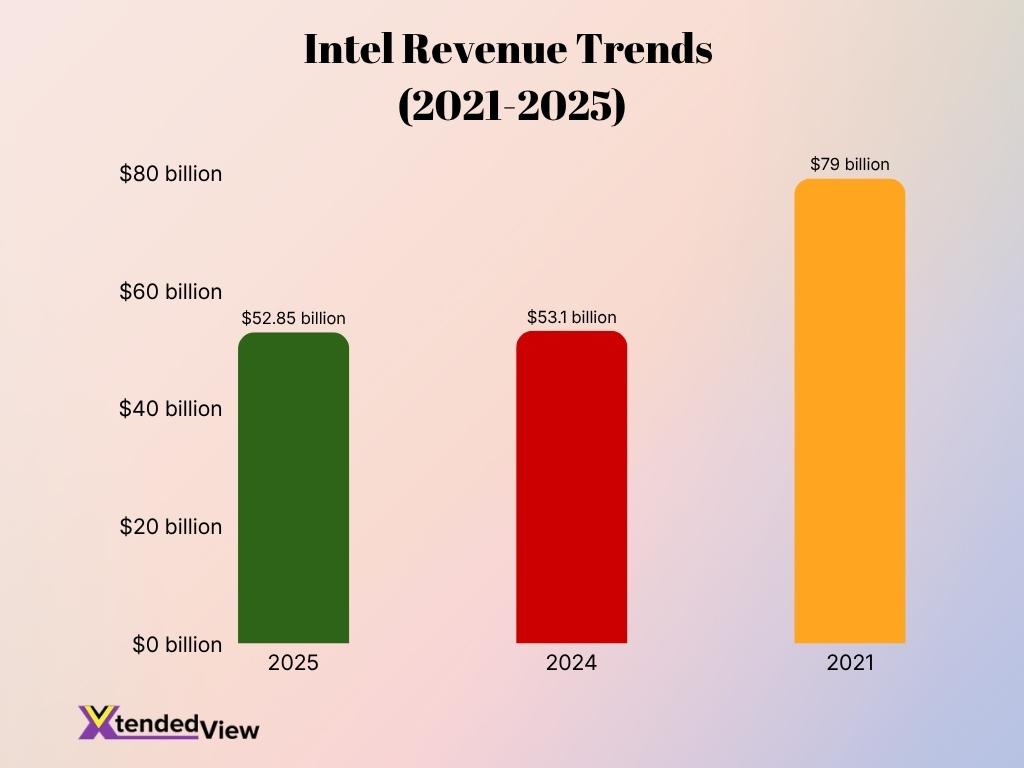
- Intel generated $52.85 billion in revenue in 2025, marking a slight year-over-year decline.
- Revenue in 2024 stood at $53.10 billion, down 2.08% from 2023.
- Intel’s revenue peaked at $79 billion in 2021, showing a long-term downward trend.
- Q4 2025 revenue was $13.7 billion, reflecting a 4% YoY decrease.
- Q4 2024 revenue was $14.3 billion, indicating continued pressure on top-line growth.
- Intel’s gross profit increased to $18.37 billion in 2025, improving efficiency.
- Cost of revenue declined to $34.48 billion in 2025, compared to $35.76 billion in 2024.
- Intel’s revenue decline since 2021 reflects PC market contraction and competitive pressure.
- The company’s quarterly revenue consistently hovered around $13–14 billion in 2025, showing stabilization.
Intel Net Income and Profitability Statistics
- Intel reported a net loss of $267 million in 2025, a major improvement from 2024 losses.
- Net income in 2024 was -$18.76 billion, reflecting restructuring and asset impairments.
- Intel posted $1.69 billion in net income in 2023, indicating a sharp profitability decline afterward.
- The company’s net profit margin was -0.5% in 2025, signaling near break-even performance.
- Operating margin stood at -4.2% in 2025, reflecting ongoing restructuring costs.
- Quarterly net loss for Q4 2025 reached -$591 million, highlighting continued pressure.
- Intel achieved temporary profitability in Q3 2025 with $4.1 billion in net income, driven by asset sales.
- Gross margin improved to around 38% in the 2025 quarters, signaling better cost control.
- Profitability remains volatile due to heavy capital investments in foundry expansion and AI initiatives.
Intel Market Capitalization Statistics
- Intel’s market capitalization fluctuated around $200–230 billion in early 2026, reflecting investor uncertainty.
- The company’s stock price hovered near $54 per share after Q4 2025 earnings.
- Intel remains part of the S&P 500 and Nasdaq-100, supporting institutional investment demand.
- Market cap declined significantly from its peak above $300 billion during 2020–2021.
- Intel’s valuation reflects competition from AMD and Nvidia, particularly in AI chips.
- The company’s restructuring and foundry investments have weighed on investor sentiment.
- Intel stock experienced double-digit volatility during the 2024–2025 earnings cycles.
- Despite challenges, Intel maintains a strong institutional ownership base, including Vanguard and BlackRock.
Semiconductor Market Share Insights
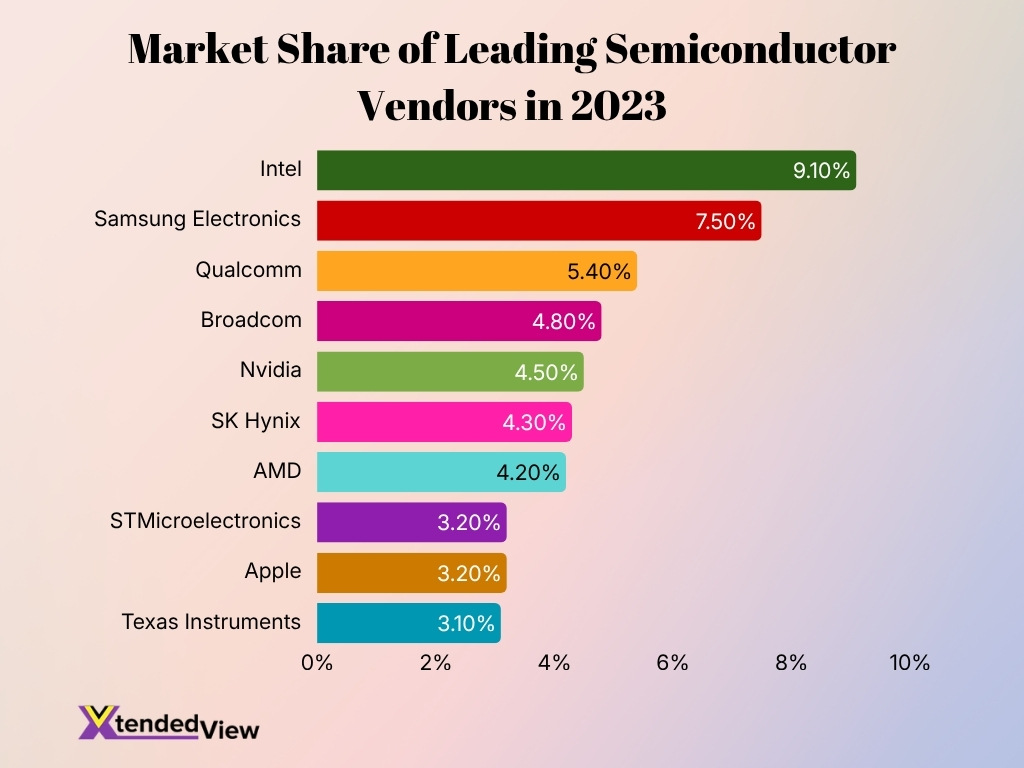
- Intel leads the global semiconductor market with a 9.10% market share, maintaining its dominant position despite rising competition.
- Samsung Electronics ranks second with 7.50%, reinforcing its strong presence, especially in memory chips.
- Qualcomm holds the third position at 5.40%, driven largely by its leadership in mobile and wireless technologies.
- Broadcom captures 4.80%, reflecting its strength in infrastructure software and semiconductor solutions.
- NVIDIA secures 4.50% market share, highlighting its rapid growth fueled by demand for AI and GPU technologies.
- SK Hynix accounts for 4.30%, continuing to be a major player in the memory semiconductor segment.
- AMD follows closely with 4.20%, showing strong momentum in CPUs and data center markets.
- STMicroelectronics and Apple are tied at 3.20% each, indicating Apple’s growing influence through in-house chip development (Apple Silicon).
- Texas Instruments holds 3.10%, maintaining a solid position in analog and embedded processing chips.
- The top 10 semiconductor companies collectively dominate a significant portion of the market, with the top two players (Intel and Samsung) alone contributing over 16% combined share.
- The data highlights a highly competitive and fragmented market, where even the top player holds less than 10% share, indicating no single company has overwhelming dominance.
Intel Valuation and Financial Ratio Statistics
- Intel’s price-to-earnings (P/E) ratio turned negative in 2024 (-12.5x) due to large net losses.
- The forward P/E ratio improved to around 28–32x in early 2026, reflecting recovery expectations.
- Intel’s price-to-sales (P/S) ratio hovered near 4.0x in 2025, aligning with semiconductor industry averages.
- The company’s price-to-book (P/B) ratio remained around 2.0x–2.5x in 2025, indicating moderate valuation.
- Intel’s return on equity (ROE) dropped to -0.5% in 2025, reflecting weak profitability.
- Return on assets (ROA) stood at -0.2% in 2025, showing limited asset efficiency.
- The company’s gross margin stabilized around 38% in 2025, improving from prior-year lows.
- Intel’s operating margin remained negative at approximately -4% in 2025, due to restructuring costs.
- Debt-to-equity ratio increased to ~0.45 in 2025, reflecting rising borrowing for capital expenditure.
Intel Earnings Per Share (EPS) Statistics
- Intel reported full-year EPS of -$0.06 in 2025, reflecting near break-even performance.
- In 2024, EPS dropped sharply to -$4.38, driven by restructuring charges.
- Intel’s EPS was $0.40 in 2023, marking a steep decline afterward.
- Q4 2025 EPS came in at $0.15, beating analyst expectations significantly.
- Q3 2025 EPS reached $0.41, driven by one-time gains and improved operations.
- Intel’s EPS forecast for 2026 is estimated at $1.80–$2.20, signaling recovery.
- Diluted shares outstanding remained stable at around 4.2 billion shares in 2025.
- EPS volatility reflects cyclical semiconductor demand and heavy capital spending cycles.
Intel Workforce Gender Diversity Insights
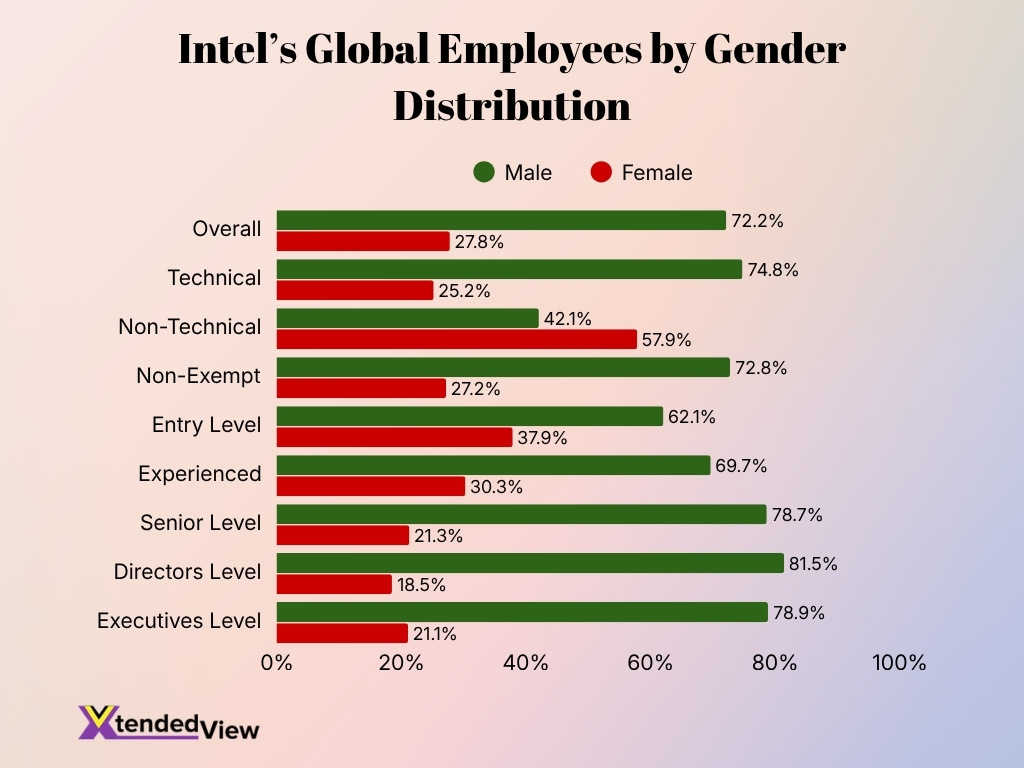
- Male employees dominate the overall workforce, accounting for 72.2%, while female representation stands at 27.8%, highlighting a significant gender gap.
- Technical roles show strong male dominance, with 74.8% men vs. 25.2% women, indicating ongoing challenges in gender diversity within engineering and tech functions.
- Non-technical roles are female-majority, where 57.9% are women compared to 42.1% men, making it the only category with higher female representation.
- Entry-level positions have relatively higher female participation, with 37.9% women, suggesting improved diversity at early career stages.
- Gender gap widens with seniority, as female representation drops to 30.3% at the experienced level and further to 21.3% at the senior level.
- Leadership roles show the lowest female representation, with only 18.5% women at the director level and 21.1% at the executive level, reflecting a clear leadership gender gap.
- Non-exempt roles closely mirror overall trends, with 27.2% women and 72.8% men, reinforcing the broader workforce imbalance.
- Overall, the data highlights a “leaky pipeline” effect, where female representation declines as job level increases, especially in technical and leadership roles.
Intel Cash Flow and Free Cash Flow Statistics
- Intel generated $11.5 billion in operating cash flow in 2025, showing recovery.
- Free cash flow remained negative at approximately -$14 billion in 2024, due to heavy capex.
- Intel’s capital expenditures exceeded $25 billion in 2024, driven by foundry expansion.
- In 2025, capex declined slightly to ~$23 billion, reflecting cost controls.
- Free cash flow improved but remained negative at around -$8 billion in 2025.
- Intel’s depreciation and amortization expenses reached over $12 billion annually, impacting cash flow.
- The company’s cash and short-term investments totaled $24 billion in 2025, providing liquidity.
- Intel aims to achieve positive free cash flow by 2027, aligned with foundry scaling plans.
Intel Balance Sheet Debt and Liquidity Statistics
- Intel’s total debt reached $50+ billion in 2025, reflecting heavy investment cycles.
- Long-term debt accounted for over $47 billion, indicating reliance on long-term financing.
- The company held $24 billion in cash and equivalents in 2025, supporting liquidity.
- Intel’s current ratio stood at 1.3x in 2025, indicating adequate short-term liquidity.
- Total assets exceeded $200 billion in 2025, driven by fabrication plant investments.
- Shareholders’ equity was approximately $105 billion in 2025, maintaining a solid capital base.
- Intel’s debt-to-assets ratio remained around 0.25, reflecting moderate leverage.
- The company continues issuing bonds to fund multi-billion-dollar semiconductor fabs globally.
Intel Business Model Insights: Segment Revenue Breakdown
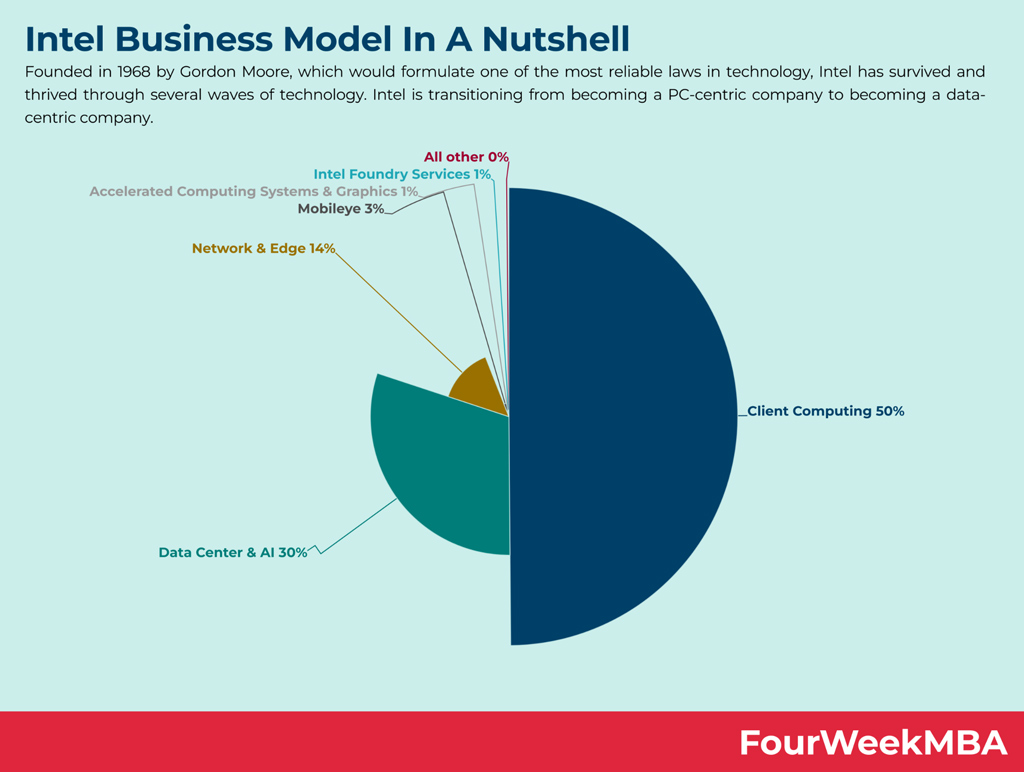
- Client Computing dominates with 50% share, making it the largest revenue driver for Intel, highlighting its continued dependence on the PC and laptop market.
- Data Center & AI contributes 30%, showcasing Intel’s strong push toward AI infrastructure and cloud computing, and signaling a strategic shift to data-centric growth.
- Network & Edge accounts for 14%, indicating Intel’s growing role in 5G, edge computing, and networking solutions.
- Mobileye holds a 3% share, reflecting Intel’s presence in the autonomous driving and automotive AI sector, though still a relatively small contributor.
- Accelerated Computing Systems & Graphics contributes 1%, showing Intel’s early-stage efforts in GPUs and high-performance computing.
- Intel Foundry Services also at 1%, highlighting its emerging semiconductor manufacturing business, which is expected to grow as Intel competes with TSMC and Samsung.
- All Other segments contribute 0%, indicating minimal impact from smaller or legacy business units.
- Overall, 80% of Intel’s revenue comes from Client Computing (50%) and Data Center & AI (30%), emphasizing a high concentration in core computing segments.
- The data clearly shows Intel is transitioning from a PC-centric company to a data-centric company, with AI, cloud, and edge technologies becoming key growth pillars.
Client Computing Group (CCG) Revenue Statistics
- CCG generated approximately $29–30 billion in revenue in 2025, remaining Intel’s largest segment.
- In 2024, CCG revenue was around $29.3 billion, showing a slight decline due to the PC market slowdown.
- Q4 2025 CCG revenue reached $8.8 billion, down slightly year over year.
- Desktop CPU demand stabilized in 2025, contributing to flat segment growth.
- Laptop shipments drove a majority of CCG revenue, accounting for over 60% of segment sales.
- Intel Core processors remain dominant in enterprise PCs, supporting corporate IT refresh cycles.
- The PC market contraction in 2023–2024 led to double-digit declines in CCG revenue, followed by stabilization.
- AI PCs and Copilot-enabled devices are expected to drive renewed growth in 2026 and beyond.
Data Center and AI (DCAI) Revenue Statistics
- DCAI generated approximately $16–17 billion in revenue in 2025, showing moderate growth.
- In 2024, DCAI revenue stood at $15.5 billion, reflecting a gradual recovery.
- Q4 2025 DCAI revenue reached $4.0 billion, up year over year.
- Cloud service providers accounted for over 50% of DCAI revenue, highlighting hyperscaler demand.
- Enterprise and government customers contributed 30–35% of segment revenue.
- AI accelerator products like Gaudi chips gained traction in 2025, supporting revenue growth.
- Intel faces strong competition from Nvidia in AI GPUs, impacting growth rates.
- The data center segment’s operating margin improved to mid-20% range in the 2025 quarters.
Intel Stock Price Predictions Trends
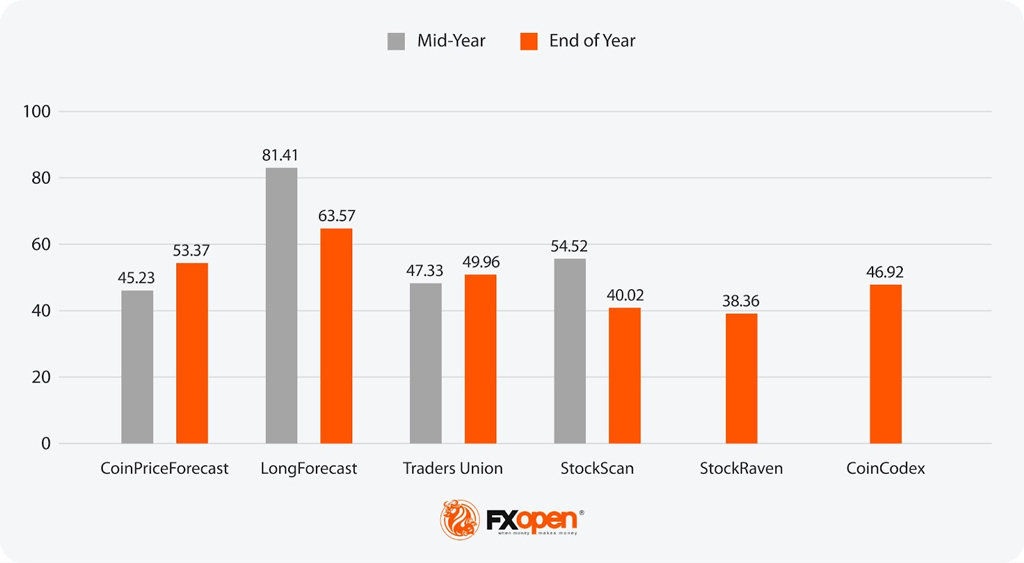
- The average end-of-year forecast across platforms ranges between $38.36 and $63.57, highlighting moderate uncertainty in Intel’s 2026 outlook.
- CoinPriceForecast predicts a steady rise from $45.23 (mid-year) to $53.37 (year-end), indicating a bullish growth trend.
- LongForecast provides the highest mid-year estimate at $81.41, but expects a decline to $63.57 by year-end, signaling potential volatility.
- Traders’ Union shows a stable outlook, with prices moving slightly from $47.33 to $49.96, suggesting low volatility expectations.
- StockScan forecasts a significant drop, from $54.52 mid-year to $40.02 at year-end, indicating a bearish sentiment.
- StockRaven gives one of the lowest projections at $38.36, reinforcing a conservative or pessimistic outlook.
- CoinCodex estimates the stock to reach $46.92 by year-end, aligning with a neutral-to-mildly bullish stance.
- Overall, predictions show a wide spread of ~$43 difference between the highest ($81.41) and lowest ($38.36) estimates, reflecting high market uncertainty.
- While some analysts expect growth beyond $50, others anticipate downward pressure below $40, making Intel’s 2026 trajectory highly mixed.
Intel Foundry Services Revenue Statistics
- Intel Foundry Services (IFS) generated approximately $4.4 billion in revenue in 2025, reflecting steady growth.
- In 2024, IFS revenue was around $3.7 billion, indicating year-over-year expansion.
- Q4 2025 IFS revenue reached $1.4 billion, supported by increased external customer demand.
- Intel’s foundry segment continues to operate at a loss, with operating losses exceeding $7 billion in 2024.
- The company plans to achieve break-even in foundry operations by 2027, aligning with its long-term strategy.
- Intel secured major foundry customers, including U.S. government contracts and commercial chip designers.
- The IFS segment focuses on advanced nodes like Intel 18A, expected to drive future revenue.
- Intel’s foundry expansion includes multi-billion-dollar fabs in the U.S. and Europe, boosting long-term capacity.
Intel CPU and PC Market Share Statistics
- Intel maintained approximately 75–78% share of the global CPU market in 2025, despite competition.
- AMD held around 20–23% CPU market share, narrowing the gap with Intel.
- Intel’s laptop CPU share remained higher at ~80% in 2025, driven by OEM partnerships.
- Desktop CPU share declined slightly to ~70%, as AMD gained traction.
- Global PC shipments reached approximately 260 million units in 2025, supporting Intel’s demand.
- Intel processors powered the majority of enterprise and government PC fleets worldwide.
- The rise of ARM-based chips (e.g., Apple Silicon) has slightly eroded Intel’s market dominance.
- AI PCs are expected to drive double-digit growth in premium CPU segments by 2026.
Intel Geographic Revenue Distribution Statistics
- The United States accounted for approximately 25–27% of Intel’s total revenue in 2025.
- China contributed around 27–30% of Intel’s revenue, making it the largest regional market.
- Asia-Pacific (excluding China) generated roughly 30% of revenue, driven by manufacturing demand.
- Europe accounted for 15–18% of Intel’s revenue in 2025, reflecting enterprise demand.
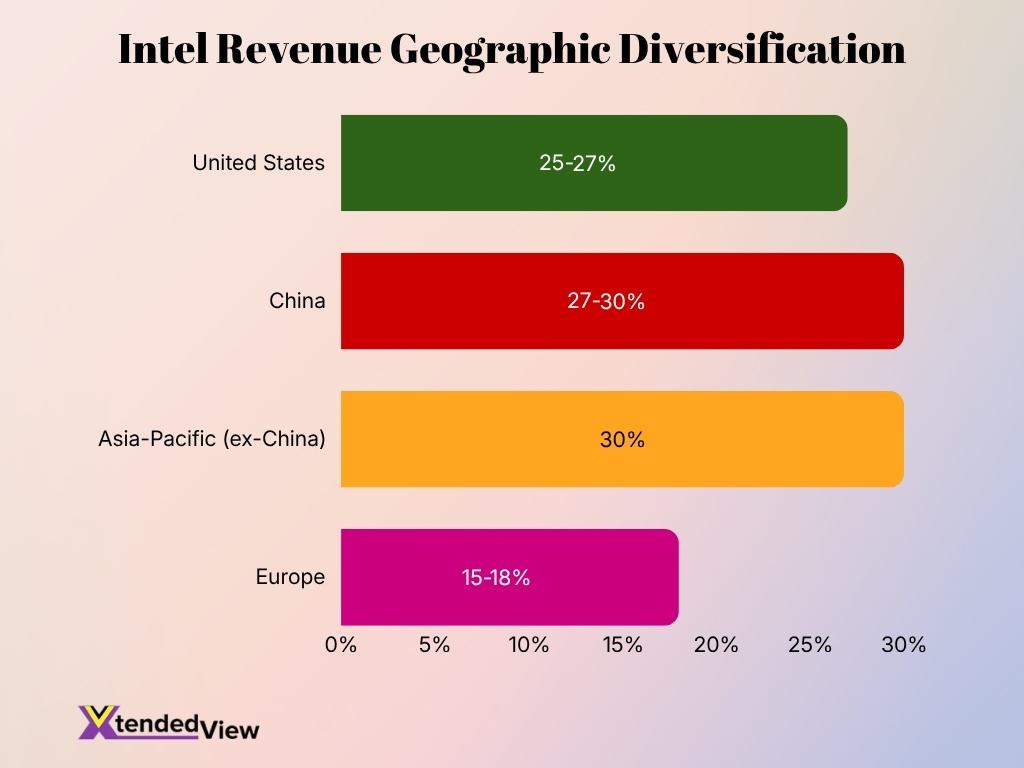
- Revenue diversification helps Intel reduce reliance on any single geographic market.
- Export restrictions and geopolitical tensions have impacted Intel’s China sales growth.
- Intel continues expanding manufacturing in the U.S. and EU to align with regional supply chain policies.
- Government incentives like the CHIPS Act in the U.S. support domestic semiconductor production.
Intel R&D Spending Statistics
- Intel invested approximately $15.2 billion in R&D in 2025, reflecting a strong innovation focus.
- In 2024, R&D spending was around $15.0 billion, showing consistent investment levels.
- R&D accounted for ~28% of total revenue in 2025, one of the highest ratios in the industry.
- Intel’s R&D spending supports the development of advanced nodes like Intel 18A and 20A.
- The company invests heavily in AI accelerators, GPUs, and data center technologies.
- Intel employs thousands of engineers globally, contributing to its R&D capabilities.
- R&D investment remains critical to compete with TSMC, Nvidia, and AMD.
- Intel’s innovation strategy includes partnerships with governments and academic institutions.
Frequently Asked Questions (FAQs)
Intel reported $52.9 billion in total revenue for 2025.
Intel posted a full-year EPS of -$0.06 in 2025, with Q4 EPS at $0.15.
Intel generated $13.7 billion in Q4 2025 revenue, down about 4% year over year.
Intel holds roughly 74–75% of the global x86 CPU market share as of 2025.
Intel Foundry holds about 6% share of the global semiconductor foundry market in 2025.
Conclusion
Intel’s position reflects a company actively navigating a complex transformation. While revenue has stabilized and core segments like client computing and data centers continue to generate substantial income, profitability remains under pressure due to heavy investments in manufacturing expansion, advanced process nodes, and AI-focused technologies. These investments, although costly in the short term, are central to Intel’s long-term strategy of reclaiming leadership in semiconductor manufacturing and competing more effectively in high-growth markets.
At the same time, the broader semiconductor industry continues to expand, driven by demand for AI, cloud computing, and edge devices. Intel’s ability to capitalize on these trends will depend on execution, particularly in scaling its foundry services, improving margins, and delivering competitive products. For investors, analysts, and industry observers, the data presented throughout this report highlights both the risks and the strategic opportunities shaping Intel’s future trajectory.
