



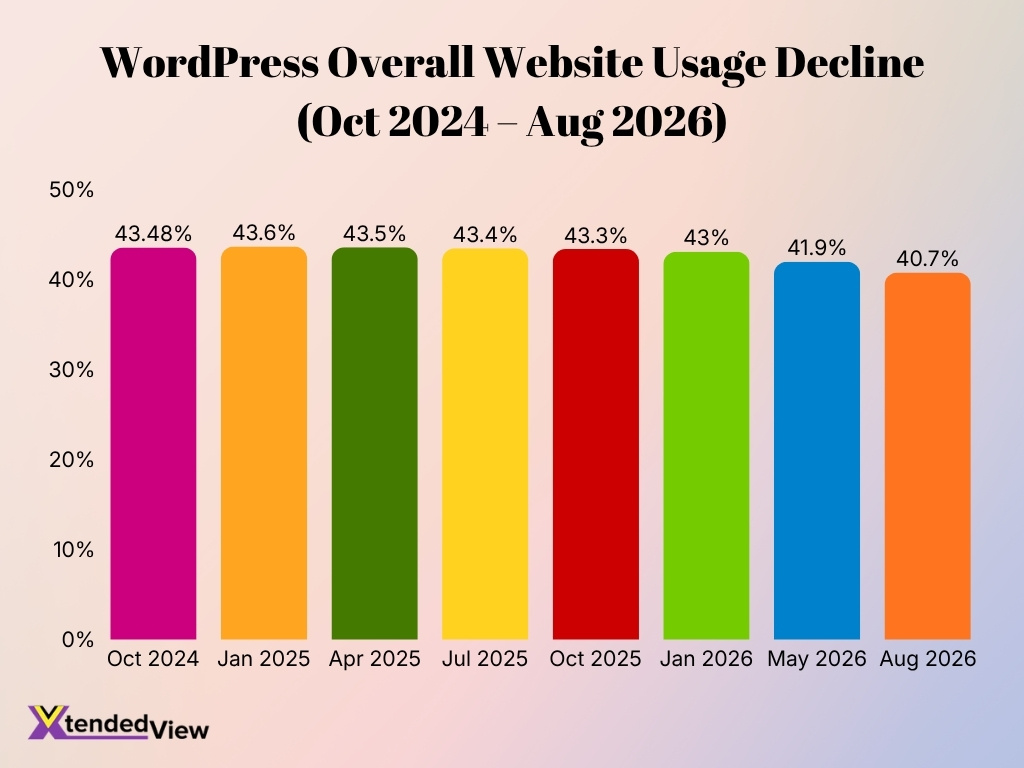
WordPress remains the largest content management platform on the web, powering 40.7% of all websites measured as of Aug. 20. Its reach extends far beyond personal blogs. Businesses use WordPress for corporate websites, news publishing, lead generation, membership platforms, and ecommerce through WooCommerce. Developers also rely on its plugin and theme ecosystem to build customized sites for clients across industries.
At the same time, WordPress is entering a more mature phase. Its market share has declined from 2025 levels, while competitors such as Shopify and Wix continue to gain ground. New releases, AI features, security improvements and performance updates are shaping how businesses and developers use the platform. The statistics below show how WordPress is performing across market share, adoption, plugins, themes, ecommerce, security, hosting, SEO and developer earnings.
Editor’s Choice: Key WordPress Statistics Overview
- 40.7% of all websites use WordPress as of Aug. 20, 2026, based on technology-detection measurements.
- WordPress controls 59.0% of the identifiable CMS market, meaning it remains larger than all individual CMS competitors by a wide margin.
- Around 37,998,485 live websites are detected as using WordPress worldwide.
- The United States accounts for 17,070,646 live WordPress sites, or roughly 45% of the detected worldwide live-site total.
- WordPress appears on 49.4% of the top 1 million websites that use an identifiable CMS in August 2026.
- Its share rises to 51.6% among the top 100,000 websites with a known CMS.
- Among the top 10,000 websites with a detectable CMS, WordPress represents approximately 52.2% in August 2026.
- WordPress’ share of all websites stood at 43.4% in June 2025, illustrating a measurable contraction heading through 2026.
- Technology-detection records show about 85.2 million live and historical WordPress sites combined, highlighting the platform’s accumulated footprint over time.
Recent Developments
- WordPress 7.0 “Armstrong” officially arrived on May 20, 2026, becoming the year’s first major WordPress release.
- WordPress 7.0 introduced an AI Client in Core, allowing WordPress to communicate with external generative AI models through a standardized interface.
- The 7.0 release added a centralized connectors screen with three presets, giving users a central location to manage external AI connections.
- WordPress 7.0 RC1 contained more than 134 updates and fixes after Beta 5, showing the volume of work completed late in the release cycle.
- RC3 subsequently addressed more than 143 issues after RC2 as the release moved toward production readiness.
- WordPress 7.0.1, released July 9, 2026, fixed 31 bugs across Core and the Block Editor.
- Version 7.0.2 followed on July 17 as a security release addressing one critical and one high-severity security issue.
- By Aug. 12, 2026, WordPress had already reached version 7.0.4, less than three months after the initial 7.0 launch.
- WordPress formed a dedicated AI Team in May 2025, initially naming four contributors to coordinate AI development and canonical projects across the ecosystem.
- WordPress 6.8 Beta 1 entered testing with 370+ editor enhancements, 520 editor bug fixes, and 230+ Core tickets ahead of its April 2025 release.
WordPress Market Share Statistics
- WordPress holds 59.0% of the CMS market as of Aug. 20, 2026.
- Its overall website usage stands at 40.7%, which means roughly two in five measured websites run WordPress.
- In July 2025, WordPress held 60.9% of the known CMS market and powered 43.4% of all measured websites.
- In October 2024, WordPress had a 62.47% CMS share, placing the August 2026 figure 3.47 percentage points lower.
- WordPress powered 43.48% of all measured websites in October 2024, compared with 40.7% in August 2026.
- Quarterly data put WordPress at 43.6% of all websites in January 2025, 43.5% in April and 43.4% in July.
- Its overall share moved to 43.3% in October 2025 and 43.0% in January 2026, extending the gradual decline.
- The decline accelerated from 43.2% in December 2025 to 41.9% by May 27, 2026, a reduction of 1.3 percentage points in about six months.
- Despite that decline, WordPress still represents more than half of known CMS usage across the overall web, top 100,000, and top 10,000 website segments.
- Among top 1,000 websites with an identifiable CMS, WordPress holds 48.0%, showing substantial adoption even at the web’s highest-traffic tier.
WordPress Website Usage Statistics
- Current technology scans identify 37,998,485 live WordPress websites worldwide.
- Another 2,385,623 domains redirect to detected live WordPress websites.
- Researchers have identified 47,227,075 websites that previously used WordPress but no longer register as live WordPress installations.
- Combining live and historical detections produces an ecosystem footprint of about 85,225,560 websites.
- About 306,841 detected WordPress sites sit within the top 1 million websites by traffic.
- Approximately 19,284 WordPress websites fall within the top 100,000 sites by traffic.
- The United States alone has more than 17 million currently detected WordPress websites.
- WordPress 7.0 has already been detected on 2,779,256 U.S. websites as of August 2026.
- Older installations remain substantial: version 6.7 alone still accounts for 552,379 U.S. websites in current detection data.
- Even WordPress 5.4 remains detectable on 68,198 U.S. websites, illustrating the long tail of legacy WordPress installations.
WordPress Growth Statistics
- WordPress’ overall web share rose from 13.1% in 2011 to 43.2% in 2022, a gain of more than 30 percentage points over 11 years.
- Its share increased from 21.0% in 2014 to 43.5% in 2024, meaning WordPress more than doubled its share over that decade.
- WordPress moved from 23.3% in 2015 to 35.4% in 2020, adding 12.1 percentage points in five years.
- Adoption reached 39.5% in 2021, putting WordPress close to the two-in-five website threshold.
- WordPress reached 43.2% in 2022, after which its overall market share entered a much flatter period.
- The platform recorded 43.1% in 2023, 43.5% in 2024 and 43.4% in 2025, illustrating how rapid historical expansion transitioned into market maturity.
- Current technology tracking found roughly 95,171 newly detected WordPress websites in seven days during August 2026.
- The 14-day new-site count reached approximately 255,494 websites, indicating that new WordPress deployments continue despite declining proportional market share.
- Approximately 689,690 new WordPress detections appeared over the preceding month, according to the same August 2026 dataset.
- Over the preceding three months, the dataset recorded about 2.48 million new WordPress websites, showing that market-share contraction does not mean WordPress installations have stopped appearing.
WordPress Usage Statistics by Country
- The United States leads WordPress adoption with approximately 17,070,646 live websites detected in August 2026.
- Based on the roughly 38 million worldwide live-site count, the United States represents about 45% of detected live WordPress sites.
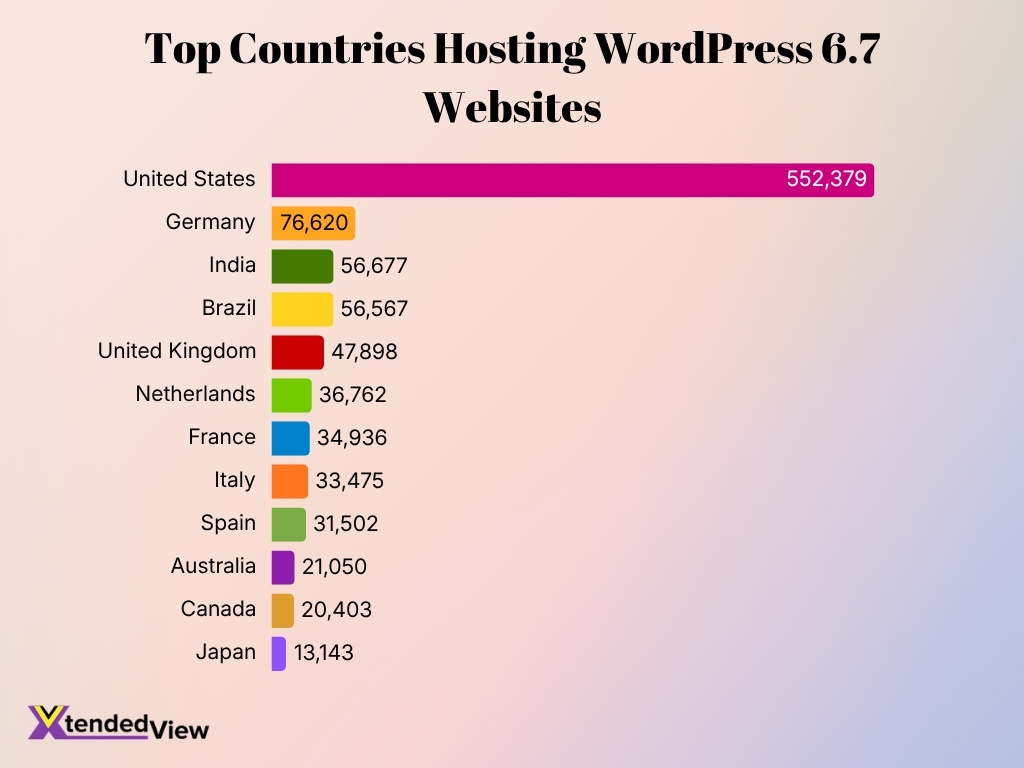
- Looking specifically at the older WordPress 6.7 branch, the United States still hosts 552,379 detected sites.
- Germany ranks second in that WordPress 6.7 dataset with 76,620 live sites, well behind the United States.
- India accounts for 56,677 WordPress 6.7 websites, narrowly ahead of Brazil’s 56,567.
- The United Kingdom has 47,898 detected WordPress 6.7 sites, placing it among the largest country markets in that version-specific dataset.
- The Netherlands accounts for 36,762 WordPress 6.7 sites, while France follows with 34,936.
- Italy and Spain register 33,475 and 31,502 WordPress 6.7 websites, respectively.
- Australia has 21,050 detected WordPress 6.7 sites, while Canada has 20,403.
- Japan accounts for 13,143 WordPress 6.7 websites in the same dataset, illustrating the platform’s reach across North America, Europe and Asia-Pacific.
WordPress Plugin Statistics
- The plugin review team recorded 805 plugin submissions during the week ending Aug. 16, 2026. Of those submissions, 721 received approval.
- During the same August 2026 reporting period, 322 plugin requests were rejected, and another 58 plugins were closed.
- The plugin review queue contained 5,217 new or pending submissions as of Aug. 17, 2026. About 4,361 had remained in the queue for more than seven days.
- Of the pending plugin cases in August 2026, 4,174 were waiting on authors, while 502 were waiting on reviewers.
- Elementor records 10+ million active installations, making it one of the largest plugins in the ecosystem in 2026.
- Yoast SEO also records 10+ million active installations, demonstrating the scale of search optimization tools within the WordPress plugin ecosystem.
- Contact Form 7 has reached 10+ million active installations, placing a form-building plugin alongside the ecosystem’s most widely installed extensions.
- The Classic Editor still has 9+ million active installations in 2026, showing strong continued demand for the pre-block editing interface.
- Akismet Anti-spam has at least 5 million active installations, while Jetpack records more than 3 million active installations.
- Plugin review activity has increased during 2026. In the week reported May 18, the team processed 606 plugin requests and approved 433, compared with 805 requests and 721 approvals in the August reporting period.
WordPress Theme Usage Statistics
- Hello Elementor leads current theme-framework detections with about 4.01 million websites across the entire internet.
- Astra ranks next with approximately 3.41 million detected websites, placing it among the largest standalone WordPress themes in use during 2026.
- Divi appears on around 2.29 million websites, giving it the third-highest detection count among individual themes in the current dataset.
- Elegant Themes-related framework detections total approximately 1.80 million websites.
- Flatsome appears on about 907,230 websites, highlighting its large footprint in the WordPress theme market, particularly among commerce-oriented installations.
- GeneratePress records approximately 676,314 detections, while Avada appears on about 623,184 websites.
- OceanWP accounts for about 516,510 websites, narrowly ahead of Kadence at roughly 509,670 detections.
- Blocksy appears on around 504,601 websites, putting three modern lightweight themes, OceanWP, Kadence and Blocksy, within roughly 12,000 detections of one another.
- Twenty Twenty-Four, an official block theme, is still detected on approximately 410,743 websites in 2026.
- Across the top 1 million sites by traffic, the theme-framework dataset contains 203,503 detections. Hello Elementor leads that group with 24,292, followed by Astra with 15,272 and GeneratePress with 11,816.
WordPress Page Builder Statistics
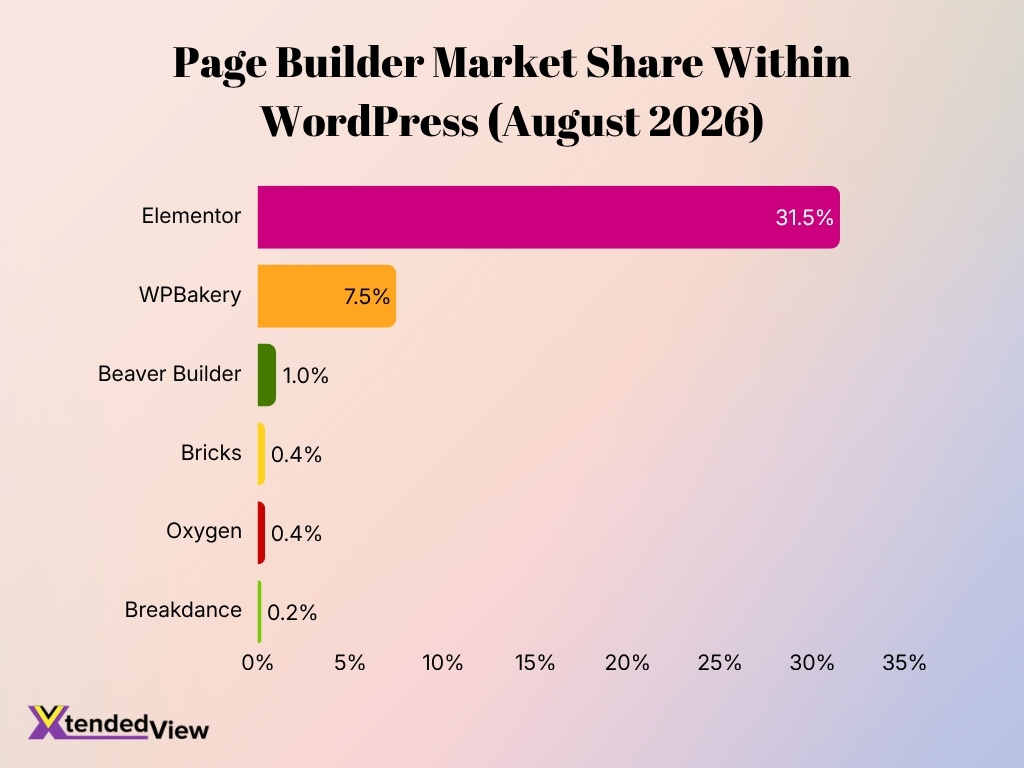
- Elementor runs on 31.5% of WordPress websites as of August 2026, making it the most widely detected WordPress page-building subtechnology in the current dataset.
- Across the entire web, Elementor appears on 12.8% of websites, equivalent to 18.6% of websites that use a recognized content management system.
- WPBakery appears on 7.5% of WordPress websites in August 2026, down from 8.9% in August 2025.
- Elementor moved in the opposite direction, rising from 29.1% of WordPress sites in August 2025 to 31.5% by Aug. 19, 2026.
- Beaver Builder remains installed on around 1.0% of WordPress websites, with its measured share staying almost unchanged throughout the past year.
- Bricks increased from 0.2% of WordPress sites in August 2025 to 0.4% in August 2026, doubling its measured share from a relatively small base.
- Oxygen holds approximately 0.4% of detected WordPress usage, with little movement across the August 2025-August 2026 period.
- Breakdance accounts for around 0.2% of WordPress websites in August 2026, compared with roughly 0.1% a year earlier.
- Among the top 1 million sites with a known CMS, Elementor holds 11.4%, while WPBakery has about 3.0%. Among the top 10,000, their shares fall to roughly 4.3% and 1.8%, respectively.
- Migration data shows 1.05% of sites recently leaving Divi Builder moved to Elementor, compared with 0.16% of Elementor sites that recently moved in the opposite direction.
WooCommerce Statistics
- WooCommerce powers 8.1% of all measured websites as of Aug. 18, 2026.
- Among websites using a recognized ecommerce system, WooCommerce controls 48.2% of the market, compared with 31.6% for its nearest major rival.
- When measured as a CMS-related technology, WooCommerce accounts for 11.7% of websites with a known CMS.
- WooCommerce appears on 19.8% of WordPress websites in August 2026, making ecommerce one of the largest specialized uses within the WordPress ecosystem.
- WooCommerce’s share of WordPress installations stood at 20.5% in August 2025, compared with 19.8% in August 2026.
- Its share of all websites also moved from 8.9% in August 2025 to 8.1% by Aug. 19, 2026. Over the same period, the competing hosted-commerce platform tracked in the dataset rose from 4.8% to 5.3%.
- Among the top 1 million websites with a detectable CMS, WooCommerce represents 9.0%. Its share falls to about 2.8% among the top 100,000 websites.
- WooCommerce accounts for approximately 1.2% of known-CMS websites in the top 10,000 and around 1.3% among the top 1,000.
- WooCommerce’s overall website usage remains substantially larger than PrestaShop’s 0.5% and Adobe Commerce’s 0.3%, according to August 2026 measurements.
- Ecommerce software appears on about 16.8% of measured websites overall in August 2026. WooCommerce alone accounts for nearly half of detected ecommerce-system usage.
WordPress Security Statistics
- Researchers identified 11,334 new WordPress ecosystem vulnerabilities in 2025, a 42% increase from the 7,966 vulnerabilities reported in 2024.
- Of the vulnerabilities identified during 2025, 4,124, or 36%, represented an actionable security threat serious enough to require protective mitigation rules.
- About 1,966 vulnerabilities, or 17% of the 2025 total, received high-severity classifications associated with a significant risk of mass exploitation.
- The number of highly exploitable WordPress vulnerabilities increased 113% year over year in 2025.
- Plugins accounted for 91% of newly discovered vulnerabilities in 2025, while themes represented 9%. WordPress core recorded only six reported vulnerabilities, all categorized as low priority in that dataset.
- For comparison, plugins accounted for 96% of disclosed WordPress vulnerabilities in 2024, while only five disclosed vulnerabilities affected WordPress core.
- During Q4 2025 alone, researchers added 2,213 vulnerabilities to one major WordPress vulnerability database, an increase of 19.2% from the previous quarter.
- Q4 2025 included 131 high-threat vulnerabilities and 100 vulnerabilities categorized as common and dangerous. At quarter-end, 905 disclosed vulnerabilities remained unpatched.
- Security telemetry recorded 9.1 billion blocked web application firewall attacks and 13.8 billion blocked brute-force attacks during Q4 2025. Approximately 467,000 monitored websites were identified as infected during the quarter.
- Cross-site scripting led the Q4 2025 vulnerability categories with 658 disclosures, followed by 611 missing-authorization issues, 224 cross-site request forgery issues, and 107 SQL injection vulnerabilities.
WordPress Core Web Vitals Performance Statistics
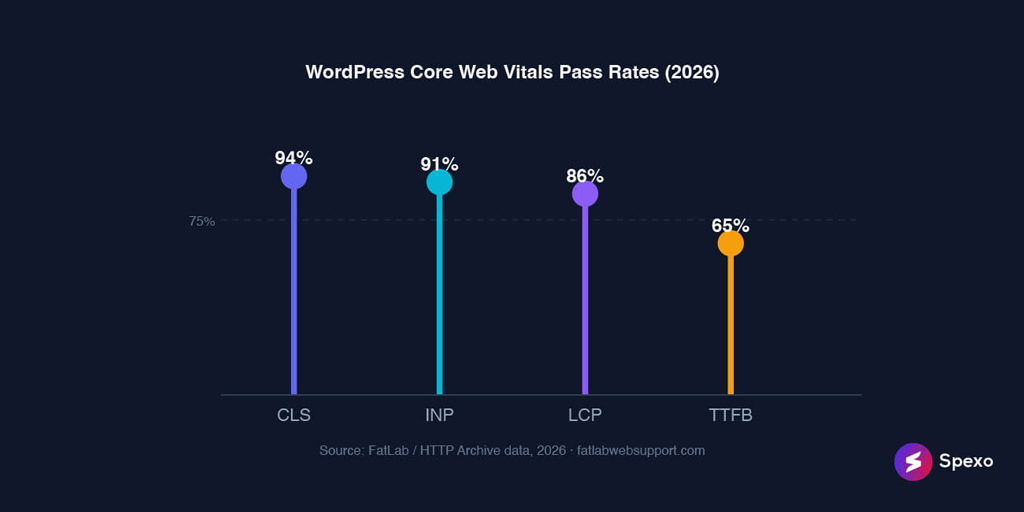
- CLS (Cumulative Layout Shift) records the highest Core Web Vitals pass rate at 94%, indicating strong visual stability across WordPress websites.
- INP (Interaction to Next Paint) achieves a 91% pass rate, showing that most WordPress sites deliver responsive user interactions.
- LCP (Largest Contentful Paint) has an 86% pass rate, placing it comfortably above the 75% benchmark shown in the data.
- TTFB (Time to First Byte) trails the other performance metrics with a 65% pass rate, making server response time the biggest performance weakness in the comparison.
- The gap between the highest-performing metric, CLS at 94%, and the lowest, TTFB at 65%, is 29 percentage points.
- Overall, three of the four metrics exceed 85%, suggesting strong Core Web Vitals performance across most measured areas, while TTFB remains the key area for improvement.
WordPress Community and Localization Statistics
- WordCamp Asia 2026 attracted 2,627 attendees to Mumbai from April 9-11, reflecting the scale of the WordPress community across Asia.
- More than 1,500 people joined Contributor Day at WordCamp Asia 2026, working across more than 20 contribution tables with 38 table leads.
- WordCamp Europe 2026 drew 2,458 ticket holders from 81 countries to Kraków, Poland, in June.
- The WordCamp Europe 2026 schedule included 49 talks and eight hands-on workshops, covering development, AI, business, accessibility and the open web.
- WordPress Campus Connect surpassed 6,200 students by early June 2026, showing how the ecosystem is expanding into colleges and universities.
- Campus Connect completed 25 events during the first half of 2026, bringing its all-time event count to 45, with another 42 in planning or already scheduled.
- Translation tracking counted 210 locales with active projects near the end of 2025, providing a useful baseline for the localization work continuing through 2026.
- That translation community included 80,240 translation contributors, 6,513 project translation editors, and 803 general translation editors in the late-2025 measurement.
- About 57.4% of WordPress sites used a translated version in the late-2025 localization snapshot, underlining the platform’s reach beyond English-language publishing.
- WordPress 7.1 entered its translation phase on Aug. 13, 2026, six days before its planned Aug. 19 release date, giving localization teams time to prepare language packs for the new version.
WordPress Technical and Performance Statistics
- WordPress 7.0 included over 419 Core tickets, featuring 76 enhancements and 300 bug fixes.
- The 7.0 update also delivered 411 editor enhancements and over 486 bug fixes across components.
- Over 40 tickets targeted the editor while 90 tickets addressed wp-admin functionality in version 7.0.
- WordPress 7.0 introduced 24 accessibility enhancements focusing on media and voice-control improvements.
- Performance testing spanned eight hosting environments between April 29 and May 4, 2026.
- Testing optimized collaboration polling intervals, adjusting them from 0.25 seconds to a steady 1-second interval.
- WordPress 7.1 RC1 packed 145+ updates, which included 57 Editor changes and 88 Core changes.
- The 7.1 RC4 release introduced 26+ additional changes, including eight Editor fixes and 18 Core updates.
WordPress Version Statistics
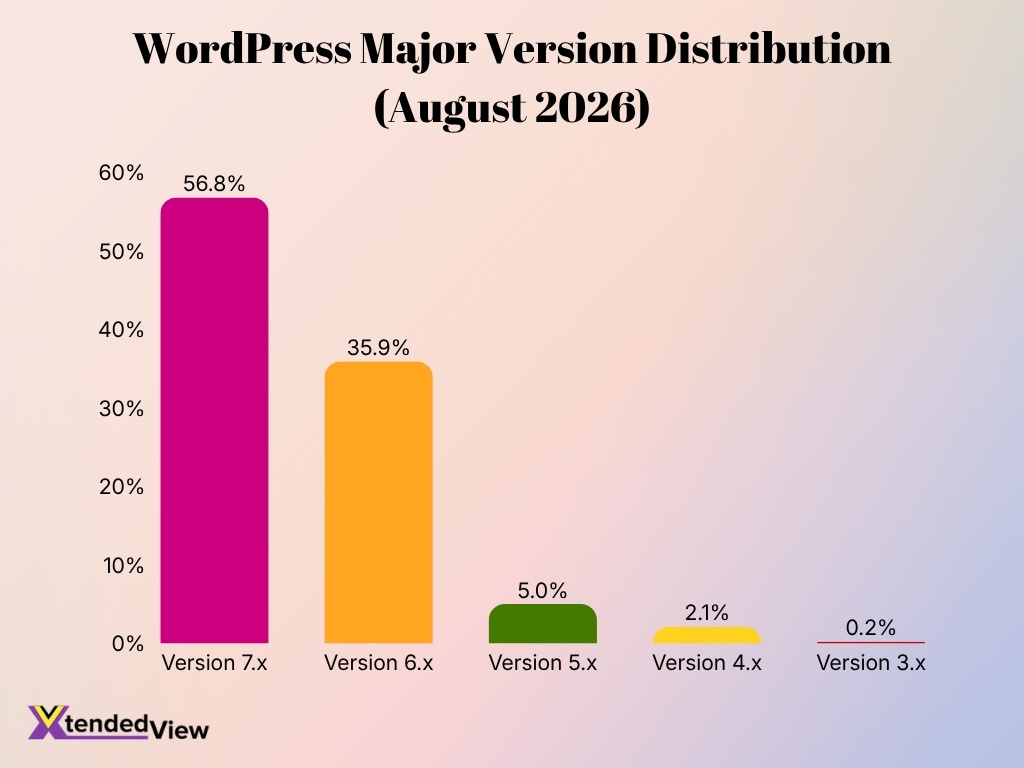
- As of Aug. 19, 2026, WordPress 7.x runs on 56.8% of detected WordPress websites, making it the dominant major-version branch only three months after WordPress 7.0 launched.
- WordPress 6.x still powers 35.9% of WordPress websites in August 2026. However, that share has fallen sharply as users upgrade to version 7.
- WordPress 5.x accounts for 5.0% of WordPress installations, showing that a meaningful long tail of sites remains several major releases behind.
- WordPress 4.x remains active on 2.1% of detected WordPress websites, despite belonging to a release generation that began more than a decade ago.
- WordPress 3.x represents about 0.2% of current installations, a small but measurable share of legacy sites.
- In July 2026, WordPress 6.x still led with 57.6%, while WordPress 7.x held 34.8%. By Aug. 19, their positions had reversed to 35.9% and 56.8%, respectively.
- On May 31, 2026, shortly after WordPress 7.0 launched, version 7 accounted for only 6.3% of WordPress sites, compared with 85.9% for version 6.
- By June 24, 2026, version 7 had climbed to 28.6%, while version 6 declined to 63.8%. This shows how quickly major-version adoption accelerated during the first month after release.
- For comparison, version 6 still represented 90.4% of WordPress installations in November 2025, while version 5 accounted for 6.8%. WordPress 7 had not yet entered the distribution.
WordPress Hosting Statistics
- Technology detection identifies about 1.91 million websites using hosting products specifically classified as WordPress-focused hosting services.
- The United States accounts for approximately 1.35 million of those detected WordPress-hosting installations, representing more than two-thirds of the category’s detected geographic footprint.
- Among the top 1 million websites, 32,370 sites use a provider classified within the specialized WordPress-hosting category.
- That figure drops to 3,222 sites among the top 100,000, 426 among the top 10,000, and 63 among the top 1,000.
- Within the tracked specialized-hosting category, WP Engine accounts for 20,550 detected websites, ahead of Kinsta at 5,565 and WP Cloud at 2,598 in the current ranked dataset.
- Among the top 10,000 websites, WP Engine appears on 341 sites, compared with 44 for Kinsta and 24 for WP Cloud.
- India records 11,652 specialized WordPress-hosting detections, with WP Cloud leading that market-specific dataset at 4,008 sites.
- The United Kingdom accounts for 97,746 detections in the broader specialized WordPress-hosting dataset, followed by Australia at 52,384 and Canada at 52,109.
- France records 19,178 WordPress-hosting detections, while the Netherlands has 14,737 and Germany has 14,262.
- Specialized WordPress hosting remains concentrated in a relatively small number of providers: the top three providers in this specific dataset account for roughly 28,700 detected top-ranked implementations combined.
WordPress SEO Statistics
- Rank Math SEO records 4+ million active installations in August 2026, giving it one of the largest footprints among dedicated SEO plugins.
- Rank Math carries a 4.8-out-of-5 rating, supported by more than 7,000 five-star reviews in the current directory snapshot.
- The plugin had reached version 1.0.276 by Aug. 11, 2026, with compatibility testing through WordPress 7.0.4.
- All in One SEO has 3+ million active installations and reached version 5.0.0.1 in August 2026.
- Site Kit records 5+ million active installations, connecting WordPress dashboards to Search Console, Analytics, PageSpeed Insights and related services.
- Site Kit has been translated into 31 locales, widening access to search and analytics reporting for non-English WordPress users.
- The Redirection plugin has 2+ million active installations, showing how common 301 redirects, 404 monitoring and URL migration management are within WordPress SEO workflows.
- Redirection had accumulated 701 published reviews in the current 2026 directory snapshot and had been translated into 29 locales.
- Broken Link Checker records 500,000+ active installations and remained compatible with WordPress 7.0.4 in August 2026.
- One leading SEO plugin reached version 28.3 in August 2026 and supported 59 listed language variants while maintaining compatibility with WordPress 7.1.
WordPress Career and Earnings Statistics
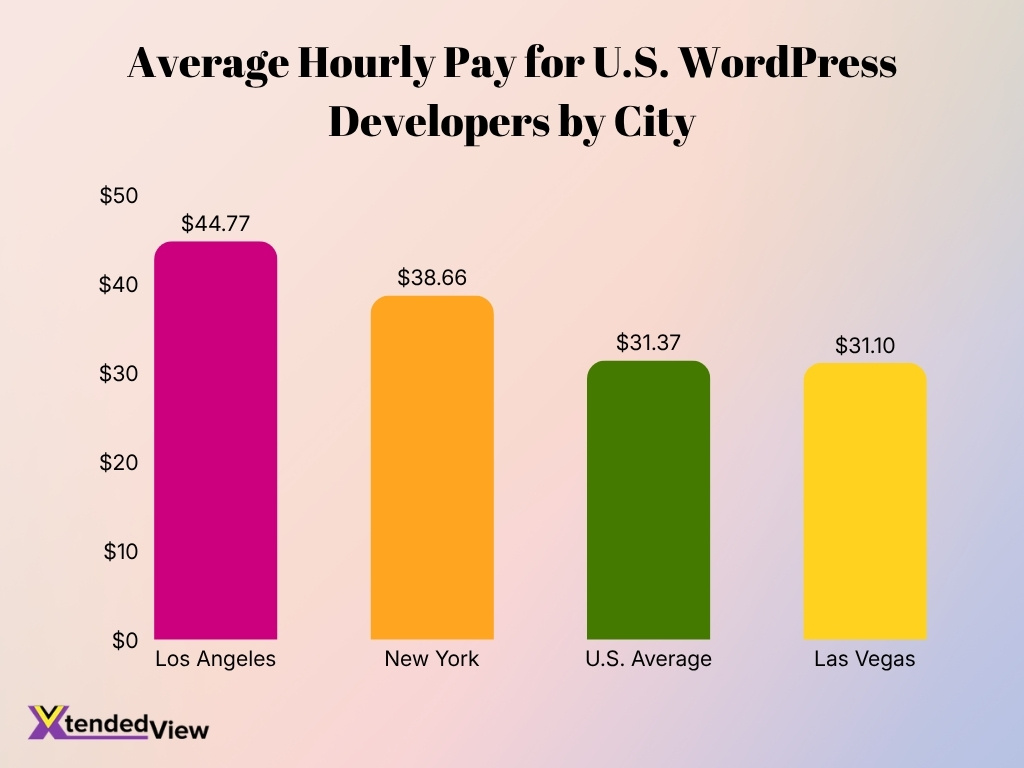
- U.S. WordPress developers earn an average of about $31.37 per hour, based on 119 salary observations collected from job postings over a 36-month period and updated in July 2026.
- The observed U.S. hourly range runs from approximately $18.06 to $54.49, reflecting wide differences in experience, specialization, and employer type.
- Los Angeles ranks among the highest-paying U.S. markets in the current sample at about $44.77 per hour.
- New York follows at approximately $38.66 per hour, while Las Vegas averages about $31.10 per hour.
- A separate U.S. salary dataset places average annual WordPress developer pay at $84,542, equivalent to roughly $40.65 per hour.
- In that dataset, the typical middle range spans roughly $60,500 to $99,500 per year, representing the 25th-to-75th-percentile range.
- The same salary data puts the 90th percentile near $148,000 annually, showing that experienced specialists can move far beyond the median range.
- The estimated median annual WordPress developer wage sits near $74,700-$74,900, depending on the specific job-title snapshot.
- Current WordPress developer listings include senior positions offering $100,000-$115,000 annually, while specialized application-development roles have advertised compensation reaching $150,000.
- Freelance and specialized WordPress work can command $25 to $100+ per hour, particularly for developers with custom theme, plugin, WooCommerce, and full-stack experience.
WordPress vs Competitors Comparison
- WordPress holds a 59.0% share of websites using a recognized CMS in August 2026, compared with 7.7% for Shopify.
- WordPress therefore controls roughly 7.7 times Shopify’s CMS share, even after losing share during the past year.
- Wix accounts for 6.1% of the CMS market, putting WordPress at almost 10 times its measured share.
- Squarespace holds 3.5%, meaning WordPress’ CMS share is approximately 17 times larger.
- Joomla represents 1.7% of recognized CMS usage, while Drupal accounts for about 1.0%.
- On an all-web basis, WordPress powers 40.7% of measured sites, versus 5.3% for Shopify, 4.2% for Wix and 2.4% for Squarespace.
- WordPress’ CMS share declined from 60.8% in August 2025 to 59.0% by Aug. 18, 2026, a decrease of 1.8 percentage points.
- Shopify moved in the opposite direction, rising from 6.7% to 7.7% over the same period, a gain of one percentage point.
- Wix increased from 5.5% to 6.1% between August 2025 and August 2026, while Squarespace moved from 3.3% to 3.5%.
- Despite those gains by competitors, WordPress still exceeds the combined CMS share of Shopify, Wix, Squarespace, Joomla, Webflow, Tilda, Duda and Drupal several times over in August 2026.
Frequently Asked Questions (FAQs)
WordPress powers 40.7% of all websites as of Aug. 21, 2026.
WordPress holds approximately 58.9% of the known CMS market as of Aug. 21, 2026, down from 60.8% in August 2025.
WordPress 7 runs on about 55.7% of WordPress websites as of Aug. 12, 2026, compared with 37.0% for version 6.
WordPress accounts for 49.4% of websites in the top 1 million that use an identifiable CMS.
WordPress fell from 43.4% of all websites in August 2025 to 40.7% in August 2026, a decline of 2.7 percentage points, or about 6.2% relative to its 2025 share.
Conclusion
WordPress enters the second half with enormous installed scale and a more competitive operating environment. Its 59.0% share of websites using a recognized CMS still places it far ahead of any individual competitor, while millions of businesses, publishers, developers and online stores continue to depend on its ecosystem. Strong adoption across plugins, themes, WooCommerce, SEO tools and specialized hosting also shows that WordPress remains deeply embedded in the wider web economy.
However, the data also points to a clear transition. Market share has softened, security risks remain concentrated in plugins and themes, and hosted competitors continue to expand. At the same time, WordPress is investing in AI integration, collaboration, localization, accessibility and performance improvements to keep pace with changing user expectations. Overall, the figures show a platform moving from rapid expansion toward ecosystem maturity, where product quality, security, performance and developer innovation will play a larger role in determining its long-term position.
