



Uber has reshaped urban transportation and logistics since its launch in 2009. Today, millions of riders rely on the platform daily for on-demand mobility, while restaurants and retailers depend on Uber Eats and last-mile delivery to reach customers faster. From airport rides in major U.S. cities to grocery deliveries in suburban areas, the platform continues to influence how people move and how businesses distribute goods. The following Uber statistics highlight its global scale, operational performance, and evolving ecosystem.
Editor’s Choice
- Uber reported $37.3 billion in revenue in 2023, up from $31.9 billion in 2022, reflecting a strong recovery in mobility and delivery demand.
- The platform served about 150 million monthly active users in 2024, representing steady growth from roughly 131 million in 2022.
- Uber completed approximately 9.4 billion trips in 2023, up significantly from 7.6 billion trips in 2022.
- The company operates in over 10,000 cities across more than 70 countries worldwide.
- Uber drivers and couriers collectively earned over $60 billion globally in 2023 through the platform.
- Uber Eats remains one of the largest food delivery platforms, reaching over 890,000 restaurant partners globally.
- Uber achieved its first full-year GAAP operating profit in 2023, marking a major financial milestone after years of losses.
Recent Developments
- In 2024, Uber expanded partnerships with autonomous vehicle companies, including agreements with firms testing driverless rides in U.S. cities.
- Uber integrated AI-powered route optimization and pricing algorithms to improve driver efficiency and reduce passenger wait times.
- In 2023, Uber launched Uber One international expansion, adding membership benefits across several European and Asian markets.
- Uber announced expanded electric vehicle incentives for drivers, aiming to transition to a fully zero-emissions platform by 2040.
- In 2024, Uber partnered with Waymo and other AV developers to deploy autonomous ride-hailing pilots in select U.S. cities.
- Uber Eats introduced retail and grocery delivery partnerships with major chains, expanding beyond restaurant delivery.
- Uber Freight increased investments in digital logistics and AI-powered freight matching tools to streamline carrier networks.
- Uber expanded airport pickup reservation features, allowing riders to book trips up to 90 days in advance.
- In 2024, Uber continued rolling out advertising products for brands and merchants, creating a new revenue stream within the app ecosystem.
Overview and Key Facts of Uber
- Uber was founded in 2009 in San Francisco by Travis Kalanick and Garrett Camp.
- The company went public on the New York Stock Exchange in May 2019 under the ticker symbol UBER.
- Uber’s core services include ride-hailing, food delivery, freight logistics, and mobility services.
- Uber reported $137 billion in gross bookings in 2023, representing strong platform demand across segments.
- The platform supports millions of drivers and couriers globally, offering flexible earning opportunities.
- Uber’s app is available in more than 70 countries and 10,000 cities worldwide.
- Uber offers multiple ride options such as UberX, Uber Comfort, Uber Black, and Uber Pool in many markets.
- The company operates three primary business segments: Mobility, Delivery, and Freight.
- Uber introduced Uber One, a subscription program that offers benefits such as discounted rides and delivery fees.
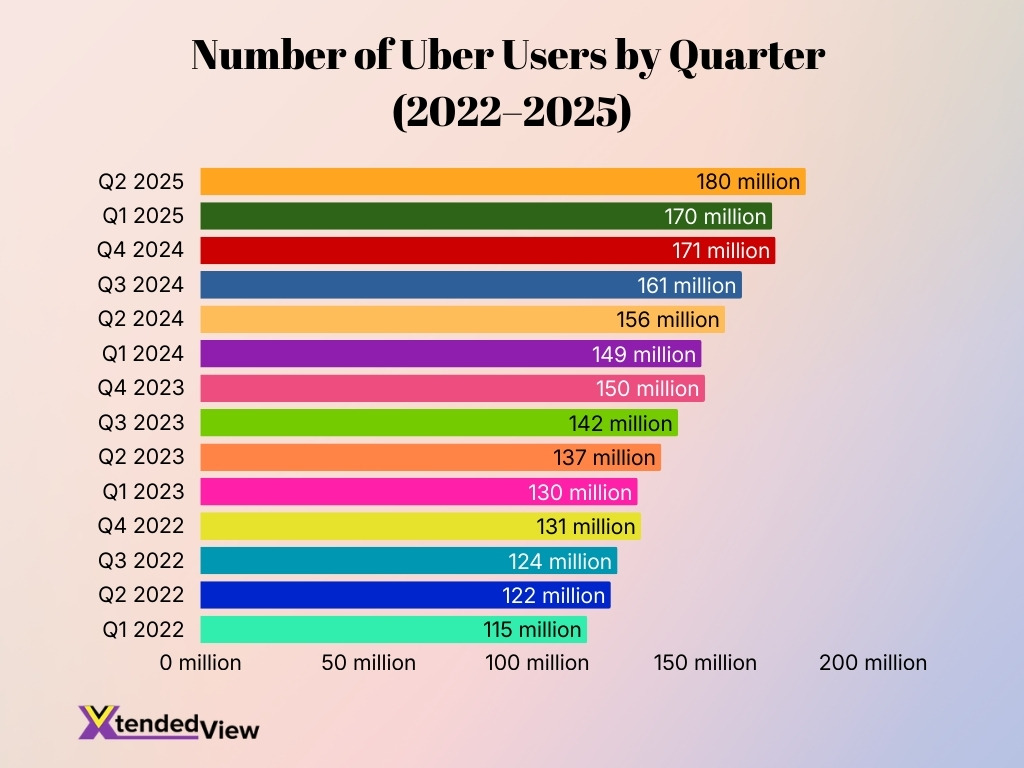
Uber Monthly Active Users Growth by Quarter
- Uber’s monthly active users reached 180 million in Q2 2025, marking the highest user count recorded in the observed period.
- The platform saw strong growth in early 2025, increasing from 170 million users in Q1 2025 to 180 million in Q2 2025, an increase of 10 million users in just one quarter.
- In 2024, Uber’s monthly users steadily increased from 149 million in Q1 2024 to 171 million in Q4 2024, reflecting a growth of 22 million users within the year.
- The platform crossed the 150 million user milestone in Q4 2023, when the number of monthly Uber users reached 150 million globally.
- During 2023, Uber’s user base grew from 130 million in Q1 2023 to 150 million in Q4 2023, representing a growth of 20 million users in one year.
- Looking back to 2022, Uber’s monthly active users increased from 115 million in Q1 2022 to 131 million in Q4 2022, adding 16 million users over the year.
- Overall, Uber’s monthly users expanded from 115 million in Q1 2022 to 180 million in Q2 2025, reflecting a total growth of 65 million users in just over three years.
- This trend highlights consistent quarterly growth in Uber’s global user base, demonstrating strong adoption and increasing demand for ride-hailing and delivery services worldwide.
Trip and Ride Volume Statistics of Uber
- Uber completed 9.4 billion trips globally in 2023, marking one of the highest annual volumes in the company’s history.
- This represents significant growth compared with 7.6 billion trips in 2022.
- On average, Uber facilitates over 25 million trips per day worldwide.
- The Mobility segment accounts for the majority of total ride volume on the platform.
- Uber reported record quarterly trips in 2023, surpassing 2.4 billion trips in a single quarter.
- U.S. cities such as New York, Los Angeles, and Chicago rank among the busiest markets for ride-hailing demand.
- Airport travel remains one of the most common Uber trip categories, especially in major metropolitan regions.
- The introduction of scheduled rides and airport reservations has increased trip reliability for frequent travelers.
- Uber Pool and shared ride services have gradually returned in several markets following pandemic restrictions.
Drivers and Couriers Statistics of Uber
- Uber reported 6 million active drivers and couriers globally in 2023, reflecting the scale of its gig workforce.
- Drivers and couriers collectively earned more than $60 billion on the platform in 2023.
- In the United States, Uber drivers earn an average of about $20–$25 per hour before expenses, depending on location and demand.
- Over 70% of Uber drivers work fewer than 20 hours per week, highlighting the platform’s role as flexible gig work.
- The majority of Uber drivers join the platform to supplement existing income rather than as full-time employment.
- Uber drivers completed an average of 3–4 trips per hour in major urban markets in 2023.
- Surveys show that around 60% of drivers cite flexible scheduling as the top reason for joining Uber.
- Uber introduced driver earnings transparency tools and trip upfront pricing features in 2023, improving driver decision-making.
- Uber continues investing in driver incentives, including EV adoption bonuses and loyalty programs for high-performing drivers.
Key Factors That Matter Most to Uber Drivers
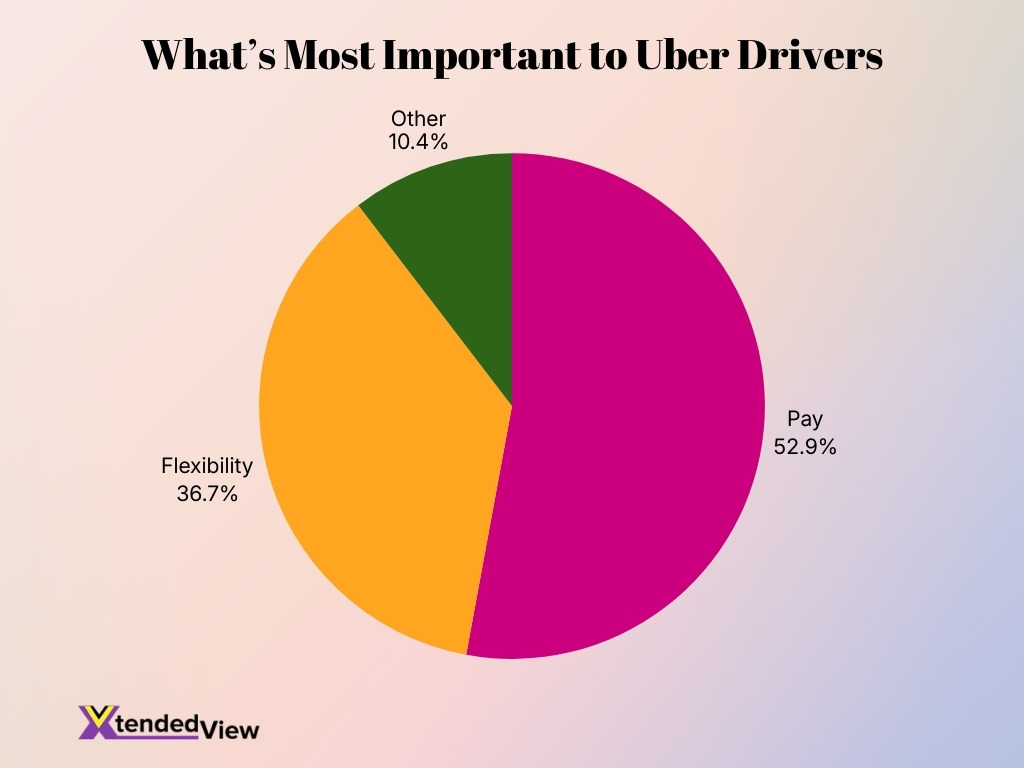
- Pay is the top priority for Uber drivers, with 52.9% saying earnings are the most important factor when choosing to drive on the platform.
- Flexibility ranks second, with 36.7% of drivers valuing the ability to set their own schedules and work hours.
- A smaller share of drivers, 10.4%, reported that other factors, such as bonuses, incentives, or personal preferences, are the most important.
- The data highlights that financial incentives remain the dominant motivator, with more than half of drivers prioritizing pay over flexibility and other benefits.
- Meanwhile, over one-third of drivers prioritize flexibility, showing that schedule control is a major appeal of the rideshare gig economy.
Revenue Statistics of Uber
- Uber generated $37.3 billion in total revenue in 2023, a significant increase from $31.9 billion in 2022.
- Mobility revenue reached approximately $20.4 billion in 2023, becoming Uber’s largest business segment again.
- Uber’s Delivery segment generated around $12.2 billion in revenue in 2023.
- The Freight segment contributed about $5.2 billion in revenue in 2023, though growth slowed due to freight market conditions.
- Uber’s quarterly revenue exceeded $9.9 billion in Q4 2023, demonstrating consistent demand growth.
- From 2020 to 2023, Uber’s revenue increased by more than 70%, driven by mobility recovery and delivery expansion.
- The United States accounts for more than half of Uber’s total revenue globally.
- Advertising revenue from in-app promotions and merchant ads has emerged as a fast-growing revenue stream for Uber since 2023.
- Subscription services like Uber One also contribute to recurring revenue growth for the platform.
Profit and Earnings Statistics of Uber
- Uber recorded its first full-year GAAP operating profit in 2023, marking a major milestone in the company’s financial performance.
- The company reported $1.1 billion in net income for 2023, compared with a loss of $9.1 billion in 2022.
- Uber generated $3.4 billion in adjusted EBITDA in 2023, reflecting improved operational efficiency.
- In Q4 2023, Uber achieved $770 million in net income, continuing its shift toward profitability.
- Uber’s operating margin improved significantly as the company reduced subsidies and optimized pricing models.
- The company reported record free cash flow of approximately $3.4 billion in 2023.
- Uber’s cost structure improved through automation, AI-powered dispatch systems, and supply-demand pricing algorithms.
- The profitability milestone helped boost investor confidence and strengthen Uber’s market position in 2024.
Uber Revenue Streams Breakdown
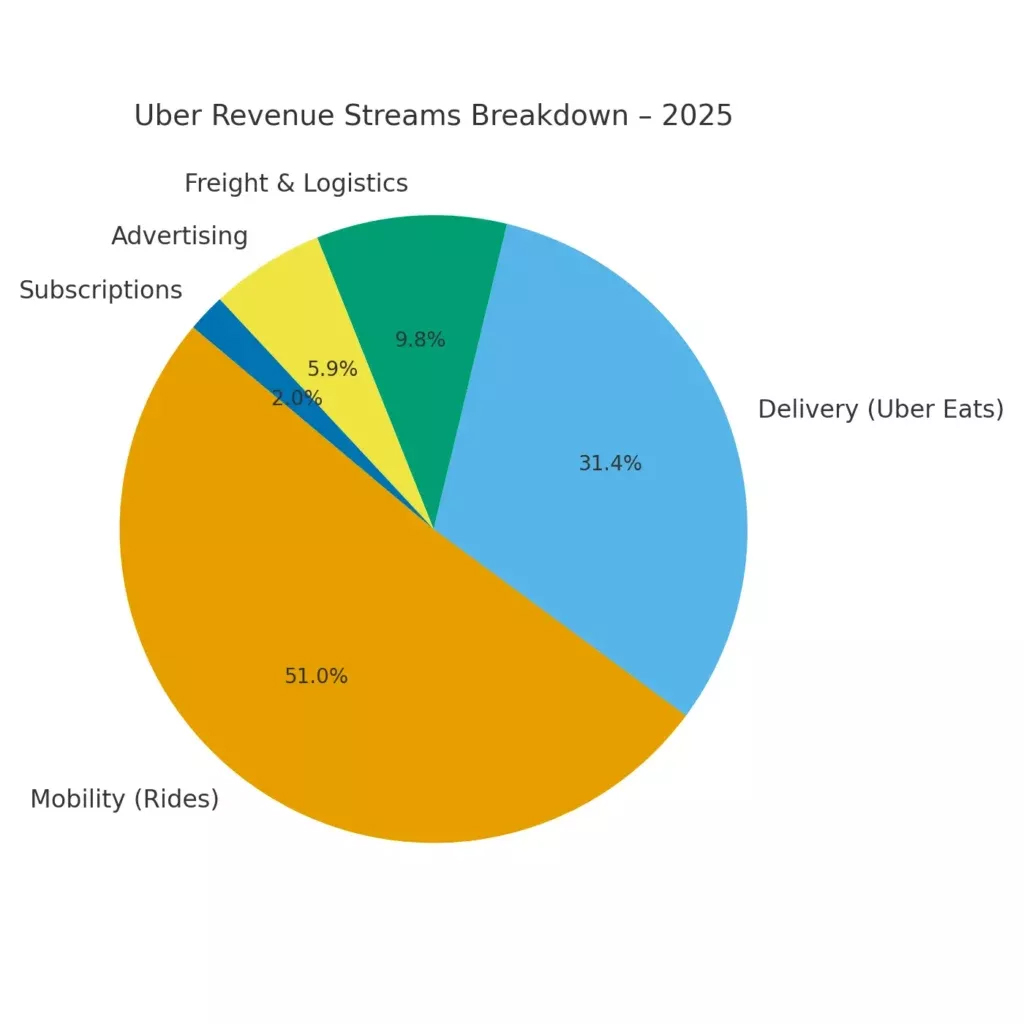
- Mobility (Rides) remains the largest revenue contributor, accounting for 51.0% of Uber’s total revenue in 2025, highlighting that ride-hailing is still the company’s core business segment.
- Delivery (Uber Eats) represents the second-largest revenue stream, contributing 31.4% of total revenue, demonstrating the strong growth and continued importance of Uber’s food delivery services.
- Freight & Logistics generates 9.8% of Uber’s revenue, showing the company’s expanding presence in the digital freight and logistics market.
- Advertising contributes 5.9% of total revenue, indicating Uber’s increasing focus on monetizing its platform through ads shown to riders and delivery customers.
- Subscriptions, including programs like Uber One, account for 2.0% of revenue, reflecting a smaller but strategic recurring revenue stream aimed at improving customer loyalty and retention.
- Combined, Mobility and Delivery make up 82.4% of Uber’s total revenue, underscoring that the company’s business model is primarily driven by transportation and food delivery services.
Gross Bookings Statistics of Uber
- Uber reported $137 billion in gross bookings in 2023, reflecting strong activity across rides and delivery services.
- Gross bookings increased from $115 billion in 2022, representing double-digit annual growth.
- Mobility gross bookings totaled about $70.9 billion in 2023, driven by global travel recovery.
- Delivery gross bookings reached $67 billion in 2023, showing continued demand for food and retail delivery.
- Uber recorded $37.6 billion in gross bookings in Q4 2023, its highest quarterly figure.
- Gross bookings in the Mobility segment grew over 30% year-over-year in 2023.
- Uber’s Delivery segment bookings increased due to expansion into grocery, retail, and convenience delivery.
- The company’s platform continues to generate billions in bookings through cross-platform demand between rides and delivery services.
Valuation and Market Cap Statistics of Uber
- Uber’s market capitalization fluctuated around $150 billion in early 2025, reflecting strong investor confidence.
- At the time of its 2019 IPO, Uber debuted with a valuation of approximately $82 billion.
- Uber’s stock price increased significantly between 2023 and 2025 as profitability improved.
- Institutional investors hold a large share of Uber stock, including major asset managers and index funds.
- Uber ranks among the largest publicly traded transportation technology companies in the world.
- Analysts estimate Uber’s long-term valuation potential could exceed $200 billion if growth in mobility and delivery continues.
- Uber’s profitability milestone in 2023 helped strengthen its valuation compared with other gig-economy companies.
- The company remains listed on the New York Stock Exchange under the ticker symbol UBER.
Global Ridesharing Market Share by Platform
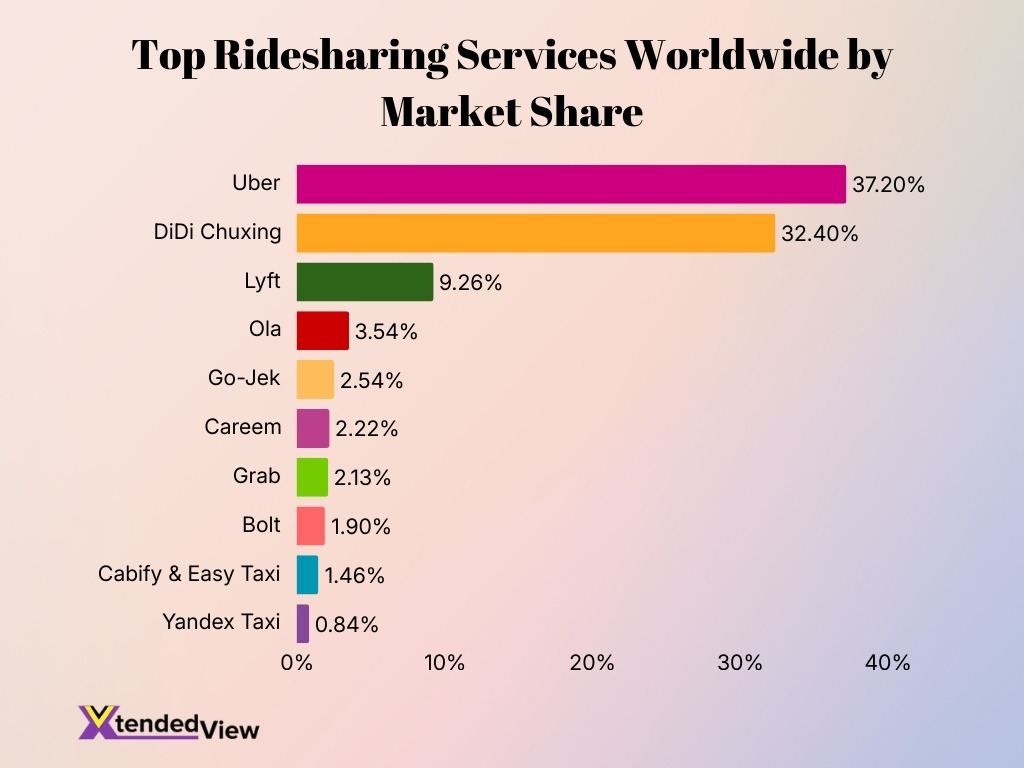
- Uber dominates the global ridesharing industry with a 37.20% market share, making it the largest ridesharing platform worldwide.
- DiDi Chuxing ranks second with 32.40% of the global market, showing strong dominance in China and other Asian markets.
- Lyft holds the third position with 9.26% market share, significantly smaller than Uber but still one of the leading ridesharing platforms in North America.
- Ola accounts for 3.54% of the global market, driven primarily by its strong presence in India and select international markets.
- Go-Jek captures 2.54% market share, supported by its super-app ecosystem and strong Southeast Asian user base.
- Careem holds 2.22% of the market, operating mainly in the Middle East, North Africa, and South Asia.
- Grab controls 2.13% market share, maintaining a significant presence across Southeast Asia’s mobility and delivery services market.
- Bolt has a 1.90% share, expanding rapidly in Europe and Africa with competitive ride pricing.
- Cabify & Easy Taxi together account for 1.46%, mainly serving Latin American and Spanish-speaking markets.
- Yandex Taxi records the smallest share at 0.84%, focusing primarily on Russia and Eastern European regions.
- Overall, the top two platforms, Uber and DiDi Chuxing, control nearly 70% of the global ridesharing market, highlighting a highly concentrated industry dominated by a few major players.
App Usage and Engagement on Uber
- The Uber mobile app has surpassed 500 million global downloads across iOS and Android as of 2024.
- Uber reported around 150 million monthly active platform consumers in 2024, reflecting continued growth in both ride and delivery services.
- Uber users collectively request more than 25 million rides daily worldwide.
- The Uber app consistently ranks among the top transportation apps in the United States in both downloads and active users.
- Approximately 70% of Uber trips are booked through smartphones, highlighting the platform’s mobile-first ecosystem.
- Uber’s average user session lasts several minutes per interaction, primarily for booking rides, tracking drivers, or managing deliveries.
- The company uses AI-powered matching algorithms to connect riders with drivers in seconds, improving app engagement and reducing wait times.
- Push notifications and dynamic pricing updates help Uber maintain high user engagement during peak travel periods.
- Uber’s in-app features include trip tracking, driver messaging, payment integration, and ride scheduling, which enhance user convenience.
Delivery Platform Statistics of Uber Eats
- Uber Eats operates in over 11,000 cities worldwide, making it one of the largest food delivery platforms.
- The platform partners with more than 890,000 restaurants globally.
- Uber Eats generated $67 billion in gross bookings in 2023, representing strong consumer demand.
- The service holds roughly a 25–30% share of the U.S. food delivery market, competing with DoorDash and Grubhub.
- Grocery and retail deliveries have grown rapidly, accounting for millions of monthly orders in 2024.
- Uber Eats supports tens of thousands of small restaurants and local businesses, helping them reach digital customers.
- The average Uber Eats order value in the U.S. is estimated to range between $30 and $40 per order.
- Uber Eats introduced advertising and sponsored listings for restaurants, creating new monetization opportunities.
- The platform continues expanding partnerships with major grocery chains and convenience stores.
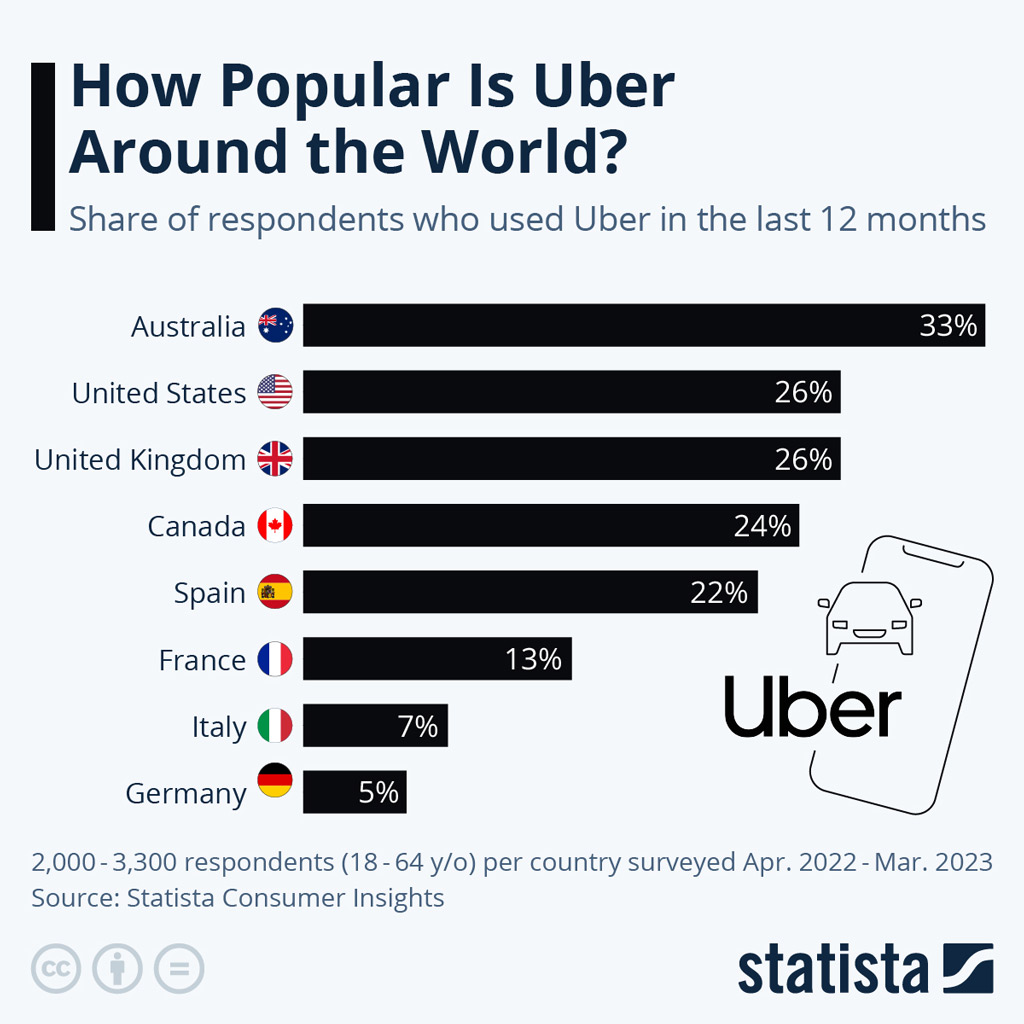
Uber Usage by Country: Australia Leads Global Adoption
- Australia ranks first, with 33% of respondents reporting that they used Uber in the last 12 months, making it the most popular market among the surveyed countries.
- The United States and the United Kingdom follow closely, with 26% of respondents in each country saying they used Uber during the same period.
- Canada records a strong adoption rate of 24%, indicating that roughly one in four consumers has used Uber within the past year.
- Spain shows moderate usage at 22%, suggesting that more than one-fifth of surveyed respondents rely on Uber for ride-hailing services.
- In France, Uber adoption drops to 13%, highlighting a notable gap compared to leading markets such as Australia and the U.S.
- Italy reports relatively low usage at 7%, indicating that fewer than one in ten respondents used Uber in the last year.
- Germany has the lowest adoption among the listed countries, with only 5% of respondents reporting Uber usage.
- Overall, the data shows a significant regional variation in Uber adoption, ranging from 33% in Australia down to 5% in Germany, reflecting differences in market penetration, regulation, and consumer transportation habits.
Freight Platform Statistics of Uber
- Uber Freight connects thousands of shippers and carriers across North America and Europe.
- The Freight segment generated approximately $5.2 billion in revenue in 2023.
- Uber Freight manages billions of dollars in freight bookings annually through its digital logistics network.
- The platform uses AI-powered load matching to connect trucking companies with shipments more efficiently.
- Uber Freight acquired Transplace in 2021 for $2.25 billion, strengthening its logistics technology capabilities.
- The network includes tens of thousands of carriers and logistics partners across the United States.
- Uber Freight provides real-time shipment tracking and automated pricing tools for shippers.
- Digital freight brokerage adoption continues to grow, with Uber Freight among the leading platforms in the sector.
Membership and Loyalty Program Statistics of Uber One
- Uber One is the company’s subscription program offering benefits across rides and deliveries.
- Uber reported over 15 million Uber One members globally in 2024.
- Members receive discounted rides and $0 delivery fees on eligible Uber Eats orders.
- Uber One subscribers tend to spend significantly more annually on the platform than non-members.
- The membership program expanded to dozens of countries worldwide by 2024.
- Uber One membership costs around $9.99 per month in the United States.
- Members also receive priority customer support and special promotions within the Uber ecosystem.
- Subscription programs like Uber One help Uber generate recurring revenue and increase customer retention.
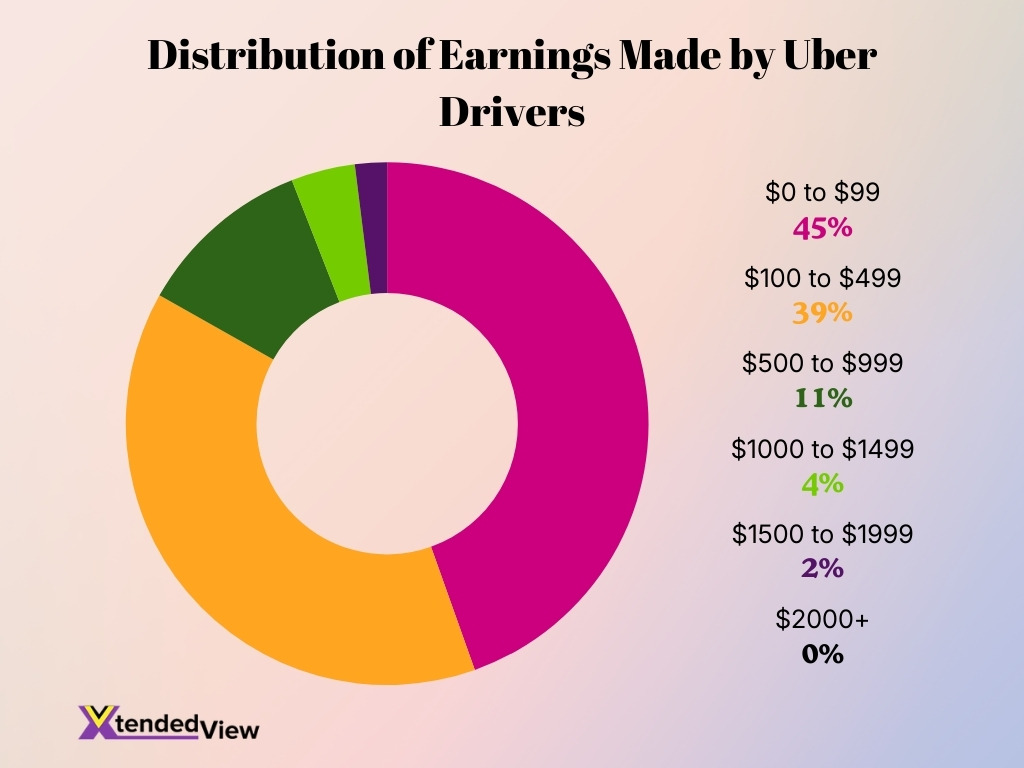
Distribution of Earnings Among Uber Drivers
- A large portion of drivers earn relatively small amounts, with 45% of Uber drivers making between $0 and $99, indicating that many drivers use the platform occasionally or as a side hustle.
- The second-largest group, 39% of drivers, earn between $100 and $499, showing that a significant share of drivers generate moderate earnings through part-time driving.
- Only 11% of Uber drivers fall in the $500 to $999 earnings bracket, suggesting that fewer drivers maintain consistent driving activity to reach higher earnings levels.
- A small segment of 4% of drivers earn between $1000 and $1499, representing drivers who likely spend more hours driving or operate more frequently on the platform.
- Just 2% of Uber drivers report earnings between $1500 and $1999, highlighting that high monthly earnings remain relatively uncommon.
- Virtually 0% of drivers earn more than $2000, indicating that very few drivers exceed this income threshold within the measured period.
- Overall, approximately 84% of Uber drivers earn less than $500, reinforcing the idea that most drivers treat Uber as a supplemental income source rather than a full-time job.
Sustainability and EV Adoption Statistics of Uber
- Uber aims to become a fully zero-emissions mobility platform by 2040.
- By 2023, Uber had facilitated over 100 million electric vehicle trips globally.
- The company committed $800 million in driver incentives to encourage EV adoption.
- Uber launched the Uber Green ride option in many cities, allowing riders to request electric or hybrid vehicles.
- EV drivers on Uber generate significantly lower emissions compared with traditional gasoline vehicles.
- Uber partners with automakers and charging networks to expand EV accessibility for drivers.
- In several European cities, Uber aims for 100% electric rides by 2030.
- The company also invests in shared mobility, micromobility, and public transit integrations to reduce urban congestion.
Frequently Asked Questions (FAQs)
Uber has about 180–202 million monthly active platform users globally as of 2025, showing steady growth in its global customer base.
Uber has approximately 8.8–10 million active drivers and couriers worldwide supporting its ride and delivery services.
Uber coordinates around 42 million trips and delivery orders per day worldwide across its mobility and delivery services.
Uber generated roughly $43.9 billion in total revenue in 2024, representing about 18% year-over-year growth.
Uber holds approximately 71–76% of the U.S. rideshare market, making it the dominant player ahead of competitors.
Conclusion
Uber has evolved from a ride-hailing startup into a global mobility and logistics platform serving millions of users every day. With strong growth in rides, food delivery, and digital freight, the company now operates across a diverse ecosystem that connects riders, drivers, restaurants, and shippers. The statistics above show how Uber continues expanding its user base, improving profitability, and investing in sustainability and technology.
As mobility and delivery services become more integrated into daily life, Uber’s platform will likely remain a major force shaping the future of transportation and logistics.
