



Social media isn’t just an engagement channel; it’s now fundamental to how brands, communities, and consumers connect. Marketers are navigating a landscape where user behavior, platform growth, and content formats are changing faster than ever. The rise of short-form video content and AI-powered targeting has redefined what success looks like across platforms. From brand awareness growth to lead generation strategies, these changes shape real outcomes for businesses and creators alike. Explore the latest numbers and trends that are driving social media marketing today.
Editor’s Choice
- 5.66 billion people globally use social media monthly, about 69% of the world’s population.
- Social platforms added approx. 259 million new users year-over-year, 2025–26.
- Daily average time spent on social media is ~2 hr 21 min per user in 2026.
- $317 billion in global social media ad spend is projected for 2026.
- 81% of marketers report higher brand exposure through social media.
- Average engagement rate across platforms is ~1.8% in 2026.
- Short-form video sees the highest interaction rates among all post formats.
Recent Developments
- Video content remains the dominant trend shaping social strategies in 2026, with serialized and short-form formats leading growth.
- AI-generated content is becoming mainstream, assisting in content creation and personalization.
- UGC, user-generated content, increasingly drives trust and conversions, with 70% of shoppers often seeking UGC before purchase decisions.
- Social becomes a search destination, ~60% of consumers use Instagram to research products.
- Algorithm updates across platforms push brands toward paid and community-centric strategies.
- Platform dynamics shift as new formats and niche networks gain attention among younger audiences.
- Regulatory and privacy changes continue shaping data-driven marketing practices.
- Interactive ad formats, like shoppable overlays, rise as second-screen behavior climbs.
Global Social Media Marketing Overview
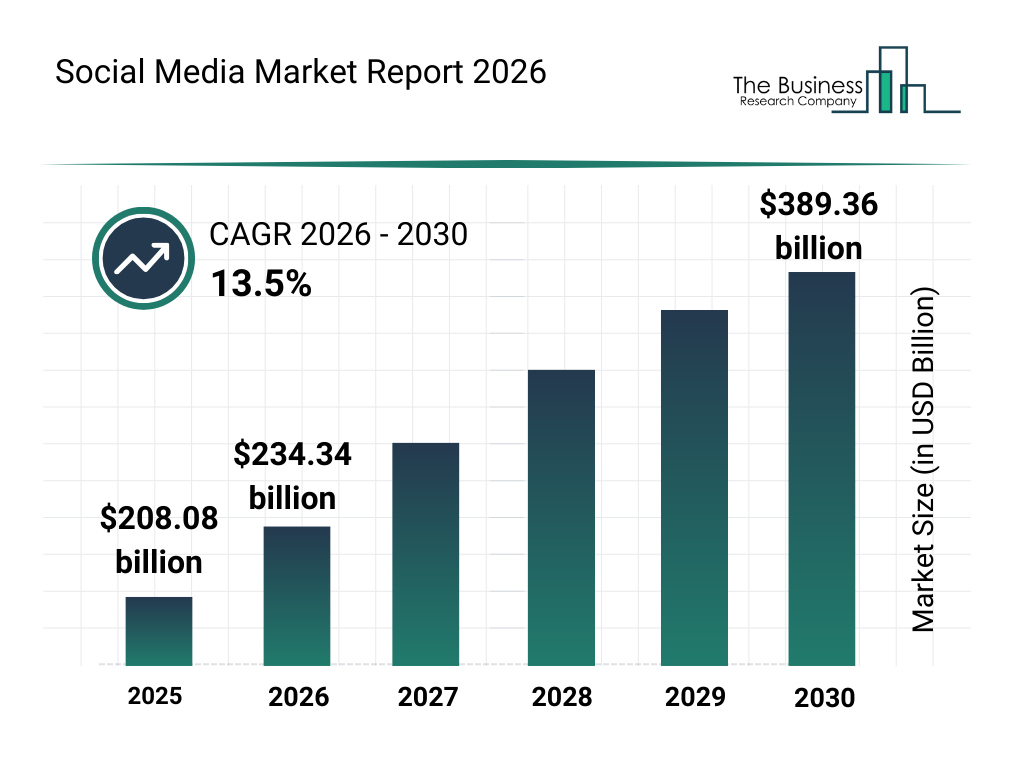
- The global social media market was valued at $208.08 billion in 2025, reflecting strong demand for digital engagement and advertising platforms.
- In 2026, the market grew to $234.34 billion, showing a solid year-over-year increase in platform monetization and user activity.
- Between 2026 and 2030, the market is projected to expand at a CAGR of 13.5%, indicating sustained long-term growth.
- By 2030, the global social media industry is expected to reach $389.36 billion, highlighting its rising importance in the digital economy.
- The market is forecast to nearly double from 2025 to 2030, growing from $208.08 billion to $389.36 billion in five years.
- This growth is driven by increasing mobile usage, video content consumption, and digital advertising spend worldwide.
- Rising adoption of AI-powered marketing tools and influencer-driven campaigns is further accelerating revenue expansion.
- Emerging markets are contributing significantly to growth, supported by higher internet penetration and smartphone adoption.
Social Media User Growth and Penetration
- 5.66 billion people use social media daily across the world.
- That marks a steady rise from 5.04 billion in the previous year.
- ~7.8 new users join social networks every second.
- Yearly growth is ~4.87% in 2026.
- Social media penetration reaches nearly 70% of the global population.
- Internet users engaging with social platforms are nearly 94% worldwide.
- Growth trends remain highest in developing markets, particularly Asia and Africa.
- The US sees ~73% of the population active on social networks as of early 2026.
Time Spent on Social Media Platforms
- Global users spend an average of ~2 hr 21 min per day on social media.
- Weekly social and online video usage averages ~18 hr 36 min.
- Daily time on social alone is slightly up from ~2 hr 19 min last year.
- Gen Z users in the US spend significantly more, about 5.1 hr per day.
- Mobile accounts for the vast majority of engagement minutes.
- Average users engage with short-form formats more frequently than traditional posts.
- Scroll frequency peaks during leisure hours, evenings, and weekends.
- Multitasking behaviors, like second-screening during video streaming, increase total session time.
Effectiveness of Stories in Social Media Marketing
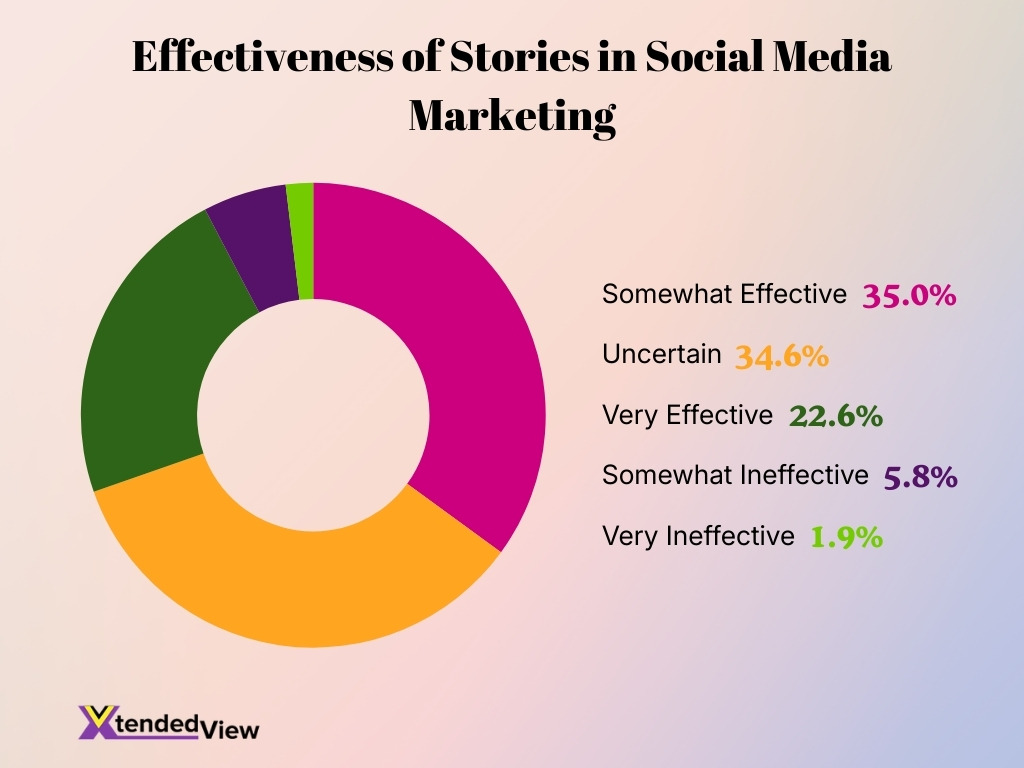
- 35% of marketers say Stories are somewhat effective, making this the largest perception group in social media campaigns.
- 34.6% of respondents remain uncertain, highlighting a significant measurement and ROI-tracking gap for Stories content.
- 22.6% of marketers rate Stories as very effective, showing strong high-performance potential for brands using optimized strategies.
- Only 5.8% consider Stories somewhat ineffective, indicating limited dissatisfaction with this format.
- Just 1.9% of users find Stories very ineffective, confirming broad industry acceptance and trust in Stories marketing.
- Overall, 57.6% of respondents (35% + 22.6%) view Stories as effective, reinforcing their role in modern digital marketing strategies.
Social Media Usage by Generation and Age Group
- Gen Z averages 5.1 hours daily on social media, far exceeding other generations.
- 81% of Gen Z spend over 1 hour daily on social media.
- 41% of Gen Z turn to social platforms first for information discovery.
- 69.2% of Millennials actively use social media in 2025.
- Teens aged 13-17 use YouTube daily at 75%, TikTok at 61%.
- 36% of teens use at least one social platform almost constantly.
- 80% of 18-29 year-olds use Instagram, versus 19% of those 65+.
- Gen Z females (16-24) spend 2 hours 59 minutes daily on social media.
- Baby Boomers average 1.5 hours daily on social media.
Regional and Country-Level Social Media Usage
- Asia hosts over 2.9 billion social media users, leading global adoption at 36.3% of the world population.
- India had 500 million social media users in 2026, the largest single-country market at 34.1% population penetration.
- China boasts 1.28 billion active social media users, equating to 90.3% of its population.
- The United States reports 254 million social media users, representing 73% of the total population.
- Brazil in Latin America has 150 million social media users with 70.4% population penetration and high daily engagement.
- Europe sees social networks used by 58.9% of enterprises, indicating a strong 89% average penetration among internet users.
- Africa experiences rapid growth, like South Africa’s 15.2% increase in social media users to 29.1 million adults in 2025.
- Canada has over 34.8 million Facebook users alone, with penetration exceeding 91% of internet users.
- US youth adoption stands at 84% of adults aged 18–29 using at least one social platform.
Social Media Adoption by Businesses
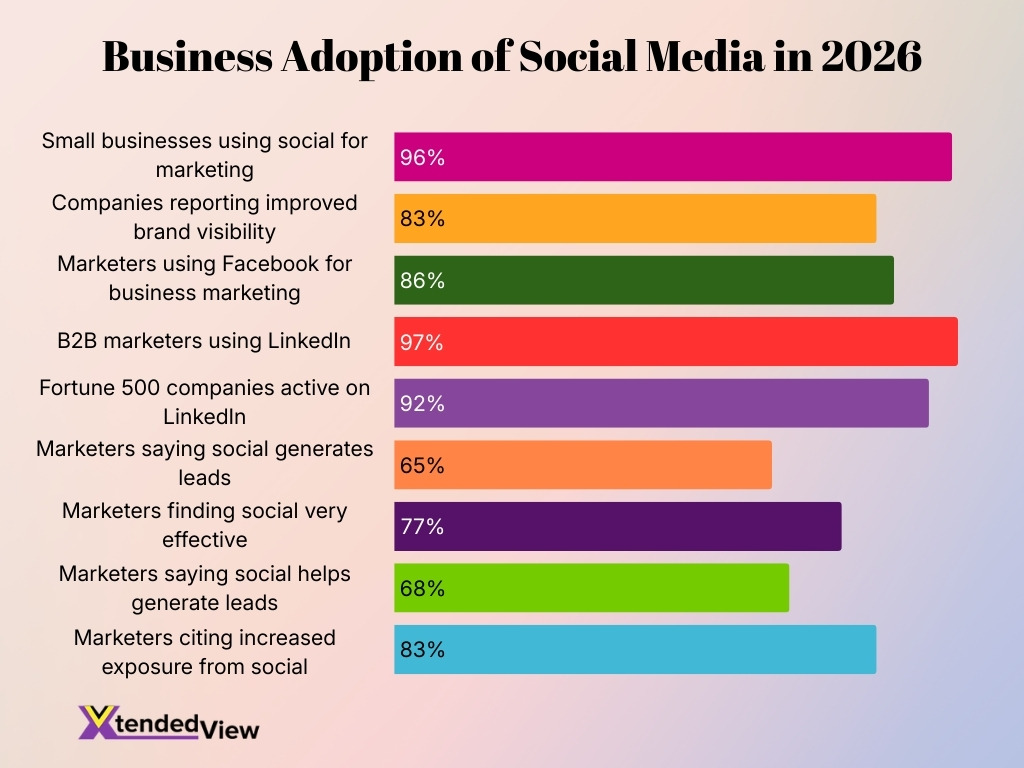
- 96% of small businesses use social media for marketing purposes.
- 83% of companies report improved brand visibility from social media.
- 86% of marketers use Facebook for business marketing.
- 97% of B2B marketers use LinkedIn in their strategy.
- 92% of Fortune 500 companies are active on LinkedIn.
- 65% of marketers say social media generates leads.
- 77% of marketers find social media very effective.
- 68% of marketers report that social media helps generate leads.
- 83% of marketers cite increased exposure from social media.
Organic vs Paid Social Media Usage
- Organic reach on Facebook averages below 5% for brand pages in 2026.
- Instagram organic reach averages ~9% for small accounts but declines as follower count increases.
- 83% of marketers use paid social advertising regularly.
- Paid social ad impressions increased by ~15% year-over-year globally.
- Cost-per-click, CPC, on social ads in the US averages between $0.50–$2.00, depending on platform and industry.
- TikTok’s paid ad engagement rate outperforms many platforms at 5%+ average engagement.
- Organic video posts generate significantly higher engagement compared to static image posts.
- 70% of brands report declining organic reach over the past two years.
Social Media Engagement Benchmarks
- Average engagement rate across platforms is approximately 1.8% in 2026.
- TikTok leads with engagement rates averaging 4–5% per post.
- Instagram engagement averages around 0.7–1.2%, depending on industry.
- Facebook engagement for brand pages averages 0.15–0.30%.
- LinkedIn posts generate average engagement rates of 2–3%, higher in B2B niches.
- Video posts generate 2x more engagement than image posts across most platforms.
- Carousel posts on Instagram see up to 1.4x higher engagement than single images.
- Brands posting 3–5 times per week achieve more consistent engagement growth than those posting daily.
- Interactive content such as polls and quizzes increases engagement rates by 20–30%.
Platforms Driving the Highest Business Impact by Segment
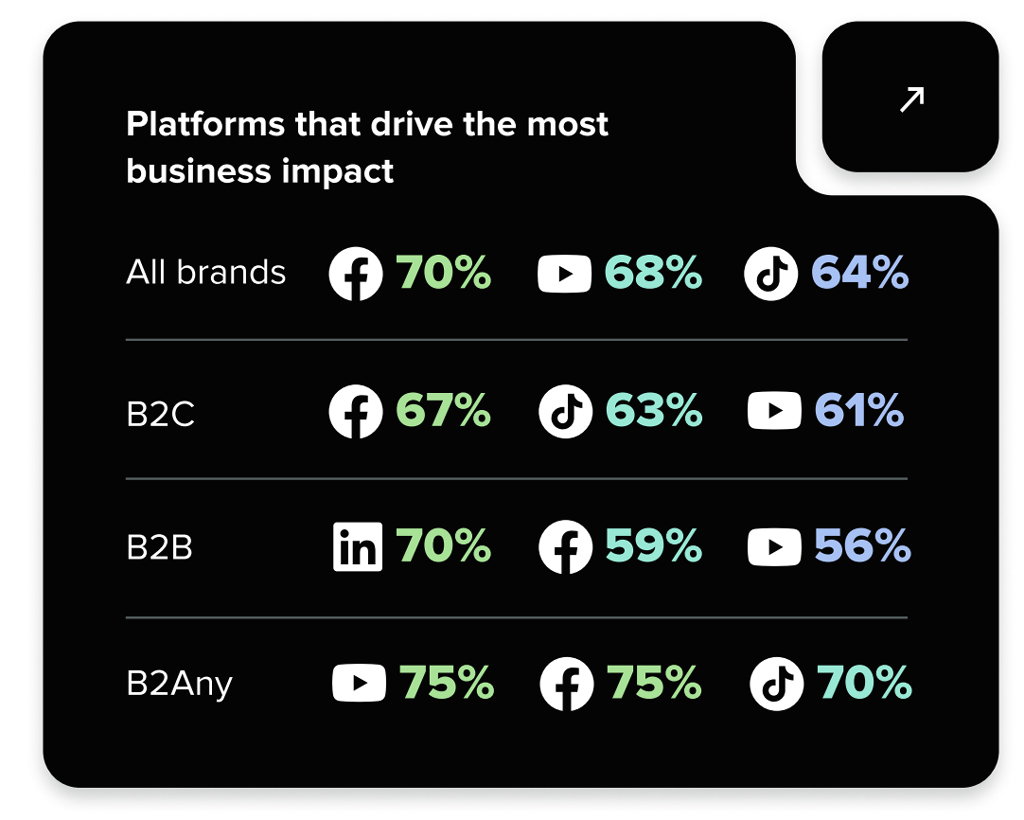
- Facebook leads overall impact, with 70% of all brands reporting it as a key driver, followed closely by YouTube (68%) and TikTok (64%).
- In the B2C segment, Facebook remains dominant at 67%, while TikTok captures 63%, outperforming YouTube at 61% among consumer-focused brands.
- For B2B companies, LinkedIn ranks first at 70%, significantly ahead of Facebook (59%) and YouTube (56%), reinforcing its strength in professional marketing.
- In the broader B2Any category, YouTube and Facebook tie at 75%, marking the highest impact levels across all segments, with TikTok following at 70%.
- The data shows a clear platform specialization trend: LinkedIn dominates B2B, while Facebook and YouTube maintain cross-segment strength, and TikTok performs strongest in B2C and B2Any markets.
Social Media Marketing ROI and Revenue Impact
- 73% of marketers report social media marketing as effective or very effective for business.
- Over 40% of marketers say social media generates the highest ROI among digital channels.
- Businesses earn an average of $2.80 in revenue for every $1 spent on social ads.
- Nearly 54% of consumers use social media to research products before purchasing.
- Social media influences 70% of US purchase decisions for younger consumers.
- 78% of salespeople using social selling outperform their peers.
- Companies responding to social media leads within five minutes are 9x more likely to convert.
- US social commerce sales are projected to surpass $100 billion in 2026.
- Brands using data-driven targeting see up to 30% higher ROI than broad targeting.
Lead Generation and Sales from Social Media
- 64% of marketers say lead generation is the biggest benefit of using social media.
- 59% of marketers use social media platforms to generate leads.
- 78% of salespeople using social selling outsell their peers who don’t.
- LinkedIn generates 277% more leads than Facebook and X for B2B.
- Responding to social media inquiries within 5 minutes boosts conversions by 100x.
- 71% of consumers with a positive social media experience recommend the brand.
- 64% of SMBs cite social media as their top website traffic source.
- 70% of consumers are influenced by social media in purchase decisions.
- 43% of marketers say Facebook contributes the most leads from social sites.
Social Media Marketing by Industry
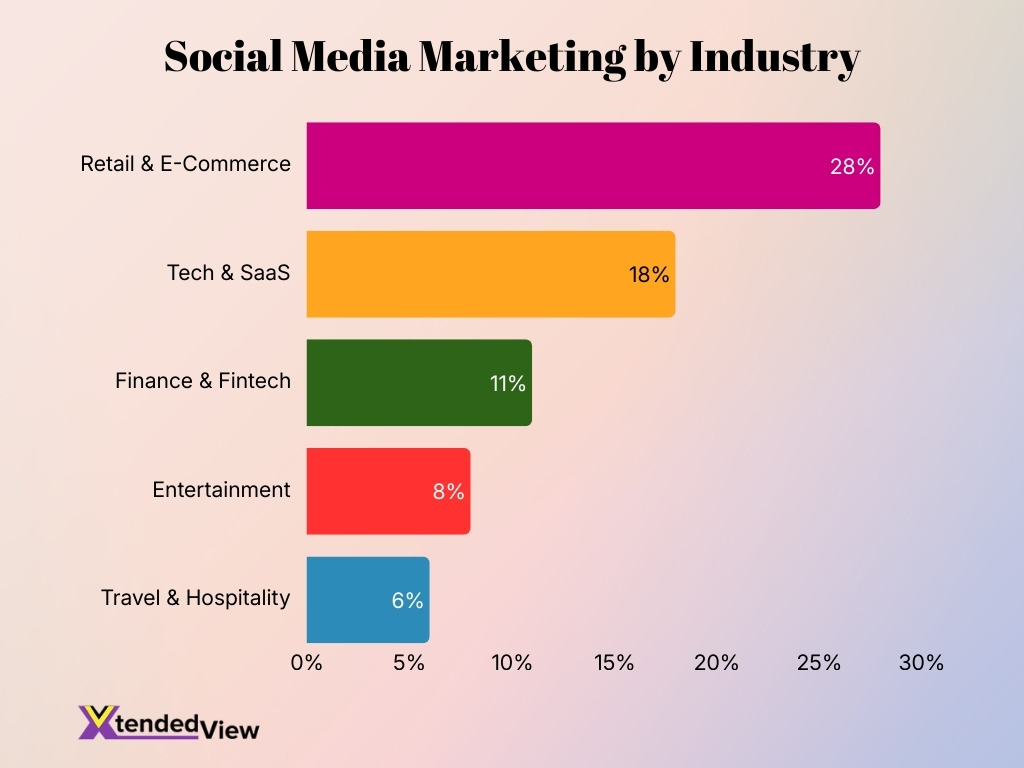
- Retail & E-Commerce dominates social media marketing with the highest share of 28%, driven mainly by Instagram, TikTok, and Pinterest for visual product discovery and shopping.
- Tech & SaaS accounts for 18% of social media marketing activity, relying heavily on LinkedIn, YouTube, and Twitter for thought leadership, B2B engagement, and product education.
- Finance & Fintech represents 11%, focusing strongly on trust-building and lead generation, while achieving an impressive ROAS of 6:1, highlighting strong advertising efficiency.
- Entertainment contributes 8%, leveraging short-form videos, memes, and trending content to generate viral reach and high engagement across social platforms.
- Travel & Hospitality holds 6%, emphasizing user-generated content (UGC) and visual storytelling on Instagram and TikTok to influence travel decisions.
- Industries with high visual appeal, especially D2C e-commerce, fashion, beauty, and entertainment, are emerging as top performers due to direct consumer engagement and strong community building.
- Overall, visually driven and community-focused sectors are leading social media marketing in 2026, showing that content quality, platform alignment, and audience interaction are key growth drivers.
Short-Form Video Marketing Statistics
- Short-form video delivers the highest ROI of any social media content format in 2026.
- TikTok surpassed 1.5 billion monthly active users globally.
- YouTube Shorts generates over 70 billion daily views.
- Instagram Reels accounts for more than 30% of time spent on Instagram.
- 90% of marketers report that video marketing increases brand awareness.
- Consumers retain 95% of a message when delivered via video compared to 10% through text.
- TikTok engagement rates average 4–5%, significantly higher than many other platforms.
- 73% of consumers prefer learning about a product through short videos rather than articles.
- US brands increased short-form video ad budgets by over 20% year-over-year entering 2026.
Where Social Media Users Will Spend More Time in 2026
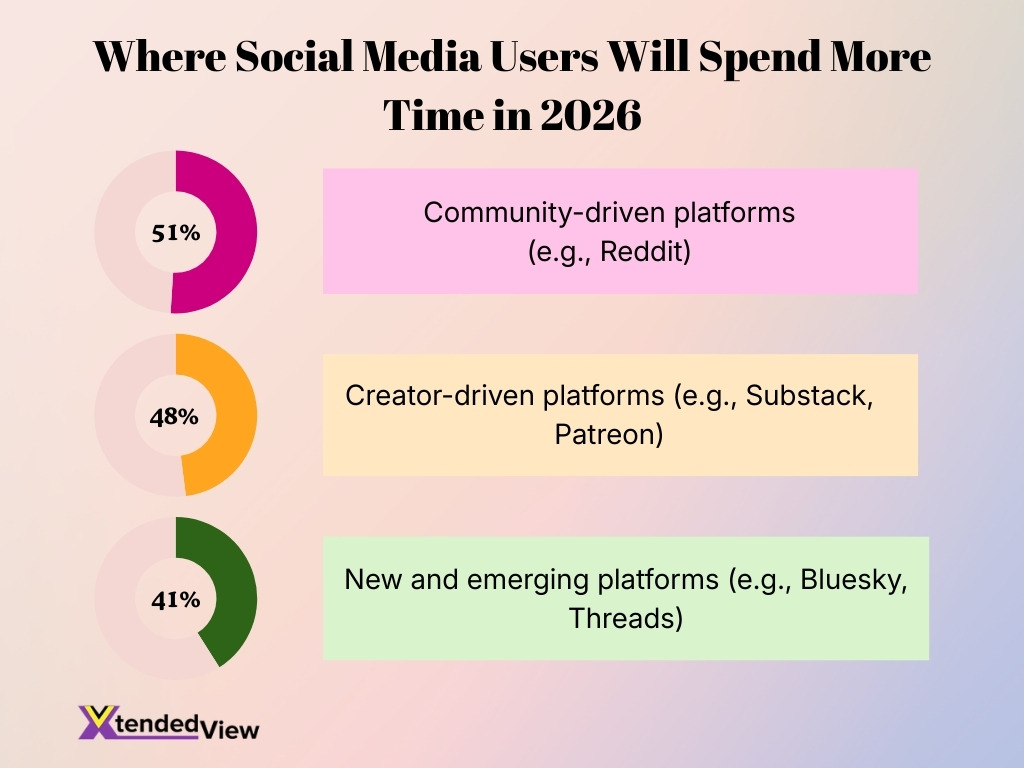
- 51% of users plan to spend more time on community-driven platforms like Reddit, highlighting the growing importance of discussion-based and interest-focused online communities.
- 48% of users prefer creator-driven platforms such as Substack and Patreon, showing strong demand for independent content creators and subscription-based models.
- 41% of users are shifting toward new and emerging platforms like Bluesky and Threads, indicating rising interest in alternative and next-generation social networks.
- Community platforms lead the trend, with over half of users (51%) prioritizing peer interaction, shared interests, and authentic conversations.
- Creator-led ecosystems remain highly competitive, as nearly one in two users (48%) continue to support direct creator–audience relationships.
- Emerging networks are gaining momentum, with more than two-fifths of users (41%) actively exploring new social media experiences in 2026.
Influencer Marketing on Social Media
- The global influencer marketing industry is valued at $24 billion in 2026.
- 89% of marketers say influencer marketing ROI matches or exceeds other channels.
- Micro-influencers, 10K–50K followers, generate engagement rates 60% higher than macro influencers.
- 63% of consumers trust influencers’ recommendations more than brand ads.
- TikTok leads influencer engagement, with average rates above 5% per post.
- 67% of brands plan to increase influencer marketing budgets in 2026.
- Affiliate-based influencer campaigns deliver measurable sales lift, especially in retail and beauty sectors.
- US Gen Z consumers are 2x more likely to purchase based on influencer recommendations compared to older generations.
- Long-term ambassador partnerships produce 3x higher conversion rates than one-off influencer posts.
Social Commerce and Shoppable Content Statistics
- US social commerce sales are projected to exceed $100 billion in 2026.
- Globally, social commerce is expected to reach over $2 trillion by 2026.
- 44% of Instagram users shop on the platform weekly.
- Facebook Shops and Instagram Checkout adoption continue to grow among SMB retailers.
- TikTok Shop saw rapid US expansion with double-digit monthly growth rates in 2025–26.
- 71% of consumers are more likely to purchase based on social media referrals.
- Live shopping events increase purchase intent by up to 30%.
- Shoppable posts improve conversion rates by 15–25% compared to traditional social posts.
- Mobile devices account for over 80% of social commerce transactions.
Social Media Marketing Spend: Key Insights and Trends
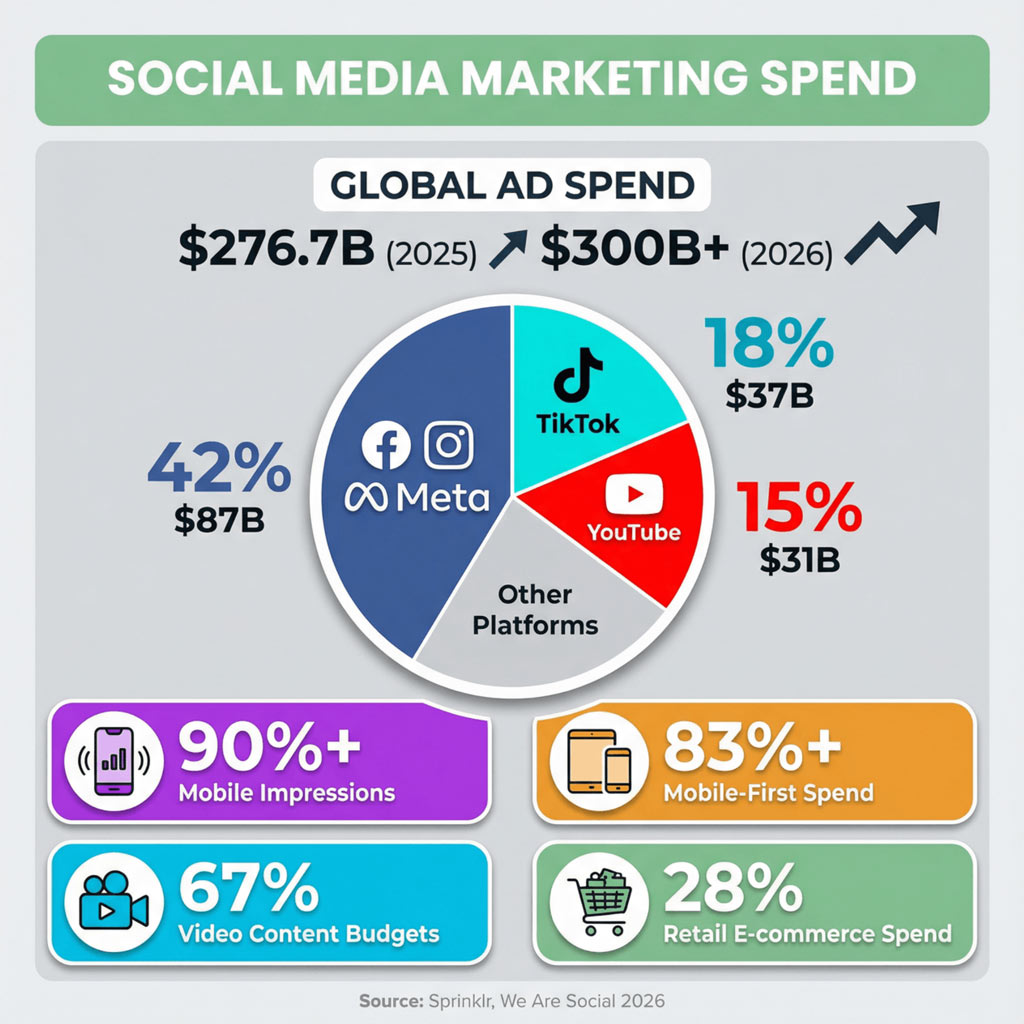
- Global social media ad spending is projected to grow from $276.7 billion in 2025 to $300+ billion in 2026, highlighting strong year-over-year expansion in digital marketing investments.
- Meta (Facebook & Instagram) dominates the market with 42% share, capturing around $87 billion in advertising revenue, making it the largest social media ad platform globally.
- TikTok continues its rapid rise, accounting for 18% of total ad spend, equivalent to approximately $37 billion, driven by short-form video popularity.
- YouTube holds a significant position with 15% market share, generating nearly $31 billion in ad revenue through video-focused advertising.
- Other social media platforms collectively represent about 25% of total ad spend, reflecting continued diversification beyond major platforms.
- Mobile advertising dominates the ecosystem, with 90%+ of impressions coming from mobile devices, reinforcing the importance of mobile-optimized campaigns.
- Mobile-first strategies now account for 83%+ of total ad spend, showing advertisers’ strong preference for smartphone-centric targeting.
- Video content continues to lead budgets, with 67% of marketers’ spending allocated to video-based campaigns across platforms.
- Retail and e-commerce advertising represents 28% of total social media spend, underlining the growing role of social platforms in online shopping and conversions.
- The overall data indicates a shift toward mobile-first, video-driven, and commerce-focused marketing strategies, positioning social media as a core channel for global brand growth.
B2B Social Media Marketing Statistics
- 96% of B2B marketers use LinkedIn for content distribution.
- 80% of B2B leads generated via social media come from LinkedIn.
- B2B companies that blog and share socially generate 67% more leads than those that do not.
- Video content increases B2B engagement rates by ~49%.
- 75% of B2B buyers use social media to inform purchase decisions.
- B2B paid social budgets grew by ~15% year-over-year entering 2026.
- Employee advocacy programs increase brand reach by up to 561% compared to brand-only channels.
- 84% of B2B executives use social media to support purchasing decisions.
- Account-based marketing campaigns integrating social ads see 20% higher engagement rates.
Challenges and Pain Points in Social Media Marketing
- Over 70% of marketers identify measuring ROI from organic social as their biggest challenge in 2026.
- 55% of marketers cite proving social media ROI as their top challenge.
- Organic reach on Facebook has dropped to ~5.9%, with some reports at 2.6% in recent years.
- 70% of marketers lack a consistent content strategy, hindering creation efforts.
- Facebook’s average cost per lead rose 21% YoY to $27.66 in 2025.
- Over half of SMBs spend less than 1 hour daily on marketing due to multi-platform demands.
- 70% of brands have faced brand safety risks at least once on social media.
- 55% of marketers report measuring ROI as their greatest challenge amid attribution issues.
- AI influencers reduce perceived authenticity and brand trust compared to humans.
Frequently Asked Questions (FAQs)
Approximately 5.66 billion people use social media globally, representing about 69.9% of the world’s population.
Total spending on social media advertising is expected to reach about $317 billion in 2026.
Social media ads account for around 30% of all digital advertising revenue worldwide.
Around 87% of marketing leaders expect their paid social advertising spend to increase in 2026.
Roughly 93.8% of internet users actively use at least one social media platform each month.
Conclusion
Social media marketing operates at an unprecedented scale. With 5.6+ billion users, rising ad investments, and expanding social commerce, platforms now shape how consumers discover, evaluate, and purchase products. Short-form video, influencer partnerships, and AI-powered personalization continue to drive measurable ROI, particularly for US businesses competing in crowded digital markets.
However, marketers face growing complexity. Organic reach declines, paid budgets increase, and privacy regulations reshape targeting strategies. The brands that win combine data-driven strategy with authentic content and rapid engagement.
Social media is no longer optional; it is foundational. Understanding the numbers behind user growth, engagement, commerce, and ROI equips marketers to invest smarter and scale faster and beyond.
