



Introduction
Baidu is one of the most influential tech companies in China, known primarily as the country’s dominant search engine. Over the years, Baidu has diversified into AI, cloud computing, autonomous driving, and other deep-tech sectors. Its impact is felt across digital advertising, mobile ecosystems, and national-level infrastructure initiatives in China. For example, Baidu powers AI-driven tools like ERNIE Bot for productivity, and also supports smart city projects with its Apollo autonomous vehicle platform.
Editor’s Choice
- Baidu’s global search engine market share in 2025 is approximately 0.88%, placing it 5th worldwide.
- Baidu dominates the Chinese search market with a 56.23% total share as of July 2025.
- On mobile in China, Baidu holds a commanding 67.76% market share.
- Baidu’s total revenue in Q1 2025 reached RMB 32.5 billion (~US$4.47 billion).
- Baidu’s AI chatbot ERNIE Bot surpassed 200 million users in 2024.
- Baidu’s website recorded approximately 2.2 billion visits in July 2025.
- The largest user demographic group is aged 25–34, making up 32.35% of Baidu’s audience.
Recent Developments
- Baidu announced ERNIE 4.5 and ERNIE X1, upgrading its core AI language models.
- In Q1 2025, Baidu increased non-online marketing revenue by 40% year-over-year.
- The company expanded its autonomous taxi service, Apollo Go, to more cities in China.
- Baidu AI Cloud saw continued growth, contributing significantly to total revenue.
- Baidu was selected for China’s next phase of national AI infrastructure partnerships.
- The company reduced its R&D spending by 15% year-over-year in Q1 2025, likely due to cost restructuring.
- ERNIE Bot integration expanded into hardware partnerships, including Samsung’s Chinese market devices.
- Baidu faced rising competition from Bing, particularly in China’s desktop search engine segment.
Baidu Overview
- Founded in 2000, Baidu is headquartered in Beijing and publicly traded on NASDAQ under the ticker BIDU.
- It began as a search engine but has expanded into AI, autonomous vehicles, cloud services, and fintech.
- Baidu employs more than 45,000 people globally, with most operations based in China.
- It owns and operates platforms such as Baidu Maps, Baidu App, and Baidu Tieba.
- The Baidu App is a major portal for mobile content discovery, especially in tier-2 and tier-3 Chinese cities.
- The company invests heavily in AI R&D, allocating a significant share of revenue toward innovation.
- Its strategic areas include intelligent cloud, smart driving, and large language models.
- Baidu also maintains a sizable presence in video content via its stake in iQIYI, though this is now classified as a separate business segment.
Baidu User Statistics
- Baidu serves over 1 billion devices monthly, primarily across China.
- Its search engine is used by an estimated 600 million active users monthly in China.
- Baidu App alone has over 580 million monthly active users as of mid-2025.
- Baidu Maps is installed on more than 70% of smartphones in China.
- Baidu’s AI voice assistant system DuerOS has been installed on over 400 million devices.
- Baidu’s content ecosystem (including Baijiahao) supports more than 1.9 million creators.
- Over 5 million developers globally are using Baidu AI open platform tools.
- The company supports tens of billions of daily search queries and ad impressions.
- Baidu’s user base skews heavily toward mobile usage, especially in lower-tier cities.
Baidu App Monthly Active Users
- As of Q2 2025, the Baidu App had over 580 million MAUs.
- In 2024, the app crossed 550 million MAUs, reflecting consistent year-over-year growth.
- The majority of users access the app daily for news, search, and video content.
- Baidu App’s smart recommendation engine personalizes feeds based on user behavior.
- Short video engagement via the Baidu App has grown significantly since 2023.
- The app integrates ERNIE Bot for AI-powered Q&A, summarization, and content generation.
- Baidu App is a top-ranking utility in China on both Android and iOS platforms.
- It offers “Mini Programs” similar to WeChat for services like travel, food delivery, and health.
- A major source of mobile ad revenue, the app accounts for the bulk of Baidu’s user traffic.
Baidu Search Volume Statistics
- Baidu processes over 6 billion search queries daily across platforms.
- It commands more than 50% of all desktop and mobile search volume in China.
- Keyword searches in Chinese have become more conversational due to ERNIE integration.
- The top search categories include entertainment, health, local services, and government-related topics.
- Baidu saw a 10% increase in health-related search queries year-over-year in 2025.
- Seasonal spikes occur during the Chinese New Year and national holidays.
- Baidu’s “Smart Mini Programs” generated significant in-app search activity.
- Voice search makes up around 25% of mobile queries, particularly among younger users.
- The platform’s search volumes are closely tied to mobile ecosystem usage patterns.
Baidu Market Share Worldwide
- Baidu holds about 0.88 % of the global search engine market.
- Another source places Baidu’s global share at 0.62 %, depending on methodology.
- Google captures nearly 89.5 % of the global market in mid-2025.
- Baidu ranks roughly 5th globally in search market share.
- Although its global share is small, Baidu’s influence is magnified by its dominance in China.
- In non-China markets, Baidu’s presence is negligible.
- Its global ranking is more symbolic than influential in many markets outside China.
Baidu Market Share in China
- As of July 2025, Baidu held 56.23 % of China’s search engine market.
- In November 2024, its share was 54.36 %.
- In April 2025, Baidu’s share was 53.1 % across all platforms.
- On desktop in April 2025, Baidu had 31.34 %, behind Bing’s 45.2 %.
- Baidu’s mobile share in April 2025 was 67.76 %.
- In November 2024, Baidu’s mobile share was 67.99 %, desktop 30.64 %.
- Bing captured ~30 % of China’s overall share in recent months.
- Other domestic engines typically account for 5–10 % combined.
- The decline from earlier peaks underlines mounting competition.

Baidu Market Share by Device
- On mobile in China, Baidu’s share consistently exceeds 65 %.
- In November 2024, Baidu’s mobile share was 67.99 %.
- On desktop in China, Baidu lags: e.g., 31.34 % in April 2025.
- Bing dominatesthe desktop in China in some periods.
- The disparity shows that Baidu’s structural strength is in mobile search.
- Globally, Baidu’s desktop influence is minimal.
- For advertisers, mobile-first strategies are crucial in China.
- This segmentation highlights monetization challenges for desktop ad revenue.
Baidu Financial Statistics
- In Q1 2025, Baidu’s total revenue was RMB 32.5 billion (≈ US$4.47 billion).
- Baidu Core revenue was RMB 25.5 billion, up ~7 % YoY.
- Online marketing revenue was RMB 16.0 billion, declining ~6 % YoY.
- Non‑online marketing revenue rose ~40 % YoY to RMB 9.4 billion.
- Cost of revenues was RMB 17.5 billion, up ~14 %.
- SG&A expenses reached RMB 5.9 billion.
- R&D expenses were RMB 4.5 billion, down ~15 % YoY.
- Operating income was RMB 4.5 billion.
- Non‑GAAP operating income was RMB 5.3 billion.
Baidu Revenue Statistics
- In 2024, Baidu’s annual revenue was around RMB 133.125 billion.
- The Q1 2025 total suggests a modest upward trend.
- Non‑marketing revenue segments are growing faster than ad revenue.
- In Q2 2025, non‑online marketing revenue exceeded RMB 10 billion.
- Online marketing in Q2 dropped ~15 % to RMB 16.2 billion.
- This highlights Baidu’s strategy to diversify.
- AI Cloud growth is a key lever for revenue stability.
- The revenue pivot is essential amid ad spending pressures.

Baidu Operating Profit Statistics
- Q1 2025 operating income: RMB 4.5 billion.
- Baidu Core’s operating income was RMB 4.2 billion, margin of ~16 %.
- Non‑GAAP operating income was RMB 5.3 billion.
- Non‑GAAP Baidu Core operating income was RMB 4.9 billion.
- Operating income in USD was ~$621 million.
- Operating income dropped 24.9 % YoY.
- In Q2 2025, operating income fell ~45 % YoY to ~$457 million.
- The contraction reflects rising costs and AI investments.
- Operating margin pressure highlights the balance challenge.
Baidu Assets Statistics
- As of June 30, 2025, Baidu’s total assets were around US$62.89 billion.
- In 2024, assets were ~ US$58.61 billion.
- The increase reflects investments in AI and cloud.
- Assets include cash, equipment, receivables, and intangibles.
- The company reported ~ US$62.897 billion in Q2 2025.
- Growth slightly accelerated compared to 2023.
- Asset expansion supports a longer-term strategy.
Baidu Liabilities Statistics
- As of June 2025, Baidu’s total liabilities were approximately US$23.076 billion.
- Some sources list liabilities at US$21.31 billion.
- At end of 2024, total liabilities were ~ US$21.75 billion.
- Current liabilities in June 2025 were CNY 85.12 billion.
- Liability mix includes short-term debt, payables, and accrued expenses.
- Long-term debt increased to ~ US$10.343 billion as of Q1 2025.
- The rise reflects investment funding.
Baidu AI and Patent Statistics
- Baidu leads China in the number of AI patent filings.
- ERNIE models have reached ERNIE 4.5 and ERNIE X1.
- Ernie Bot crossed 200 million users by 2024.
- It handles millions of API calls daily.
- ERNIE is integrated into Samsung phones in China.
- Patents filed span multimodal models, LLMs, and more.
- Baidu’s AI models are the subject of academic studies.
- The company builds ad-matching AI models like MOBIUS.
Baidu Research and Development Statistics
- In Q1 2025, Baidu spent RMB 4.5 billion on R&D.
- Spending was down ~15 % YoY.
- Historically, R&D is 10–15 % of core revenues.
- Focus areas: foundation models, autonomous driving, inference optimization.
- Apollo Go is a core R&D project with city-level rollouts.
- Baidu publishes research on model bias and ad-matching.
- R&D supports model compression and AI scalability.
- Investment signals long-term AI differentiation.
Baidu Website Traffic Statistics
- As of July 2025, baidu.com had ~ 2.2 billion visits.
- 95.25 % of traffic came from China.
- Bounce rate was low: ~ 6 %.
- Average pages per visit: 8.46.
- Average session duration: 5 minutes 19 seconds.
- Country breakdown: China, Hong Kong, USA, Taiwan, Singapore.
- Ranked #17 globally, #1 in China.
- Desktop accounted for ~ 93.99 %, mobile ~ 6.01 %.
- Traffic sources: direct ~80.03 %, search ~14.65 %.
Baidu User Demographics
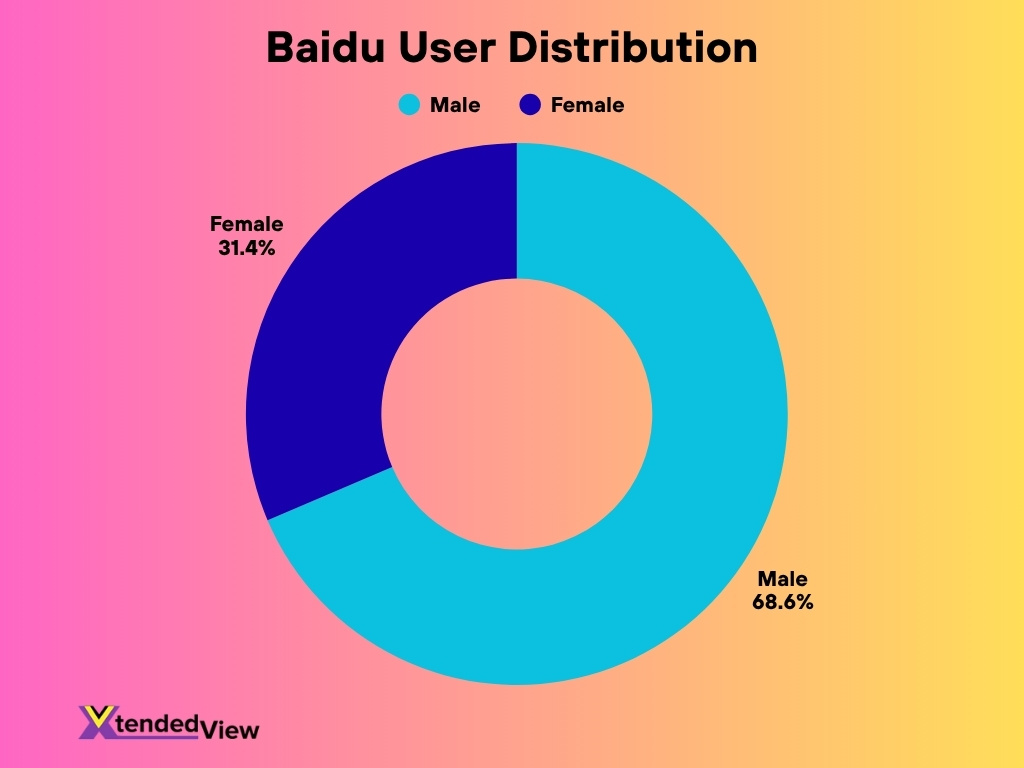
- ~ 68.59 % of users are male, 31.41 % female.
- Age breakdown:
- 25–34: 32.35 %
- 35–44: 22.69 %
- 18–24: 18.94 %
- 45–54: 13.40 %
- 55–64: 7.97 %
- 65+: 5.14 % - Almost all Baidu users are based in China.
- User base skews toward the 18–44 age group.
- Male dominance implies different content behavior.
- Strong domestic user base drives ad targeting strategies.
Frequently Asked Questions (FAQs)
Baidu reported 724 million MAUs in Q1 2025.
Baidu’s revenue in the last 12 months was US$18.54 billion.
In November 2024, Baidu held 54.36% of China’s search engine market share.
Baidu’s global search engine market share is about 0.88%.
Baidu held US$17.29 billion in cash and carried US$12.82 billion in debt, giving a net cash position of US$4.47 billion.
Conclusion
Over these three parts, we have dissected Baidu’s user scale, market dominance in China, financial structure, asset liabilities, AI investment, traffic footprint, and user demographics. The numbers show a company in transformation, still anchored in search and advertising, yet aggressively pushing into AI, cloud, and infrastructure. Its strong asset base and patent leadership support this transition, though rising liabilities and operating pressures caution the balance. Given how intertwined Baidu remains with China’s digital economy, it is both a bellwether and a battleground. In sum, Baidu today is far more than a search engine; it’s a strategic AI frontier.
