


Google Maps has become one of the world’s most-used digital services, helping people navigate cities, discover local businesses, and make purchasing decisions. Businesses rely on it for local SEO and customer acquisition, while logistics companies use its traffic data to optimize delivery routes and reduce fuel costs. From daily commuting to tourism planning, Google Maps shapes how people move and interact with places. The statistics below reveal the platform’s scale, growth, and influence.
Editor’s Choice
- Google Maps surpassed 2 billion monthly active users worldwide, making it one of Google’s largest consumer products in 2026.
- More than 250 million businesses and places are listed on Google Maps globally.
- Over 200 million businesses actively maintain listings on the platform, with roughly 1.5 million new listings added every month.
- More than 500 million contributors have submitted reviews, photos, edits, and local information to Google Maps.
- Around 75% of U.S. smartphone users rely on Google Maps each week for navigation and local searches.
- Google Maps remains the world’s leading navigation app with an estimated 67% market share in the United States.
- Google Maps ranked among the top three most-downloaded travel and navigation apps globally in 2025.
Recent Developments
- In March 2026, Google launched Immersive Navigation, its largest navigation update in more than a decade, featuring 3D route visualization.
- Google introduced Ask Maps, a Gemini-powered conversational assistant embedded directly into the Maps interface in 2026.
- The AI assistant can generate recommendations using information from more than 300 million places.
- Google Maps now uses insights from 500 million contributors to improve route suggestions and local recommendations.
- Gemini integration allows Maps users to ask complex questions, such as finding nearby charging stations or planning custom trips.
- Enhanced voice navigation now responds dynamically to construction zones, traffic changes, and road closures.
- The new navigation experience supports Android, iOS, Android Auto, and selected in-car systems.
- Google also expanded AI-powered route planning to provide personalized recommendations based on previous activity within Maps.
- The company continues to integrate Maps with other Google products, including Calendar and Gemini, to streamline trip planning.
Google Maps Market Share
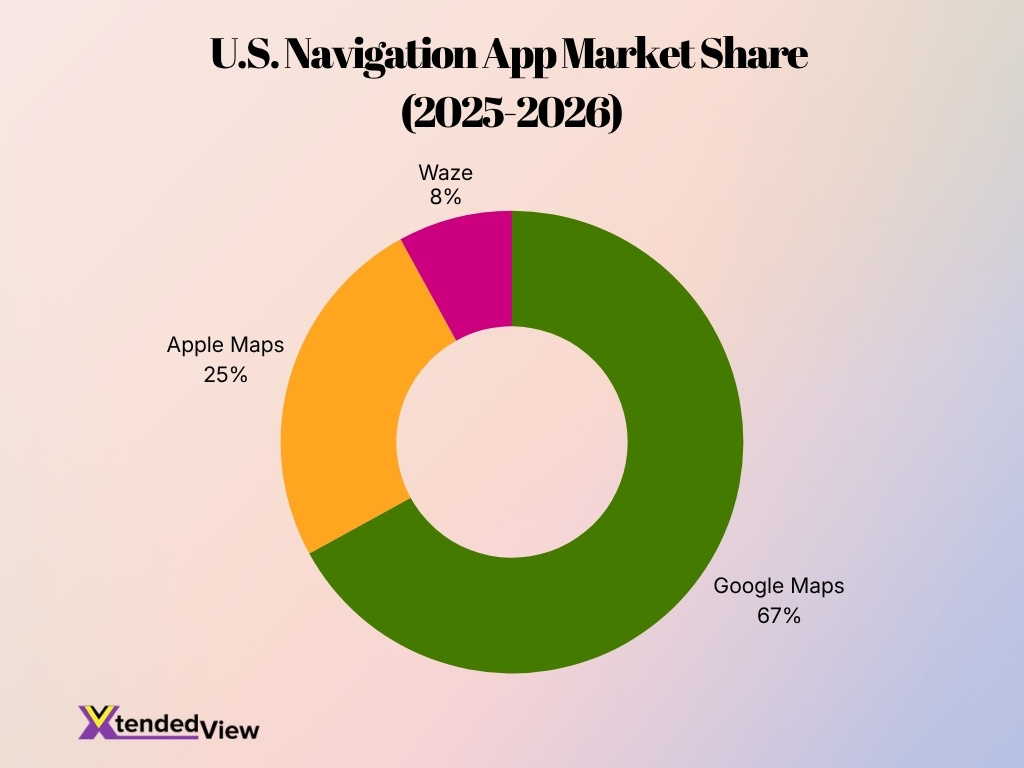
- Google Maps controls roughly 67% of the U.S. navigation app market, maintaining a commanding lead over competitors.
- In the U.S., Apple Maps holds approximately 25% market share, while Waze accounts for around 8%.
- In Australia, Google Maps commanded 79.9% of weekly active users among mapping applications in 2025.
- Waze, Google’s sister navigation platform, captured approximately 17.1% of Australia’s navigation market.
- Google Maps remains the most popular mapping application worldwide by user count and usage frequency.
- More than 80% of consumers worldwide prefer Google Maps for navigation and route planning.
- Google Maps consistently ranks first among navigation apps in Europe based on downloads and active usage.
- Android’s global dominance has strengthened Google Maps’ position because the app comes pre-installed on most Android smartphones.
- Google Maps has roughly 11 times more global users than Apple Maps, according to long-term usage comparisons.
Google Maps User Base
- Google Maps exceeded 2 billion monthly active users in late 2024 and maintained that milestone throughout 2025 and 2026.
- The platform’s daily active user base grew approximately 6% year over year between 2025 and 2026.
- Nearly 25% of the global population uses Google Maps every month.
- Around 154.4 million people in the United States use Google Maps each month.
- More than 70% of smartphone owners prefer Google Maps over competing navigation apps.
- Adults aged 18 to 34 account for nearly half of Google Maps traffic worldwide.
- The largest age segment on the platform is users aged 25 to 34, representing about 26.45% of the audience.
- Male users account for 54.08% of the user base, while female users represent 45.92%.
- The United States, Brazil, and Turkey rank among the largest traffic sources to Google Maps online services.
Google Maps Downloads and Installs
- Google Maps has surpassed 10 billion downloads on the Google Play Store, placing it among the platform’s most-installed apps.
- The app ranked among the top three most-downloaded travel and navigation applications globally in 2025.
- Google Maps generated roughly twice as many downloads as Waze in the United States.
- The app remains pre-installed on the majority of Android devices, giving it an unparalleled distribution advantage.
- Sensor Tower data showed Google Maps consistently ranked among Europe’s top five navigation apps by installs and active users in 2025.
- Google Maps continues to attract millions of new users each year due to increasing smartphone adoption in developing markets.
- The app’s integration with Android Auto and connected vehicles has contributed to continued installation growth in automotive systems.
- Google Maps remains one of the most downloaded navigation apps across both Android and iOS ecosystems.
- The continued rollout of AI features in 2025 and 2026 has driven renewed interest and user engagement with the application.
Most Downloaded Google Apps
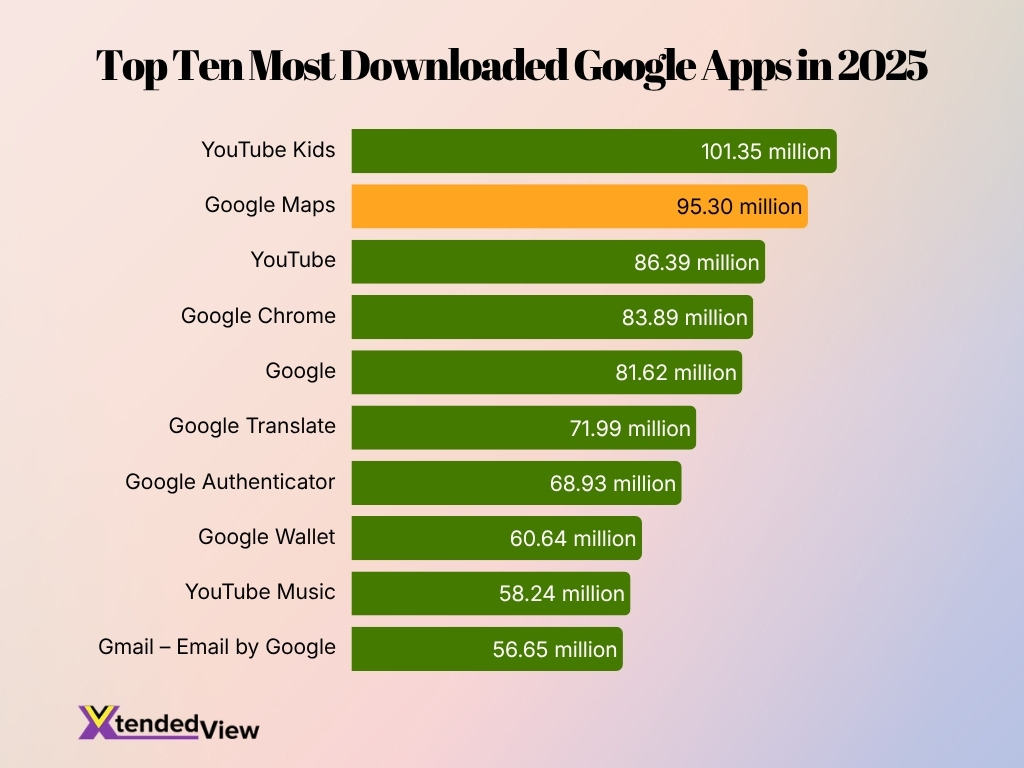
- YouTube Kids ranked first with 101.35 million downloads, making it the most downloaded Google app in 2025.
- Google Maps secured second place with 95.3 million downloads, highlighting its strong global demand.
- YouTube recorded 86.39 million downloads, placing it third among Google’s most popular apps.
- Google Chrome reached 83.89 million downloads, reflecting its continued dominance as a web browser.
- The Google app itself accumulated 81.62 million downloads, ranking fifth overall.
- Google Translate achieved 71.99 million downloads, demonstrating its widespread utility for multilingual users.
- Google Authenticator was downloaded 68.93 million times, showing growing interest in account security.
- Google Wallet registered 60.64 million downloads, indicating rising adoption of digital payment solutions.
- YouTube Music attracted 58.24 million downloads, maintaining its position as a leading music streaming app.
- Gmail – Email by Google rounded out the top 10 with 56.65 million downloads worldwide.
Google Maps Global Availability
- Google Maps is available in more than 250 countries and territories around the world.
- The service supports 74 languages, allowing users to navigate and search in their preferred language.
- High-resolution imagery on Google Earth and Maps covers the equivalent of 36 million square miles of Earth’s surface.
- Google Maps supports driving, walking, cycling, and public transportation routes across most major urban regions globally.
- The platform processes geographic data from millions of roads, businesses, and landmarks worldwide.
- More than 250 million mapped locations contribute to Google’s location intelligence ecosystem.
- Countries such as Brazil and the United States represent some of the largest online traffic sources for Google Maps.
- Google continues to expand mapping coverage in developing regions through local contributions and AI-powered mapping technologies.
- The company’s long-term investments in mapping infrastructure have helped establish Google Maps as the world’s most widely available digital mapping platform.
Google Maps Business Listings
- Google Maps hosts more than 250 million businesses and places worldwide, making it the largest local business directory on the internet.
- Over 200 million businesses actively manage their profiles on Google Maps and Google Business Profile.
- Approximately 1.5 million new business listings are added to Google Maps every month.
- Around 64% of consumers use Google Business Profiles to find contact information for local companies.
- Nearly 87% of consumers used Google to evaluate local businesses in 2025, with Maps playing a central role in the discovery process.
- About 76% of people who search for a nearby business on their smartphone visit it within one day.
- Roughly 28% of local searches result in a purchase within 24 hours.
- More than 90% of consumers are more likely to visit businesses with complete Google Business Profiles, including photos, hours, and reviews.
- Businesses with photos on their listings receive approximately 42% more requests for directions than businesses without photos.
Google Maps Customers by Geography
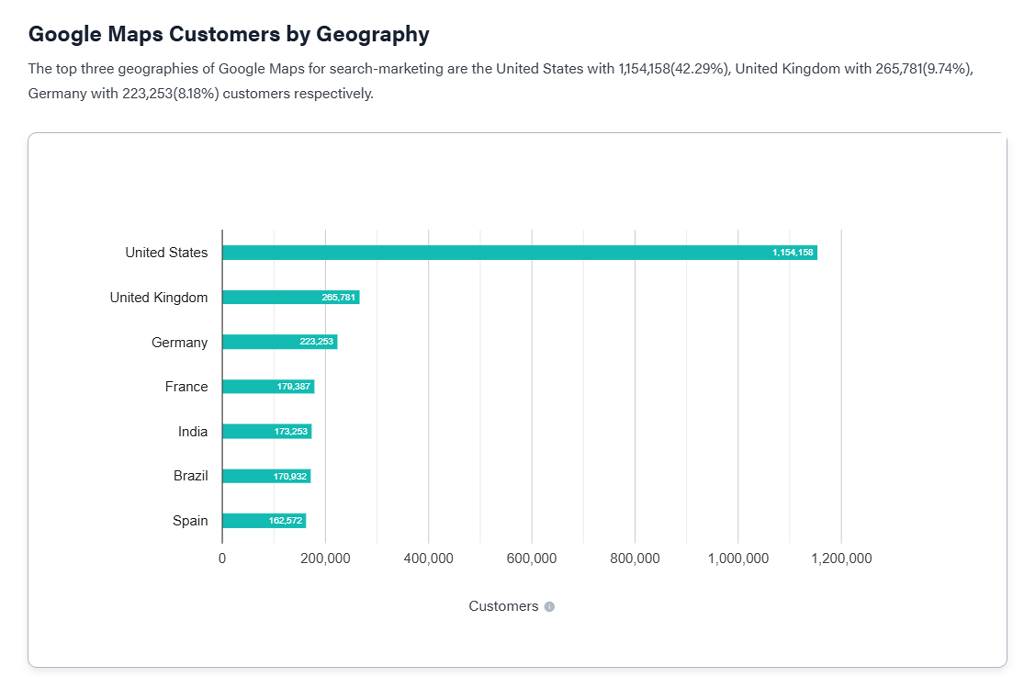
- The United States leads with 1,154,158 customers, accounting for 42.29% of the total customer base.
- The United Kingdom ranks second with 265,781 customers, representing 9.74% of customers.
- Germany holds third place with 223,253 customers, making up 8.18% of the total.
- France ranks fourth with 179,387 customers, highlighting a strong European presence.
- India follows closely with 173,253 customers, reflecting significant adoption in Asia.
- Brazil records 170,932 customers, making it the leading market in South America.
- Spain rounds out the top seven with 162,572 customers, demonstrating solid demand in Southern Europe.
- The United States has more than four times the customer count of the United Kingdom, emphasizing its dominant market position.
- European countries occupy four of the top seven positions, showing the region’s strong contribution to Google Maps’ customer base.
- The top three countries together account for over 60% of the customers represented in the chart.
Google Maps Search and Usage Volume
- Google Maps users perform billions of searches every month for businesses, addresses, and points of interest.
- Google reported that users request directions through Maps more than 20 billion times each year.
- Over 1 billion people use Google Maps monthly to search for local places and services.
- Approximately 86% of consumers use Google Maps to locate businesses before making an in-person visit.
- Searches containing the phrase “near me” have grown by more than 500% over the past several years, largely driven by mobile users.
- More than 46% of all Google searches have local intent, increasing traffic to Google Maps listings.
- About 30% of all mobile searches relate to a specific location.
- More than 88% of consumers who conduct a local search on their phone either call or visit a business within one week.
- Restaurants, gas stations, hotels, and retail stores remain the most searched categories on Google Maps globally.
Google Maps Navigation Usage
- Google Maps delivers navigation services to more than 2 billion monthly users worldwide.
- Users request driving directions on Google Maps approximately 20 billion times annually.
- About 70% of smartphone users rely on Google Maps as their primary navigation app.
- In the United States, Google Maps holds roughly 67% of the navigation app market.
- Google Maps serves over 220 countries and territories with turn-by-turn navigation.
- The application processes traffic information from hundreds of millions of devices every day to optimize routes.
- Around 60% of Google Maps users access the app while driving.
- Walking directions and cycling routes have become increasingly popular, particularly among urban users in Europe and North America.
- Google Maps’ navigation data helps reduce traffic congestion by rerouting millions of drivers each day.
Google Maps Reviews and Ratings
- Google reviews account for approximately 73% of all online reviews worldwide, making Maps the largest review platform.
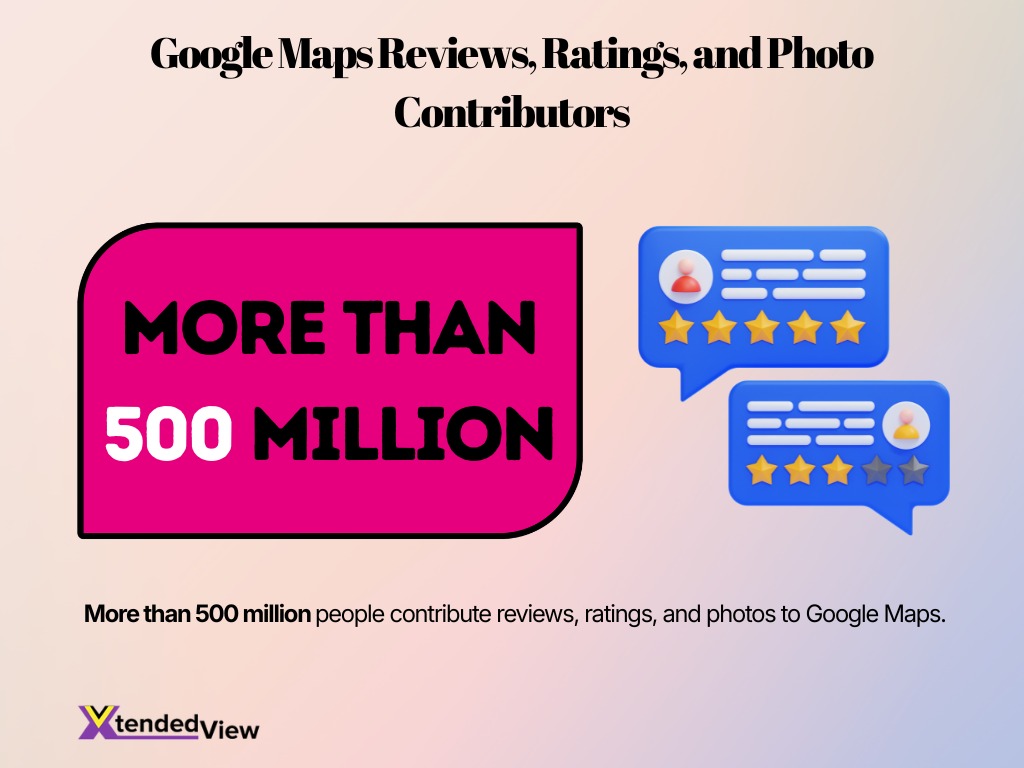
- More than 500 million people contribute reviews, ratings, and photos to Google Maps.
- Around 98% of consumers read online reviews for local businesses before making a purchase decision.
- Approximately 87% of consumers used Google reviews to evaluate local businesses in 2025.
- Businesses with ratings of 4 stars or higher receive significantly more clicks and direction requests than lower-rated competitors.
- Nearly 76% of consumers trust online reviews as much as personal recommendations from friends and family.
- More than 60% of customers say they avoid businesses with ratings below four stars.
- Restaurants, hotels, and tourist attractions receive the highest volume of reviews on Google Maps.
- Businesses that respond to reviews are viewed as more trustworthy and often generate higher customer engagement.
Google Maps Local Guides Contributions
- Google Maps has attracted more than 500 million contributors who submit reviews, photos, edits, and local information.
- Local Guides have contributed billions of photos and reviews to the platform since the program launched.
- More than 20 million new contributions are added to Google Maps every day.
- Local Guides have helped map millions of roads, landmarks, and businesses in developing regions.
- User-generated content now powers a significant share of Google’s place information and business details.
- The Local Guides program operates in more than 200 countries and territories.
- Millions of contributors participate in local mapping events and community-driven editing initiatives each year.
- User submissions help Google detect business closures, updated operating hours, and road changes faster than traditional mapping methods.
- Photos uploaded by Local Guides generate billions of views every month across Google Maps listings.
Google Maps Traffic and Commute Usage
- Google Maps uses real-time traffic data from hundreds of millions of mobile devices to estimate congestion levels.
- More than 1 billion kilometers of driving routes are calculated through Google Maps every day.
- Approximately 70% of commuters in major U.S. cities use navigation apps to avoid traffic delays.
- Google Maps’ predictive traffic models can estimate travel times with accuracy rates exceeding 90% in many urban regions.
- The app provides live traffic conditions in more than 80 countries.
- Traffic alerts and incident reporting save drivers millions of hours annually by suggesting alternate routes.
- During peak travel periods, navigation usage increases significantly, especially around holidays and long weekends.
- Commute-based notifications remain one of the app’s most frequently used features among daily users.
- Integration with electric vehicle routing and charging information has increased commute-related engagement since 2025.
Google Maps Usage Across Industry Verticals
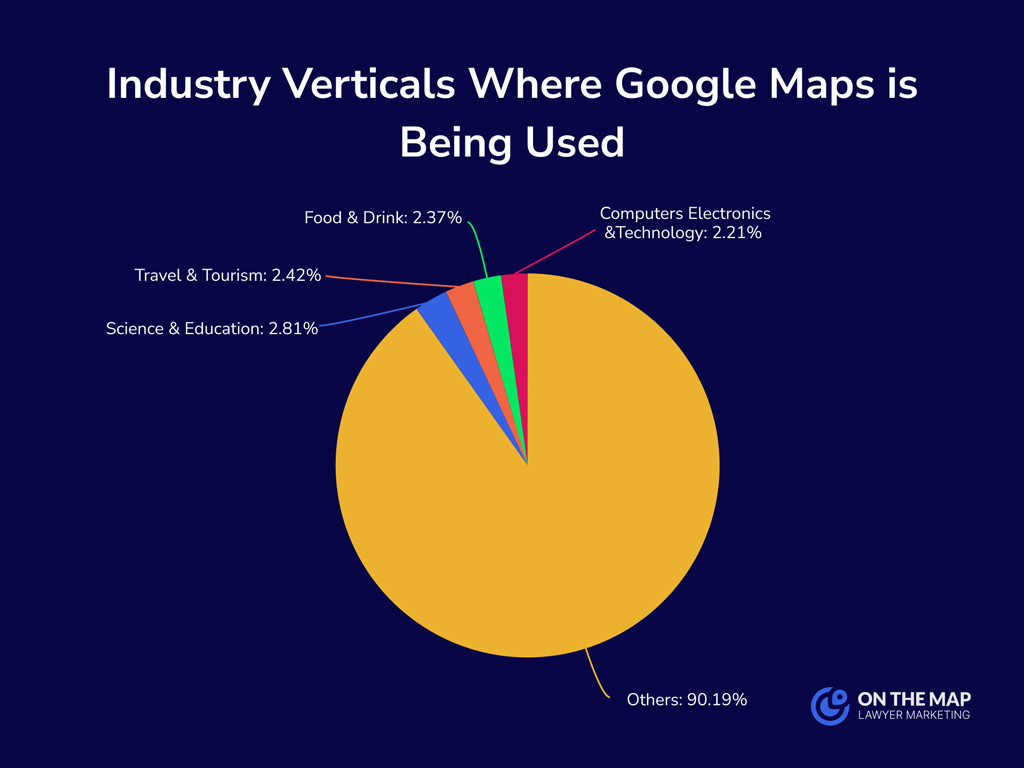
- Others account for the overwhelming majority of Google Maps usage, representing 90.19% of all tracked industry verticals.
- Science & Education is the largest named industry category, contributing 2.81% of Google Maps usage.
- Travel & Tourism follows closely with a 2.42% share, highlighting its reliance on location-based services.
- Food & Drink businesses make up 2.37% of Google Maps usage, reflecting strong demand for local discovery.
- Computers, Electronics & Technology contribute 2.21% of overall Google Maps usage across industries.
- The top four named industries combined account for 9.81%, while the remaining 90.19% is distributed across other business categories.
- The data shows that Google Maps adoption is highly diversified, with “Others” dominating usage beyond the major tracked industry segments.
Google Maps Public Transit Coverage
- Google Maps provides public transit directions in over 10,000 cities and towns worldwide.
- The platform integrates real-time schedules from 1,000+ public transport agencies globally.
- Transit navigation features are actively available across 100-plus countries worldwide.
- Over 2 billion monthly active users rely on the platform for daily navigation and transit.
- Arrival time predictions for public transportation maintain a 97% accuracy rate using AI.
- Real-time transit and traffic data covers approximately 99% of North American urban areas.
- The navigation application has surpassed 10 billion total downloads across global app stores.
- Global mapping and transit features currently reach roughly 98% of the world’s population.
Google Maps Platform and API Usage
- The Google Maps Platform serves more than 10 million websites and apps through its APIs and developer tools.
- Google Maps Platform supports over 7 million active developers worldwide who use mapping, geolocation, and routing APIs.
- The Maps JavaScript API remains one of the world’s most-used mapping APIs, processing billions of requests every month.
- More than 5 million businesses use Google Maps APIs to power store locators, delivery tracking, and customer-facing applications.
- Google Maps Platform offers 18+ APIs and SDKs, including Maps, Places, Geocoding, and Routes APIs.
- The Places API contains information on 250 million places and businesses globally.
- More than 90% of Fortune 1000 companies use some form of location intelligence technology, with Google Maps Platform among the leading providers.
- Industries such as logistics, food delivery, ride-sharing, and real estate rank among the biggest users of Google Maps APIs.
- Developers increasingly use Google Maps Platform with AI tools and cloud services to build location-aware applications and personalized customer experiences.
Top Reasons People Choose Their Favorite Navigation App
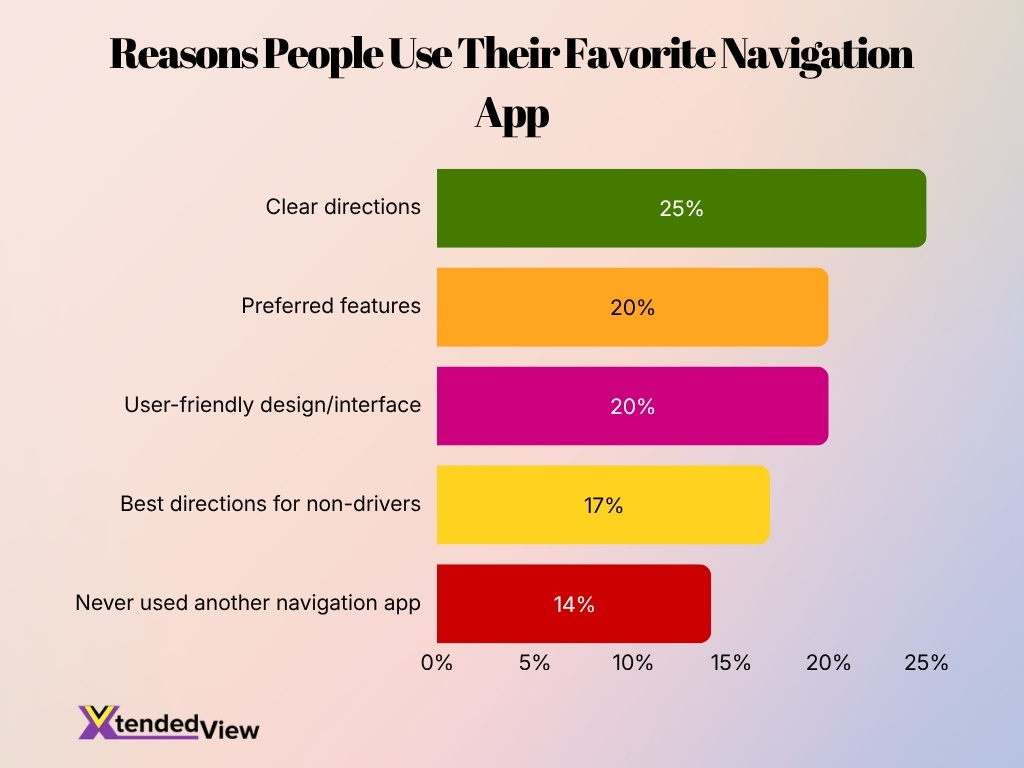
- Clear directions are the leading reason, chosen by 25% of users.
- Preferred features influence 20% of users when selecting a navigation app.
- User-friendly design/interface is equally important, cited by 20% of respondents.
- 17% of users prefer apps that provide the best directions for non-drivers.
- 14% of users stay with their app because they have never used another navigation app.
- Clear directions, preferred features, and ease of use together account for the top three reasons users favor a navigation app.
Google Maps Revenue and Monetization
- Alphabet, Google’s parent company, surpassed $400 billion in total revenue for 2025 with advertising as the core driver.
- Google Maps independently generates approximately $11.1 billion in annual revenue through local business integrations.
- Advertising formats such as promoted pins account for a massive 82% of total Google Maps revenue.
- More than 2.5 million businesses actively invest in promoted pins to capture local search traffic.
- Location-based advertising spending across the United States officially exceeded $45 billion in 2025.
- The Google Maps Platform processes over 40 billion API calls every month from enterprise developers.
- Google Maps advertising campaigns successfully drive a 40% increase in direct store visits and calls.
- Over 1.2 million companies globally pay licensing fees to utilize the Google Maps API infrastructure.
- Ride-hailing services relying on the Maps API complete over 1 billion trips every single month.
Google Maps Compared with Competitors
- Google Maps remains the world’s largest navigation platform with more than 2 billion monthly active users.
- Apple Maps has an estimated 500 million monthly users, significantly smaller than Google Maps’ audience.
- In the United States, Google Maps holds around 67% market share, compared with roughly 25% for Apple Maps.
- Waze, another Google-owned platform, focuses primarily on community-driven traffic reporting and has a considerably smaller user base.
- Google Maps supports public transit information in 10,000-plus cities, exceeding the coverage offered by most competitors.
- Google Maps is available in 250-plus countries and territories, giving it broader global reach than many alternatives.
- The platform maintains one of the world’s largest business databases, containing more than 250 million places and listings.
- Apple Maps remains strongest among iPhone users, while Google Maps dominates across Android devices and international markets.
- Businesses often prioritize Google Maps optimization because of its larger audience and stronger local search visibility.
Future of Google Maps
- The global geospatial intelligence market is projected to reach $62.88 billion by 2030, growing at an 11.1% CAGR.
- Google Maps currently serves over 2 billion monthly active users worldwide, cementing its core position in navigation.
- The platform’s ETA predictions are 97% accurate, driven by DeepMind AI integration for predictive traffic modeling.
- Google Maps surfaces rich information for approximately 250 million places and businesses globally to support customer acquisition.
- Users collectively drive over 1 billion kilometers every day using Maps directions, emphasizing the growing need for eco-friendly routing.
- The platform’s Street View imagery now covers more than 10 million miles of roads across 87+ countries for immersive exploration.
- Over 120 million Local Guides submit more than 20 million contributions daily, keeping real-time business and location data accurate.
- The GNSS and Positioning segment is expanding rapidly and is expected to surpass $640 billion by 2030 for advanced mobility and autonomous systems.
- More than 5 million active apps and websites integrate core Google Maps Platform products for smart device and connected vehicle experiences.
Frequently Asked Questions (FAQs)
Google Maps has more than 2 billion monthly active users worldwide, making it one of Google’s largest consumer products.
Google Maps contains information on approximately 250 million places and businesses globally.
Google Maps has surpassed 10 billion downloads on the Google Play Store.
More than 75% of U.S. smartphone users use Google Maps weekly for navigation and local searches.
Google Maps Platform powers more than 5 million websites and applications through its APIs and mapping services.
Conclusion
Google Maps has evolved far beyond a navigation tool. It now functions as a global platform for business discovery, local commerce, transportation planning, and location intelligence. With more than 2 billion monthly users, over 250 million business listings, and a rapidly expanding set of AI-powered features, Google Maps continues to influence how consumers make decisions and how businesses reach customers.
As artificial intelligence, connected vehicles, and smart city technologies mature, Google Maps is positioned to play an even larger role in the digital economy. For businesses, marketers, developers, and consumers alike, understanding these statistics provides valuable insight into one of the world’s most influential location platforms.
