



The digital workplace has evolved from a productivity initiative into a core business strategy. Companies now rely on cloud collaboration tools, AI-powered workflows, and hybrid work environments to connect employees across locations and devices. Industries such as healthcare use digital workplaces to coordinate patient care remotely, while financial institutions depend on secure collaboration platforms to support distributed teams and maintain compliance. As investments in workplace technology continue to grow, the statistics below reveal how organizations are reshaping the future of work.
Editor’s Choice
- The global digital workplace market is projected to reach $74.55 billion in 2026, up from $60.65 billion in 2025.
- Global spending on digital transformation technologies is expected to increase to $3.4 trillion in 2026, compared with $2.92 trillion in 2025.
- The digital workplace market is forecast to grow at a 22.93% CAGR through 2034.
- In the United States, the digital workplace market is expected to expand at a 21.1% CAGR between 2025 and 2030.
- Approximately 52% of remote-capable U.S. employees work in hybrid arrangements in 2025.
- More than 32.6 million Americans work remotely in 2025, accounting for roughly 22% of the workforce.
- Around 64.4% of large companies worldwide have already adopted a hybrid work model.
- About 78% of business leaders say digital transformation has become a strategic priority for innovation and talent retention.
Recent Developments
- The digital workplace market entered a demand stabilization phase in 2025, with enterprises focusing on high-impact use cases.
- Companies increasingly prioritize AI-driven collaboration platforms and workflow automation to improve operational efficiency.
- Over 1,500 companies worldwide are adopting hybrid work models, with adoption growing by approximately 18.58% annually.
- Organizations are moving from measuring employee output by office presence to evaluating productivity through digital work ecosystems and outcomes.
- Financial firms and multinational companies continue to increase investments in secure digital workplace infrastructure because of rising compliance requirements.
- New digital workplace investments increasingly focus on cybersecurity, virtual desktops, and cloud-based collaboration platforms.
- European organizations continue to increase digital workplace spending to support sustainability initiatives and regulatory compliance.
- Organizations increasingly deploy AR and XR tools to support remote training and real-time operational guidance in manufacturing and logistics.
- Businesses are rapidly integrating AI assistants into workplace applications, creating a new “blended work” model that combines human and AI collaboration.
Digital Workplace Market Size
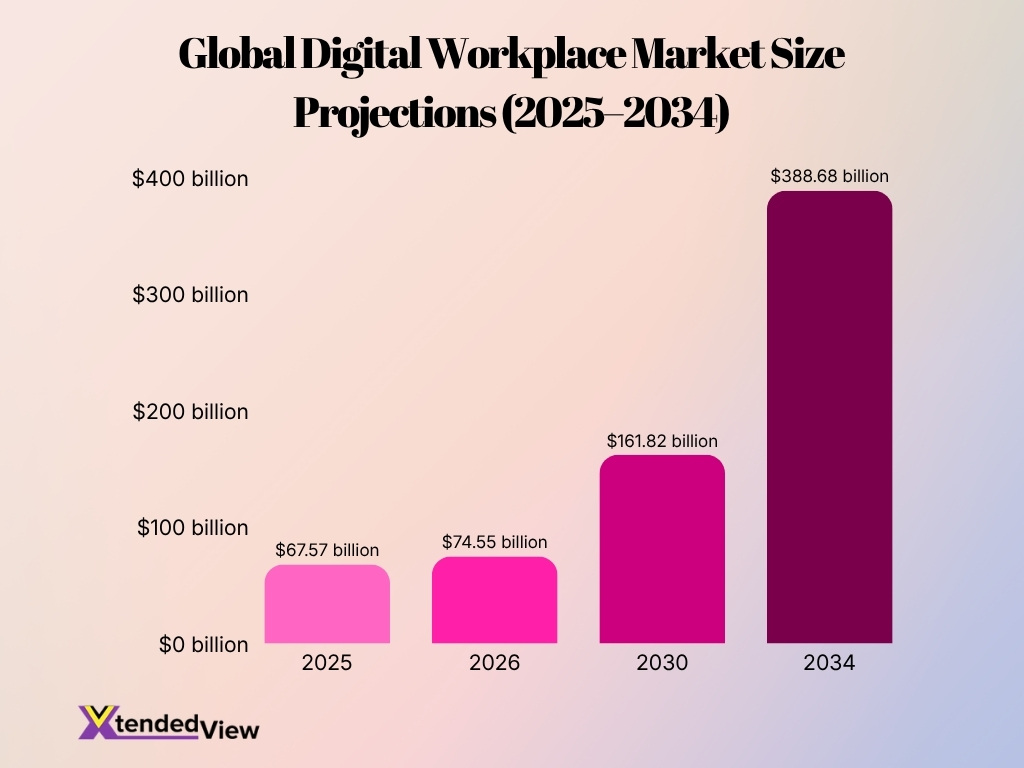
- The global digital workplace market reached an estimated $67.57 billion in 2025.
- Another industry estimate places the market at $60.65 billion in 2025, reflecting varying methodologies across research firms.
- Market forecasts suggest the sector will reach $74.55 billion in 2026.
- The market could expand to $161.82 billion by 2030, nearly 2.4 times its 2025 size.
- Another forecast estimates the market could reach $175.9 billion by 2030.
- Long-term projections indicate the market may surpass $388.68 billion by 2034.
- Europe generated approximately $15.69 billion in digital workplace revenue during 2025.
- Another industry estimate values the digital workplace market at $48.96 billion in 2025, highlighting continued momentum despite differing measurement criteria.
- Analysts expect the market to create an additional $709.24 billion opportunity between 2024 and 2029.
Digital Workplace Market Growth
- The global digital workplace market is expected to grow at a 19.1% CAGR from 2025 to 2030.
- Another forecast projects a 22.93% CAGR through 2034, driven by AI and hybrid work adoption.
- Market Research Future estimates a 15.16% CAGR between 2025 and 2035.
- The U.S. market alone is expected to expand at a 21.1% CAGR through 2030.
- Europe is projected to record a 22.2% CAGR from 2026 to 2030.
- Technavio projects an aggressive 51.5% CAGR between 2024 and 2029, fueled by lower enterprise hardware costs and digital transformation initiatives.
- The market’s year-over-year growth rate reached 35.1% between 2024 and 2025, according to one industry estimate.
- Growth in the sector increasingly comes from investments in AI, automation, and secure collaboration technologies.
- North America continues to hold the largest market share because of sustained demand for next-generation workplace technologies.
Digital Workplace Adoption Trends
- Approximately 64.4% of large organizations worldwide have adopted hybrid workplace models.
- Around 18.6% of organizations operate fully remotely.
- Only 17% of companies still rely entirely on traditional office models.
- About 74% of knowledge workers prefer hybrid work arrangements in 2025.
- Roughly 83% of employees globally say hybrid work represents the ideal arrangement.
- Nearly 78% of business leaders identify digital transformation as a priority for innovation and retention.
- About 31% of organizations report satisfaction with their digital transformation progress, indicating significant room for improvement.
- Nearly 70% of professionals say focused work becomes easier when working remotely.
- About 98% of remote workers want remote work options throughout their careers.
- Roughly 29% of all paid U.S. workdays were completed from home in 2025, showing that remote work has stabilized at a high level.
Digital Technology Adoption in the Workplace
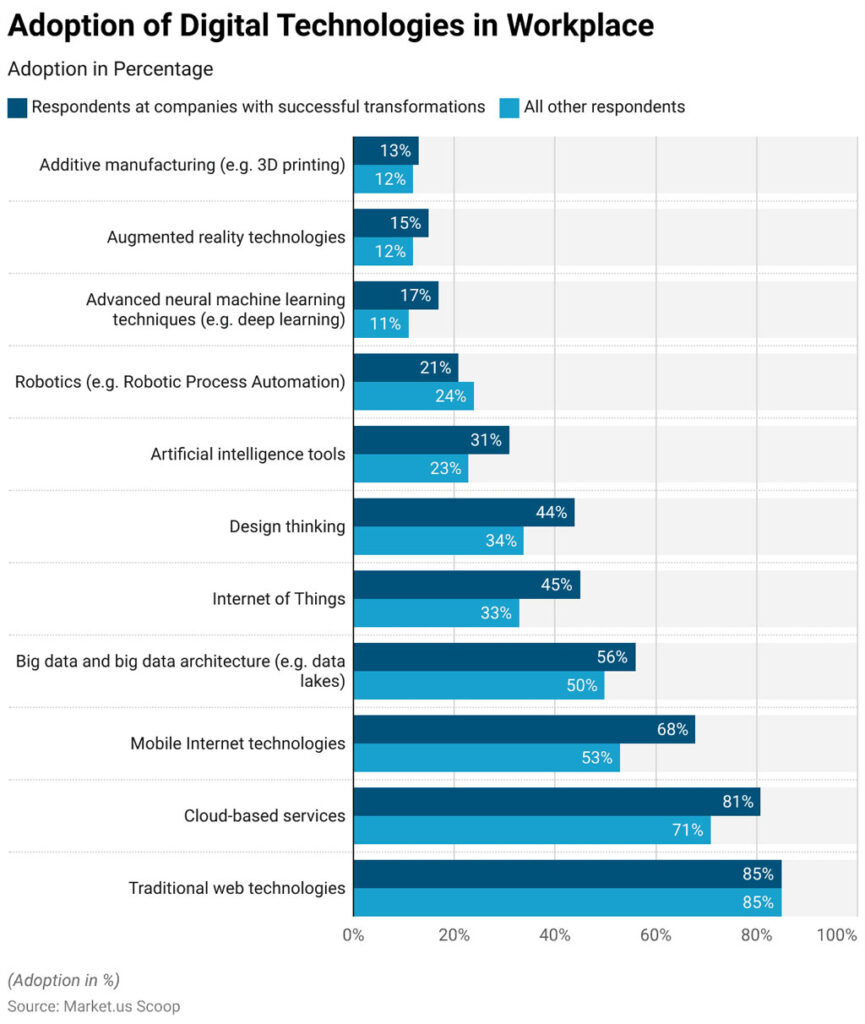
- Traditional web technologies are the most widely adopted, with 85% adoption among both successful transformation companies and other respondents.
- Cloud-based services show 81% adoption in companies with successful transformations, compared to 71% among other organizations.
- Mobile Internet technologies are used by 68% of successful transformation companies, versus 53% of other respondents.
- Big data and big data architecture have an adoption rate of 56% in successful organizations, compared to 50% elsewhere.
- Internet of Things (IoT) adoption reaches 45% among successful companies, significantly higher than 33% for other respondents.
- Design thinking is adopted by 44% of successful transformation companies, compared to 34% of other organizations.
- Artificial intelligence tools are used by 31% of successful companies, exceeding the 23% adoption rate among other respondents.
- Robotics, including Robotic Process Automation (RPA), is the only technology with higher adoption among other respondents (24%) than successful transformation companies (21%).
- Advanced neural machine learning techniques, such as deep learning, are adopted by 17% of successful organizations, compared to 11% of other respondents.
- Augmented reality technologies have relatively low adoption, with 15% in successful companies and 12% among other respondents.
- Additive manufacturing (3D printing) remains one of the least adopted technologies, at 13% for successful companies and 12% for other organizations.
- Overall, companies with successful digital transformations consistently report higher adoption rates for nearly every digital technology, highlighting the strong link between technology adoption and transformation success.
Remote and Hybrid Work Adoption
- Around 52% of remote-capable U.S. employees worked in a hybrid arrangement in 2025, while 27% worked exclusively remotely.
- Approximately 29% of all paid workdays in the United States were completed from home in early 2025.
- More than 32.6 million Americans worked remotely in 2025, representing nearly 22% of the national workforce.
- About 64.4% of large organizations globally have adopted hybrid work models as their long-term workplace strategy.
- Roughly 83% of workers worldwide prefer hybrid work arrangements over fully office-based schedules.
- Nearly 98% of remote workers want the option to work remotely for the rest of their careers.
- About 74% of employees say flexible work arrangements improve their work-life balance and overall job satisfaction.
- Companies offering hybrid work report 35% lower employee turnover compared with businesses requiring full-time office attendance.
- Around 71% of organizations have redesigned office spaces to better support hybrid collaboration and flexible work.
- Approximately 60% of CEOs say hybrid work has improved their ability to attract and retain talent.
Digital Workplace Tools and Platforms
- The global collaboration software market is expected to surpass $20 billion in 2026, driven largely by hybrid work adoption.
- More than 90% of organizations use cloud-based productivity suites as their primary digital workplace platform.
- Around 85% of enterprises increased spending on digital workplace tools during the past two years.
- Approximately 73% of employees rely on at least three different digital collaboration platforms each day.
- About 67% of companies have invested in digital employee experience platforms to improve productivity and engagement.
- Nearly 80% of organizations plan to consolidate workplace applications to reduce software complexity and licensing costs.
- More than 65% of companies now deploy virtual desktop infrastructure or desktop-as-a-service solutions for remote employees.
- Around 76% of organizations consider digital workplace platforms critical for business continuity planning.
- Nearly 58% of businesses use employee experience analytics to monitor technology adoption and performance.
Collaboration and Communication Tools
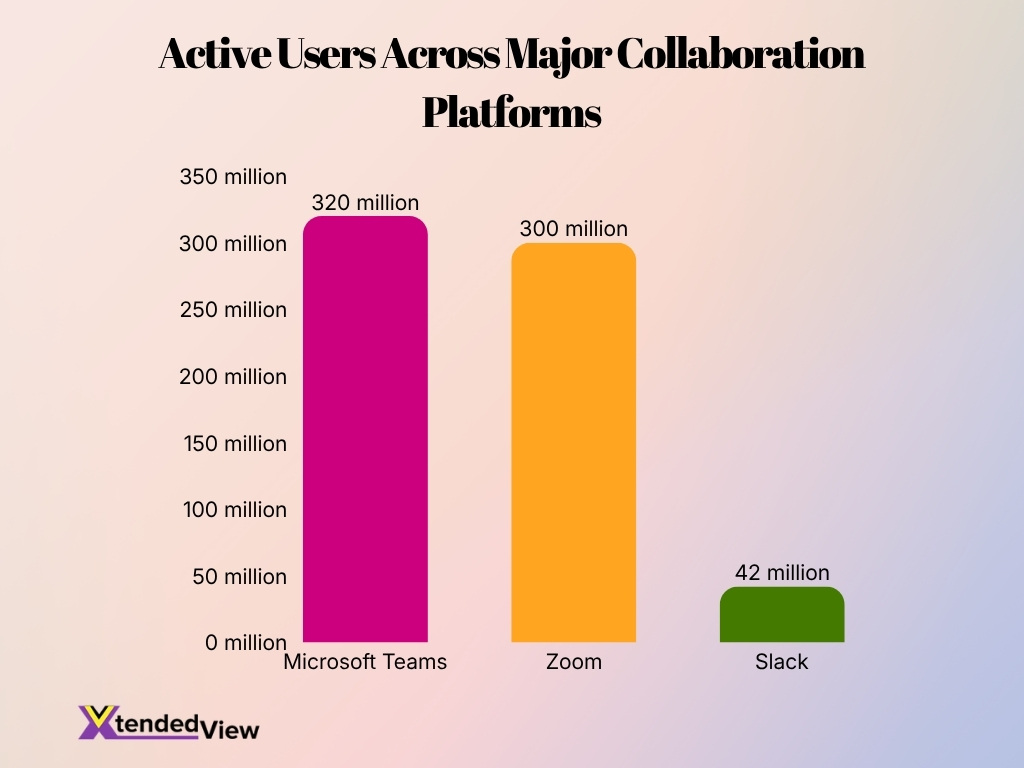
- Over 320 million monthly active users use Microsoft Teams worldwide in 2025.
- Slack has surpassed 42 million daily active users, reflecting continued demand for workplace messaging platforms.
- Zoom serves more than 300 million daily meeting participants globally.
- Around 80% of employees say collaboration technology improves team efficiency and project execution.
- Nearly 68% of workers spend up to one hour each day switching between applications and communication tools.
- Approximately 72% of organizations have adopted asynchronous communication practices to reduce meeting fatigue.
- About 57% of employees believe excessive meetings reduce productivity.
- Organizations using integrated communication platforms report 20% faster project completion times than businesses with disconnected systems.
- Around 87% of employees say collaboration tools are essential for maintaining team relationships in hybrid environments.
- Businesses with strong collaboration practices are five times more likely to achieve high performance.
Employee Productivity in Digital Workplaces
- Employees using digital workplace tools effectively report productivity improvements of up to 25%.
- Nearly 70% of remote workers say they are more productive working outside a traditional office.
- Organizations implementing AI-enabled workplace tools report productivity gains of 15% to 40%.
- About 77% of employees say flexible work arrangements increase their productivity.
- Workers spend approximately 19% of their workweek searching for information or tracking down colleagues for answers.
- Employees lose an average of 9% of their annual work time because of inefficient technology and fragmented systems.
- Businesses that prioritize employee experience technologies experience 31% higher productivity levels.
- Around 63% of knowledge workers say digital collaboration tools help them complete tasks faster.
- Approximately 41% of workers report experiencing digital fatigue because of excessive notifications and app switching.
- Organizations with mature digital workplaces are 23% more profitable than peers with limited digital capabilities.
Employee Engagement in Digital Workplaces
- Only 21% of employees globally describe themselves as actively engaged at work.
- Companies with highly engaged employees report 23% higher profitability than organizations with low engagement levels.
- Approximately 77% of employees say workplace flexibility improves engagement and job satisfaction.
- Around 70% of managers believe digital collaboration tools have strengthened employee engagement in hybrid settings.
- Employees with positive digital experiences are three times more likely to remain with their employer.
- Roughly 54% of workers say poor technology experiences negatively affect their motivation and engagement.
- Organizations that invest in digital employee experience platforms report 35% lower employee turnover.
- About 69% of employees say they would work harder if they felt more connected to their colleagues and company culture.
- Companies with highly engaged employees experience 18% higher productivity and significantly lower absenteeism.
- Nearly 80% of employees expect employers to provide modern digital tools that make work easier and more collaborative.
Hybrid, Home, and Office Work Location Statistics
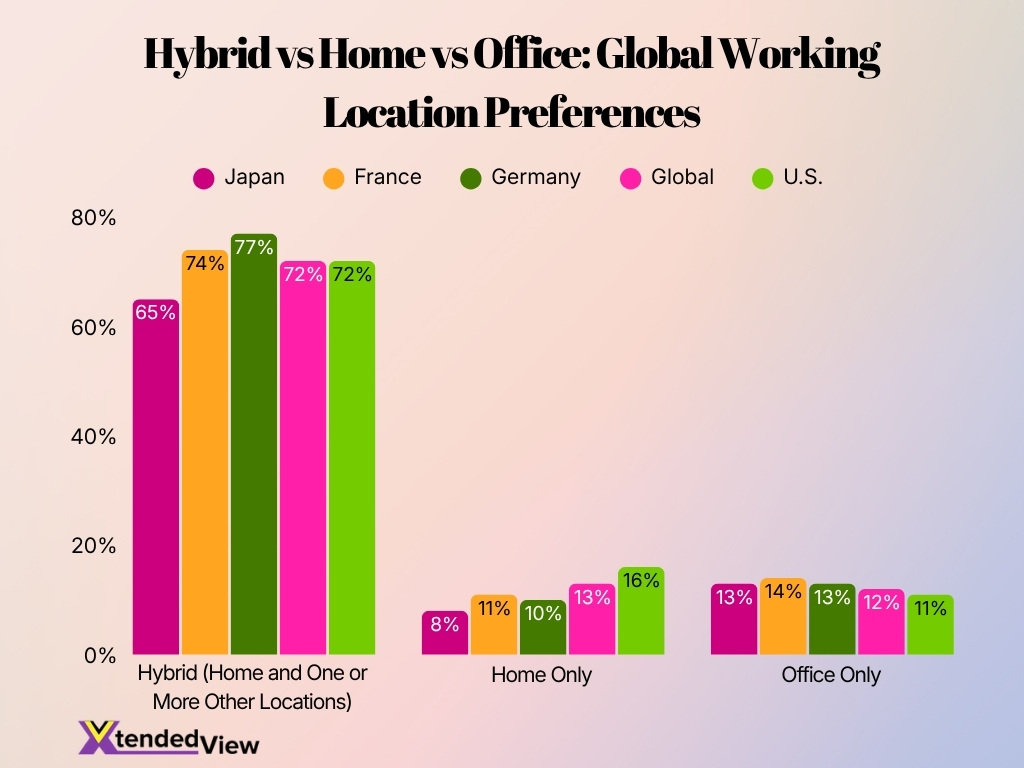
- Hybrid work is the dominant preference globally, with 72% of employees favoring a mix of home and other work locations.
- Germany records the highest hybrid work preference at 77%, leading all surveyed countries.
- France follows closely, with 74% of workers preferring a hybrid work model.
- The U.S., UK, and Australia each report an identical 72% hybrid work preference, matching the global average.
- Japan has the lowest hybrid work preference among the surveyed countries at 65%.
- Home-only work is chosen by just 13% of workers globally, showing limited preference for fully remote work.
- The U.S. has the highest home-only preference at 16%, followed by the UK at 15%.
- Japan records the lowest home-only preference at just 8%, indicating fewer employees prefer working exclusively from home.
- Office-only work remains the least popular option globally, with only 12% choosing to work exclusively from the office.
- France has the highest office-only preference at 14%, while the UK has the lowest at 8%.
- Japan, Australia, and Germany each report 13% of employees preferring to work only from the office.
- Across all surveyed countries, hybrid work consistently outperforms both home-only and office-only arrangements, highlighting its growing role as the preferred workplace model.
Digital Workplace Security Statistics
- The average global cost of a data breach reached $4.88 million in 2024, the highest amount ever recorded.
- Human error contributed to approximately 68% of cybersecurity breaches in recent years.
- Around 74% of organizations reported an increase in cyberattacks after adopting hybrid work models.
- Nearly 43% of companies experienced security incidents linked to remote employees accessing corporate systems.
- About 85% of organizations now use multi-factor authentication as a standard security requirement.
- Organizations using AI-driven security tools and automation saved an average of $2.22 million in breach-related costs.
- Approximately 61% of businesses increased spending on cybersecurity technologies in response to hybrid work risks.
- Around 80% of enterprises consider zero-trust security frameworks essential to protecting digital workplaces.
- More than 90% of cyber incidents begin with phishing or social engineering attacks targeting employees.
- Companies with mature security awareness training programs experience up to 70% fewer security incidents than organizations without regular employee training.
Cloud Adoption in the Digital Workplace
- Global spending on public cloud services is projected to reach $723 billion in 2025, up from approximately $596 billion in 2024.
- More than 94% of enterprises now use at least one cloud service to support business operations and workplace collaboration.
- Around 87% of organizations rely on hybrid cloud environments to power digital workplace applications.
- Approximately 79% of companies cite cloud adoption as a key driver of digital transformation initiatives.
- Nearly 65% of enterprise workloads are expected to run in cloud environments by 2026.
- About 82% of organizations say cloud technology has improved business agility and employee productivity.
- Roughly 51% of enterprises identify managing cloud costs as their biggest cloud-related challenge.
- Around 72% of organizations use cloud collaboration platforms as their primary workplace communication infrastructure.
- Businesses that fully adopt cloud-based workplaces experience up to 20% lower IT operating costs than organizations that depend heavily on on-premises infrastructure.
- Nearly 90% of companies consider cloud computing essential for supporting remote and hybrid work environments.
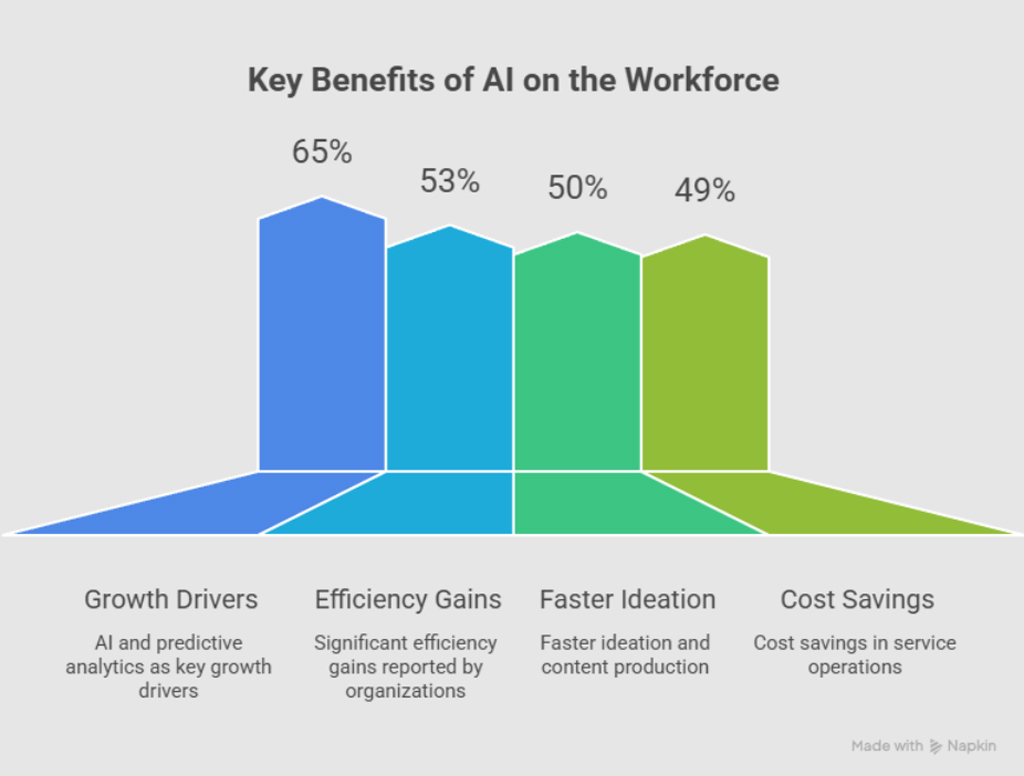
Key Benefits of AI on the Workforce
- 65% of organizations identify AI and predictive analytics as major growth drivers for business expansion.
- 53% of organizations report significant efficiency gains after implementing AI-powered solutions.
- 50% say AI accelerates ideation and content production, enabling faster innovation.
- 49% of businesses achieve cost savings by using AI to optimize service operations.
- Growth drivers (65%) rank as the top reported benefit, highlighting AI’s strategic business value.
- Efficiency gains (53%) remain the second most common advantage, demonstrating AI’s operational impact.
- Faster ideation (50%) shows that one in two organizations leverage AI to improve creativity and productivity.
- Cost savings (49%) indicate that nearly half of organizations use AI to reduce operational expenses.
Mobile Workforce Statistics
- The global mobile workforce is projected to exceed 1.9 billion people by 2025, representing nearly one-quarter of the world’s workforce.
- Approximately 60% of employees use mobile devices for work-related tasks every day.
- Around 80% of workers use smartphones to access email, messaging apps, and collaboration tools outside the office.
- Nearly 58% of organizations have implemented bring-your-own-device (BYOD) programs to support workforce flexibility.
- About 85% of businesses report improved productivity after adopting mobile workplace solutions.
- Employees who can work from mobile devices report 43% higher productivity levels than workers restricted to desktop-only environments.
- Approximately 70% of remote workers rely on mobile applications to stay connected with colleagues and customers.
- Around 67% of enterprises have invested in mobile device management technologies to secure workplace data.
- Nearly 75% of field service employees say mobile technologies significantly improve job performance and customer response times.
- The enterprise mobility market is expected to surpass $96 billion by 2026, reflecting growing demand for mobile work solutions.
Digital Transformation in the Workplace
- Global spending on digital transformation initiatives is forecast to reach $3.4 trillion in 2026, compared with approximately $2.92 trillion in 2025.
- Around 89% of organizations have adopted or plan to adopt a digital-first business strategy.
- Nearly 78% of executives consider digital transformation a top strategic priority.
- Approximately 55% of businesses have accelerated digital transformation initiatives since the rise of hybrid work.
- Companies with mature digital transformation programs are 23% more profitable than less digitally advanced peers.
- About 70% of digital transformation initiatives fail to achieve their intended objectives due to organizational and cultural challenges.
- Roughly 68% of businesses say employee experience has become a primary reason for digital workplace investments.
- Organizations that invest heavily in digital transformation are 26% more profitable than industry competitors.
- Nearly 74% of executives believe digital transformation initiatives have improved organizational resilience and agility.
- Around 60% of companies plan to increase digital transformation spending over the next two years.
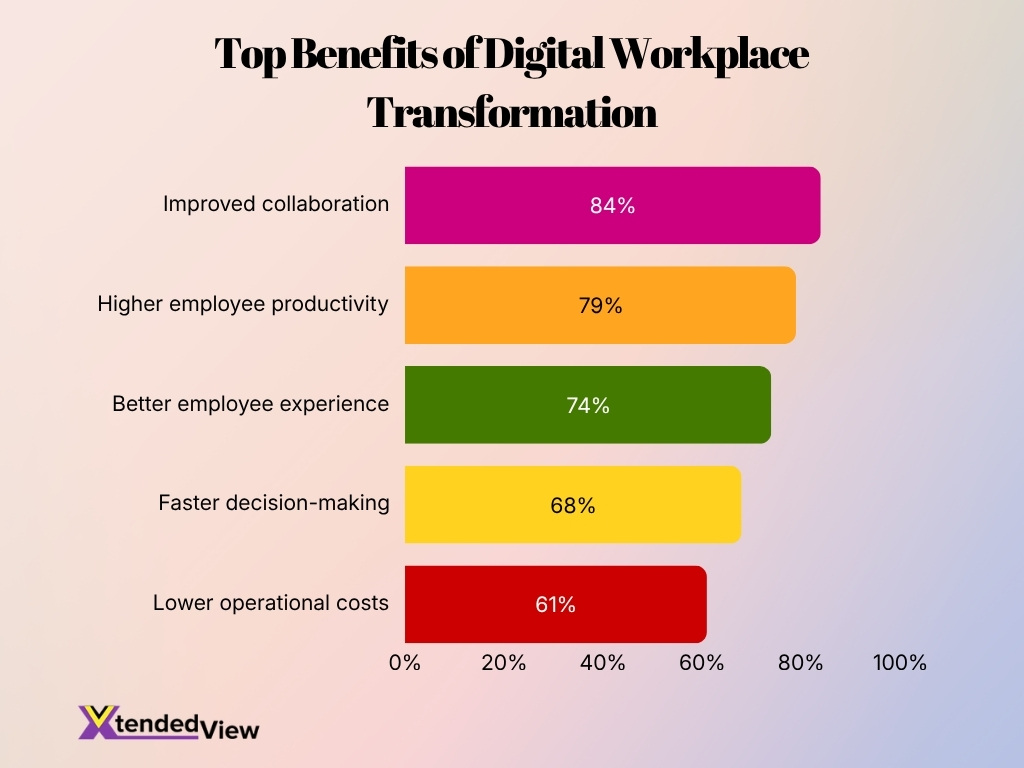
Key Benefits of Digital Workplace Transformation
- 84% of organizations report improved collaboration, making it the top benefit of digital workplace transformation.
- 79% of businesses experience higher employee productivity after adopting digital workplace solutions.
- 74% of organizations say digital workplaces deliver a better employee experience through enhanced flexibility and communication.
- 68% of companies achieve faster decision-making by enabling real-time collaboration and streamlined workflows.
- 61% of organizations reduce operational costs, highlighting the financial value of digital workplace transformation.
- More than three in four organizations (79%) gain measurable productivity improvements from modern digital workplace initiatives.
- Nearly seven in ten businesses (68%) accelerate business decisions by leveraging connected digital tools and platforms.
- Employee-focused benefits such as collaboration (84%), productivity (79%), and experience (74%) rank higher than cost savings (61%), showing that workforce performance is the primary driver of digital workplace adoption.
Workplace Experience and User Satisfaction
- Employees with positive digital experiences are three times more likely to remain with their employers.
- Around 80% of employees expect their workplace technology to match the ease of use of consumer applications.
- Approximately 54% of workers say poor workplace technology negatively affects job satisfaction and engagement.
- Organizations with strong digital employee experiences report 35% lower employee turnover.
- Nearly 63% of employees believe better workplace technology would help them perform their jobs more effectively.
- About 69% of employees feel more engaged when they have access to modern collaboration tools.
- Around 41% of workers experience digital fatigue because of too many applications and notifications.
- Employees who are satisfied with workplace technology are 230% more engaged than employees with poor digital experiences.
- Approximately 74% of workers say flexibility and digital tools improve their overall workplace experience.
- Organizations that prioritize digital employee experience initiatives report 31% higher productivity.
Return on Investment in Digital Workplace Solutions
- Companies that invest in employee experience technologies achieve 31% higher productivity and improved business performance.
- Organizations implementing digital workplace strategies report average productivity gains of 20% to 25%.
- Businesses with advanced collaboration tools reduce operational costs by approximately 20%.
- Companies adopting cloud-based workplace technologies report up to 20% lower IT costs.
- Organizations with mature digital workplaces are 23% more profitable than their industry peers.
- Businesses that successfully implement digital transformation initiatives generate 26% higher profitability than competitors.
- Employee experience investments can deliver a return of more than three times the original investment through productivity and retention improvements.
- Companies with engaged employees achieve 23% higher profitability and stronger customer outcomes.
- Organizations using AI-powered automation report administrative cost reductions of approximately 30%.
- Businesses that effectively deploy digital workplace solutions experience 35% lower employee turnover, reducing recruitment and onboarding costs.
Future of Digital Workplace Trends
- By 2027, approximately 80% of knowledge workers are expected to use generative AI tools daily.
- Around 92% of organizations plan to increase AI investments during the next three years.
- Nearly 65% of enterprise workloads are expected to run in cloud environments by 2026.
- About 75% of organizations are expected to adopt some form of immersive technologies, such as AR and VR, for training and collaboration by 2030.
- Approximately 70% of executives expect AI to fundamentally transform business models and employee workflows within three years.
- More than 50% of organizations plan to redesign office spaces around collaboration rather than individual workstations.
- Around 85% of companies expect flexible work arrangements to remain permanent.
- The digital workplace market is projected to exceed $388 billion by 2034, indicating sustained long-term growth.
- Nearly 60% of employees believe AI assistants will become a standard part of daily work within the next few years.
- Analysts expect digital employee experience platforms to become a standard enterprise technology category by the end of the decade.
Frequently Asked Questions (FAQs)
The global digital workplace market is projected to reach $74.55 billion in 2026, up from $60.65 billion in 2025.
The digital workplace market is forecast to grow at a 22.93% CAGR from 2026 to 2034, according to recent industry estimates.
North America accounted for 36.9% of global digital workplace revenue in 2025, making it the largest regional market worldwide.
Worldwide spending on digital transformation technologies and services is expected to reach $3.4 trillion in 2026, rising from $2.92 trillion in 2025.
Industry forecasts estimate the global digital workplace market could reach between $259.2 billion and $323.5 billion by 2033, depending on the research methodology used.
Conclusion
Digital workplaces have moved well beyond simple remote work solutions and now serve as the foundation of modern business operations. Organizations continue to invest heavily in cloud computing, AI, automation, and employee experience technologies because these tools improve productivity, strengthen engagement, and support flexible work models.
The statistics also reveal that digital transformation remains a work in progress. Companies still face challenges related to cybersecurity, technology adoption, and employee burnout. However, businesses that successfully build connected and secure digital workplaces consistently report higher profitability, lower turnover, and stronger operational resilience.
As AI and cloud technologies mature, the digital workplace will continue to evolve into a more intelligent, personalized, and collaborative environment that shapes how organizations attract talent and compete in the global economy.
