


The modern workplace is transforming. As companies integrate digital tools across functions and locations, the concept of the digital workplace has moved from theory into reality. In healthcare, for example, remote patient monitoring systems enable clinicians to collaborate virtually. In logistics, real‑time dashboards and mobile apps allow field teams to coordinate across geographies. This article provides a detailed look at current statistics for the digital workplace, so you can understand where things stand and where they’re headed.
Editor’s Choice
Here are seven compelling statistics that highlight major shifts in the digital workplace:
- The global digital workplace market is projected to grow from $49.17 billion in 2024 to $59.18 billion in 2025, representing a CAGR of roughly 20.4%.
- One research estimate forecasts the market to reach $166.27 billion by 2030, growing at around 22.8% annually from 2025.
- Among employees globally, between 20% and 40% are reported to use some form of AI at work, according to a recent Federal Reserve note.
- In 2025, about 91% of employees say their organisations use at least one AI technology, and around 54% use generative AI tools.
- In recruitment specifically, 87% of companies are using AI‑driven tools, and over 65% of recruiters have implemented AI to streamline hiring processes.
- The managed digital workplace services market alone is expected to reach $56.18 billion in 2025.
- A key driver, about 74% of firms adopt hybrid work models, and 80% invest in cloud collaboration platforms.
Recent Developments
- Organisations recently reported that the digital workplace market will grow from $49.17 billion in 2024 to $ 59.18 billion in 2025.
- One article noted a CAGR of 24.7% in market growth through 2029, driven by cloud and enterprise mobility.
- New research indicates that among workers surveyed, 27% of white‑collar employees report frequent AI use at work, up from the prior year.
- In recruitment, 67% of HR professionals expect increased AI usage as a top trend in 2025.
- A recent report found that only 3% of employers believe higher education is preparing graduates adequately for an AI‑driven workplace.
- The transformation service segment of the digital workplace market is projected to grow at a CAGR of around 10.87% from 2025 to 2034.
- More firms are adopting cloud collaboration (80% in one survey) and automation (70%) as part of digital workplace strategies.
- Emerging focus on governance, data from a major study shows significant concern over governance and training as the top barriers to AI adoption.
Global Digital Workplace Market Overview
- Market Growth Trend:
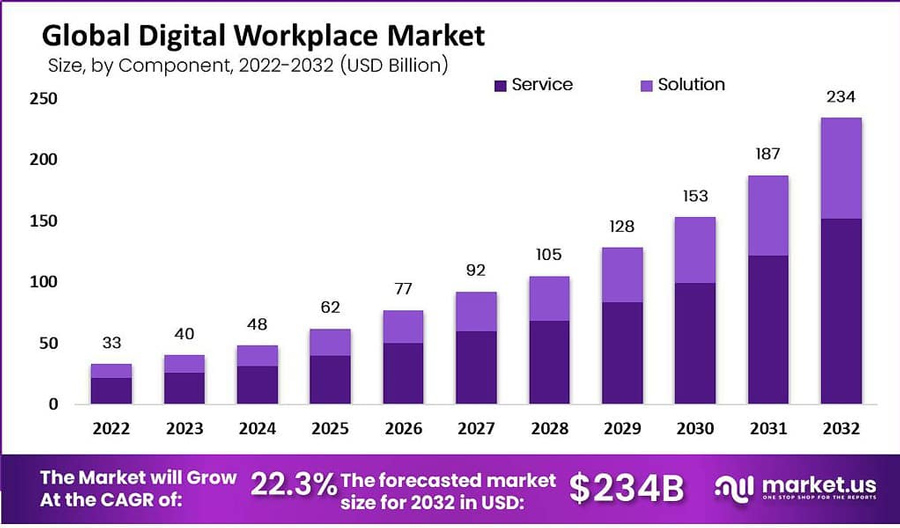
The Global Digital Workplace Market is projected to grow rapidly from USD 33 billion in 2022 to USD 234 billion by 2032. - CAGR (Compound Annual Growth Rate):
The market is expected to expand at a CAGR of 22.3% during the forecast period (2022–2032). - Component Growth Insight:
- Both the Service and Solution segments are expected to grow consistently.
- By 2032, Solutions take a slightly higher share compared to Services, indicating rising adoption of integrated digital workplace platforms.
- Key Takeaway:
The digital workplace ecosystem is becoming essential for modern organizations, with robust investments in both software solutions and support services driving the growth. - Forecasted Market Value:
The total market size is expected to reach USD 234 billion by 2032, reflecting the transformative shift towards digital collaboration tools, cloud-based platforms, and remote work enablement.
Key Adoption Rates of Digital Technologies in the Workplace
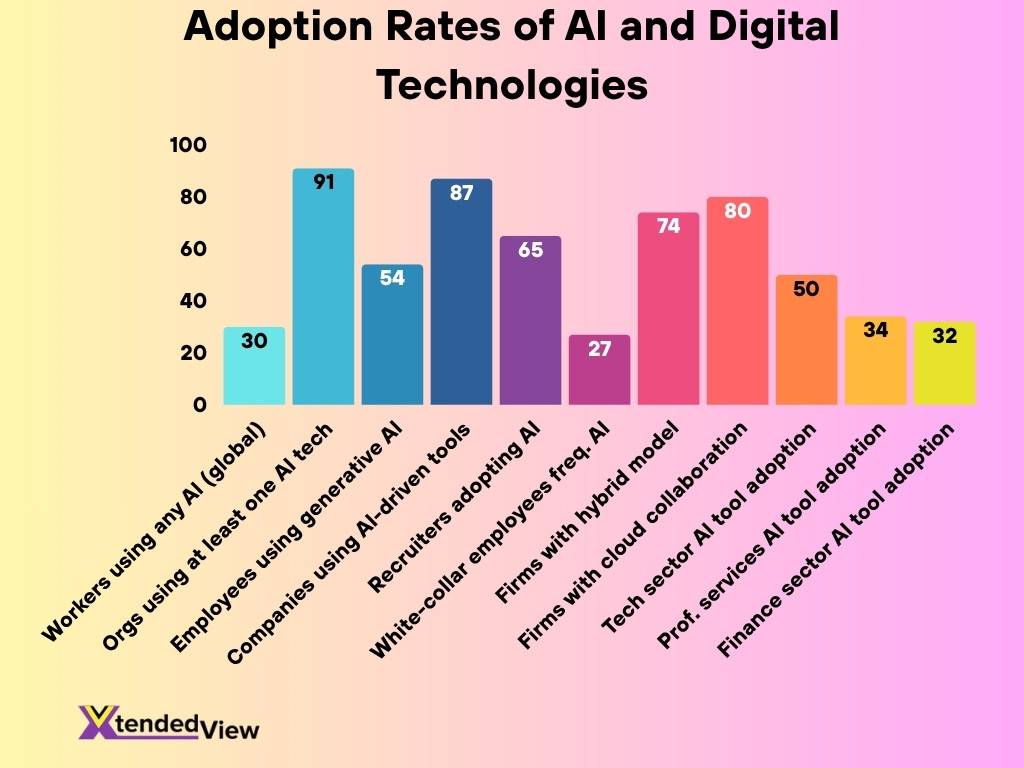
- Between 20% and 40% of workers globally report using some form of AI at work, per survey data.
- About 91% of employees in 2025 say their organisations use at least one AI technology, 54% say they specifically use generative AI.
- In recruitment, 87% of companies now use AI‑driven tools, and more than 65% of recruiters have adopted AI to streamline processes.
- One survey shows 27% of white‑collar employees report frequent AI use, up 12 points from 2024.
- A report shows that 74% of firms adopt hybrid work models, and 80% invest in cloud collaboration platforms.
- An adoption study found that the technology sector had 50% adoption, professional services 34%, and finance 32% adoption of AI tools.
- In managed service offerings, the market size of services related to the digital workplace is forecast at $56.18 billion in 2025, indicating wide adoption of outsourced digital workplace models.
- Among large enterprises, deployment of solutions such as VDI (virtual desktop infrastructure) and BYOD (bring your own device) policies is driving growth, though specific adoption rates vary by region.
Commonly Adopted AI Use Cases in the Digital Workplace
- AI use in the workplace has nearly doubled in two years, according to the Anthropic Economic Index 2025 report.
- Data show that 57% of employees admit to not checking for accuracy in AI‑produced output.
- In email drafting, 35% of workers specifically want AI assistance, 33% want help with meeting‑note summarisation.
- One study found that UK administrative workers using AI could save about 122 hours/year, equating to roughly £400 billion in savings.
- In recruitment, AI is reducing hiring costs by up to 30% per hire.
- One report notes that wages in AI‑exposed industries are growing twice as fast as in non‑AI sectors.
- The Federal Reserve note pointed out variation, adoption in some occupations is significantly higher (e.g., programming roles) than the 20‑40% worker average.
- According to research by McKinsey & Company, the long‑term AI opportunity across corporate use cases is valued at about $4.4 trillion in added productivity.
Top Digital Transformation Initiatives in Organizations
- Around 74% of organizations say digital transformation is a top priority in 2025.
- Only 35% of digital transformation initiatives achieve their intended objectives.
- The global digital transformation market is expected to grow to about $3.29 trillion by the end of the decade.
- 56% of CEOs report seeing increased profits from their digital investments.
- In many firms, 51% of digital transformation efforts stem from growth opportunities rather than cost‑cutting.
- By 2025, 58% of companies with high digital maturity will provide digitally connected products, compared with 17% of lower maturity firms.
- More than 38% of executives plan to invest more in technology in the next year to gain a market edge.
- In 2025, many initiatives focus on AI‑ready employees, improved data governance, and better training rather than pure moonshot technology.
- About 72% of organisations expect to have fewer in‑person meetings as part of their digital transformation strategy.
- Nearly 82% of managers expect more flexible and home working as part of transformation outcomes.
Digital Workplace Spending and Investment Trends
- Global spending on digital transformation technologies and services is expected to reach $2.92 trillion in 2025, rising further to about $3.4 trillion in 2026.
- The broader digital workplace market is projected to grow at a CAGR of 22.3% and reach around $62.0 billion in 2025 from lower base figures.
- For 2024, the digital workplace market size was estimated at $48.8 billion, with forecasts pointing to $166.27 billion by 2030 (CAGR 22.8%).
- In 2025, 92% of executives surveyed expect to increase AI spending in the next three years, and 55% expect at least a 10% increase in that investment.
- The North America region held more than 37% of the market share in 2024 for digital workplace solutions.
- Solutions (software, platforms) comprised over 66% of revenue share in 2024 in the digital workplace market, with services making the rest.
- Large enterprises accounted for more than 59% of the revenue share in 2024 in this market.
- About 7.5% of organisational revenue is being allocated, on average, to digital transformation efforts.
Global Digital Workplace Market Share by Sector
- In the digital workplace market, the IT & telecommunications end‑use vertical held the largest share, at over 22% in 2024.
- The digital workplace market in 2024 was valued at $49.17 billion and expected to grow to $58.93 billion in 2025 (CAGR 19.8%).
- By organisation size in 2024, large enterprises held >59% revenue share, while small & medium enterprises comprised the remainder.
- Regionally, North America dominated in 2024, and Asia‑Pacific is the fastest‑growing region according to forecasts.
- By component type in 2024, the solutions segment held >66% of revenue share, and services accounted for the rest.
- In a breakdown of deployment types, cloud‑based digital workplace models are gaining share over on‑premise models.
- Organisations utilising comprehensive digital workplace strategies report 43% higher employee engagement and 31% faster decision‑making processes.
- A digital workplace market estimate projects growth from $47.19 billion in 2025 to $233.4 billion by 2033 (CAGR 22.1%).
Benefits of Adopting a Digital Workplace Model
- Organisations that adopt a full digital workplace model report up to 43% higher employee engagement.
- With digital workplace tools, decision‑making processes can be 31% faster on average.
- A shift to remote/hybrid enabled by digital tools is linked to industry‑level productivity growth; a 1 percentage‑point increase in remote‑capable workers corresponded to a 0.05 percentage point increase in total factor productivity.
- Firms aligning digital workplace strategies with employee experience (DEX) see better retention and fewer unscheduled absences.
- Digital workplace adoption enables broader talent pools, resulting in improved access to diverse employees.
- Cost savings are enabled by reduced real‑estate footprint; for example, remote/hybrid arrangements correlate with decreases in unit office building cost growth.
- Digital workplace models support faster collaboration, enabled by cloud collaboration platforms and mobile applications.
- Improved employee experience and well‑being, in hybrid or flexible digital workplace environments, up to 67% of workers report reduced anxiety, depression, or improved mental health.
Digital Workplace Trends and Innovations
- Adoption of cloud‑based collaboration platforms is at 91% among organisations using digital workplace strategies.
- Use of AI‑powered productivity tools is at 73% in digital workplace initiatives.
- Mobile‑first workplace applications are used by 67% of organisations with digital workplace strategies.
- Use of IoT workplace sensors in digital workplaces stands at a 42% adoption rate.
- Digital workplace analytics capability is adopted by 58% of organisations.
- The use of augmented reality (AR) tools in the workplace is at 28%, while virtual reality (VR) training platforms are adopted by 34% of organisations.
- The integration of next‑generation collaboration tools, video, asynchronous workstreams, and intelligent assistants is a major trend noted in top‑tech outlooks for 2025.
- The shift to cloud‑first digital workplace architecture is increasingly prevalent as firms prioritise scalability, flexibility, and remote capability.
Impact of Hybrid and Remote Work Models
- In the U.S., as of early 2025, about 66% of employers reported that hybrid work had positively impacted employee productivity, 65% said it had benefited employee well‑being.
- According to a global survey, 46% of the workweek for hybrid employees is spent in the office, about 2.3 days, up from 42% in 2022.
- Remote/hybrid job postings in the U.S. increased from 15% in Q2 2023 to 24% in Q2 2025.
- Globally, in 2025, approximately 32.6 million Americans (≈22% of the workforce) work remotely at least part‑time.
- A survey showed 83% of workers globally say hybrid arrangements represent the ideal work model, a balance of flexibility and collaboration.
- Hybrid models are now mainstream; in 2025, about 60% of business leaders say their company operates a hybrid model, with 27% in‑office and 13% fully remote.
- Employees working fully remotely report higher engagement, 31%, than hybrid, 23%, and on‑site non‑remote, 19%, but also higher stress, 45% reported experiencing a lot of stress the prior day.
- Remote‑capable work and hybrid arrangements create real estate savings, a 1 pp increase in remote workers associated with a 0.4 pp decrease in unit office building cost growth.
Employee Experience and Well‑being in Digital Workplaces
- Global employee engagement fell to approximately 21% in 2024, showing that many workers feel disconnected.
- About 83% of workers say work‑life balance is now a top priority when choosing a job.
- 73% of workers report higher productivity under hybrid work models, with a lift of 7.6 hours a week.
- Only 57% of employees globally say they have good overall health across mental, physical, social, and other dimensions.
- A 2025 survey found 71% of employees prefer mental health benefits (such as counselling or mindfulness apps) over traditional perks like snacks or gym memberships.
- Organisations that prioritise digital employee experience (DEX) see 87% reporting productivity gains, 85% reporting higher satisfaction, and 77% reporting improved retention.
- Inclusive workplaces boost employee satisfaction by about 32% and overall wellness by about 43%.
- In hybrid settings, 31% of fully remote workers are engaged, the highest among work‑location groups, though they also report higher stress levels.
- Roughly half of U.S. employees in 2024 were either actively seeking or watching for a job change, and 42% of voluntary departures were deemed preventable by employers.
- Digital tools can affect well‑being negatively: about 41% of workers report stress or anxiety from notification overload and platform switching.
Digital Workplace Tools and Solutions Overview
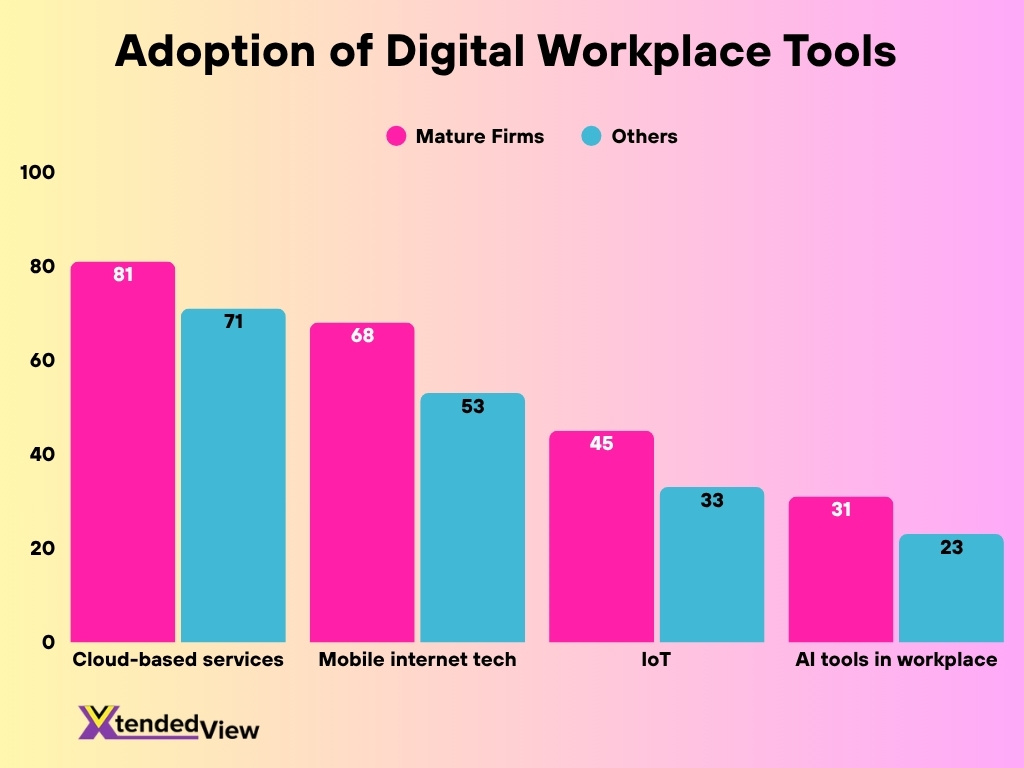
- In organisations with successful transformation programs, 81% use cloud‑based services, compared with 71% in less mature firms.
- Mobile internet technologies are used by around 68% of successful transformation companies and 53% of others.
- The Internet of Things (IoT) enjoys adoption rates of about 45% in successful transformation companies versus 33% among others.
- Artificial intelligence tools in the digital workplace are adopted by 31% of companies vs. 23% in lower maturity firms.
- A large number of employees—75%—acknowledge their organisation’s remote‑work tools need upgrades.
- More than 90% of employees would consider leaving their jobs if flexibility or remote work options were removed.
- By 2025, it is estimated that 50% of knowledge workers will be using virtual assistants or smart digital tools in their daily workflows.
- Unified Communications as a Service (UCaaS) is growing rapidly: 75% of companies aim to reduce the number of applications in their workflow for better efficiency.
- Digital workplace platforms increasingly integrate AI‑enabled workplace solutions to support hybrid work, collaboration, and endpoint management.
- Self‑service portals and consolidated tool stacks are being widely deployed to streamline HR, IT, and workplace support functions.
Cloud‑First and Cloud‑Based Digital Workplaces
- More than 85% of organizations are predicted to have a cloud‑first strategy by 2025.
- Approximately 95% of new digital workloads are expected to run on cloud‑native platforms by 2025.
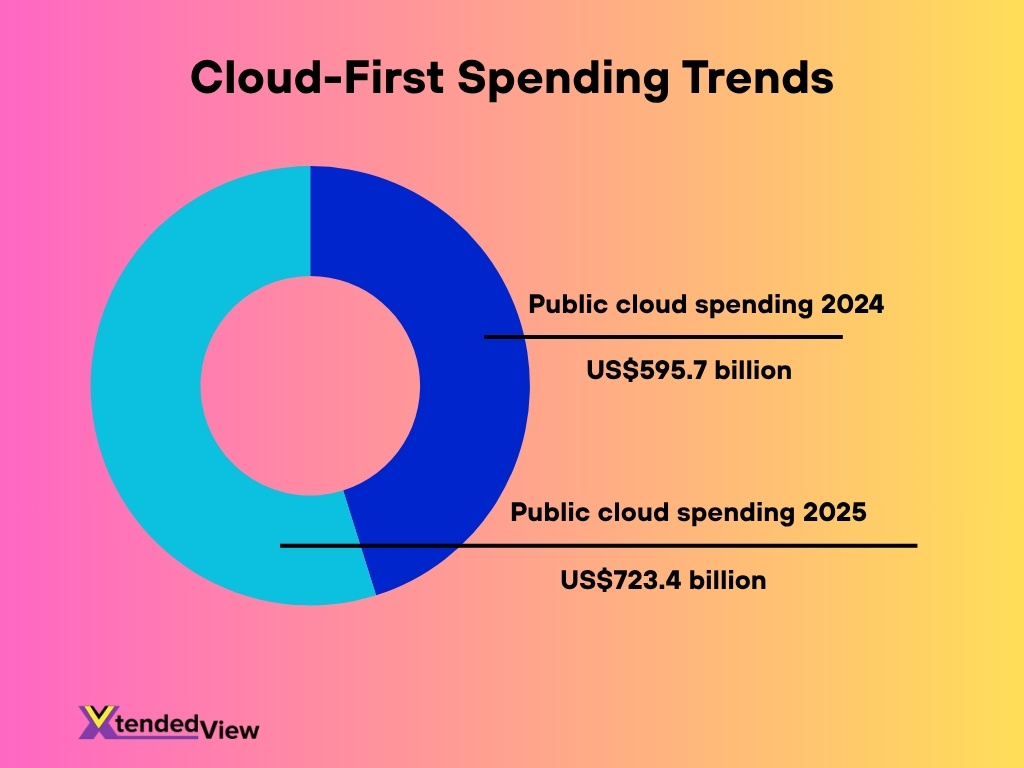
- Global public‑cloud spending is forecast to rise from about $595.7 billion in 2024 to $723.4 billion in 2025.
- Roughly 94% of enterprises worldwide already use cloud services of some kind.
- Around 89% of organizations use multiple public clouds, and 73% combine public and private, indicating hybrid cloud is dominant.
- In a survey of IT decision‑makers, 87% agreed that the pandemic accelerated migration to the cloud.
- Cloud‑based digital workplace architectures, compared to on‑premises, offer greater flexibility for hybrid/remote work, leading to faster collaboration and scaling.
- Among organisations adopting digital workplace models, 91% reported using cloud‑based collaboration platforms.
- Private and sovereign cloud usage is gaining traction; in one survey, 83% of CIOs planned to repatriate some workloads to private cloud for security/compliance reasons.
- Firms with mature cloud‑first workplaces report higher employee digital satisfaction scores, though specific percentages vary by industry.
Cybersecurity and Privacy in the Digital Workplace
- Cybersecurity is rated a high priority by 81% of organisations in 2025.
- About 68% of organizations say they have high cybersecurity capability.
- Global cybercrime losses are projected at up to $10.5 trillion by 2025.
- Phishing and ransomware attacks rose sharply; one study reported that ransomware payouts doubled in Q2 2025 compared to Q1.
- For organisations undergoing digital workplace transformation, data breaches correlate strongly with the speed of transformation and legacy system reliance.
- In hybrid and remote work environments, device security and endpoint management have become critical; failure to secure endpoints is cited as a major vulnerability.
- Workforce identity risk is increasing; machine identities now outnumber human ones in many enterprises, creating new governance gaps. 47% reduction in incidents reported by firms using modern unified identity frameworks.
- Smaller companies face disproportionate risk due to limited resources, while larger enterprises focus more on data governance and privacy issues.
- Compliance and privacy demands are driving the adoption of zero‑trust and continuous verification architectures in digital workplaces.
- Despite high prioritisation, many organisations admit to a lack of metrics and a lack of threat understanding as key barriers to cybersecurity improvements.
Challenges Facing Digital Workplaces
- Around 67% of employees say they never use AI tools, despite organisational investments.
- Remote/hybrid work models are causing communication overload; 41% of workers report stress or anxiety from excessive notifications and platform switching.
- Many digital workplace initiatives fail; research suggests that 70% of digital transformations do not meet expected outcomes.
- Skills and leadership gaps persist; only 1% of companies consider themselves fully mature in AI deployment.
- The ROI of digital workplace investments is still unclear for many; only 19% of IT budgets are dedicated to innovation vs. maintenance.
- Digital fatigue is rising, and knowledge workers show heightened stress and anxiety related to digital tool overload.
- Hybrid models bring culture and engagement issues; maintaining team cohesion and company identity remains a major challenge.
- Legacy systems and technical debt slow down digital workplace deployments and increase the cost of change.
- Data governance and privacy compliance are major obstacles, particularly in regulated sectors such as healthcare and finance.
- While many organisations claim digital workplace is a priority, 83% do, but a majority report they are still in early stages of maturity.
Best Practices for Digital Workplace Adoption
- Secure executive sponsorship and align digital workplace strategy with business strategy; companies with engaged leadership report better outcomes.
- Implement a cloud‑first architecture, enabling remote/hybrid work, greater flexibility, and scalability.
- Prioritise employee experience (DEX), measure tech satisfaction, eNPS for IT services, and reduce friction in workflows.
- Use change management to support adoption, including training, culture programs, and feedback loops to mitigate resistance.
- Adopt zero‑trust security frameworks, continuous identity verification, and endpoint management, given the rising cyber risk.
- Define and track clear KPIs, e.g., workflow completion time, tool adoption rate, and self‑service support usage.
- Use cross‑functional teams (HR, IT, security) to coordinate digital workplace roll‑out and ensure aligned goals.
- Prioritise hybrid/remote readiness, optimise collaboration platforms, mobile tools, and digital workflows.
- Establish continuous improvement through analytics, track usage, employee feedback, productivity metrics, and iterate.
- Maintain a governance framework that balances innovation speed with control, compliance, and employee trust.
Measurement and KPIs for Digital Workplace Success
- Workflow productivity, time taken to complete a business‑critical workflow, is a core KPI.
- Employee Net Promoter Score (eNPS) for IT/technology services, a popular metric for DEX.
- Tool adoption rate and active usage, tracking how many employees actively use the digital workplace platforms.
- Self‑service capability, the percentage of IT requests handled via self‑service portals instead of manual support.
- Employee satisfaction with digital tools, measured via surveys or usage feedback, is often tied to retention.
- Incident resolution time and support costs, shorter resolution, and lower cost signal a mature digital workplace support.
- Productivity gains, measured as % improvement in output or decision‑making speed after digital workplace implementation.
- Security metrics, number of security incidents, mean time to detect/respond, and endpoint vulnerabilities under control.
- Remote/hybrid work enablement, % of workforce using flexible work, % of workloads cloud‑based.
- Return on investment (ROI), the ratio of business value gained to the cost of digital workplace investment, is often lacking in many firms.
Future Outlook for Digital Workplaces
- The global digital workplace market is forecast to reach approximately $166.27 billion by 2030, growing at a 22.8 % CAGR from 2025.
- By 2025 and beyond, AI, automation, and cloud‑native architectures will be integral to the digital workplace rather than optional add‑ons.
- Employee experience and well‑being will become central; models that ignore culture or wellness risk falling behind.
- Hybrid and remote work will remain dominant, shifting focus from “how to work remotely” to “how to optimally work digitally”.
- Cybersecurity and privacy concerns will push organisations to invest more in governance, identity, and resilience.
- Digital workplace maturity will separate leaders from laggards. Companies that measure, iterate, and invest in people will outperform.
- The boundary between physical office and digital workspace will continue to blur; the future “office” may be defined by platform, not location.
Frequently Asked Questions (FAQs)
The global digital workplace market is expected to reach about $59.18 billion in 2025.
The digital workplace market is expected to grow at a CAGR of approximately 22.8% from 2025 to 2030.
Around 91% of organisations report using cloud‑based collaboration platforms as part of their digital workplace transformation.
According to IT professionals, 87% believe that a strong DEX positively affects employee productivity.
In early 2025, approximately 22% of the U.S. workforce — about 32.6 million Americans — worked remotely at least part‑time.
Conclusion
The shift toward the digital workplace is no longer optional; it has become a strategic imperative. Cloud‑first architectures, hybrid work models, and robust cybersecurity frameworks are now table stakes. At the same time, real challenges persist, such as measuring success, managing culture, and aligning technology with human needs. Organisations that put people, process, and metrics at the heart of implementation, rather than just tools, will stand apart.
