


Digital banking has moved from a convenient choice to a foundational channel for financial services. In the U.S. and globally, banks and fintechs are increasingly relying on digital platforms to deliver account access, payments, and lending. For example, a mobile‑first bank uses app‑based onboarding and real‑time analytics to reduce costs and improve customer satisfaction. In another scenario, a regional bank leverages online banking dashboards to support small‑business clients remotely, which significantly expands reach. Explore the full article to understand the latest statistics shaping this transformation.
Editor’s Choice
Here are seven standout figures that highlight the pulse of digital banking in 2025:
- 216.8 million: Projected number of digital banking users in the U.S. by 2025.
- 86%: Share of the U.S. population (231.9 million people) forecast to be digital banking users in 2025.
- 77%: Percentage of consumers who report that digital banking is their preferred method of managing accounts.
- CAGR ~ 16.4%: Growth rate expected for the global digital banking platforms market between 2024 and 2029.
- USD 9.98 trillion: Estimated size of the global e‑banking market in 2025.
- 59%: Australia’s (or actually India’s!) digital banking maturity index in 2025 for the growth‑market segment, up from 43%.
- 55%: Percentage of U.S. consumers using mobile apps as their top channel for banking in 2024.
Recent Developments
- In a 2025 survey, 96% of U.S. banks reported investing in online banking platforms.
- 95% of banks indicated they will boost mobile‑banking capabilities in 2025.
- Global banking executives (300 from 220 institutions) gathered in 2025 to discuss agentic AI in digital banking.
- The adoption of digital channels accelerated further due to remote‑first habits established in the pandemic and reinforced into 2025.
- Collaborations between banks and fintechs have increased as banks seek to deliver seamless digital experiences.
- Regulatory focus on digital services intensified, with institutions adapting to new frameworks for open banking and embedded finance.
- Several major branches and physical networks continued shrinking as banks push digital‑first strategies.
- Analytics and real‑time data‑driven personalization became central to differentiating services.
Key Digital Banking Statistics
- 216.8 million U.S. digital banking users projected for 2025 (up from 196.8 million in 2021).
- 73% of U.S. adults (2025) actively use online banking services.
- 55% of U.S. bank customers ranked mobile‑app banking as their primary channel in 2024.
- Globally, more than 3.6 billion people were expected to use online banking by 2024.
- In the U.S., 86% of the population (231.9 million people) is forecast to be digital banking users by 2025.
- Digital banking is the top choice for 77% of users, and mobile banking is 2.5 times more popular than online browser banking.
- Among U.S. consumers, 17% are likely to change financial institutions in 2025.
- 42% of Americans now use a non‑traditional digital banking provider (e.g., fintech) according to a 2025 consumer survey.
- In the U.S., 83% still have accounts with traditional banks, showing digital adoption coexisting with legacy institutions.
- The digital banking platforms market is growing at a ~16.4% CAGR from 2024 to 2029.
Global Digital Banking Market Size & Growth
- The global digital‑banking market is projected to reach USD 20.43 billion by 2025 from about USD 13.96 billion in 2021, representing a CAGR of ~9.98%.
- The global e‑banking market is estimated at USD 9.98 trillion in 2025, on track to reach USD 15.59 trillion by 2034, growing at ~5.08% CAGR.
- The digital banking platforms segment will grow by USD 27.8 billion between 2025 and 2029 globally.
- North America is expected to hold about 37.7% of the global digital banking market share in 2025, with the U.S. contributing ~74.8% of North America’s market.
- The Asia Pacific region is projected to grow fastest, with APAC market sales reaching ~USD 4.678 billion by 2025 from ~USD 3.03 billion in 2021 (64.8% growth).
- The digital banking platform market size will go from USD 7.33 billion in 2024 to approximately USD 8.42 billion in 2025, marking about a 15% year‑on‑year increase.
- The market for digital banking platforms is forecast to nearly double by 2033, reaching ~USD 14.69 billion from USD 8.42 billion in 2025 (CAGR ~14.9%).
Digital Banking Usage Demographics
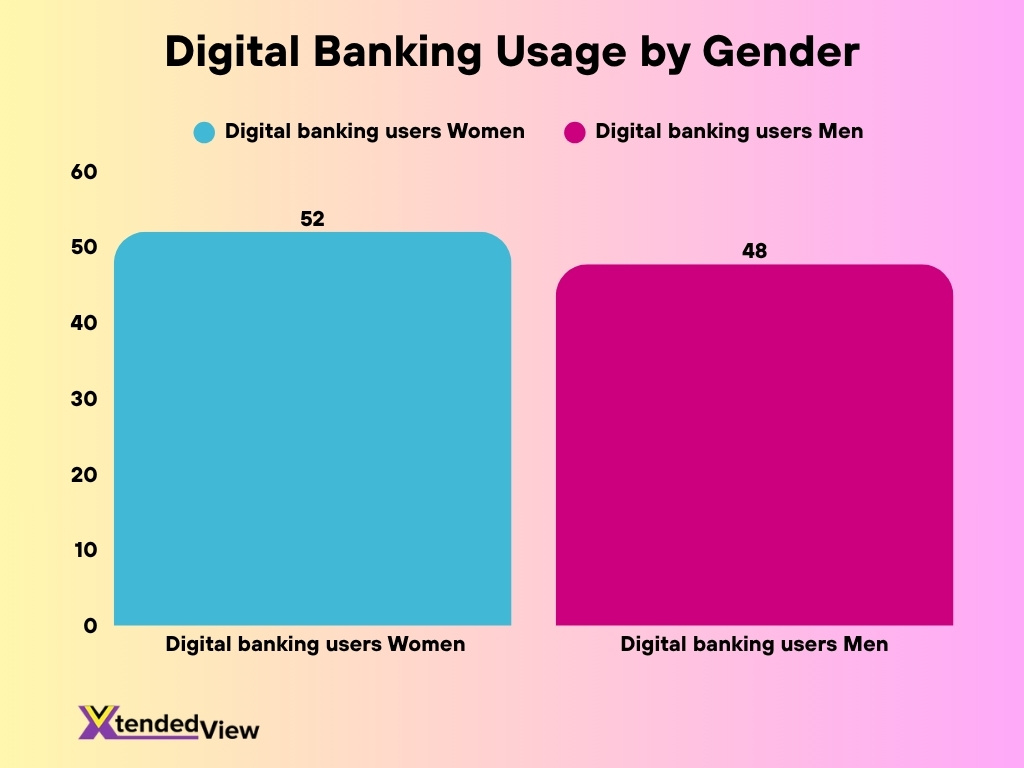
- In the U.S., 52.3% of women will be digital banking users in 2025, compared with 47.7% of men.
- Countries with younger populations exhibit higher digital‐banking adoption.
- In India, the digital‑banking maturity index rose from 43% to 59%, a 16‑point increase, surpassing the global average by 20 points.
- Millennials show the greatest usage of specialised accounts (22%), such as crypto‑linked or health‑savings accounts.
- In the U.S., younger users (e.g., Gen Z, Millennials) are increasingly choosing mobile‑first over branch visits.
- The global “digital divide” remains; older users and lower‑income groups still trail in digital banking adoption.
- The U.S. trend shows 55% of consumers using mobile apps as top channels, emphasising mobile usage over PC.
Online Banking Statistics
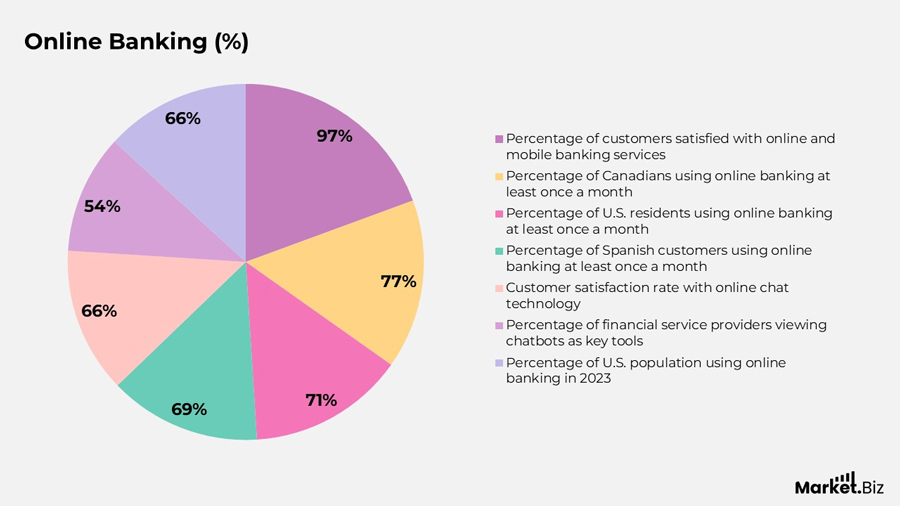
- 97% of customers are satisfied with their online and mobile banking services, showing strong user confidence in digital financial platforms.
- 77% of Canadians use online banking at least once a month, reflecting a high rate of digital banking adoption.
- 71% of U.S. residents engage in online banking monthly, underlining its integration into everyday financial habits.
- 69% of Spanish customers also use online banking at least once a month, indicating solid engagement across Europe.
- 64% is the customer satisfaction rate in Spain, which, while positive, suggests potential areas for service improvement.
- 66% of financial service providers view chatbots as key tools in enhancing online banking experiences, emphasizing the growing role of AI in customer service.
Mobile Banking Statistics
- As of 2025, 72% of U.S. adults report using mobile banking apps, up from 65% in 2022 and 52% in 2019.
- Globally, about 2.17 billion people used mobile banking services by the end of 2025, a ~35% increase since 2020.
- In the U.S., 55% of bank customers ranked mobile‑app use as their top channel for managing their accounts in 2024.
- A survey found that 34% of consumers use a mobile banking app daily in 2025.
- Among millennials in the U.S., 68% now primarily use mobile banking apps in 2025.
- Overall satisfaction with U.S. national banking apps rose, score of 669/1,000 in 2025, up 18 points from 2024.
- Globally, mobile banking penetration in Europe hit 76% in 2025, with Scandinavian countries exceeding 87% usage.
- U.S. mobile banking app downloads increased by 22% in 2025, driven by demand for instant payments, budgeting tools, and investment features.
- Around 48% of consumers demand higher levels of security in mobile banking in 2025.
- Global mobile banking transaction volume in Asia‑Pacific grew by 34% in 2025, driven by e‑commerce and real‑time settlement platforms.
Traditional Banking vs. Digital Banking
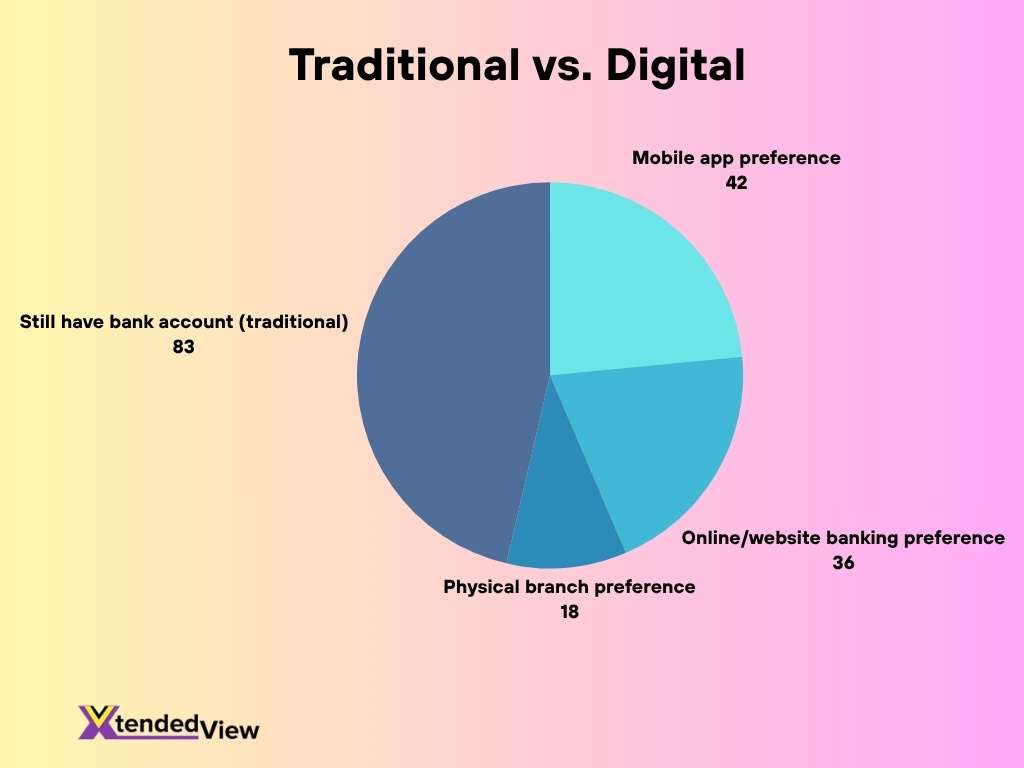
- In 2025, 42% of U.S. consumers prefer using a mobile app to manage finances, versus 36% preferring online banking via a website.
- Only 18% of consumers still favour visiting a branch in person as their primary banking method.
- Since 2018, the U.S. has closed an average of 1,646 bank branches per year, highlighting the shift toward digital channels.
- According to Bankrate in 2025, 77% of consumers prefer to manage their bank accounts through a mobile app or computer.
- In the U.S., 83% of adults still have an account with a traditional bank, showing digital adoption co‑exists with legacy institutions.
- A 2024 survey found 55% of U.S. consumers use mobile apps as their top banking channel, while only 22% use online banking via PC as their primary method.
- Digital banking transactions rose by 21.5% year‑over‑year (YoY) in 2025, underscoring strong shift away from traditional processes.
- Among U.S. Gen Z and Millennials, 58% and 57% respectively are likely to switch financial institutions if newer digital capabilities are better.
- In 2025, 66% of consumers indicated banks could do more to anticipate their financial needs, an advantage for digital‑first banks.
Digital Banking Revenue & Profitability Metrics
- Worldwide, digital banks are projected to generate net interest income of USD 1.61 trillion in 2025, with a forecast CAGR of ~6.8% to 2029.
- Banks that build high customer‑advocacy scores in digital delivery saw revenue growth 2.6× faster in North America in 2025.
- Digital transformation efforts in banking can reduce operating costs by 20% to 40%, according to industry reports.
- A digital onboarding timeframe of under 5 minutes is now a performance benchmark for profitability in neobanks.
- The global digital banking market reached about USD 20.7 billion in 2025 (platforms and services), with a projected CAGR of ~13.2% through 2028.
- In the U.S., nearly 17% of consumers said they were likely to change financial institutions in 2025, putting pressure on banks to improve profitability via retention.
- U.S. citizen consumer survey indicates 89% of bank‑account holders say they are satisfied with their primary bank, which supports retention and margin stability.
Consumer Preferences in Digital Banking
- 84% of digital banking consumers say the quality of the digital experience is very important when choosing a provider.
- 77% of Americans processed banking transactions on smartphones, tablets, or computers in 2025.
- 55% of U.S. consumers use mobile banking apps as their go‑to channel for banking in 2024.
- Younger consumers, 80% of millennials, prefer digital banking as their primary method.
- 59% of consumers say they want digital banking services to include financial literacy tools and educational resources.
- Among active digital banking users, 50% are willing to switch providers for a better digital experience, 31% already have in 2025.
- For many U.S. consumers, 42% prefer mobile apps, while 36% prefer website banking, showing a digital channel hierarchy.
- 66% of consumers feel their institution could anticipate their financial needs more effectively, emphasising expectations for personalised digital services.
Benefits of Digital Banking
- 24/7 account access is cited as the top benefit by 81% of digital banking users in 2025.
- Digital banking reduces transaction costs by up to 80% compared to traditional methods.
- Real-time alerts and notifications help 67% of users track activity and prevent fraud.
- Instant fund transfers between accounts or external recipients are a key driver of satisfaction for 69% of users.
- Paperless statements and e-documents improve convenience and reduce environmental impact, preferred by 58% of users.
- Personalized financial insights powered by AI help 48% of users make better spending and saving decisions.
- Digital banking reduces the need for in‑person visits, saving consumers an average of 2 hours per month.
- Integrated budgeting and goal-setting tools are used by 43% of mobile and online users, improving financial literacy.
- Users report fewer errors and higher transparency with digital platforms due to access to transaction histories and audit trails.
- For banks, digital transformation delivers 20%–30% efficiency gains, allowing reinvestment into customer-facing improvements.
Challenges and Concerns in Digital Banking
- 60% of financial institutions and fintechs reported an increase in fraud in 2025.
- In India during FY 2024, fraud value rose to ₹36,014 crore (~US$ 4.4 billion) from ~₹12,230 crore in FY 2023, roughly triple year‑on‑year.
- Globally, 72% of respondents say cyber risks, including fraud and social engineering, have increased over the past year.
- “1 in 20 verification attempts” (≈ 5%) in digital banking are now fake or manipulated (e.g., deepfakes) in 2025.
- In the U.S., 34% of bank customers use a mobile banking app daily, implying real‑time risk exposure via mobile channels.
- Fraud rings and organised crime account for the majority of fraud attempts at many banks.
- Card‑not‑present (CNP) data breaches remain dominant; in 2024, 269 million card records were posted on dark or clear web platforms.
- A survey found 48% of consumers demand higher security for mobile banking in 2025, underlining heightened expectations.
- While digital channels scale fast, the average application abandonment rate doubled to 67% for some banks in 2025, showing process and UX risk.
AI in Digital Banking
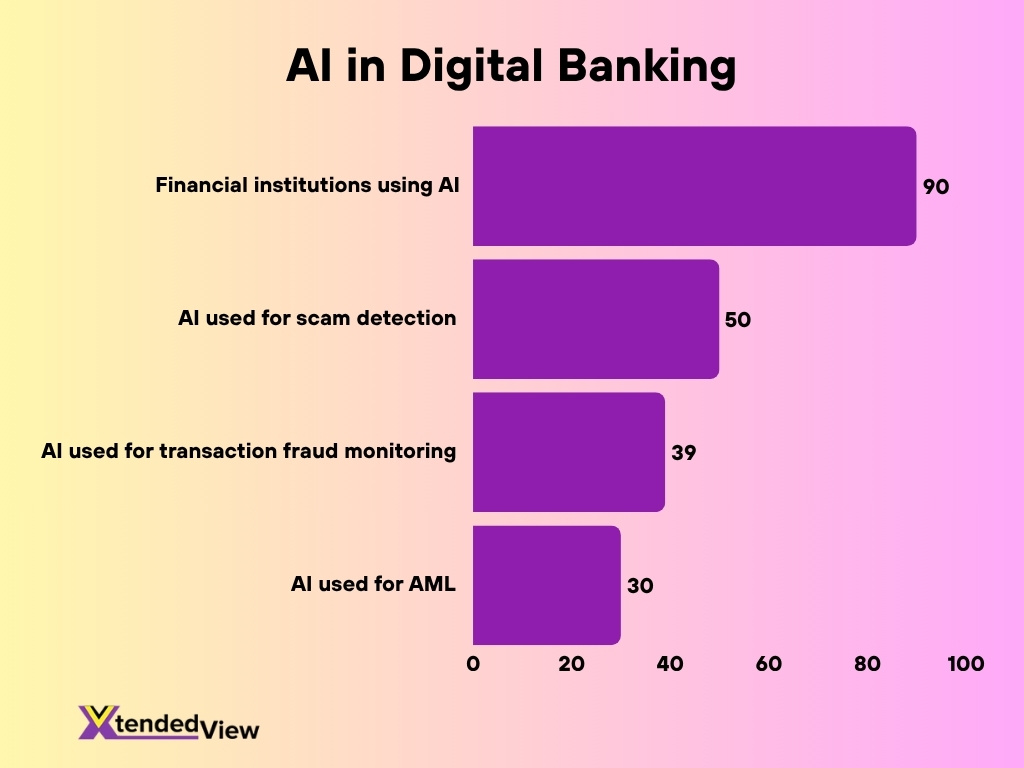
- 90% of financial institutions reported using AI for fraud investigations, scam detection, or real‑time monitoring in 2025.
- Within that group, AI was deployed for scam detection (50%), transaction fraud monitoring (39%), and anti‑money‑laundering (AML) (30%).
- Banks using advanced AI and automation report operational cost reductions of 20% to 40% in digital banking transformation.
- More than 64% of mobile banking app users in the U.S. now use biometric login (fingerprint, face, voice) in 2025.
- About 46% of U.S. banks report improved customer experience thanks to AI deployment in 2025.
- Embedded finance and open‑banking models rely heavily on AI for data analytics. The embedded finance market is projected to reach US$7.2 trillion by 2030.
- AI‑powered deepfake voice or video fraud is cited among the top threats for 2025, forcing banks to adopt stronger verification.
- Smaller banks and fintechs deploying AI report a 70% higher likelihood of retaining customers who feel “digitally satisfied”.
- AI‑driven onboarding, digital account opens rose 31% YoY in 2025; however, only 20% of checking accounts originate fully online.
Digital Banking Security and Fraud
- In India, digital payment and loan‑related frauds tripled in FY2025, according to the Reserve Bank of India data.
- In 2024, a global survey found 269 million card records and 1.9 million U.S. bank checks traded on dark web platforms.
- 48% of U.S. consumers expect stricter mobile‑banking security in 2025.
- Phishing remains rampant; 3.4 billion spam or phishing emails are sent daily, and email remains the primary vector.
- About 5% of verification attempts are malicious in digital banking onboarding in 2025.
- Instant‑payments fraud is a rising risk, as new rails are adopted, fraudsters shift focus accordingly.
- Organisations report more than US$1 million direct fraud losses in ~30% of cases in 2025.
- Weak link, user authentication and social engineering remain top causes of fraud in digital channels.
- Despite hardening defences, account takeover (ATO) attacks continue to surge through credential stuffing and mobile wallets.
Rise of Online‑Only Banks
- In the U.S., 42% of those aged 18‑24 say they’re very likely or somewhat likely to use an online‑only bank as their primary account in 2025.
- Nearly 18% of U.S. consumers used online‑only banks in the past year.
- Over 2 in 5 Americans now use a non‑traditional digital banking provider (fintech or neobank) in 2025.
- Digital banks operating solely on apps or platforms have lower overhead and claim cost savings, which allows competitive pricing and higher customer growth.
- Younger demographics show the strongest intent, over 50% of Millennials and Gen Z would change their financial institution for better digital capabilities.
- Online‑only banks’ growth is part of a shift in banking; overall, traditional branch use continues to decline.
- Digital bank adoption remains higher in urban, tech‑savvy regions versus rural areas, creating divergence in service levels.
- Customer satisfaction for digital‑only banks averages higher than traditional banks in digital experience metrics.
- The margin pressure on traditional banks from neobanks is accelerating; fintech revenue rose 21% YoY in 2025.
Role of Physical Bank Branches
- 64% of banks expect to decrease their branch networks (by less than 25%) in 2025.
- Digital‑transformation data show the number of U.S. physical bank branches has declined by about 4.11% in 2025.
- Industry reports forecast that 56% of U.S. banks expect to reduce branch footprints by 2030.
- Only 18% of U.S. consumers prefer visiting a branch as their primary banking method in 2025.
- Bank executives cite mobile and online banking adoption as the primary factors driving branch closure decisions.
- For complex services (e.g., mortgages, wealth advice), branches still rate higher in trust and service quality.
- Branch closures raise concerns about financial inclusion in rural and underserved urban areas.
- Some banks repurpose branches into “digital experience centres” rather than full-service outlets, blending remote and physical channels.
- The fact that 39% of U.S. adults rely exclusively on mobile banking supports the shift.
Regulatory & Compliance Influences on Digital Banking
- Regulatory complexity remains high, and banks cite regulatory divergence and operational impact as major concerns entering 2025.
- Expanded scope, regulations now cover digital assets, open banking data sharing, and embedded finance horizontally.
- Compliance teams are under pressure, with increased data‑sharing requirements, privacy mandates, and third‑party risk assessments.
- Failure to comply with AML or CTF frameworks is increasingly costly, and fines and reputational risk remain significant.
- Digital banks face specific rules around onboarding, KYC, and fraud prevention, often stricter than legacy banks.
- API‑driven “Banking as a Service” (BaaS) models raise questions around which entity (bank or fintech) holds liability in a shared ecosystem.
- Regulatory bodies are starting to treat non‑bank financial‑service providers more like traditional banks, elevating compliance burdens.
- Institutions report increasing investment in compliance tech and staffing, diverting spend from growth initiatives.
- Regulatory expectations on cyber‑resilience, incident‑reporting, and vendor risk have increased in 2025 under global guidance.
Emerging Technologies Shaping Digital Banking (AI, Embedded Finance, Open Banking)
- The global embedded‑finance market is projected to reach US$7.2 trillion by 2030, with rapid acceleration from 2025.
- Banking IT spending worldwide is expected to reach US$761 billion by 2025, emphasising tech investment.
- “Open banking” and APIs enable banks and fintechs to integrate services, and adoption rates are rising sharply in 2025.
- AI‑driven features such as personalised finance, chatbots, and predictive analytics are becoming standard rather than optional.
- Digital banks process ~$1.4 trillion annually via 1.75 billion digital banking accounts globally in 2025.
- Super‑apps and embedded banking in non‑bank platforms (e‑commerce, retail, mobility) are gaining traction, shifting competition away from traditional banks.
- The shift from digital‑first to digital‑only experience is powered by modular tech stacks, microservices, and ecosystems.
- Vendors and banks highlight “connected, live, contextual banking” as the next phase in digital banking innovation.
- Generative AI, machine learning and real‑time analytics are critical to fraud detection, new product rollout, and customer engagement.
Future Trends in Digital Banking
- By 2029, global digital banks are forecast to generate US$2.09 trillion in net interest income (from US$ 1.61 trillion in 2025).
- Demand for seamless, mobile‑first banking will continue growing, U.S. adult mobile‑banking users expected to exceed 75% by 2026.
- The cost‑structure advantage of digital‑only banks will drive further competition and margin pressure on legacy banks.
- Banking will become more embedded, and financial services offered within non‑bank platforms (retail, mobility, utilities) will increase significantly.
- Cybersecurity and fraud‑prevention will remain front‑and‑centre, and banks must balance rapid innovation with risk control.
- Physical branches will increasingly serve advisory, complex services and act as digital‑engagement hubs rather than routine transaction centres.
- Personalisation will deepen, banks will use AI to anticipate needs, offer tailored advice, and take proactive action on behalf of customers.
- Sustainability, social impact, and ethical banking will influence consumer choice; digital banks are already offering “green” features.
- Regulatory frameworks will evolve, data sovereignty, digital‑asset licensing, and open‑finance rules will reshape how banks partner, compete, and deliver services.
- Institutions that invest in agility, technology, customer experience, and risk management will lead the next wave of growth; others risk falling behind.
Frequently Asked Questions (FAQs)
Approximately 3.6 billion people worldwide.
Around 86% of the U.S. population.
Roughly US$1.61 trillion in net interest income.
About 95% of U.S. banks.
Nearly 17% of consumers.
Conclusion
Digital banking in 2025 and beyond is not simply about moving services online; it’s about transforming how banks deliver, secure, and monetise those services. From fraud and compliance risks to embedded finance and digital‑only challengers, the landscape is shifting fast. Institutions that invest in tech, manage risk actively, and deliver a superior digital experience stand to gain. For U.S. banks, particularly, the race is on to re‑envision branch roles, security models, and partnership ecosystems before digital natives claim a larger market share.
