


Online reviews shape how consumers compare products, choose local businesses, and evaluate brands before making a purchase. They also influence search visibility, customer trust, and revenue across industries such as ecommerce, healthcare, hospitality, and home services. As AI-generated summaries, verified purchases, and stricter review regulations reshape the landscape, understanding the latest statistics has become essential for businesses and marketers alike. Explore the data below to see how online reviews continue to influence consumer behavior and business performance worldwide.
Editor’s Choice
- 93% of consumers read online reviews before making a purchase or choosing a local business in 2026.
- 49% of consumers trust online reviews as much as personal recommendations from friends or family.
- Businesses displaying customer reviews can achieve up to 270% higher conversion rates than those without reviews.
- Consumers read an average of seven reviews before deciding whether to trust a business.
- In 2026, 31% of consumers say they will only consider businesses with a 4.5-star rating or higher, reflecting rising quality expectations.
- Around 74% of consumers prioritize reviews written within the last three months, making review freshness a major trust signal.
- 97% of consumers believe businesses should face penalties for posting fake reviews, highlighting growing demand for authenticity.
Recent Developments
- During 2026, consumers increasingly use AI-powered recommendation tools alongside traditional review platforms when researching local businesses.
- AI assistants have become the third most-used source for local business recommendations, following traditional search and review platforms.
- Consumers increasingly expect businesses to respond to reviews almost immediately, and delayed responses are viewed as warning signs.
- Governments continue tightening oversight of fake reviews. The U.S. Federal Trade Commission finalized rules banning the buying and selling of fake reviews, including AI-generated fake testimonials.
- Google expanded efforts to identify fraudulent reviews, remove suspicious content, and penalize businesses involved in review manipulation following regulatory scrutiny.
- Businesses increasingly combine video reviews, AI summaries, and traditional text reviews to help consumers evaluate products faster.
- Consumers increasingly expect review platforms to detect fraudulent reviews automatically, with 63% believing review platforms should take primary responsibility.
- Review recency has become more influential than total review volume, with shoppers placing greater weight on recent customer experiences than historical ratings.
General Online Review Statistics
- 93% of shoppers consult online reviews before making purchasing decisions in 2026.
- Consumers read an average of 7 reviews before deciding to trust a business.
- 49% of consumers trust online reviews as much as personal recommendations.
- Customer reviews contribute 17% of the ranking factors for local search visibility.
- Over 99% of customers read reviews before deciding to shop online.
- Customers are willing to spend 31% more on businesses with excellent reviews.
- 54% of consumers will visit a local business after reading a positive review.
- A 0.1-star increase in a rating can boost overall conversion rates by 25%.
- 73% of consumers value the written review text over the overall star rating.
Consumer Review Behavior
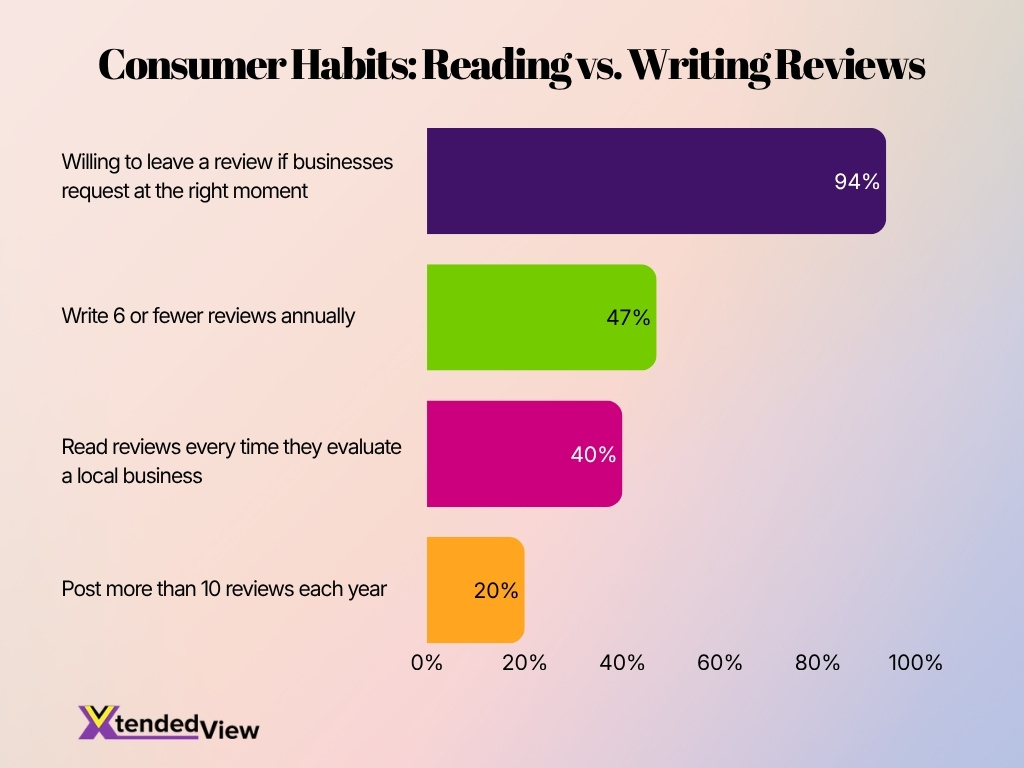
- 40% of consumers say they read reviews every time they evaluate a local business.
- Most consumers read both positive and negative reviews before making a decision instead of focusing only on star ratings.
- A typical consumer writes between 4 and 6 reviews per year.
- 94% of consumers are willing to leave a review if businesses request feedback at the right moment.
- 47% of consumers write 6 or fewer reviews annually, while 20% post more than 10 reviews each year.
- A growing number of consumers verify information by visiting business websites and social media after reading reviews instead of purchasing immediately.
- Many shoppers now rely on AI-generated review summaries to quickly evaluate businesses before reading full customer feedback.
- Consumers increasingly value detailed experiences that explain product quality, customer service, and value over short one-line reviews.
Review Volume and Star Ratings
- 31% of consumers exclusively consider businesses boasting 4.5 stars or higher in 2026.
- 83% of shoppers believe that star ratings only hold value if the reviews are recent and relevant.
- Products maintaining realistic ratings between 4.2 and 4.7 stars tend to generate the highest sales volume.
- 67% of consumers refuse to trust a perfect high rating without a substantial review volume backing it.
- Over 50% of people explicitly state they would never use a local company displaying under a 4-star rating.
- Increasing a business’s average rating by one full star can yield up to a 44% improvement in overall conversions.
- Customers are likely to spend 31% more when visiting a business that maintains an excellent review volume.
- An average consumer will read through at least 10 different reviews before choosing to trust a business.
Trust and Credibility
- 49% of consumers trust online reviews as much as personal recommendations.
- 97% of consumers support penalties for businesses that intentionally publish fake reviews.
- 63% of consumers believe review platforms should be responsible for detecting fraudulent reviews before they influence buyers.
- 57% of consumers say businesses caught posting fake reviews should be removed from review platforms.
- 46% of consumers say AI-generated language can make reviews appear suspicious or inauthentic.
- Research published in 2025 found both humans and AI systems correctly distinguished AI-generated fake reviews only about 50.8% of the time, highlighting growing authenticity challenges.
- Verified purchase indicators, reviewer history, and detailed review content continue to strengthen consumer confidence more than anonymous ratings alone.
- Regulatory action in both the U.S. and Europe has accelerated platform investment in fake review detection, identity verification, and stronger enforcement against review manipulation.
Top Reasons Consumers Leave Online Reviews
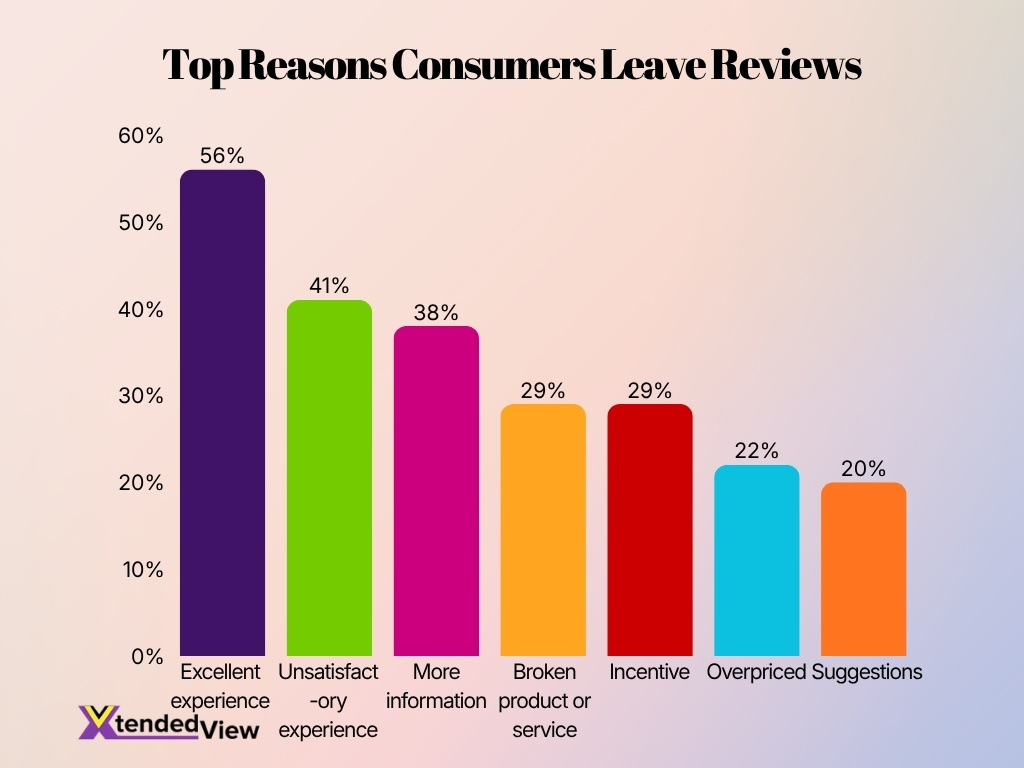
- Excellent experiences are the biggest driver of customer reviews, with 56% of consumers leaving feedback after receiving outstanding products or services.
- 41% of consumers write reviews to share an unsatisfactory experience, highlighting the importance of resolving customer issues quickly.
- Around 38% of reviewers post feedback to provide more information that can help other shoppers make informed purchasing decisions.
- Broken products or services motivate 29% of consumers to leave reviews, emphasizing the impact of product quality on brand reputation.
- An equal 29% of consumers are encouraged to write reviews because of incentives, showing that rewards can significantly increase review volume.
- 22% of consumers leave reviews because they believe a product or service is overpriced, reflecting the role of pricing in customer satisfaction.
- About 20% of reviewers use online reviews to offer suggestions that could help businesses improve their products, services, or overall customer experience.
- The data shows that while positive experiences (56%) generate the most reviews, negative experiences and opportunities for improvement also account for a significant share of customer feedback.
- Businesses can increase high-quality reviews by delivering excellent customer experiences while actively responding to complaints and implementing customer suggestions.
- Encouraging honest feedback through ethical review incentives and maintaining product quality can help businesses build stronger online credibility and customer trust.
Impact on Buying Decisions
- A 2026 survey found that online reviews influence the purchase decisions of 97% of consumers, confirming that customer feedback now affects nearly every stage of product and service research.
- 68% of consumers will not use a business with a rating below four stars, which places a clear competitive disadvantage on companies with weaker review profiles.
- Nearly 31% of consumers now limit their choices to businesses rated at least 4.5 stars, almost twice the share recorded in 2025.
- Reviews play a larger role in expensive purchases, displaying that reviews increased purchase likelihood by 380% for higher-priced products, compared with 190% for lower-priced items.
- 45% of shoppers will not purchase a product when its page contains no customer reviews, making the absence of feedback a direct barrier to conversion.
- Nearly 85% of consumers actively look for negative feedback before purchasing because critical reviews help them identify product limitations and possible risks.
- More than 57% of shoppers read online reviews while evaluating products inside physical stores, showing that digital feedback also shapes offline retail sales.
- Consumers who interact with product questions and answers show a 177.2% conversion lift, indicating that detailed customer information can influence buying decisions alongside star ratings.
- Review freshness increasingly shapes final choices; 32% of consumers focus on feedback written within the previous two weeks, up from 20% in 2025.
Impact on Business Revenue
- Displaying reviews increased conversion by 190% for lower-priced products, demonstrating that even routine purchases benefit from visible customer feedback.
- Visitors who interact with ratings and reviews have produced a 108.6% higher conversion rate than visitors who do not engage with review content.
- Adding the first review to a product page that previously had none can increase sales for that product by 65%.
- Shoppers who engage with reviews can become 115% more likely to convert, which connects review visibility directly with ecommerce revenue.
- Review-search tools generated a 271.9% conversion lift among shoppers who used them, showing the revenue value of helping customers find relevant experiences quickly.
- Selecting a “helpful” vote on a review correlated with a 356.3% conversion lift, one of the strongest measured effects among review-page interactions.
- Products rated between 4.75 and 4.99 stars tend to generate the highest conversion rates, while perfect 5-star ratings can prompt skepticism.
- Shoppers have shown a willingness to pay 7.7% more for products rated at least 4.7 stars, indicating that strong reviews can support premium pricing.
- Verified reviews can support a price premium of approximately 4.6%, as buyers place additional monetary value on evidence that feedback came from real customers.
Most Trusted Online Review Platforms Statistics
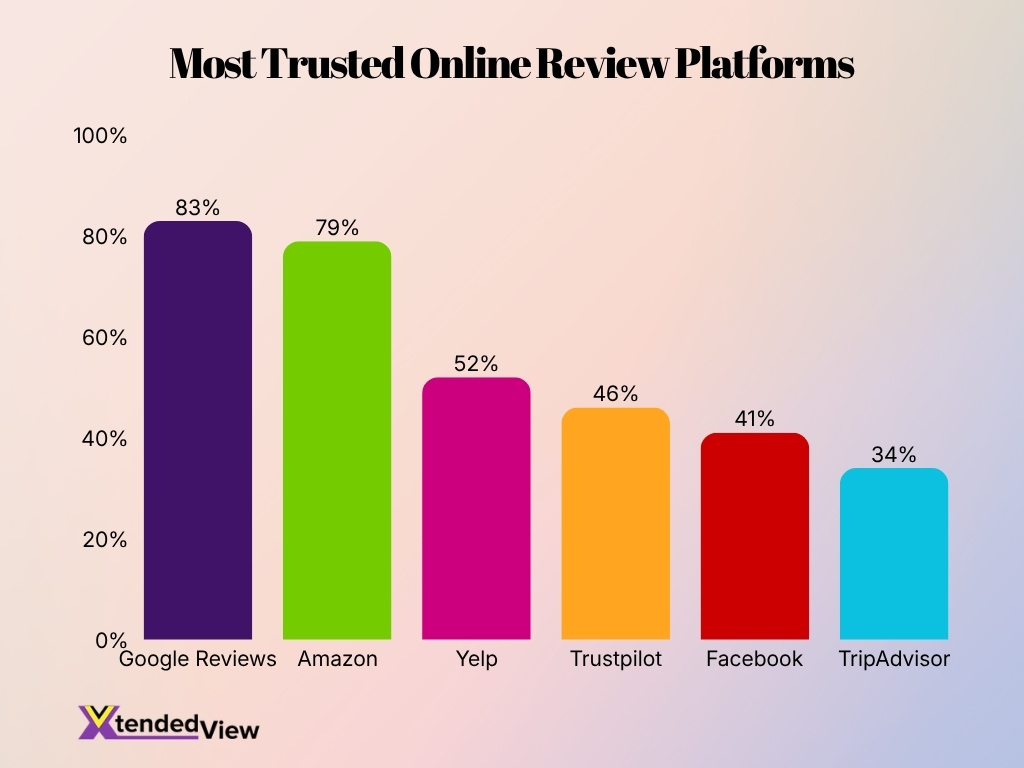
- Google Reviews is the most trusted review platform, with 83% of consumers using its reviews before making purchasing decisions.
- Amazon ranks second at 79%, showing that product reviews remain a major influence on online shopping behavior.
- More than half of consumers (52%) rely on Yelp reviews, making it one of the leading platforms for evaluating local businesses.
- Trustpilot is trusted by 46% of consumers, highlighting its growing importance for comparing brands and online services.
- Facebook review content influences 41% of consumers, demonstrating that social media platforms continue to play a role in purchase research.
- TripAdvisor is used by 34% of consumers, reflecting its continued relevance for travel, hospitality, and tourism-related decisions.
- The gap between Google Reviews (83%) and TripAdvisor (34%) is 49 percentage points, illustrating Google’s clear dominance in the online review ecosystem.
- All six major review platforms are used by at least one-third of consumers, emphasizing the widespread reliance on online reviews across multiple industries.
Review Platform Statistics
- 45% of consumers now use AI tools for local recommendations, up from 6% a year earlier.
- A major review platform surpassed 300 million consumer reviews worldwide in 2024.
- Over 200,000 new reviews are submitted each day on a single global review network.
- Usage of the leading review service declined from 83% in 2025 to 71% in 2026.
- Only 35% of small and midsize businesses have claimed a profile on the largest search platform.
- In 2022, 87% of consumers evaluated local businesses using the leading platform, up from 81%.
- AI recommendation tools now outrank established review services for local business searches.
- Platforms removed 7.8 million suspected fake reviews in 2025 due to growing review fraud.
- Automated systems identified 82% of removed fake reviews in 2023, up from 68% in 2022.
Google Review Statistics
- The share of consumers consulting Google reviews fell to 71% in 2026, down 12 percentage points from 83% in 2025.
- Despite that decline, Google remains well ahead of individual competing review platforms for local business research.
- The platform’s usage rate rose from 81% in 2021 to 87% in 2022, showing how quickly it became central to local business evaluation.
- A study of 351 consumers examined how fake Google restaurant reviews affect trust and restaurant selection, highlighting the platform’s role in dining decisions.
- The same research found that AI-written restaurant reviews can confuse consumers and influence their choices when they mistake generated content for genuine customer experiences.
- Nearly one-third of consumers now require a 4.5-star rating or higher when choosing a business, which raises the performance threshold for companies competing in local search results.
- 68% of consumers reject businesses rated below four stars, making the rating displayed in a local profile a significant customer-acquisition factor.
- Recent feedback can matter more than a large historical total, as 18% of consumers only feel influenced by reviews posted during the previous week.
- Local business reviews carry the most importance in sectors such as health care, automotive services and skilled trades, where risk, cost and trust strongly affect selection.
Google’s Share of Online Reviews by Industry
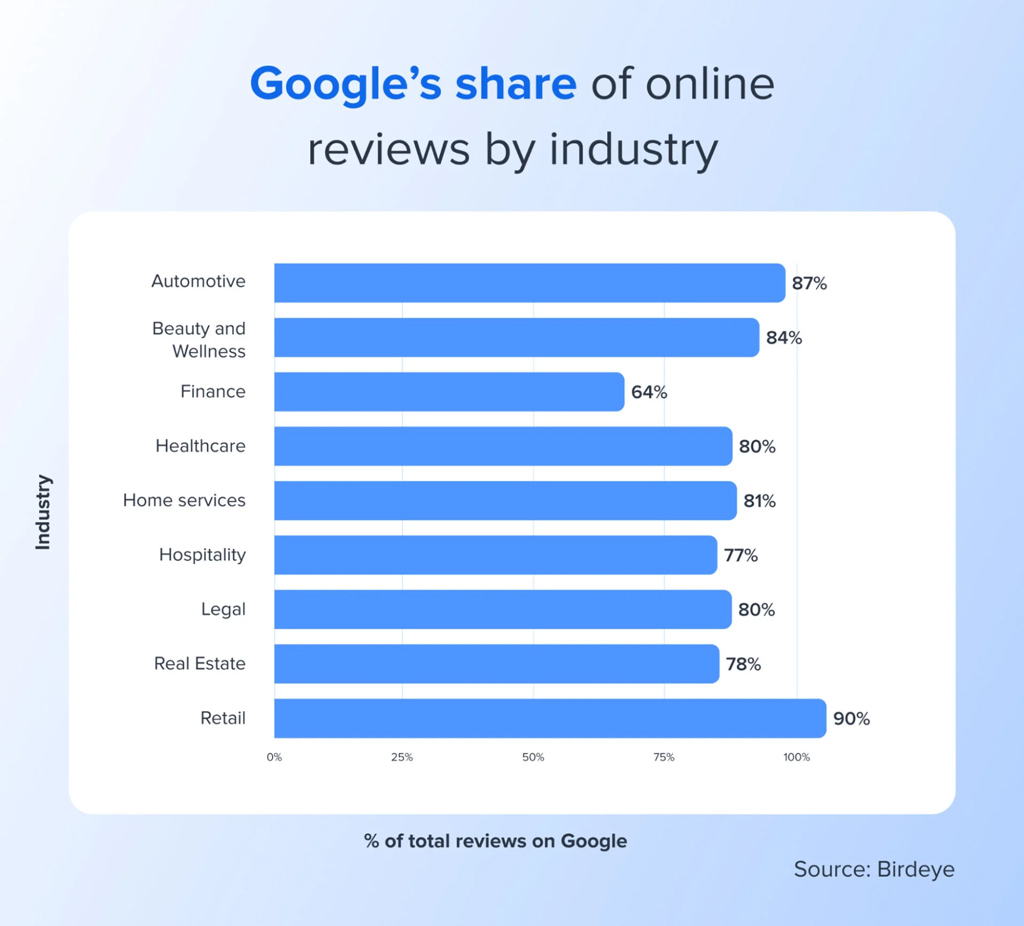
- Retail leads all industries, with 90% of its online reviews appearing on Google, making it the most dominant review platform for retailers.
- The Automotive industry follows closely, with 87% of all customer reviews hosted on Google, highlighting its importance for dealerships and auto service businesses.
- Beauty and Wellness businesses receive 84% of their online reviews through Google, reflecting consumers’ preference for Google when evaluating salons and wellness providers.
- Home Services companies generate 81% of their online reviews on Google, demonstrating the platform’s strong influence on local service discovery.
- Both the Healthcare and Legal sectors report 80% of their reviews on Google, emphasizing the platform’s role in building trust for professional services.
- The Real Estate industry records 78% of its online reviews on Google, making it a key platform for attracting potential buyers and sellers.
- Hospitality businesses receive 77% of their online reviews via Google, reinforcing its significance for hotels, resorts, and travel-related businesses.
- Finance has the lowest Google review share at 64%, indicating customers are more likely to use alternative review platforms alongside Google.
- Across every industry shown, Google accounts for more than 60% of all online reviews, underscoring its position as the leading review platform for local businesses.
- The 26 percentage point gap between Retail (90%) and Finance (64%) illustrates how reliance on Google reviews varies significantly across industries.
Fake Review Statistics
- One large review network removed 7.8 million fake reviews in 2025, showing that fraudulent submissions remain a high-volume problem.
- In 2024, another review-integrity report documented the removal of 4.5 million fake reviews.
- Those removals represented 7.4% of all reviews submitted in 2024, up from 6.1% in 2023.
- Automated detection models identified 90% of the fake reviews removed in 2024, while user reports and manual investigations identified the remaining share.
- In 2023, platforms removed 3.3 million fake reviews, compared with 2.6 million in 2022.
- Approximately 97% of consumers believe businesses should face consequences when they use fake reviews.
- The U.S. rule addressing deceptive reviews took effect on Oct. 21, 2024, giving regulators stronger authority to pursue knowing violations.
- The rule prohibits reviews attributed to nonexistent people, including AI-generated personas, as well as reviews from individuals who never used the product or service.
- The maximum civil penalty for certain violations rose to $53,088 in 2025, increasing the financial risk associated with deceptive review practices.
- In a study testing AI-generated product reviews, both people and language models achieved only 50.8% accuracy when distinguishing fake reviews from genuine ones.
Review Authenticity and Verification
- Consumers were willing to pay 4.6% more for an item when reviews carried a verified status, indicating that verification can create measurable economic value.
- About 78% of consumers identified credibility as one of the most important qualities in online feedback.
- 75% of consumers said fake reviews damage their trust in the platforms that publish them.
- Trust in reviews as an equivalent to personal recommendations dropped from 79% in 2020 to 42% in 2025, reflecting growing consumer caution.
- In a 2026 survey, 93% of consumers said they verify AI-generated recommendations before making a purchase, while 27% said they always check them.
- 86% of consumers expressed concerns about AI-generated product recommendations, 28% worried about bias, and 21% suspected paid placement.
- Only 31% of U.S. adults felt confident that they could distinguish human-written reviews from AI-generated content.
- When tested, just 30% of participants correctly identified whether business reviews came from a person or AI.
- Research found that fake negative reviews pose a specific authenticity risk because both consumers and automated systems can misclassify them as genuine.
- Purchase verification offers a stronger safeguard than writing style alone because neither humans nor general-purpose AI systems can consistently detect machine-generated reviews from the text.
Consumer Expectations for Business Review Responses
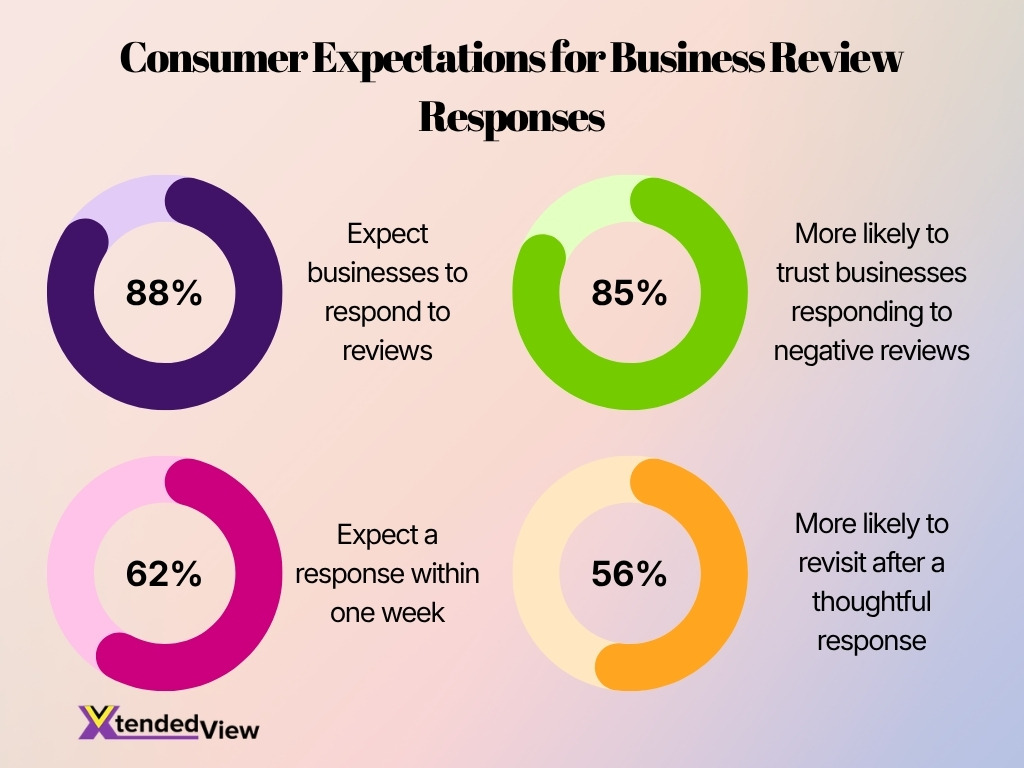
- 88% of consumers expect businesses to respond to customer reviews, making active engagement a key part of online reputation management.
- Around 85% of consumers are more likely to trust businesses that professionally respond to negative reviews, highlighting the value of thoughtful communication.
- Nearly 62% of customers expect businesses to reply to reviews within one week, showing that timely responses are increasingly important.
- About 56% of consumers say they are more likely to revisit a business after receiving a thoughtful and personalized response to their review.
- Businesses that consistently respond to reviews can strengthen customer trust, improve satisfaction, and encourage long-term loyalty.
- Responding to both positive and negative feedback demonstrates transparency and shows customers that their opinions are valued.
- Fast, professional review responses can help businesses improve their public reputation and influence future purchasing decisions.
- These findings suggest that review management is no longer optional, as consumers increasingly expect businesses to actively participate in online conversations.
Ecommerce Review Statistics
- 93% of consumers make a purchase after reading positive reviews.
- 50% of buyers spend under $500 post-review, while 27% spend over $1,000.
- 13% of shoppers spend over $5,000 on high-value items after consulting reviews.
- Having just one review generates a 52.2% conversion lift over pages with none.
- Pages with 11 to 30 reviews see conversion rates double compared to zero reviews.
- Products boasting 101+ reviews achieve a massive 250% conversion lift.
- 68% of shoppers expect 26+ reviews, though 53% read 10 or fewer.
- Electronics pages with 31 to 50 reviews see a 224.7% conversion lift.
- Home and garden items get a 211.6% conversion lift from 31 to 50 reviews.
- 80% of consumers read more reviews when evaluating expensive or luxury products.
Local Business Review Statistics
- 97% of U.S. consumers read online reviews when researching local businesses in 2026.
- 41% of consumers always read reviews when browsing for a business, up from 29% in 2025.
- Consumers use an average of six review sources when choosing a local business, limiting the value of relying on one profile alone.
- 47% of consumers will not use a business with fewer than 20 reviews, making review volume an important initial screening factor.
- 31% of consumers require at least a 4.5-star rating in 2026, up sharply from 17% in 2025.
- 68% of consumers will only consider a business with four stars or more, compared with 55% one year earlier.
- 74% of consumers focus on reviews written within the previous three months, placing ongoing review collection ahead of large but outdated totals.
- After reading positive reviews, 54% of consumers visit the business’s website, up from 32% when the question was previously measured in 2019.
- Positive reviews prompt 31% of consumers to visit the business location, while 20% contact the business and 20% book an appointment.
- Only 34% of consumers move directly toward a purchase or booking after reading a positive review, the remaining 66% conduct more research.
Generative AI Emerges as a Major Source for Business Recommendations
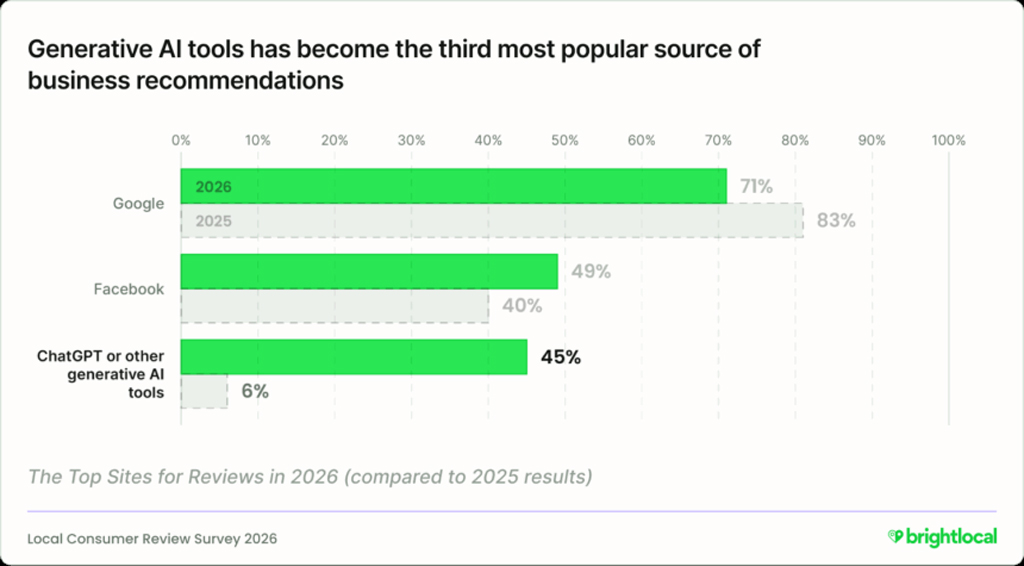
- Google remained the leading source for business recommendations in 2026, with 71% of consumers using it, although this was down from 83% in 2025.
- Facebook increased its role in business discovery, rising from 40% in 2025 to 49% in 2026, reflecting a 9 percentage point gain.
- ChatGPT and other generative AI tools became the third most popular recommendation source, surging from just 6% in 2025 to 45% in 2026.
- Generative AI recorded the largest year-over-year increase, climbing by 39 percentage points, far outpacing every other platform.
- The gap between Facebook (49%) and ChatGPT or other AI tools (45%) narrowed to only 4 percentage points, highlighting AI’s rapid adoption.
- Despite remaining the market leader, Google’s usage declined by 12 percentage points, suggesting users are exploring alternative discovery channels.
- Nearly one in two consumers (45%) now rely on generative AI tools for business recommendations, demonstrating a significant shift in search and review behavior.
- The data indicates that AI-powered recommendation platforms are becoming mainstream, challenging traditional search engines and social media for local business discovery.
Emerging Online Review Trends
- Consumers who always read business reviews increased from 29% in 2025 to 41% in 2026, indicating that reviews have become a more routine part of local research.
- The share of consumers using the largest search-based review channel fell from 83% to 71%, while AI and video-based recommendations gained ground.
- Consumers now consult an average of six separate review sources, reflecting a shift toward cross-platform verification.
- 32% of consumers look for reviews published within the previous two weeks, up from 20% in 2025.
- 18% of consumers only feel influenced by reviews published within the previous week.
- Same-day response expectations more than tripled, rising from 6% in 2025 to 19% in 2026.
- 32% of consumers expect a response by the day after posting a review, compared with 18% one year earlier.
- A new AI review assistant can analyze approximately 500 reviews in seconds, compared with the small number that consumers typically read manually.
- Local recommendation services now draw from databases exceeding 330 million reviews, increasing the need for AI summaries, filters and source transparency.
- Among current AI nonusers, 47% expect to try AI for local search within the next six months, suggesting that adoption may continue rising through 2026.
How Reviews Affect Local SEO
- 97% of consumers read local business reviews to evaluate search exposure.
- 31% of consumers reject listings that are rated below 4.5 stars.
- 47% of consumers avoid businesses with fewer than 20 reviews.
- 74% of consumers prioritize feedback posted within the previous three months.
- Positive reviews drive 54% of consumers directly to a business website.
- Consumers consult an average of six review sources to determine local credibility.
- Review signals make up five of the six top purchase influences after an AI recommendation.
- 29% of AI users consider review recency a major decision factor.
- 34% of users rank the star rating as their leading influence for taking action.
Frequently Asked Questions (FAQs)
97% of consumers read online reviews when researching local businesses in 2026.
41% of consumers always read reviews before selecting a business, up from 29% in 2025.
31% of consumers require at least a 4.5-star rating, while 68% will only consider businesses rated four stars or higher.
42.7% of global consumers used an AI tool for local search within the previous month in 2026.
Detected fake reviews accounted for 7.4% of all reviews submitted in 2024, up from 6.1% in 2023.
Conclusion
Online reviews continue to influence nearly every stage of the customer journey, from product discovery and local business research to final purchase decisions. The latest data show that consumers increasingly prioritize authentic, recent, and detailed reviews while also relying on AI-powered recommendations to complement traditional review platforms.
For businesses, maintaining a strong review strategy means consistently collecting genuine customer feedback, responding promptly to reviews, and monitoring reputation across multiple platforms. As consumer expectations continue to evolve, companies that invest in transparency, review quality, and customer engagement will be better positioned to build trust, improve local search visibility, and drive long-term growth.
